
*** Walter Sinnott-Armstrong discusses the following objection: “Harming others is sometimes in some people’s best interest, even considering probable costs. In those cases, some theists say that only a divine threat of Hell provides a reason to be moral. Since atheists and agnostics do not believe in God, they do not believe in divine retribution […]
Entries Tagged as 'Philosophers'
Sinnott-Armstrong on God, Secularism and “reasons” to be moral. Part two: Do unselfish reasons answer the question, “Why be moral?”
September 8th, 2025 Comments Off on Sinnott-Armstrong on God, Secularism and “reasons” to be moral. Part two: Do unselfish reasons answer the question, “Why be moral?”
Tags: Dualism of Practical Reason · Hell · Mark Murphy · Walter Sinnott-Armstrong · Why be Moral?
Evil, limited, and Indifferent deities: The Horrendous Deeds Objection Redivivus?
November 22nd, 2021 2 Comments
www.youtube.com/watch?v=J3zSoGqKdEk
Last week, I was scheduled to present the above paper at the Annual Meeting of the Evangelical Philosophical Society at Fort Worth, Texas. Unfortunately, Auckland’s lockdown prevented this, and the paper had to be cancelled due to the logistics involved. I did, however, pre-record the talk, so it is available below: Abstract: A common objection […]
Tags: Divine Command Theory · Horrendous Deeds Objection · Jason Thibodeau
Can a Divine Command Theory Vindicate the Objectivity of Morality: Huemer on Observer Independence, part two
September 12th, 2021 Comments Off on Can a Divine Command Theory Vindicate the Objectivity of Morality: Huemer on Observer Independence, part two
In my last post, I discussed Michael Huemer’s argument that a divine command theory cannot vindicate the objectivity of moral requirements. As I interpret him, the argument is: [1] Our commitment to morality presupposes that moral requirements are objective. [2] Moral requirements are objective just in case there obtain facts about what is right and […]
Tags: Alvin Plantinga · Divine Command Theory · John Foster · Michael Huemer · Objectivism · Robert Adams
Can a Divine Command Theory Ground the Objectivity of Morality? Michael Huemer on Observer Independence: Part One
September 12th, 2021 Comments Off on Can a Divine Command Theory Ground the Objectivity of Morality? Michael Huemer on Observer Independence: Part One
In a previous post I criticized David Brink’s argument that a divine command theory cannot vindicate the objectivity of morality. Brink argued: [1] Our commitment to morality presupposes that moral requirements are objective [2] Moral requirements are objective just in case facts about what is right or wrong obtain independently of the moral beliefs or […]
Tags: David Brink · Divine Command Theory · Elizabeth Tropman · Michael Huemer · Objectivism · William Lane Craig
Does the Incommensurability of Prudential and Impartial rationality avoid the dualism of Practical Reason?
August 14th, 2021 Comments Off on Does the Incommensurability of Prudential and Impartial rationality avoid the dualism of Practical Reason?
I have been discussing the dualism of practical reason. As I understand it, this is an inference from three premises: [1] We always have most reason to do what is morally required [2] An act is morally required if and only if it is impartially demanded: demanded by rules justified from a perspective of impartial […]
Tags: Derek Parfit · Dualism of Practical Reason · God and Morality · Henry Sidgwick · Peter Bryne · Stephen Layman
Divine Command Theory and the Euthyphro Dilemma: Part IV
May 20th, 2021 Comments Off on Divine Command Theory and the Euthyphro Dilemma: Part IV
This is a talk I gave to the Philosophy Club at Glendale Community College in Phoenix, Arizona, this weekend. The talk was followed by a long discussion with some faculty, students at the college, and others who zoomed in. In this talk, I introduced and defended a divine command theory of ethics. I divided the talk into three […]
Tags: Divine Command Theory · Euthyphro Dilemma · Graham Oppy · James Rachels

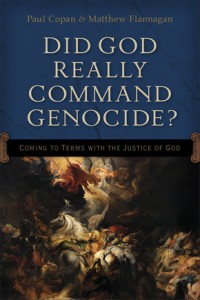 A common objection to belief in the God of the Bible is that a good, kind, and loving deity would never command the wholesale slaughter of nations. In the tradition of his popular Is God a Moral Monster?, Paul Copan teams up with Matthew Flannagan to tackle some of the most confusing and uncomfortable passages of Scripture. Together they help the Christian and nonbeliever alike understand the biblical, theological, philosophical, and ethical implications of Old Testament warfare passages.

Michael Huemer on Wokeness
September 8th, 2025 Comments Off on Michael Huemer on Wokeness
Political Philosopher Michael Huemer weighs in on the question: what is wokeness? I have been known to describe the essence of wokism as “reverse bigotry”. In the past, various forms of bigotry were common: prejudice against blacks, against women, against gays, against transgender people, and more. Wokism proposes, rather than to eliminate bigotry, to reverse […]
Tags: Michael Huemer · Political Correctness · Political Philosophy