Category: Hermeneutics

  • Response to William Lane Craig’s Question 225: “The ‘Slaughter’ of the Canaanites Re-visited” Part II

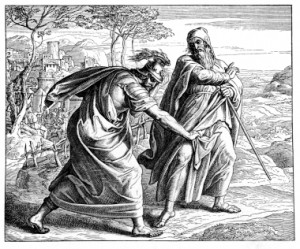
    Samuel rebukes SaulIn my last post “Response to William Lane Craig’s Question 225: “The ‘Slaughter’ of the Canaanites Re-visited” Part I” I discussed William Lane Craig’s position on the Canaanite Conquest account (in light of the fact that Craig referred to my argument in his question of the week: “Question 225: The “Slaughter” of the Canaanites Re-visited”). I clarified the delineations as to where he agrees and disagrees with the position I presented at the Evangelical Philosophical Society’s session at the Society for Biblical Literature Meeting in Atlanta last year and I established that the point of divergence in our agreement rests on 1 Samuel 15.

    In my Atlanta paper I argued that Nicholas Wolterstorff’s reading of the Canaanite conquest accounts in Joshua can also be applied to the account of Saul exterminating the Amalekites in 1 Sam 15.

    First, the so-called ‘genocide accounts’ in 1 Sam 15 are part of a broader context that includes the rest of Samuel and also other canonical books, such as 2 Samuel and the book of Chronicles. When one reads the whole sequence, one observes that while 1 Samuel 15 describes Saul, at God’s command, exterminating the Amalekites, later passages in Samuel and Chronicles proceed on the assumption this never literally happened.

    The key passage is God’s command to Samuel, “strike [nakah] Amalek [the Amalekites] and utterly destroy [haram] all that he has, and do not spare [hamal] him; but put to death both man and woman, child and infant, ox and sheep, camel and donkey.”[1] The text goes on to explicitly state that the Amalekites were all wiped out:

    “So Saul defeated [nakah] the Amalekites, from Havilah as you go to Shur, which is east of Egypt. He captured Agag the king of the Amalekites alive, and utterly destroyed [haram] all the people with the edge of the sword. But Saul and the people spared [hamal] Agag and the best of the sheep, the oxen, the fatlings, the lambs, and all that was good, and were not willing to destroy them utterly; but everything despised and worthless, that they utterly destroyed.” [2]

    A few verses later (15:33) the text records that Agag, the sole survivor, was executed. So, read literally, this passage states that all the Amalekites were killed and all their livestock were either destroyed or taken as plunder to be sacrificed to God at Gilgal.[3]

    Now the language of “defeated” (or struck), “utterly destroyed”, the reference to “sparing” and to livestock parallels the language of the command in 15:3. Given this, it seems implausible that we should interpret the command in verse 3 as literal but the fulfilment, just 4 verses later, as hyperbolic; the text requires that the command and fulfilment be read in the same sense.

    That said, when one reads this passage as part of as a single narrative a literal reading appears untenable; the proceeding text states quite emphatically that the Amalekites were not, in fact, literally wiped out. In 1 Samuel 27:8-9 David invaded a territory full of Amalekites:

    “Now David and his men went up and raided the Geshurites, the Girzites and the Amalekites. (From ancient times these peoples had lived in the land extending to Shur and Egypt.) Whenever David attacked an area, he did not leave a man or woman alive, but took sheep and cattle, donkeys and camels, and clothes. Then he returned to Achish.”

    Not only does this text affirm that the Amalekites still existed but the reference to Egypt and Shur states that they existed in the very same area that Saul ‘utterly destroyed every single one of them’ in in the previous passages. Moreover, David took sheep and cattle as plunder; again, livestock was another of the things Saul was said to have already eradicated.

    After the text has told us that Saul “utterly destroyed all the people”, including King Agag, and despite the text telling us that when David attacked an area (the very same areas as Saul) he did “not leave a man or woman alive”, three chapters later we read that a sizeable Amalekite army attacked Ziklag![4] David apparently pursued this army and fought a long battle with them and 400 Amalekites fled on horseback!![5] Where are all these Amalekites coming from?

    These are not the only examples. In 2 Samuel 1:8 an Amalekite took credit for killing Saul –but didn’t Saul “utterly destroy all the people”? In 1 Chronicles 4:43 Amalekites were still around in battle-ready numbers during the reign of Hezekiah who reigned after Saul and David.

    Read literally, the narrative affirms both that the Amalekites were and were not totally wiped out. This apparent contradiction in the Samuel narrative is (more…)


  • Response to William Lane Craig’s Question 225: “The ‘Slaughter’ of the Canaanites Re-visited” Part I

    Every week William Lane Craig answers a question on his website; this week’s question of the week is entitled “The “Slaughter” of the Canaanites Re-visited”. The questioner asked what Craig thinks of the Canaanite Conquest account. I got a mention in Craig’s reply:

    The EPS Session at the SBL: Richard Hess, Randal Rauser, Paul Copan, me, Michael Rea

    “The topic of God’s command to destroy the Canaanites was the subject of a very interesting exchange at the Evangelical Philosophical Society session last November at the Society of Biblical Literature Convention in Atlanta. Matt Flannagan defended the view put forward by Paul Copan in his Is God a Moral Monster? that such commands represent hyperbole typical of Ancient Near Eastern accounts of military conquests. Obviously, if Paul is right about this, then the whole problem just evaporates. But this answer doesn’t seem to me to do justice to the biblical text, which seems to say that if the Israeli soldiers were to encounter Canaanite women and children, they should kill them (cf. Samuel’s rebuke of Saul in I Sam. 15.10-16).”

    Craig raises an important issue. In God and the Genocide of the Canaanites I, II and III I defended Nicholas Wolterstorff’s take on the Canaanite massacre in “Reading Joshua”.[1] Wolterstorff argued that the book of Joshua is a highly figurative, hagiographic and hyperbolic account of Israel’s early skirmishes and it is not intended to be taken literally in its details. My adaptation of Wolterstorff’s argument consists of three points.

    First, taken as a single narrative, and taken literally, Joshua 1-11 gives a contradictory account of events to that narrated by Judges and also to that narrated by the later chapters of Joshua itself.

    Second, those who put these books into a single narrative would have been well aware of the obvious contradictions mentioned above. These editors were not mindless or stupid, particularly if we hold that God spoke through them.

    Third, while Judges reads more like “down-to-earth”[2] history, a careful reading of Joshua shows it to be full of ritualistic, stylised accounts and formulaic language. I supported this third point with research into Ancient Near Eastern conquest accounts. Studies show such accounts are hyperbolic, hagiographic, figurative and follow a common transmission code. Comparisons between these accounts and the early chapters of Joshua suggest Joshua was written according to the same literary conventions and transmission code. I suggest these three points, taken together, provide compelling reasons for thinking that one should interpret the text as a hyperbolic, hagiographic and figurative account of what occurred; it was not meant to be taken as literally true in all its details.

    Craig’s objection to my position (and that of Paul Copan’s whose position is very close to mine) is a reference to 1 Samuel 15. Craig referred specifically to verses 10-16, where Samuel rebuked Saul “because [Saul] has turned away from [God] and has not carried out [God’s] instructions.”[3] The instructions in question were given in verse 3; God commanded Saul, “Now go and strike [nakah] Amalek [the Amelekites] and utterly destroy [haram] all that he has, and do not spare [hamal] him; but put to death both man and woman, child and infant, ox and sheep, camel and donkey.”[4] Craig suggests this “seems to say that if the Israeli soldiers were to encounter Canaanite women and children, they should kill them”. I think Craig pushes an important objection (more…)

  • Guest Post: Paul Copan Replies to Hector Avalos – Deuteronomy 25:11-12, an Eye for an Eye, and Raymond Westbrook

    My book review of John Loftus’s The Christian Delusion: Why Faith Fails prompted several responses from Hector Avalos, one of the book’s contributors. Avalos has offered critiques of not just my arguments but also those of my good friend Paul Copan. This Guest Post, written by Paul Copan, responds to some of Avalos’s charges. Paul Copan writes:

    Paul CopanRecently Hector Avalos has responded to a particular argument in my book Is God a Moral Monster? (Baker).  In it, I follow biblical scholar Jerome Walsh’s interpretation of Deuteronomy 25:11-12:[1] If two men, a man and his countryman, are struggling together, and the wife of one comes near to deliver her husband from the hand of the one who is striking him, and puts out her hand[yad] and seizes his genitals, then you shall cut off her hand [kaph]; you shall not show pity.

    I first came across Walsh’s perspective by way of Richard Davidson’s book on sexuality in the Old Testament, Flame of Yahweh (Hendrickson)—a book I highly recommend.  I follow both Walsh and Davidson on the view that this text is not referring to amputating the hand, but rather depilation.  This was a punishment of humiliation involving shaving a woman’s pubic hair in thekaph—the curved region below the waist.  I won’t elaborate on what my book says, but I’ll simply address Deuteronomy 25:11-12 in the bulk of this blog posting.  In the post, I’ll address the question of lex talionis (“an eye for an eye”) and the work of Raymond Westbrook.

    1. Preliminary remarks: I have been in communication with Jerome Walsh, who prefers to stay out of the discussion.  Walsh has read Avalos’s post, though, and noted too that he did not see anything new in Avalos’s arguments that he hasn’t encountered before.  He simply saw nothing linguistically to persuade him to alter his views.

    Avalos’s repeated identification of kaph = “hand” as the “literal” meaning is misleading.  While it may be the commonest meaning, the term has less-common usages too (the bowl of a spoon, the frond of a palm tree).  It’s unproductive to start from the assumption that commonest meaning is the only one allowable unless one can prove otherwise.  The point in the article is that yad tends to refer to the hand without connotation or nuance, or when the hand is envisaged, as an instrument of pointing, hitting, doing.  Kaph, so far as he can see, connotes the hand as an instrument of grasping and holding, thus the curvature and the focus on the palm.

    In Walsh’s estimation, Avalos seems to be operating from the position of a methodological absolutism:  “X” is the common opinion, and unless one can definitively prove not-X, then one must espouse X.  He doesn’t appear to leave much room for “more likely” or “less likely” as the possible evaluation of a hypothesis.

    Avalos cites Marc Cortez for support: “The Law on Violent Intervention: Deuteronomy 25.11-12 Revisited,” Journal for the Study of the Old Testament 30:3 (2006), 431-47.  As I note in my book, though, it is unfortunate that Cortez fails to interact with Walsh’s essay, which had been published two years earlier.

    In correspondence with Walsh (May 2010), he commented on an online version of Cortez’s article.  He pointed out that while Cortez dismisses Eslinger’s attempt to identify kaph with gynecological exactitude (and he can agree with Cortez on that point), Cortez does not deal with the fact that kaph is used not just for the palm of the hand, but for several other curved, arched objects, both corporeal (sole of foot) and not (bowl of a spoon, frond of a palm tree).  Walsh’s argument simply treats kaph as the curve of the groin, a very likely meaning in Song of Solomon, and (pace Cortez) in Genesis as well.

    Cortez wants to retain without discussion the understanding of kaph as “hand.”  But Walsh notes that Cortez’s explanation of why a “talionic” law would equate “hand” as an instrument of offense with “palm of the hand” as the object of “cutting-off” is, basically, “why not?”  That begs the question.  Further, he ignores completely that there is no reason whatsoever for treating the qal of qatsats as if it were the piel.  In the piel, it clearly means “to cut off.”  In the few other instances of its appearance in the qal, it means “to cut (hair).”  Why, in this unique case, should the qal be translated as if it were a piel?

    Now, Walsh readily acknowledges that his article is not the standard reading of the passage, and that Cortez’s evaluation of others’ interpretations of Deut 25:11-12 is judicious, careful, and sober.  He would agree with Cortez completely that the peculiarities of this unique law in the Israelite corpus have led scholars to some truly egregious attempts to make sense of its oddity.  And Cortez is very good indeed at identifying the unpersuasive lengths to which some scholars have gone.  But he, like all of those scholars, has not looked at the words.  This is the contribution that Walsh’s article proposes to make.  Instead of accepting unquestioningly that “you shall cut off her hand” is what the Hebrew words mean, he has argued that that is a misreading of the Hebrew terms.  To put the disagreement in a nutshell, let me quote a line from Cortez’s article.  Cortez says:  “The first and most important question that must be addressed with respect to the woman’s punishment is (more…)

  • Contra Mundum: Pacifism and Just Wars

    Comedian Bill Maher recently berated Christians for being hypocrites for supporting military action against terrorists in his “New Rules” segment on the U.S. TV show Real Time (transcript here). Jesus, Maher contended, was a pacifist; “Jesus lays on that hippie stuff pretty thick. He has lines like, “do not repay evil with evil,” and “do not take revenge on someone who wrongs you.” Here Maher was citing from Romans 12, where Paul formulated Christ’s teaching about loving one’s enemies. In this passage Paul commanded people to “bless those who persecute them,” they are forbidden to “repay evil for evil” and are commanded to “not take revenge” but to “leave room for God’s wrath. For it is written, ‘Vengeance belongs to me. I will pay them back’.”

    Maher scathingly contended that this support contradicted Christ’s clear teaching; he said, “nonviolence was kind of Jesus’ trademark. Kind of his big thing. To not follow that part of it is like joining Greenpeace and hating whales.”

    After saying this Maher quipped, “the next line isn’t ‘and if that doesn’t work, send a titanium fanged dog to rip his nuts off.’” The irony is that it Maher clearly had not bothered to actually read the next line; Romans 13 states that the “governing authorities” are “established by God”; one is morally bound to submit to rulers because “rulers do not bear the sword for no reason. They are God’s servants, agents of wrath to execute vengeance upon evil doers”.

    The Greek words for evil, wrath, and vengeance are the same in both Romans 12 and 13. Paul is stating that the very things Christians are forbidden to do with regard to not repaying evil for evil, are precisely what the State has been given the legitimate authority and right to do.

    Paul here elaborates the basic premise that moral theologians appeal to to reject pacifism and to support the claim that war can be just under certain circumstances. The premise is that a government has the right and duty to use force to uphold within the geographical area over which it has jurisdiction. A just war is simply an extension of a government’s power to pass laws and create police powers.

    If a criminal attempts to rape or kill people within the geographical realm over which a government has authority then the government can justifiably use force to prevent this. And it can also use force to try and punish anyone who does these things; hence, the existence of a legislature, police force, courts and prisons. Just War theorists simply note that there seems no reason why this would not extend to when the person committing the offence is a soldier from another country as opposed to a domestic criminal.

    These theorists argue that for a war to be just it must (more…)

  • Stark Wars

    Darth VaderThom Stark has written a lengthy response (304 pages!) to Paul Copan’s book Is God a Moral Monster? which he has published on his blog, Religion at the Margins; it is entitled Is God a Moral. Compromiser? A Critical Review of Paul Copan’s. “Is God a Moral Monster?” In it, alongside his criticisms of Copan, Stark makes several criticisms of the work of Richard Hess and Matt.

    Matt has not yet had time to read Stark’s book-length review, much less respond to it, but Copan and Hess have. Copan has published the following blog posts on his blog, Parchment and Pen:

    Is God a Moral Monster Revisited: Preliminary Replies to Thom Stark

    Richard Hess’s Response to Thom Stark

    Matthew Flannagan’s Interactions with Thom Stark

    Stark has responded to these posts with:

    Copan and Company, Part 1: A Brief Introduction

    Copan and Company, Part 2: Response to Matt Flannagan

    Copan and Company, Part 3: Response to Paul Copan

    Copan and Company, Part 4: Response to Richard Hess

    Other blogs have chimed in:

    Thom Stark’s Sweeping Claims by Christopher Copan Scott

    Reflections on the Thom Stark-Paul Copan debate by Randal Rauser

    Matt has on his ‘to do’ list an intention to wade through Stark’s review and write a response, at the very least, to the parts that critique his work. He also intends to answer Stark’s questions put to him on this blog post. However, Matt has several publication, conference and marking commitments to meet first and Matt simply cannot churn material out at the prolific rate Stark can.

    RELATED POSTS:
    Thom Stark on Wolterstorff and Hagiographic Hyperbole
    Is God a Moral Monster? A Review of Paul Copan’s Book
    God and the Genocide of the Canaanites Part I: Wolterstorff’s Argument for the Hagiographic Hyperbolic Interpretation
    God and the Genocide of the Canaanites Part II: Ancient Near Eastern Conquest Accounts
    God and the Genocide of the Canaanites Part III: Two Implications of the Hagiographic Hyperbolic Account

  • Hear Iain Provan on Why Should we Read the Old Testament, and How?

    Compass Foundation and Regent College are hosting Iain Provan at an event in Auckland next month entitled ‘Why Should we Read the Old Testament, and How?’ Here is the info from their blurb:

    Iain ProvanWhy read the Old Testament? What relevance could this old collection of books have for us today? And how should we read it? How do we approach this text from a very different time and culture?

    Iain will be exploring these questions, drawing on his many years of teaching, study and wrestling with these ancient texts. He will give special attention to the book of Jonah as an example of why we should read the Old Testament and how we should do it.

    When: Monday 4 July, 7pm to 9pm
    Where: Greenlane Christian Centre, 17 Marewa Road, Greenlane, Auckland

    Iain Provan is Marshall Sheppard Professor of Biblical Studies at Regent College, Vancouver, Canada. He is an accomplished Biblical scholar, writer of numerous books and articles, including commentaries on Lamentations, 1 and 2 Kings, Ecclesiastes and Song of Songs, as well as co-author of A Biblical History of Israel. Iain is an ordained minister of the Church of Scotland and was born and educated in the UK. He has taught at universities in England, Wales, Scotland, and most recently Canada.

    More info on how to rsvp for catering purposes @ Compass or on Facebook. To see Iain Provan’s other New Zealand events see his upcoming speaking engagements page.

  • Madeleine on Unbelievable?

    Recently we posted a link to an episode from Justin Brierly’s Unbelievable? show on the UK station Premier Christian Radio which featured a podcast of Paul Copan and Norman Bacrac discussing Is God a Moral Monster? Yesterday we were alerted to the fact that at the end of the Unbelievable? episode of 23 Apr 2011, “Rob Bell defends ‘Love Wins’“, Brierly had a  follow-up feedback session where he played calls and read out emails from listeners commenting on the issues raised in the Copan and Bacrac show. Several people were clearly confused by Copan’s argument and we were pleasantly surprised to hear Brierly positively offer a short hermeneutical piece written by Madeleine on the Unbelievable? forums as a response to the concerns of his listeners.

    To listen to the whole follow-up feedback session on the Copan Bacrac podcast click on Rob Bell defends ‘Love Wins’ and skip forward – just drag the slider forward – to 1:06:21 and play from there. (The section relating to Madeleine starts at 1:11:43.)

    We have had several requests for the text of what Madeleine wrote that Brierly read out, so here it is below:

    It does not follow that just because there is good textural and cultural evidence to read specific passages this way that all passages must now be read that way.

    Chocolate Cake

    If I wrote a book of memoirs of my life that included a poem I wrote to be read out at my wedding, my favourite recipe for chocolate cake and my first hand experience of surviving an earthquake do you read the part of my memoirs recording my experience and observations of the earthquake as a poem? Do you take the chocolate cake recipe as historical narrative of a natural disaster? Do you assume I am an idiot for mixing my genres in a single text? Of course not! you can recognise the different genres as you read your way through the book and strike them – doing this is easy when we are reading texts from our own culture and time but when we talking about another culture and time written in another language, it is a lot harder but it does not mean that the we stop looking for genre and context clues and we start saying if we are to interpret passage x as rhetorical flourish then we have to interpret everything as rhetorical flourish.

    It never ceases to amaze me that people fail to get this point which Madeleine makes in a far more pithy way than I could.