Category: Hermeneutics

  • Contra Mundum: Stoning Adulterers

    Back in 2005 there was a minor furore when Labour MP Ashraf Choudhary stated he agreed with the Koran’s teaching that people who engaged in homosexual conduct or who committed adultery should be stoned to death. In the media spiral that followed, some commentators pointed out that it was not just Islam that held this view; Christians are committed to the same conclusion. Consider Deuteronomy 22:22 “If a man is found sleeping with another man’s wife, both the man who slept with her and the woman must die. You must purge the evil from Israel” or Leviticus 20:10 “If a man commits adultery with another man’s wife—with the wife of his neighbour—both the adulterer and the adulteress are to be put to death. Often passages like this motivate a rhetorical question “why don’t Christians today stone to death women who commit adultery? After all, this is what the Bible commands isn’t it?”

    Ten Commandments

    I’ll make two points in response to this. First, those who press this line of argument assume that these commands are addressed to contemporary Christians. This is a dubious assumption; the laws occur as part of a covenant or vassal treaty between the tribes of Israel and God. While some of the laws expounded in this treaty reflect rules of justice and equity applicable to all people, Gentiles were not parties to this treaty nor were gentile Christians required to be – something the New Testament spends a lot of time elaborating on.

    Second, and this will be my main focus, this line of argument assumes that these apparent laws function like modern statute law; the assumption is that they are literal and binding commands to kill people who had committed certain crimes. It is also assumed that the author of these laws expected them to be carried out. Interestingly, it is precisely this assumption which many scholars of these laws have questioned. Here I will spell out some reasons why they do so.

    Comparisons between Leviticus and Deuteronomy and other ancient Near Eastern (“ANE”) law codes suggest they are the same genre. One feature of such codes is seemingly harsh penalties. In old Babylonian law, the hand that assaults was severed; a man who kissed another’s wife was to have his lips cut off; a person who stole bees was to be stung by bees; a man who raped another’s wife would be sentenced to having his own wife or daughter raped; a negligent builder whose house collapsed and killed another’s son would be sentenced to having his own son killed, and so on.

    ANE expert Raymond Westbrook notes that these prescribed punishments are both inconsistent with the actual legal practice known to have occurred in these cultures and are often inconsistent with themselves. He notes, “some law codes impose physical punishments and others payments for the same offenses, while some codes have a mixture of the two.” The contradiction is only apparent because, “in highlighting one or the other alternative, the codes are making a statement as to their view of the gravity of the offence.” He argues that the laws “reflect the scribal compilers’ concern for perfect symmetry and delicious irony rather than the pragmatic experience of the law courts.” Westbrook concludes that the method used in ANE legal texts was “to set out principles by the use of often extreme examples.”

    A similar point is made by Old Testament scholar John Goldingay who suggests that many of these laws “were not intended to be enforced” but rather were “promulgated to indicate the moral and social priorities of the law giver.” They functioned to express certain ideals of behaviour, to denounce actions like adultery as really bad and intolerable rather than to define precise penalties for these actions.

    Westbrook points to the practice of (more…)

  • Moving Beyond Sunday School

    On this blog we often rail against new-atheist readings of Biblical texts. Our pages are littered with expositions as to what a text is really saying when you consider the context, genre and textual evidence, all of which demonstrates that the new-atheist readings of the texts are at best wanting and at worst down-right stupid or dishonest. But, of course, it is not just atheists who sometimes fail to read Biblical texts properly.

    Joshua Fit the Battle of Jericho

    I was reminded of this recently in an exchange with someone who on considering Paul Copan’s work in Is God a Moral Monster? and Matt’s blog series God and the Genocide of the Canaanites Part I, Part II and Part III, asked me:

    “If these Biblical battles are so clearly exaggerated, why aren’t they taught to be so in churches? When I learnt in Sunday School about how “Joshua fit the battle of Jericho”, should the Sunday-School teacher have added “Of course, it didn’t really happen!”

    Aside from the fact that I thought it was an interesting observation on his part that he had never really sought to take his own understanding of those passages beyond Sunday School level, I think there is something in his question but before I go on I should make a brief qualification. Neither Copan or Matt have argued that the Battle of Jericho never happened; they have argued that the ‘genocide language’ in the earlier parts of the Book of Joshua should be read as hyperbolic hagiographic accounts of Israel’s early skirmishes in Canaan and that this language and the accounts of those battles should not be read in isolation from the rest of the Book of Joshua and the surrounding texts – especially Judges. This more Canonical approach shows that the Bible does not teach that the Canaanites were genocided by the Israelites.

    As to why Sunday School teachers don’t get into how to interpret the ‘genocide passages’ in Joshua, I expect it has something to do with the same reason the dove with the olive branch is generally not depicted flying over any floating, swollen corpses in the pictures of the happy pairs of animals floating on an ark with a rainbow in the background that dot the Sunday School walls. A Sunday School teacher should focus on the message or point of these stories and leave the realities of floods and wars and their effect on the people who don’t survive them for when a child is older.

    But this I guess is my correspondent’s point. The church seems to have produced Christians en masse whose understanding of these passages has not really moved beyond the Sunday School glossing of the story – their understanding now appears to be the Sunday School version plus, now they have lived a bit and get that floods and wars kill people, X number of dead people. If you scan the comments on the half or dozen posts Matt has published on the ‘genocide passages’ on this blog you will find Christians struggling to get their heads around the idea that perhaps instead of reading only Joshua 6-11 and forming a conclusion that is only fractionally more in touch with reality as the Sunday School stories they should instead read all 24 chapters plus a fair decent way through Judges.

    Now I am not trying to say that my fellow Christians are all stupid (or even that new atheists are) (more…)

  • Unbelievable? Is God a Moral Monster? Paul Copan & Norman Bacrac

    Paul Copan recently debated Norman Bacrac on the topic “Is God a Moral Monster?” on a recent episode of Unbelievable? on the UK station Premier Christian Radio.

    Matt and I just listened to it and we both thought it was worth sharing as Copan really handled himself well and very clearly articulated his position on the hyperbolic reading of the Canaanites (a position he has co-authored with Matt on). The interaction between Copan, Bacrac and the show’s host Justin Brierly was very good too.

    Unbelievable?Listen here: Unbelievable? 9 Apr 2011 – Is God a Moral Monster? Paul Copan & Norman Bacrac
    [If the link will not load the Copan v Bacrac debate directly go to the Unbelievable? page then locate the 9 April 2011 episode ]

    The blurb from the show is:

    Richard Dawkins describes the Old Testament God as “a vindictive, bloodthirsty ethnic cleanser” (among other things).  Paul Copan is a Christian apologist and has written a book, “Is God a Moral Monster?” aiming to show why God’s actions in the Old Testament are not immoral when taken in context.

    Norman Bacrac is an atheist humanist and part ot the South place Ethical Society. He believes that Old Testament morality was barbaric and we don’t need a God to tell us how to behave.  He holds that God’s morality is called into question if we take the Old Testament literally.

    So how do we interpret passages where the Israelites were commanded to wipe out whole towns including women and children?

    “The blog of Matthew and Madeleine Flannagan in New Zealand” rates a mention from the host, Justin Brierly, about 38 mins in 😉

  • Thom Stark on Wolterstorff and Hagiographic Hyperbole

    Earlier this year I finished a forthcoming article in which I defended Nicholas Wolterstorff’s take on the Canaanite massacre recorded in the book of Joshua. Wolterstorff argues that the Book of Joshua is a highly figurative, hagiographic and hyperbolic account of Israel’s early skirmishes and it is not intended to be taken literally in its details.[1] The accounts of killing everything that breathes function something like the boast of a high school student who describes winning a football game in terms of totally slaughtering the opposition.[2]

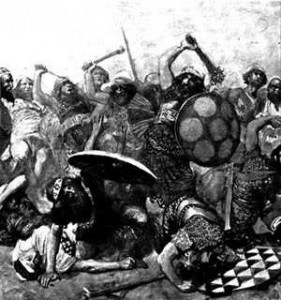
    Joshua Slaughters the CanaanitesMy article was a revised version of a paper I presented in Atlanta in November last year (my God and the Genocide of the Canaanites series gives a good overview of my position). Around the same time I presented this paper, Thom Stark, posted a critical review of Douglas S. Earl’s book The Joshua Delusion? Rethinking Genocide in the Bible. As a review, much of it was addressed to the specifics of Earl’s book. However, in the introduction Stark offered a critique of Wolterstorff’s position and made reference to my defence of it.

    He offered three lines of argument; two against the conclusion Wolterstorff and I offered and one against Wolterstorff’s argument itself. Since then several people have asked me my thoughts on his critique. In this post I will look at his critique of Wolterstorff’s argument, which I defended and adapted in my article.

    Before one can criticise an argument it is important to be clear as to what it is. As I note in my forthcoming article (and in the post I linked to above) Wolterstorff’s argument consists of three points and a basic assumption. The assumption is that “Joshua as we have it today was intended as a component in the larger sequence consisting of Deuteronomy, Joshua, Judges, I and II Samuel, and I and II Kings”.[3] On the basis of this assumption Wolterstorff contends “…  I propose that we interpret the Book of Joshua as a component within this larger sequence – in particular, that we interpret it as preceded by Deuteronomy and succeeded by Judges.”[4] In taking this approach, Wolterstorff engages in a more canonical approach to the text; he focuses on the meaning of the final form as part of a canonical sequence.

    The three premises are as follows. First, the so called genocide accounts in Joshua 1-11 are part of a broader context which includes both the rest of Joshua but also other canonical books, such as the book of Judges. When one reads the whole sequence one observes that while early passages in Joshua describe Israel exterminating the inhabitants, later passages in Joshua and Judges proceed on the assumption this never literally happened.[5] Taken literally these accounts of the conquest contradict each other (more…)

  • Matthew Flannagan on The Sermon on the Mount Part 1 (MP3)

    Matt preached at Takanini Community Church last Sunday and gave the first sermon in his series on the Sermon on the Mount. Download and listen to the MP3 of Matt preaching on The Sermon on the Mount Part 1.

    Now when Jesus saw the crowds, he went up on a mountainside and sat down. His disciples came to him, and he began to teach them. He said:
    “Blessed are the poor in spirit,
    for theirs is the kingdom of heaven.
    Blessed are those who mourn,
    for they will be comforted.
    Blessed are the meek,
    for they will inherit the earth.
    Blessed are those who hunger and thirst for righteousness,
    for they will be filled.

    Matthew 5:1-6 NIV

    The Sermon on the Mount

    Matt will be preaching Part 2  at 10:00 am on Sunday 20 March 2011 at Takanini Church of Christ, 160 Great South Road, Takanini, Auckland – all welcome.

    Hat tip: Christian LIFE Church Takanini

  • Contra Mundum: “Till Death do us Part” Christ’s Teachings on Abuse, Divorce and Remarriage

    Anne was clearly angry. She relayed how her former husband had been abusive, had beaten her and sexually violated her. Despite this, however, he had never – as far as she knew – had an affair. Did this mean she had sinned before God for leaving her marriage? Was she now required to remain celibate for the rest of her life? Anne recited Jesus’ words with palpable sarcasm, “whoever divorces his wife, except for adultery, and marries another woman commits adultery.”

    Christian MarriageAnne’s story was the real life face of an intellectual journey and struggle I had faced some years earlier during my theology studies. How should I understand the bibles teaching on divorce? When I was at Bible College I remember two approaches vividly.

    The first was from a marriage counsellor who, when I asked him if we should counsel battered spouses to leave their marriages, responded “no, until death do we part”. He refused to take with any seriousness my suggestion that in some cases the death of one spouse might be a realistic outcome if the battered spouse does not leave.

    The second was a lecturer who argued that the New Testament did not speak unequivocally on this topic. While Matthew’s gospel allowed an exception for adultery, Mark’s gospel seemed to condemn divorce outright with no exceptions. On the other hand Paul, in his epistle to the Corinthians, contended that a person abandoned by their spouse “is not bound”. The Greek in this epistle alluded to the wording of a Jewish divorce certificate, which stated that the person in question had a right to remarry. The lecturer, quite correctly, concluded that Paul allowed divorce and remarriage for abandonment. The lecturer then suggested that because Paul added to Jesus’ teaching so could we.

    Both approaches seemed to me to be evidently problematic. My questions remained equally unsolved by the Pastor who told me that he accepted Jesus’ teaching as correct but did not follow it because it was “impractical” in the real world and in his experience. I was underwhelmed by the author who suggested that because Mark, Paul and Matthew disagreed, we should just choose the one we find the most congenial.

    Then I discovered a study, which to my mind answered my questions and addressed Anne’s concerns. The book was Divorce and Re-Marriage in the Bible: The Social and Literary Context by David Instone-Brewer. Brewer is a scholar of first century rabbinical writings. In his book he places Christ’s teaching within the cultural context of first century Judaism; the results are interesting and enlightening.

    The passage Anne cited comes from Matthew 19. This passage begins with a question from the Pharisees – the Jewish religious scholars at that time – which asked, “Is it lawful for a man to divorce his wife for any reason?” In the dialogue the (more…)

  • Contra Mundum: Is God a 21st Century Western Liberal?

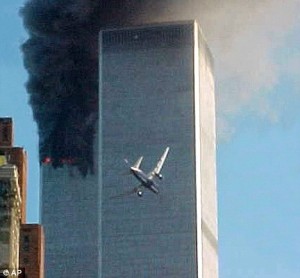
    World Trade Centre Terrorist AttackOn 11 September 2001 Islamic terrorists flew two planes into the World Trade Centre killing thousands of innocent people. Ostensibly they did this because they believed God commanded them to do so. This event has invigorated a fear latent in the Western psyche since the 17th century when wars of religion tore Europe apart, the fear of religious fanaticism, of people willing to murder hundreds in the name of God. These fears were centre-stage recently at a Conference held by the Centre for Philosophy of Religion at the University of Notre Dame. Sceptics presenting at the conference argued passionately that the God of the bible issues commands which are at odds with contemporary modern understandings of morality. Adultery is punished with death; on some occasions, God is portrayed as commanding the killing of non-combatants in “holy wars” against the local Canaanite population.

    There is a lot that can be said about these concerns and in a short column I cannot say everything. In many instances I think the sceptics fail to appreciate the context and genre of the passages they cite. They fail to appreciate, for example, that Ancient Near Eastern conquest accounts employ highly figurative rhetoric, which hyperbolically describe victories in terms of total annihilation of the enemy. They fail to appreciate that Ancient Near Eastern legal texts, as noted by Raymond Westbrook, “reflect the scribal compilers’ concern for perfect symmetry and delicious irony rather than the pragmatic experience of the law courts.” Or that, as JJ Finkelstein points out, they “were not meant to be complied with literally” but to “serve an admonitory function” and so probably do not command execution for the crimes mentioned. Sceptics can fail to grasp that claiming the bible is God’s word does not mean it did not come to us mediated through the writings of human beings who wrote in a particular time and place using the language, rhetoric and literary conventions of their time and so and frequently they fail to appreciate the bible is a Canon and that passages need to be read in their broader context i.e. taking into account the whole bible. A full articulation of these points, however, would take more space than I can here muster.

    Instead I will address another feature of this issue which concerns the general method in play here. In each case the sceptic takes a purported divine command and compares it to a moral belief that he takes to be correct. The conclusion he draws is that the purported command is inauthentic. This is of course a possibility; there is, however, another possibility that on at least some occasions, moral statements these sceptics are relying on are mistaken.

    This feature of the dialectic became clear to me after a public debate I had on these issues in August. A sceptic wrote to me claiming that (more…)