Category: Theology

  • Contra Mundum: Abraham and Isaac and the Killing of Innocents

    Since 9/11 a choir of commentators have claimed that the willingness to murder innocent people in the name of God stems from the progenator of the Abrahamic faiths. Abraham, the father of Christianity, Judaism and Islam is commended for attempting to kill his own son.

    The account of this episode is arguable the most infamous passage in the Hebrew Scriptures:

    Then God said, [to Abraham] “Take your son, your only son, Isaac, whom you love, and go to the region of Moriah. Sacrifice him there as a burnt offering on one of the mountains I will tell you about.” (Genesis 22:2)

    Now, as anyone who has read the story knows, God intervened and prevented Abraham from killing Isaac. In the Mosaic laws that follow this story, the Prophets, Psalms and the historical books, human sacrifice is unequivocally condemned. Notwithstanding these prohibitions, it appears inescapable that Abraham was acting on God’s commands. For this reason, it is not surprising that this story looms large in the criticisms of theological morality. The passage appears to show that God commanded someone to do something clearly and obviously immoral.

    Appearances can be deceiving. There are two issues here: the first is whether the text teaches that God commanded the killing of an innocent child, the second is whether commanding the killing of an innocent child is always immoral. For this objection to have force both these contentions must hold, I will examine each one in turn.

    Turning to the first, did God command the killing of an innocent child? I think the answer is yes, but in a specific context. Let me elaborate. In Gen 12:1-2, Abraham is told, by God, that he will be the father of an entire nation, one that will have its own country. An obvious implication of this is that Abraham believed he would have descendants, he would have a son who would live long enough to have children of his own. The text implicitly teaches here that Abraham knew, on the basis of a reliable source, that his son would live to adulthood.

    This point is reiterated in several other encounters between God and Abraham. In Gen 15 “the word of the LORD” came to Abraham “in a vision.” Abraham’s response was, “You have given me no children; so a servant in my household will be my heir.” God’s answer was emphatic, “This man will not be your heir, but a son coming from your own body will be your heir.” Abraham was told and hence knew, that his heir would be a son from his own body, a biological descendant.

    The text continues, “He took him outside and said, ‘Look up at the heavens and count the stars—if indeed you can count them.’ Then he said to him, ‘So shall your offspring be.’” Again, the narrative implies that Abraham knew that he would both, have a biological son and that this son would live at least long enough to have children. Moreover, the passage continues with God promising, as part of a covenant, that these things will be so. Abraham clearly had assurance that God would see that his son lived into adulthood.

    After this incident, Abraham made the mistake of sleeping with Hagar, which resulted in her giving birth to Ishmael. This lead to various domestic problems including rivalry between Hagar, Ishmael and Abraham’s wife Sarah. Abraham then had another encounter with God (Gen 17:2-14) and here again God promised that Abraham’s descendants would be numerous, again implying, very clearly, that Abraham’s son would live to adulthood. This promise was signified by a covenant marked by circumcision and it was reiterated by God changing his name from Abram (exalted father) as he was called at that point in the text to Abraham (father of many). God again promised and assured Abraham that his son would grow to adulthood.

    More specifics can be found, Gen 17:15-19 makes it crystal-clear that the promise of future descendants came through the line of  Isaac who would be born of Sarah. This seemed impossible to Abraham due to the fact that his wife was barren. God, however, was emphatic and changed his wife’s name from Sarai (my princess) to Sarah (mother of nations). So Abraham was again reassured that Isaac would be born and would live at least long enough to have children of his own. This promise is to be confirmed by a seemingly impossible event, a barren woman bearing a child.

    In chapter 18 the promise is again reiterated. Abraham is visited by three men who appear to represent God himself. The text records in verse 10, “Then the LORD said, ‘I will surely return to you about this time next year, and Sarah your wife will have a son.” Sarah will have Abraham’s child, this is the child that will live on to adulthood to have children of his own.

    If the point has not yet been be-laboured enough, when Isaac is born (Gen 21) God again makes it clear to Abraham on the day Isaac is weaned. Abraham is told in verse 12 “it is through Isaac that your offspring will be reckoned.” Again Abraham is reassured that Isaac will live to adulthood and have children of his own.

    This narrative of several chapters is the backdrop to the events described in Gen 22. To the astute reader reading the whole story as one block of text (note that chapter and verse divisions were not present in the original text, these were added centuries later) by the time a we to get to Gen 22 both Abraham and the reader should know that Isaac is not going to die, both the reader and Abraham know that Isaac will live beyond this day to rear children of his own. The text reminds us in verse 5, just before Abraham goes up the mountain to sacrifice Isaac Abraham states to his servants, “Stay here with the donkey while I and the boy go over there. We will worship and then we will come back to you.” Abraham expected Isaac to return alive.

    Further, the New Testament teaches that this is the correct way to understand this passage,

    By faith Abraham, when God tested him, offered Isaac as a sacrifice. He who had received the promises was about to sacrifice his one and only son, even though God had said to him, “It is through Isaac that your offspring will be reckoned.” Abraham reasoned that God could raise the dead, and figuratively speaking, he did receive Isaac back from death. (Hebrews 11:17-19)

    This is significant because Christians, at least, do not accept any and all interpretations of the Old Testament. Christians accept as authoritative the Old Testament as interpreted by the New Testament. If one attacks a different interpretation of the passage, one is attacking an interpretation Christians (should) reject and hence, one is not attacking anything Christians (should) believe or are committed to believing.

    The text teaches that God commanded Abraham to kill his son in a context where Abraham knew that his son would not die but would live on after the incident. God commanding killing, in this context, needs to be shown as immoral for the objection to gain traction.

    The brings us to the second question, is commanding the killing of an innocent always immoral? Here I think the answer is yes, provided a certain context is assumed.

    The applicability of many moral prohibitions depend in part on certain facts about the world. Hitting someone in the head is wrong because doing so causes pain and risks harming another. However, if the physical structure of the world was different, if hitting someone in the head did not harm people but instead advanced their health and improved their quality of life then it may be permissible to hit someone in the head. Of course, this does not show us that hitting people in the actual world is permissible because in the real world hitting people does cause harm but it does show that prohibitions rely on certain background assumptions about the effects of hitting. If these assumptions are not true then the prohibition will not hold.

    Yale philosopher John Hare develops this point in an interesting way. Hare asks us to imagine a world in which when people of a certain age are killed they immediately come back to life suffering no injury. He opines, quite plausibly, that if this were to be the case then killing people at this age would not be wrong or at least, not seriously wrong. One of the reasons that killing people is wrong in the world we live in is because people stay dead. If they were only unconscious for a split second and came back to life in full health then arguably killing a person would not be the serious wrong we believe it is. The answer to the question, is it wrong to kill an innocent then is yes, provided a certain context is assumed.

    The context where it is plausible to state that killing innocent people is seriously wrong is the very context in which the narrative shows that Abraham knew did not apply to Isaac. God commanded Abraham to kill his son in the highly unusual context where Abraham knew that he would not be deprived of an earthy life but would come down the mountain afterwards and live on to adulthood to father children of his own.

    At this stage I am sure some readers will scoff, they will contend that they do not believe these stories could be literally true, they do not think God appeared to Abraham and told him any of this or that he could not know these things for certain. This complaint is beside the point. Whether one believes the story or not, this is what the story says. If one seeks to argue that the text teaches something immoral or portrays God in a certain way then one needs to accurately portray what the text actually says. Misrepresenting what it says and using that distortion as the basis of an argument to a conclusion is not a valid criticism of the text or the faiths that hold to those texts.

    I write a monthly column for Investigate Magazine entitled Contra Mundum. This blog post was published in the Oct 10 issue and is reproduced here with permission. Contra Mundum is Latin for ‘against the world;’ the phrase is usually attributed to Athanasius who was exiled for defending Christian orthodoxy.

    Letters to the editor should be sent to:
    editorial@investigatemagazine.DELETE.com

    RELATED POSTS:
    Contra Mundum: Selling Atheism
    Contra Mundum: Did God Command Genocide in the Old Testament?
    Contra Mundum: Fairies, Leprechauns, Golden Tea Cups & Spaghetti Monsters
    Contra Mundum: Secularism and Public Life
    Contra Mundum: Richard Dawkins and Open Mindedness
    Contra Mundum: Slavery and the Old Testament

    Contra Mundum: Secular Smoke Screens and Plato’s Euthyphro

    Contra Mundum: What’s Wrong with Imposing your Beliefs onto Others?
    Contra Mundum: God, Proof and Faith
    Contra Mundum: “Bigoted Fundamentalist” as Orwellian Double-Speak
    Contra Mundum: The Flat-Earth Myth
    Contra Mundum: Confessions of an Anti-Choice Fanatic
    Contra Mundum: The Judgmental Jesus

  • Commonsense Atheism and the Canaanite Massacre

    Luke Muehlauser at Commonsense Atheism has written a review of my argument on the genocide of the Canaanites (Joshua and the Genocide of the Canaanites Part I and Part II). Luke’s comments are largely positive (and I appreciate that a critic of Theism and Christianity sees merit in my position) he does, however, raise a few issues I would like to respond to.

    First, Luke summarises my conclusion as:

    Perhaps instead the most genocidal phrases in Joshua were meant as hyperbole. Imagine a basketball team speaking of how they “totally slaughtered” their opponents like their coach told them to. In the same way, maybe the Israelites wrote in hyperbolic language about how they defeated their enemies. Indeed, this kind of exaggeration and hagiography on a nation’s own behalf is common in ancient literature.

    This is not quite right; I did not state “perhaps” the passages are hyperbolic. I argued a hyperbolic reading best fits the context, as it explains why the author uses stylised phrases in some passages which, if taken literally, contradict what he affirms elsewhere in the text did literally happen. Furthermore, I did not suggest that such exaggeration and hagiography is common in ancient literature. I suggested it was common in literature of the same general time and place, which used the same literary conventions and rhetorical techniques as the Bible does in the Book of Joshua – namely Ancient Near-Eastern war and conquest accounts.   

    Second, Luke states that my position “agrees with the Biblical minimalism already espoused by most atheists, for it says that these events found in the Bible never happened.” This comment is intriguing because much of my research drew from the writings of biblical maximalists who were criticising minimalism. My repeated citation of Kenneth Kitchen is an obvious example. Minimalists point out that the archaeological record does not fit the picture of total conquest and genocide and hence conclude the Bible is inaccurate. Maximalists, such as Kenneth Kitchen and James Hoffmeier, respond by arguing that the text is not inaccurate because, having examined the literary conventions of Ancient Near-Eastern historiography, one finds it does not actually teach total conquest and genocide as it is written according to the hyperbolic and to some extent hagiographic rhetoric of Ancient Near-Eastern historiography. So I am inclined to think my position is a development of a rejoinder to minimalist challenges.  

    This is of course another area where my perspective has merit. It resolves not only some of the moral questions people have with the narrative; it also resolves the apparent contradictions within the text cited by critical scholars, answers the challenge of archaeology and fits what we know about the conventions of such literature. If we know that Joshua is written according to certain literary conventions and we know that these conventions frequently are hagiographic and hyperbolic, then to insist on a literal reading is implausible. This is particularly so when it makes the text contradictory, contrary to archaeological record and seemingly immoral.   Luke goes on to ask,

    If Matt did think these events happened literally as described in the Bible, would he then conclude that God was an evil monster to command them? Or would he, in the end, agree with Bill Craig that genocide is okay as long as God feels like it?

    I will make two points in answering Luke’s questions.

    One, it seems to me one could only conclude that Joshua actually carried out a divinely authorised Genocide if, in addition to taking Joshua literally one also accepts that the Bible is inerrant. But Joshua is not the only text in the canon, the Bible also in various other places teaches that God is good, just, and so on. So it’s hard to see how a person could coherently draw the conclusion Luke mentions. A person who concluded that God is evil, would have to conclude that much of what the Bible teaches about God is mistaken, but if this is the case then one has reason for doubting that it is accurate in its description of Genocide in the first place.

    Two, Luke asks if I “agree with Bill Craig that genocide is okay as long as God feels like it?” It is important to note is that this is not Craig’s position. Craig claims that killing non combatants in war is permissible if a loving and just God commands it. He also contends that God in fact did not command this in the biblical narratives hence his view is about a hypothetical conditional.1 Once this is realised the issues are not as simple as Luke appears to think.   Either it is possible for a just and loving omniscient person to command genocide or is not. If it is, then genocide would only be commanded in situations where a just and loving person aware of all the relevant facts could endorse it, and under these circumstances its hard to see how genocide could be evil.

    On the other hand if it is impossible for a perfectly good omniscient being to ever command genocide, then the situation Luke mentions is one with an impossible antecedent. On the standard accounts of counter factual logic, conditionals with impossible antecedents are true. Of course this is a disputed point of modal logic, the debate however is technical and complex and certainly not one with an obvious answer. As I have argued elsewhere every ethical theory is such that under impossible circumstances it entails that genocide is permissible.

    Finally, Luke argues that atheists are not “‘attacking a straw man’ or ‘taking things out of context’ as Matt sometimes says” but rather, “they are responding to the way that millions of Christian fundamentalists interpret these verses.” He states,  

    Atheists are not, as Matt claims, reading the Bible as fundamentalists. Atheists don’t believe the genocide ever took place! What we atheists are saying is this: If you think these events were literally commanded by God and carried out by the Israelites, then how can you call God “perfectly good”?

    But here Luke is quoting me out of context.  The argument I responded to was developed by Ray Bradley. Ray’s conclusion was not that fundamentalist Christianity is false but that theism is false, and that all forms of theistic ethics are false. This only follows if you assume either,

    (a) that fundamentalist readings are the only defensible ones or,
    (b) all theists as a matter of fact do make such readings.

    To affirm (a) is to adopt a fundamentalist hermeneutic as correct interpretation.

    To affirm (b) is to attack a straw man.

    Of course someone might adopt a more qualified argument along the manner he suggests. But if he does, then it is not an argument against theism, nor is it an argument against Christianity, it is not even an argument against a form of Christianity committed to a strong view of inerrancy. It is an argument against anyone who accepts these things and also accepts an interpretation of Scripture which reads these passages as a literal description of what actually happened, as opposed to hagiographic or hyperbolic description. Now showing this combination of positions to be indefensible might be  interesting and useful, but it is extremely limited in its conclusion. Anyone appraised of such an argument can respond simply by moving to a less literalistic hermeneutic and retaining every thing else. I suspect this is much less than atheists typically want and certainly less than they typically maintain this argument shows.

    1. In Divine Command Morality and Voluntarism William Lane Craig writes “I’ve come to appreciate that the object of God’s command to the Israelis was not the slaughter of the Canaanites, as is often imagined.” The command rather was primarily to drive them out of the land.” He goes on to state “But I’m assuming a “worst case” scenario for the sake of argument.”

    RELATED POSTS:
    Joshua and the Genocide of the Canaanites Part I
    Joshua and the Genocide of the Canaanites Part II
    Contra Mundum: Did God Command Genocide in the Old Testament? 

  • Watch the Video of “The New Atheism, Science & Morality” with Glenn Peoples

    The unofficial video of Glenn Peoples’ talk at Auckland Uni “The New Atheism, Science & Morality” is online.

    Hat Tip: E†B

  • Free eBook “Is Christianity True?”

    Not so long ago Apologetics 315 ran an essay series on the topic Is Christianity True? Twenty-three apologist bloggers contributed, Matt’s essay “Showing Christianity is True” was selected to be the concluding essay in the series, before Brian Auten’s conclusion.

    23 Essays Exploring the Truth of Christianity

    At the time, an audio version of each essay was created and the series was turned into a podcast. Now, Apologetics 315 have made the series available as a free ebook entitled, “23 Essays Exploring the Truth of Christianity.”

    Kindle Version | Mobi | ePub| PDF.

    Chris Reese – Foreword
    Brian Auten – Introduction
    Tawa Anderson – Does God Exist?
    Jim Wallace – The Best Explanation
    Wes Widner – Coherent, Consistent & Livable
    Richard Gerhardt – The Failure of Naturalism
    Bob Perry – Defrocking the Priests of Scientism
    Peter Grice – Orthogonal Complexity
    Chad Gross – Cumulative Reasons for Christianity
    Shelby Cade – Prophecy and Resurrection
    Luke Nix – Making Sense of the Resurrection
    Aaron Brake – The Facts of the Resurrection
    Amy Hall – The Historical Event of the Resurrection
    James Patrick Holding – The Impossible Faith
    Stephen J. Bedard – Christianity and Other Ancient Religions
    Anthony Horvath – Christianity Proved by the Nature of the Jewish Nation
    Mariano Grinbank – The Euthyphro Dichotomy
    Marcus McElhaney – Christianity is Objectively True
    Vocab Malone / Paul D. Adams – The Gospels Tell Me So
    Glenn Hendrickson – Christianity Explains Logic
    Brian Colón – Atheism: A Falsified Hypothesis
    Kyle Deming – Testing Christianity’s Core Truth Claims
    Matthew Flannagan – Showing Christianity is True
    Brian Auten – The Wise Man Seeks God

    H/T: Thinking Matters

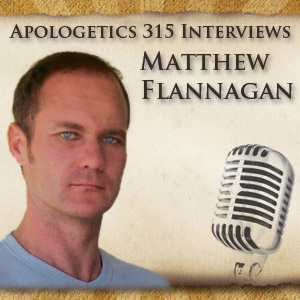
  • Apologetics 315 Interviews Matthew Flannagan on his Contribution to Apologetics

    Apologetics 315, which brings together a variety of apologetics resources including audio, debates, podcasts, book reviews and articles profiling the works of the best apologists in the world, has interviewed Matt as part of their series.

    Apologetics 315 Interviews Matthew Flannagan

    Matt is the first kiwi apologist to be featured in this series and stands alongside

    such contemporary greats as William Lane Craig, Michael Licona, Gary Habermas, Paul Copan, Greg Koukl, Doug Groothius, Doug Geivett, Craig Hazen, Peter Williams, Kenneth Samples, Chris Shannon to name a few.

    The interview is in the form of a half-hour podcast entitled Apologist Interview: Matthew Flannagan. It covers how Matt got into philosophy of religion, the international attention some of his work has received, his upcoming research projects, his upcoming US speaking engagements, his recent debate with Raymond Bradley, his thoughts on the benefit of public debate, the need for reasoned faith and more.

    We’d like to thank our generous supporters who donated the necessary equipment for us to be able to do interviews via Skype.

  • Tim McGrew’s Library of Historical Apologetics: Rediscovering Forgotten Defenders of the Faith

    Last year Timothy McGrew, Professor of Philosophy at Western Michigan University (and reader of and occasional commenter on this blog) was kind enough to ship us a hard-drive from the US filled with thousands of old theological works on the historical argument for the truth of Christianity. It is truly a gold-mine of information, which Matt gets himself routinely lost in and for which visitors to our home have been known to arrive carrying their own portable hard drives so as take away a copy.

    Library of Historical Apologetics

    At the time Tim told us he was aiming to get this material online so that everyone could access it. Along with his advisory board of William Lane Craig, Gary Habermas, Craig Hazen, Robert Stewart, it seems he has made some progress as the Library of Historical Apologetics is now live and open for browsing and is really worth checking out.

    Paraphrasing and splicing bits together from the Collection page:

    The collection contains both one of the world’s largest catalogs of works in historical apologetics, the branch of apologetics dealing with the authenticity and credibility of the scriptures and particularly of the New Testament. The authors come from various denominational and educational backgrounds and would not agree with each other on all points of theology. Some are profound works of research and scholarship; others are brief works addressed to a non-specialist audience. But each makes a distinctive contribution to the literature of historical apologetics.

    In addition to the library, the site features:

    • Annotated Bibliography: Short descriptions of selected works.
    • Spotlight Articles: Published monthly, these two page articles describe an author, book or apologetic theme [Very cool!]
    • Quotation of the Week: Significant and pithy excerpts that make a poignant point and illustrate the subject matter of a particular author.

    All works available at the library are in English and are part of the public domain.

    HT Tim McGrew

  • Dr Glenn Peoples on Science and Morality, Sam Harris & the Claims of the New Atheism @ Auckland Uni

    Christian philosopher and blogger Dr Glenn Peoples is coming to Auckland to give a public talk entitled “Science and Morality: Is there a Naturalistic Basis of Moral Truth?” This talk will examine the claims of the new atheism, particularly the work of Sam Harris. Dr Peoples will ask, can the natural world tell us what is right and wrong, without need for God? Can moral facts be grounded scientifically? He will argue that the attempt to ground morality outside of God ultimately fails. An opportunity for questions and answers will follow the talk.

    Science and Morality

    The talk will be held at the University of Auckland on Monday 6 September from 7-9pm in LIB 15 (in the main campus library basement at 5 Alfred St, Auckland City). Admission is free and is open to anyone. We do advise that you arrive early to locate parking and to obtain a good seat.

    If you enjoyed the panel discussions and the debate we organised earlier this year on Auckland’s campus, you should enjoy this event.

    Dr Glenn Peoples is a graduate in theology (BD) from the Bible College of New Zealand and has a masters degree (MTHeol) and a doctorate in philosophy from the University of Otago. For over ten years he has been writing and speaking, both in New Zealand and abroad, on intellectual issues that Christians face, including the place of faith in the public square, justice and human rights and the reasons for Christian belief. He lives in Dunedin with his wife Ruth and their four children and he blogs at “Say Hello to my Little Friend: The Beretta Blog and Podcast“

    This event is brought to you by Thinking Matters, in association with Evangelical Union. Here is the event’s Facebook Page.