 Jason Thibodeau over at The Secular Outpost has written a thoughtful discussion and response to the critique I made of Walter Sinnott Armstrong’s arbitrariness objection in my article, “Is Ethical Naturalism more Plausible than Supernaturalism: A Reply to Walter Sinnott-Armstrong.”
Jason suggests that when you disambiguate the premises of Armstrong’s argument, it is formulated as follows:
(1) Either: (i) there is a reason, r, why God prohibits rape; or, (ii) there is no reason, r, why God prohibits rape.
(2) If there is no reason, r, why God prohibits rape, then God’s commands are arbitrary.
(3’’) If there is a reason, r, why God prohibits rape then r is what constitutes the wrongness of rape.
(4’’) If r is what constitutes the wrongness of rape then God’s commands are explanatorily superfluous.
The word “constitute” in premises (3”) and (4”) is a technical term for a particular kind of explanatory relationship. Mark Murphy explains, “The sense of explanation at stake is that of informative identification, as we explain the nature of water by identifying it with H2O or explain the nature of heat by identifying it with molecular motion.”[1]
In my paper, “Is Ethical Naturalism more Plausible than Supernaturalism“, I argued that (4’’) was false; (4’’) relies on a particular principle:
PI: If A is constituted by B, and someone has reasons, r, for bringing about B, then A is constituted by r.
However, PI is false. Consider a counter-example drawn from Stephen Sullivan. Consider Giorgio who is bachelor. Giorgio is unmarried because he prefers to live alone. Given that the property of being a bachelor is constituted by the property of being an unmarried man, and Giorgio’s love of living alone provides a reason for him to be an unmarried man, PI entails that the property of being an unmarried man is constituted by the property of preferring to live alone, but this is clearly false. Giorgio’s preference for living alone provides him with a reason for being a bachelor, in the sense that it is what motivates him to continue to be one, but his preferences do not constitute him being a bachelor.[2] There are, after all, many people who are bachelors who would prefer not to live alone.
Thibodeau agrees that this counter example refutes PI, he suggests a repair: (more…)
 Well done Matt and Paul. 🙂
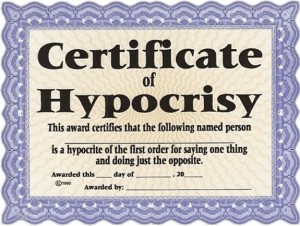 In this post I want to respond to two objections to this line of argument. The first contends my position is contradictory or incoherent; one cannot coherently deny that God is subject to the commands he issues to human beings. The second contends my argument makes God a cosmic hypocrite. Human morality consists of God saying to us, “do as I say not as I do”.
 Recently I discovered Coyne’s latest riposte on the issue of divine commands: “
