Category: Guest Posts

  • Guest Sunday Study: Moral Perspectives on Lying

    Bethyada explores the morality of lying. (This guest post is part of open mic week(s))

    There are a range of Christian theories on the moral acceptability of lying.

    The issues around lying seem difficult to fully categorise in English. The problem is a lack of simple words to express subtle differences in meaning. To illustrate this note that the concept of lying can be considered analogous to killing. With killing we have sub-terms such as murder, manslaughter, and capital punishment. We also recognise killing in a variety of situations such as warfare and self-defence. The debate about the morality of types of killing is more transparent because we agree on meaning, even if we disagree or the moral acceptability of them.

    Whereas “lying” merely means distorting the truth irrespective of the circumstances. There are terms such as deception, falsification, untruthfulness, but these are basically synonymous. There are situational terms though, such as perjury.

    So is falsehood a single conceptual category? I have long thought it meaningful that the 9th commandment is not, “You shall not lie,” but rather, “You shall not bear false witness against your neighbour.” I have previously distinguished between reality and what one perceives as reality stating that affirming a false belief is not lying. I have also made the distinction between voluntary and forced disclosure of information which I wish to expand on here.

    The moral debate is that either:

    • lying (or specific types or lying) is objectively wrong, that is, various forms of absolutism; or
    • lying is not intrinsically wrong (for all people), (though it may be preferable to avoid in certain situations for other reasons), that is, forms of subjectivism.

    Christianity claims that morality has its source in the moral law giver, thus it views the morality of truth telling as objective: the same rules for all people at all times. Here are particular forms of such absolutism.

    1. Unqualified Absolutism

    Lying is always wrong. People should never lie ever. No matter what the situation or consequences.

    Doug Beaumont explains such unqualified absolutism.

    Unqualified Absolutism is based on the idea that most moral actions are intrinsically right or wrong, and because sin is always avoidable there can be no actual moral conflict. Given a choice between telling the truth or lying to avoid a murder, for example, one must choose telling the truth for in that instance it is not the one speaking, but the murderer who is sinning. In that case it is better to permit sin than to commit it. This view states that moral “oughts” are viable regardless of their consequences, for any moral philosophy that has exceptions results in relativism. Moral law is based on God’s unchanging nature, therefore moral law itself is unchanging. Logically, if an act is intrinsically evil, it cannot become good because of a changing situation. Finally, God can always provide a third alternative to sinful actions.

    This is how many people view lying. It is a somewhat reasonable but it lacks depth. Exceptions to rules don’t intrinsically mean relativism. True, exceptions can be special pleading or hypocrisy, but they may be legitimate (eg. age based rules). And as I note below, unqualified absolutism may conflate intrinsically different actions.

    2. Conflicting Absolutism

    Lying is wrong, but it needs to be considered within the situation. If lying conflicts with another moral commandment then one must do obey the higher moral. But lying, while required, is still sinful.

    Such a position acknowledges that we have moral conflict (at least in this age). I think this is an improvement as it notes that as bad as lying may be, it may not be the greatest evil (though lying is a bigger evil than many acknowledge). This position encourages people to do good and love their neighbour.

    It fails in that it suggests at times all options a man may have involve sin. However if we wish to do right, Scripture suggests we are able to do so (thru God). Further, how much less are we to blame when others have placed us in a dilemma, rather than our own prior choices.

    3. Graded Absolutism

    Lying is wrong unless it conflicts with a higher moral commandment. Obeying the higher moral by lying is not wrong or sinful.

    This resolves the dilemma or not being able to make a right choice. It affirms moral conflict, but it claims that the choice to do the better is good. And not sinful if a greater good is being done. There may be some support from Jesus’ words to the Pharisees. It discussing tithing garden herbs Jesus states

    “But woe to you Pharisees! For you tithe mint and rue and every herb, and neglect justice and the love of God. These you ought to have done, without neglecting the others.”

    While one could claim that tithing herbs and doing justice are morally equal—Jesus does say not to neglect the former—the context would suggest that doing justice is a higher moral command. Apologists for unqualified absolutism could argue Jesus commands they do both, but there is no conflict between moral obligations set up here, so unqualified absolutism cannot be proven from the passage. I am merely illustrating that moral commands are graded.

    It is important to note that this is not arguing that the end justifies the means. Yes, the end is considered, but for the sake of doing good, not for preferred result. Doing good may have unpleasant consequences.

    4. Libertarian Absolutism

    Lying is wrong if one is voluntarily giving information. One need not tell the truth if one is being compelled to divulge information. I am responsible for my actions, not yours.

    This has the advantage over graded absolutism in that it recognises that voluntary information and compelled information are categorically different. It is somewhat analogous to saying that predatory killing is sinful but self-defensive killing is not.

    Interestingly Jesus’ words may shed some light on our understanding here.

    After this Jesus went about in Galilee. He would not go about in Judea, because the Jews were seeking to kill him. Now the Jews’ Feast of Booths was at hand. So his brothers said to him, “Leave here and go to Judea, that your disciples also may see the works you are doing. For no one works in secret if he seeks to be known openly. If you do these things, show yourself to the world.” For not even his brothers believed in him. Jesus said to them, “My time has not yet come, but your time is always here. The world cannot hate you, but it hates me because I testify about it that its works are evil. You go up to the feast. I am not going up to this feast, for my time has not yet fully come.” After saying this, he remained in Galilee.

    But after his brothers had gone up to the feast, then he also went up, not publicly but in private. The Jews were looking for him at the feast, and saying, “Where is he?” And there was much muttering about him among the people. While some said, “He is a good man,” others said, “No, he is leading the people astray.” Yet for fear of the Jews no one spoke openly of him.

    About the middle of the feast Jesus went up into the temple and began teaching. (John 7, emphasis added)

    Jesus said he wasn’t going but then he did. This implies that Jesus’ answer was not true. In fact some manuscripts say, “I am not yet going up to this feast.” Which would seem to make Jesus’ answer more honest. Looking at the passage it is clear Jesus wished to go without others initially knowing he was there. He is asked if he is going, however Jesus does not wish to tell this person. Being evasive may be construed as a yes. Jesus says that he is not going to this feast. Within the libertarian absolutism view a request is made of Jesus to divulge information he does not wish to give and he is at liberty to answer in a way that does not divulge same information.

    This position is distinct from graded absolutism in that one is not weighing up morality in conflict. The distinction is in will for informing.

    Although one could think nothing one hears in conversation is reliable, the solution is listen to what people wish to tell you.

    5. Authoritative Absolutism

    Non aggressive version

    • Lying is wrong in non-aggressive situations. Self-defence against an aggressor allows for lying. Authorities are owed the truth.

    Libertarian version

    • One need not tell the truth if one is being compelled to divulge information unless being compelled by a legitimate authority.

    Authoritative absolutism states the voluntary information must be true as per libertarian absolutism, or that all information must be true unless facing an aggressor. It states that, in general, compelled information does not need to be true though there can be variation on what is meant by compulsion.

    But this position does allow an appropriate authority to force information (whereas strict libertarian absolutism would not). A person following libertarian absolutism would allow one to lie in court if he did not wish to divulge the truth. Non-aggressive absolutism would mean that it is eumoral (morally good) to tell the truth in legitimate courts and immoral to withhold it. Note the caveat: obeying a lesser authority is not required if that means disobeying a higher one. Obeying a policeman, a ruler, or a court is necessary even unjust ones, or in unpleasant circumstances; unless doing so compromises a higher earthly ruler or God.

    Conclusion

    People may argue for the legitimacy of any of these options within Christian theology. Unless one recognises that the concept of lying may include more than one category, graded absolutism is as far as one can advance and this seems to be the best approach. However the knowledge of a permissible sub-categorisation based on the distinction between voluntary and involuntary knowledge sharing allows for more nuanced views.

    Moral perspectives on lying


    There are a range of Christian theories on the moral acceptability of lying.

    The issues around lying seem difficult to fully categorise in English. The problem is a lack of simple words to express subtle differences in meaning. To illustrate this note that the concept of lying can be considered analogous to killing. With killing we have sub-terms such as murder, manslaughter, and capital punishment. We also recognise killing in a variety of situations such as warfare and self-defence. The debate about the morality of types of killing is more transparent because we agree on meaning, even if we disagree or the moral acceptability of them.

    Whereas “lying” merely means distorting the truth irrespective of the circumstances. There are terms such as deception, falsification, untruthfulness, but these are basically synonymous. There are situational terms though, such as perjury.

    So is falsehood a single conceptual category? I have long thought it meaningful that the 9th commandment is not, “You shall not lie,” but rather, “You shall not bear false witness against your neighbour.” I have previously distinguished between reality and what one perceives as reality stating that affirming a false belief is not lying. I have also made the distinction between voluntary and forced disclosure of information which I wish to expand on here.

    The moral debate is that either:

    • lying (or specific types or lying) is objectively wrong, that is, various forms of absolutism; or
    • lying is not intrinsically wrong (for all people), (though it may be preferable to avoid in certain situations for other reasons), that is, forms of subjectivism.

    Christianity claims that morality has its source in the moral law giver, thus it views the morality of truth telling as objective: the same rules for all people at all times. Here are particular forms of such absolutism.

    1. Unqualified Absolutism

    Lying is always wrong. People should never lie ever. No matter what the situation or consequences.

    Doug Beaumont explains such unqualified absolutism.

    Unqualified Absolutism is based on the idea that most moral actions are intrinsically right or wrong, and because sin is always avoidable there can be no actual moral conflict. Given a choice between telling the truth or lying to avoid a murder, for example, one must choose telling the truth for in that instance it is not the one speaking, but the murderer who is sinning. In that case it is better to permit sin than to commit it. This view states that moral “oughts” are viable regardless of their consequences, for any moral philosophy that has exceptions results in relativism. Moral law is based on God’s unchanging nature, therefore moral law itself is unchanging. Logically, if an act is intrinsically evil, it cannot become good because of a changing situation. Finally, God can always provide a third alternative to sinful actions.

    This is how many people view lying. It is a somewhat reasonable but it lacks depth. Exceptions to rules don’t intrinsically mean relativism. True, exceptions can be special pleading or hypocrisy, but they may be legitimate (eg. age based rules). And as I note below, unqualified absolutism may conflate intrinsically different actions.

    2. Conflicting absolutism

    Lying is wrong, but it needs to be considered within the situation. If lying conflicts with another moral commandment then one must do obey the higher moral. But lying, while required, is still sinful.

    Such a position acknowledges that we have moral conflict (at least in this age). I think this is an improvement as it notes that as bad as lying may be, it may not be the greatest evil (though lying is a bigger evil than many acknowledge). This position encourages people to do good and love their neighbour.

    It fails in that it suggests at times all options a man may have involve sin. However if we wish to do right, Scripture suggests we are able to do so (thru God). Further, how much less are we to blame when others have placed us in a dilemma, rather than our own prior choices.

    3. Graded absolutism

    Lying is wrong unless it conflicts with a higher moral commandment. Obeying the higher moral by lying is not wrong or sinful.

    This resolves the dilemma or not being able to make a right choice. It affirms moral conflict, but it claims that the choice to do the better is good. And not sinful if a greater good is being done. There may be some support from Jesus’ words to the Pharisees. It discussing tithing garden herbs Jesus states

    “But woe to you Pharisees! For you tithe mint and rue and every herb, and neglect justice and the love of God. These you ought to have done, without neglecting the others.”

    While one could claim that tithing herbs and doing justice are morally equal—Jesus does say not to neglect the former—the context would suggest that doing justice is a higher moral command. Apologists for unqualified absolutism could argue Jesus commands they do both, but there is no conflict between moral obligations set up here, so unqualified absolutism cannot be proven from the passage. I am merely illustrating that moral commands are graded.

    It is important to note that this is not arguing that the end justifies the means. Yes, the end is considered, but for the sake of doing good, not for preferred result. Doing good may have unpleasant consequences.

    4. Libertarian absolutism

    Lying is wrong if one is voluntarily giving information. One need not tell the truth if one is being compelled to divulge information. I am responsible for my actions, not yours.

    This has the advantage over graded absolutism in that it recognises that voluntary information and compelled information are categorically different. It is somewhat analogous to saying that predatory killing is sinful but self-defensive killing is not.

    Interestingly Jesus’ words may shed some light on our understanding here.

    After this Jesus went about in Galilee. He would not go about in Judea, because the Jews were seeking to kill him. Now the Jews’ Feast of Booths was at hand. So his brothers said to him, “Leave here and go to Judea, that your disciples also may see the works you are doing. For no one works in secret if he seeks to be known openly. If you do these things, show yourself to the world.” For not even his brothers believed in him. Jesus said to them, “My time has not yet come, but your time is always here. The world cannot hate you, but it hates me because I testify about it that its works are evil. You go up to the feast. I am not going up to this feast, for my time has not yet fully come.” After saying this, he remained in Galilee.

    But after his brothers had gone up to the feast, then he also went up, not publicly but in private. The Jews were looking for him at the feast, and saying, “Where is he?” And there was much muttering about him among the people. While some said, “He is a good man,” others said, “No, he is leading the people astray.” Yet for fear of the Jews no one spoke openly of him.

    About the middle of the feast Jesus went up into the temple and began teaching. (John 7, emphasis added)

    Jesus said he wasn’t going but then he did. This implies that Jesus’ answer was not true. In fact some manuscripts say, “I am not yet going up to this feast.” Which would seem to make Jesus’ answer more honest. Looking at the passage it is clear Jesus wished to go without others initially knowing he was there. He is asked if he is going, however Jesus does not wish to tell this person. Being evasive may be construed as a yes. Jesus says that he is not going to this feast. Within the libertarian absolutism view a request is made of Jesus to divulge information he does not wish to give and he is at liberty to answer in a way that does not divulge same information.

    This position is distinct from graded absolutism in that one is not weighing up morality in conflict. The distinction is in will for informing.

    Although one could think nothing one hears in conversation is reliable, the solution is listen to what people wish to tell you.

    5. Authoritative absolutism

    Non aggressive version

    • Lying is wrong in non-aggressive situations. Self-defence against an aggressor allows for lying. Authorities are owed the truth.

    Libertarian version

    • One need not tell the truth if one is being compelled to divulge information unless being compelled by a legitimate authority.

    Authoritative absolutism states the voluntary information must be true as per libertarian absolutism, or that all information must be true unless facing an aggressor. It states that, in general, compelled information does not need to be true though there can be variation on what is meant by compulsion.

    But this position does allow an appropriate authority to force information (whereas strict libertarian absolutism would not). A person following libertarian absolutism would allow one to lie in court if he did not wish to divulge the truth. Non-aggressive absolutism would mean that it is eumoral (morally good) to tell the truth in legitimate courts and immoral to withhold it. Note the caveat: obeying a lesser authority is not required if that means disobeying a higher one. Obeying a policeman, a ruler, or a court is necessary even unjust ones, or in unpleasant circumstances; unless doing so compromises a higher earthly ruler or God.

    Conclusion

    People may argue for the legitimacy of any of these options within Christian theology. Unless one recognises that the concept of lying may include more than one category, graded absolutism is as far as one can advance and this seems to be the best approach. However the knowledge of a permissible sub-categorisation based on the distinction between voluntary and involuntary knowledge sharing allows for more nuanced views.

  • Guest Post: The Rise and Fall of the New Zealand Christian Blogosphere

    ScrubOne has gone back through the  New Zealand blog rankings over the past year and documented the rise and fall of the Christan blogs to see if the launch of the MandM Top 10 NZ Christian Blog rankings has had observable impact. (This guest post is part of open mic week(s))

    A lot of people have noticed that the top 10 Christian blogs here on MandM are ranking higher in the general rankings over time. It’s been suggested that the rankings themselves might be responsible themselves for this phenomenon, by making more people aware of the Christian blogs out there.

    So I thought I’d put that hypothesis to the test.

    I used Tumeke! Ranking data to trace blogs over the past year. I noted the rank of the blogs included in the MandM rankings, from the time they were first used in those rankings, not when they first appeared on Tumeke!.

    I used Tumeke! for several reasons.

    1. It’s more respected
    2. It’s been operating longer
    3. Halfdone rankings have tended to favour Christian blogs for some unknown reason. Thus the Tumeke! Rank becomes a “tougher” test of popularity
    4. Basically, I’m too lazy to do both!

    The first issue we have is that the data is problematic. New blogs come on the scene, old blogs fall off. So I tweaked the data a bit.

    1. Removed MacDoctor – he scored very highly before being placed on the “Christian” list. I think most people would agree that him being a Christian isn’t the primary reason why people read his blog. So he’s not really
    2. Removed Backchat Café and NZ Debate, both of whom started and ended within the survey period.

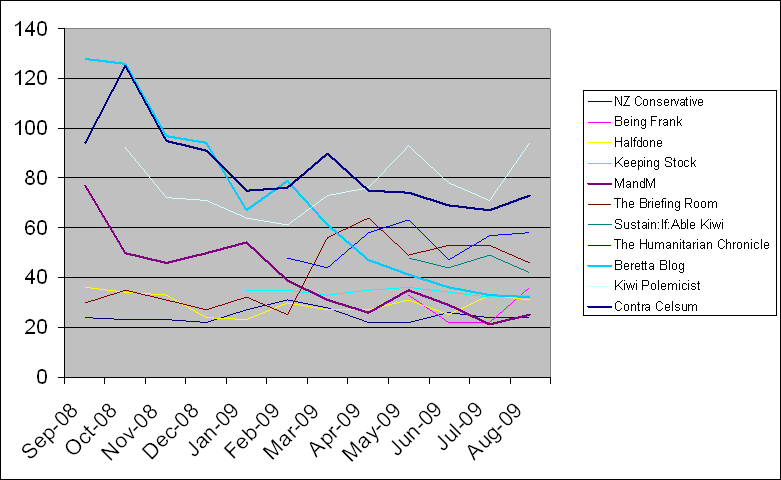
    Charting what’s left, we come up with this (I’ve divided the Max score by 10 to keep it in the scale).

    Total Christian Blogs

    So the number of Christian blogs has increased. Also, as the blog rankings have grown the lowest ranked blog has pushed out lower and lower – i.e. if 300 blogs are ranked, clearly the lowest ranked Christian blog is likely to be in the 200s. No surprises with either of those. The average looks interesting, but we need to dig further.

    Here’s the 11 blogs that averaged the highest score.

    Note the highest score in a Christian blog that didn’t make it onto this chart is 62. That was by Samuel Dennis back in November, so our method didn’t eliminate any good starters thus making the trend look better.

    Improvements Over the Year

    The most impressive improvements over the year have been MandM and the Beretta blog. Both have come from very uninspiring rankings to sweep into the top 40.

    Contra Celsum also made some good gains. I’ve highlighted these blogs to make their movement easier to see.

    Not all blogs gained during the year. Kiwi Polemicist slipped after almost making it to 60. The Briefing room dropped right off after February.

    But what has really gotten the attention of those watching the Christian rankings is the number of blogs that are now in the top 50/60. This can be clearly seen in this chart, with a mere 3 in the top 40 at the beginning. Now however, there are 8, 5 of those being in the top 40. That’s all in spite of TBR’s dropping off the pace.

    Some of us have suspected that this is due to improving scores. That’s partially true, with Beretta and MandM improving drastically, but mostly it’s been due to already good Christian blogs getting included in the stats, and other blogs such as MacDoctor and Keeping Stock identifying or being identified as Christian.

    Speaking of MacDoctor, in spite of his exclusion from the analysis, he is the only one who consistently makes it into the Tumeke! top 20.

    Something for us all to work on, eh?

  • Guest Post: Dan Brown’s History of Science

    This guest post was submitted by Dr James Hannam. Dr Hannam is a UK based historian with degrees in physics and history from the Universities of Oxford and London and a PhD in the history of science from the University of Cambridge. He blogs at Quodlibeta.

    The film adaptation of Dan Brown’s Angels and Demons was released this year and, on top of Brown’s new novel, appears to have done a roaring trade. Reports suggest that this is a better effort by director Ron Howard than his The Da Vinci Code, although most critics would feel that making a worse film would have been a stiffer test.

    For those lucky enough to be unfamiliar with the book, Angels and Demons is set in Rome where hunky Harvard symbologist Robert Langdon, played by Tom Hanks, is trying to prevent the Illuminati from detonating an anti-matter bomb.  According to Dan Brown’s alternative view of history, the Illuminati are a secret society of scientists (Copernicus and Galileo were, of course, members) who were persecuted by the Catholic Church.  After a great purge in the seventeenth century, we learn, the society went underground and plotted revenge. For some reason, it has taken them over three hundred years to get their act together.

    The Da Vinci Code launched the literary careers of a whole faculty previously-obscure professors of New Testament Studies. Admittedly, they had good reason for wanting to put the record straight about Brown’s distortions of early Christian history.  This time, it’s historians of science who might be upset by Brown’s misrepresentation. Because his contention that the Catholic Church has spent the last two millennia holding back the advance of science is as wrongheaded as the story that Mrs Jesus retired to the south of France with her kids.

    Of course, it’s not just Dan Brown who believes in the battle between science and religion. While few people think that the Illuminati really were a group of scientists suppressed by the Church, the perception of an eternal conflict between reason and faith is widespread. It’s true that the Church did make a single significant mistake in 1616, when it banned Copernicus’s opinion that the earth orbits the sun. But the subsequent trial of Galileo over the issue had more to do with papal self-esteem than astronomy. And even in this case, the Catholic Church was siding with the scientific consensus of the time. Still, you can’t manufacture an eternal conflict from a single example, so proponents of the hypothesis have had to resort to a different strategy – inventing the evidence.

    For example, in the book of Angels and Demons, Brown alleges that the Church had Copernicus murdered for his heliocentric model. While this is a more extreme allegation, there is a general belief that Copernicus feared persecution for his ideas. It’s widely thought that he refrained from publishing them until he was on his deathbed. In fact, he had circulated a pamphlet outlining his theory decades before he died. This was favourably received by senior churchmen and he was urged to publish by a cardinal. He even dedicated his great book, On the Revolutions of the Heavenly Spheres, to the Pope.

    Alas, as long as the likes of Dan Brown sell far more books than historians of science, this is a myth that is unlikely to go away.

    James Hannam’s book God’s Philosophers: How the Medieval World Laid the Foundations of Modern Science is published by Icon. The best price we could find for it from a New Zealand bookseller, with free delivery, was through The Nile Online Bookstore at the above link. International readers can buy it through Amazon. As I have previously stated elsewhere, it would make a good Christmas gift…

    RELATED POSTS:
    The “Dark Ages” and Other Propaganda
    More on the “Dark Ages” and Other Propaganda
    Things They Don’t Teach you in Public Schools…
    The Flat Earth Myth
    Contra Mundum: The Flat-Earth Myth

  • Guest Post: Having a Beer… for the Glory of God!

    As it is still open mic (blog?!) week(s) here are MandM; here is another guest post from Jonny King who, if you have not visited his blog before, you’ll find has a rather distinctive style; he threatened to burn effigies of our blog if we didn’t publish him LOL!

    Having a Beer… for the Glory of God!

    What?… I did put it in the singular… “a beer,”… lest we also forget 1 Cor. 10:31, unless you are planning other excursions for the liquid refreshment?!

    No, I don’t believe that this will be a candidate for the next issue in the Tui billboards dotting themselves over various parts of the Islands of NZ [for all you unfortunate individuals who are not so domiciled, these are somewhat tongue-in-cheek, culturally relevant statements, attached to the phrase “Yeah Right.”].

    … and No, I haven’t had one, let alone a few, quiet ones, before I sat my repository of blogging thoughts down before my little friend, the computer… I can talk to it for days and it will listen to every word, unlike some other people I know… Yes, I am referring to my fixer.

    I am Jonny King is not a big fan of the amber ale as a drink of choice.  Maybe, it is an acquired taste, but surely such shows that I have probably not inculcated myself to such a reality.  Or, maybe, I need to pay for the privilege.  Therefore, whatever you think of my liquidity, I am not pushing my barrow in the pursuit of guilt-free cravings.

    I, in fact, prefer something even darker… (more…)

  • Guest Post: Corruption Rampant in Student Unions Throughout New Zealand

    Andy Moore penned this guest post. It follows nicely on from ScrubOne’s:

    “Free hamburgers and sausage sizzle, $5 jugs of beer” read the advertisement in the student magazine CANTA, a week or so before the University of Canterbury Student Association’s (UCSA) AGM. The quorum for the AGM is 120 students as established in the constitution, and it was pitiful to read the president pleading in his weekly column for people to come along. Of course they’d already attempted to run the AGM the week before, but hadn’t made the quorum. So out with the bribes and cheap beer and let’s try this one again. And where else to host the AGM than outside the student pub, in the amphitheatre? From a compulsory membership of 18,000 students, the UCSA was struggling to make up this poorly representative quorum by offering cheap alcohol and free food, only it wasn’t free because the students paid for it in their levy – yep, even the ones who didn’t attend the meeting. Oh, but perhaps I’m coming down a bit strong – after all, the agenda for the meeting was seeking to raise the quality of life for students. Ahem. Seeking to raise the quality of life for the students on the Exec, by raising all their salaries, including bumping the president’s salary up over the $50k mark. With a budget close to $9m ($1.2m from student levy in 2008) and aprox $400k expenditure by the Exec on a yearly basis it makes you wonder where all the money is going. All the while you’ve got growing frustration from students at steadily increasing food-costs on campus with only one cafe operating that is not owned by the University or UCSA.

    Meanwhile in Wellington, pro-VSM students have got together, primarily from within the ACT on Campus and Young Nats groups, and outflanked the executive and other pro-compulsion students at Victoria University. As Jenna Raeburn says in her live-blog post, “a bunch of liberty lovers and I decide to exercise our rights as (unwilling) members of VUWSA and attend their Student Representative Council”. Ultimately, “The motion passes 45-35! [how does this work when there are only 63 people here??? where did these 35 come from?] VUWSA supports the Education (Freedom of Association) Amendment Bill.” You can read Jenna’s full account of the meeting here – as she says, “VUWSA can’t even count hands or run a meeting, and we subject tens of thousands of students to their antics and put them in charge of millions of dollars every year?” – and without consent of their constituents (students) at that! The ACT on Campus Youtube channel has full footage of the meeting which is a real eye-opener. Vice President of ACT on Campus NZ summarily congratulated VUWSA on their stance on VSM in an (albeit) tongue-in-cheek press release later that evening. However the VUWSA exec aren’t going to go down without a fight and so are attempting to illegally veto the decision made at the annual meeting that took place on Wednesday.

    Roger Douglas’s private members bill to bring freedom of association into student unions will go a long way in addressing this snapshot of problems.

  • Snowed

    Matt and I are really snowed this week (as alluded to recently). If anyone wishes to submit a guest post please do. If we like it enough to use it we’ll link to your blog so you’ll get some traffic, a link… the satisfaction of being a good samaritan… We have no issue with  cross-posting the same item on your own blog so there is no extra effort involved, just send us what you are about to post on your own…

    Guest posts do not have to agree completely with what Matt and I think but they do have to be within our niche,  whether it is something deep and meaningful or commentary on current events and it should be well argued and supported.

    Email submissions to m_flannagan at clear dot net dot nz

  • Guest Post: Laidlaw College’s Mark Strom Responds to Critics

    Some weeks ago I wrote a review on the launch of Laidlaw College. I commented on the new vision for the future and my own reflections and frustrations of studying at its previous incarnation, Bible College of New Zealand.

    The comments section of this post saw the eruption of strong sentiment and criticism of Laidlaw College. The level of tension evident in what was said and the volume of readers concerned about the issue was quite surprising; our site stats record that this entry is one of our most read and most commonly Googled-for blog posts. Under fire was the seriousness of Laidlaw’s commitment to its new stated vision, its ability to commit to it and the employment process around the appointment of one of the new heads of department.

    As we are not party to the hiring practices of Laidlaw and as I was an unsuccessful candidate for the position that came under fire, we did not feel it appropriate to participate in the discussion. However, given the nature of some of the claims made, we have granted Dr Mark Strom, Principal of Laidlaw College, a right of reply.

    Matt

    Mark Strom’s Response:


    I’m delighted that the changes at Laidlaw have drawn so much interest. I’m also amazed that so many people (claim to) know (alleged) relationships between institutions, the intentions of board members, the processes of faculty appointments, my motives, the extent of faculty members’ knowledge, and so much more.


    Perhaps I can clarify one or two things.

    First of all, a big thanks to Matt and Madeleine for their very fair and balanced comments on Laidlaw. I personally appreciate encouragement and support from fair-minded friends able to be constructively critique and provoke us to push on.

    Second, people are right that Laidlaw still has a very long way to go. Our best over 86 years has been very significant. But did we become somewhat captive to a dualistic piety and its attendant culture(s)? Yes. Was this true of everyone and everything at college? No. Are we genuinely imagining, articulating, designing and making concrete something more holistic and engaged? Yes. Are there gaps between what we espouse and what we deliver? Yes. Is the trajectory clearly toward teaching, researching and championing real integration of thought and culture around a critically-informed evangelical theology at the highest standards of academic quality, intellectual rigour and serious faith? Yes, yes, and yes. This is our commitment. Piece by piece we are rethinking things and taking decisions that move us toward this. And we’ll take all the constructive criticism we can get from people who can imagine what a difference Laidlaw College could make to New Zealand and beyond, and who will give us room to try, to fall short, to grow and just maybe to succeed.

    Third, a few comments on details raised by respondents.

    Matt is right to note that evangelical organisations sometimes do not follow through on significant reforms. Like every other western institution, two legacies shape us: a Classical tradition that (for the greater part) censured change; and a Judeo-Christian tradition that introduced the appalling innovation (to classical minds) that one could break with conformity and be transformed by a radically changed mindset. Centuries of dialogue, intrigue, enmity and plagiarism between the traditions, overlaid by wave upon wave of Christian convention, has bequeathed an uneasy juxtaposition of conformity and innovation to evangelical institutions and leaders. I know this only too well within myself.

    I am loathe to comment on a colleague (and Rod will be appalled that I have defended him). Were there other candidates? Yes. Were some better qualified as per degrees and writings? Yes. Were these the only criteria for the appointment? No. The following competencies were crucial. First, an ability to see the disciplines of theology through the lens of the Bible’s own narrative structures and in particular the NT witness that the story and its great themes have reached their culmination in Jesus Christ. In other words, to read Christology not as one of many loci of Christian theology, but as that which makes theology Christian. [Barth surely had that right.] Second, an ability to model the teaching of theology as engaged in matters of historical, intellectual and public discourse, ie. worldviews and their impact on society. Third, an ability to inspire teaching around these themes. Fourth, an ability to model a realistic and effective mentoring of students as they seek to choose patterns of personal and public response to God and his world that reflect an integrated faith grounded in the historic gospel. Fifth, the maturity and gifts to nurture a relational culture between academics. Rod was a very strong choice on all these criteria.

    Has Laidlaw reached its full potential as an academic institution? Not by a long shot. Do we have some fine scholars with impressive PhDs and publishing records? Yes. Do we need more of both? Absolutely, and we will seek them. Respondents may be interested to know that earlier this year we completed a faculty restructure process. Three faculty chose not to apply for new roles. All others were rehired under improved conditions for the express purpose of completion of PhDs and the generation of peer-reviewed research publications. Eleven already have PhDs. Six are underway on their PhDs (some nearing completion). Two have begun advanced studies (with highest grades) to progress into PhD studies: one in philosophy at the University of Auckland, and one in ancient history at Macquarie University. We have set the bar high for ourselves, and we have embarked on an ambitious programme of making good on these aspirations. These things do not happen overnight.

    The conspiracists may be interested to know that the Laidlaw board represents a very healthy mix of theological perspectives (within a broad evangelical consensus) and political and economic perspectives, and we enjoy spirited banter and debate on these things. The board ‘relationship’ with Maxim amounts to a few friendships. And why wouldn’t there be?! Many respondents have noted there are far too few individuals and groups in NZ prepared to engage in serious thought and action on matters that shape society. So when you find some, you engage. Do we always agree? Far from it. Do you shun the dialogue because someone has caricatured your dialogue partner (even in this blog)? I choose not to. Ignorant caricatures are one thing, but when someone writes “that Laidlaw, like many other NZ Christian organisations has been captured by Maxim institute and appointments are being made not on academic ability but from the approved Maxim checklist”, this is a stupid comment. Plain stupid…and offensive. If it were naming an individual, it might be considered defamatory. There is no agenda. There is no captivity. There is no list. This comment is ignorant, untrue and offensive to the good people of Laidlaw and of Maxim. [On a personal note, had I voted in the last Australian election (I’m an Aussie), I would have voted for Rudd – I doubt that fits the assumptions of the conspiracists.]

    The question has been raised about whether “we really need a Christian liberal arts college”. I am on record as being against the idea. Like doctoral mentor, Emeritus Professor Edwin Judge of Macquarie University, I always read the early Christians’ distinctive innovations and interactions with Greco-Roman society and thought as evidence for arguing against the idea of a distinctively Christian educational institution. Our forebears showed no sense of need nor ambition to establish Christian structures as alternatives to those of their societies. That evidence and line of inference is still suggestive to me for the modern context. Personally I have long argued against the establishment of university type programmes in Christian colleges. In my opinion, a public university education has afforded both a better education (greater breadth and less cloistered) and a stronger platform for progression into places of influence.

    However, more recently I have come to a different place. Since 2006 I have found myself arguing in favour of this College offering a small number of first class qualifications equal to or better than the best New Zealand universities (yes that is an audacious goal – but closer than some might think in some areas; yes we have a long way to go). My shift of argument has 3 pillars:

    1. I am alarmed at the loss of faith among undergraduate students (some student workers estimate it is as high as 70-80% of students by the end of their programmes). This trend includes Maori and Pacific Island students. I have come to believe the College can and should address this tragedy through the provision of first class tertiary education grounded in a biblical worldview.

    2. I believe the reductionism of knowledge in university programmes has diminished their intellectual and academic rigour and integrity (not of course in every case). I believe in time this diminishes public discourse to the detriment of the nation. I have come to believe Laidlaw can offer a credible alternative education capable in time of influencing public discourse through literate and articulate graduates. Are we there? No. This is an audacious goal that will not come quickly, easily or cheaply.

    3. I believe Laidlaw should prepare (particularly young) women and men more deliberately for leadership in society, as well as in the churches. I have come to believe Laidlaw can equip such leaders for society most effectively through first class qualifications in education and the humanities (we are moving towards a School of Humanities with a PPE style BA degree: philosophy, politics, economics). I believe these qualifications offer appropriate ‘generalist’ educations for placing leaders of faith within education, media, business, health, social services, arts, politics and community leadership as well as continuing to serve the churches. My experience advising heads of corporations (commercial and government) confirms the sense that many employers are frustrated by the narrowness of many bright young university graduates of law, accountancy, commerce, business and engineering. Many are looking for classics and PPE grads. [This was confirmed earlier this year by the global managing partner of one of the world’s highest profile consultancies when I spoke at their global partners conference.]

    My argument for Laidlaw becoming such a College is not a reaction to ‘liberal’ humanism, nor an apologetic for a retreat into a Christian ghetto. On the contrary, I want to argue for a turning of the tables on the assumed hegemony of public universities over higher education. Most of the famed European and American universities began as colleges teaching a breadth of knowledge unified by theology as the core discipline. In short, they started like us. Over time almost every one of these institutions abandoned this theological and epistemological core. In the USA in particular this has prompted the rise of the Christian liberal arts college. [Yes, you may well hear echoes of Wolterstorf, Plantinga and others, as well as my own teacher of many years ago, Cornelius Van Til (and no, I am not a card-carrying VanTillian). By the way, Nick Wolterstorf enthused with me about the vision of Laidlaw when I visited him last year. And yes, that is name-dropping to counter some respondents’ assertions that no one knows or has read anyone.]

    The current education situation seems unnecessarily polarised: it seems we either accept the hegemony of the public university over intellectual discourse; or we retreat into the parallel universe of the Christian college. I no longer accept these as the only options. The time may be propitious for quietly, slowly building a credible alternative to university education on behalf of a nation: an alternative grounded in the theological worldview of historic Christianity, free of the dualistic legacies of traditional piety, and genuinely world-engaging and world-serving in the quality and openness of its teaching, mentoring and research and its contribution to public discourse. As Madeleine points out, this will require and make possible new engagements between Laidlaw College and the public universities.

    To all this talk of excellence I hasten to add our gospel commitment to strength-in-weakness and wisdom-in-foolishness. God delights in nullifying the “things that are” by the “things that are not”. Personally, I am a university drop-out who went on to consult to CEOs of major commercial and government institutions; I am a labourer who earned a PhD in the history of ideas; I am a spare parts salesman who become a principal. Some of the finest young men and women whom we seek as our students dropped out of school, did poorly at school, and generally do not think themselves capable of the kind of academic and personal formation we are seeking to make a reality. So in all our plans for “lifting the bar” we are working hard to establish a dignified, high-quality, effective pathway for those who would otherwise be overlooked.

    We don’t for one moment think any of this can be done easily or quickly. If this is a worthy task, it is a commitment to a generation.

    The notes about William Lane Craig are a bit of a mystery to me. I certainly know who he is (recall my VanTillian heritage). So do others at Laidlaw. I do recall hearing about it late. That happens. It had far more to do with poor communication (perhaps by us) than with ignorance or reluctance. We will endeavour not to make another “academic faux pas of this magnitude”.

    This has ended up a lot longer than I intended when I started. I’d like to frame my final comments (for now) around a thought I muse upon:

    I wonder how many respondents have lead significant institutions and been charged with effecting large-scale structural and cultural change? Or let me put it another way: a lot of people who point out our inadequacies, nonetheless join us in longing for high calibre Christian scholarship that has broken with the captivity of dualism to play a significant role in influencing a nation, society and church, with the gospel. I wonder if these people have the foggiest idea what it takes to position a traditional institution to deliver on such a desire.

    In other words, the ease with which people offer their opinions on what we should or shouldn’t have done at Laidlaw to this point is remarkable. Having been charged with being naïve, it seems only fitting to turn the table.

    Changing an 86 year old institution takes imagination, courage, humility and patience. Fortunately I am surrounded by people with far more of each than I possess. The pace at which we have instituted change has been mind-bogglingly fast for some, and too slow for others. One must honour a heritage and its continuing rich contributions even as one frames a vision that calls for radical changes. You cannot go from financial uncertainty to fully funded PhDs, new faculty and facilities overnight. Governance must be tightened. Financial reporting must be reworked. Deficits must be turned into surpluses. Assets must be reexamined. Accrediting and funding agencies must be given time to appraise and support the new directions. Cultures must begin to shift.

    Those expecting overnight adoption of the conventions and facilities of fine public universities will be deeply disappointed. Public lectures putting theological reflection on the table for the first time for hundreds of people will be viewed as populism. Hiring people with outstanding capacity to forge new trust and integration of gospel, culture and faith will be viewed as far less important than getting impressive CVs. Those with an eye to the long term will recognise strategy; the laying of further foundations (in addition to the fine existing legacies) upon which a great institution can be reimagined and redesigned by people in whom is combined an acuity and humility that will welcome scholars and students who exceed them.

    Can Laidlaw “see past their discovery of the basics”? I think so.

    Will people who read theology and philosophy beyond the popular, and who long for change within churches and evangelicalism and academies and public discourse in New Zealand, give us room to try, to fail, to grow, and just maybe to succeed? Time will tell.

    The Tall Poppy Syndrome is a pernicious, cowardly trait. Laidlaw College seeks an end to its hold over the imaginations and wills of New Zealanders. The fact that we have named a big vision makes us a target. We welcome the support of those with the faith, heart and guts to back something that just might make a difference.

    RELATED POSTS:
    Laidlaw College