
Category: Ethics

  • Matthew Flannagan on The Sermon on the Mount Part 2 (MP3)

    Matt preaches most Sundays at Takanini Community Church. Earlier in they year he did a series on the Sermon on the Mount. We published Matthew Flannagan on The Sermon on the Mount Part 1 (MP3) at the time but then we never got around to publishing Part 2. So now, download and listen to the MP3 of Matt preaching on The Sermon on the Mount Part 2.

    Now when Jesus saw the crowds, he went up on a mountainside and sat down. His disciples came to him, and he began to teach them. He said:
    “Blessed are the poor in spirit,
    for theirs is the kingdom of heaven.
    Blessed are those who mourn,
    for they will be comforted.
    Blessed are the meek,
    for they will inherit the earth.
    Blessed are those who hunger and thirst for righteousness,
    for they will be filled.

    Matthew 5:1-6 NIV

    The Sermon on the Mount

    Hat tip: TCC

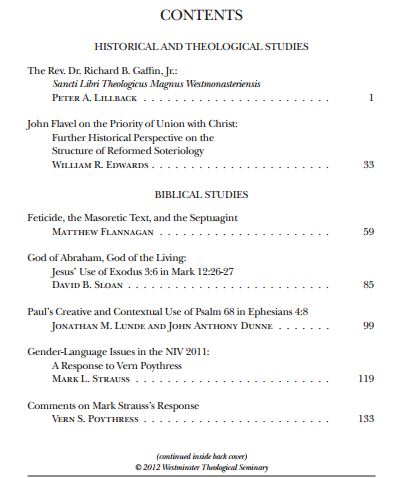
  • Published: “Feticide, the Masoretic Text, and the Septuagint” in The Westminster Theological Journal

    Matt’s article “Feticide, the Masoretic Text, and the Septuagint” is now available in Vol 74, No. 1 – Spring 2012 of The Westminster Theological Journal.

    The Westminster Theological Journal

    An abstract of “Feticide, the Masoretic Text, and the Septuagint” follows:

    A long Christian tradition of moral reflection on feticide interprets feticide, the killing of a formed conceptus, as a violation of  God’s law against homicide. In her book, Our Right to Choose, Beverly Harrison attempts to undercut this tradition of interpretation.

    Harrison alleges that the Alexandrian argument is based on a mistranslation of the Hebrew text. Harrison’s argument is based on apparent discrepancies between the Septuagint (LXX) and the Masoretic Text (MT) over the rendering of Exod 21:22-25. She makes three claims. Firstly, she suggests that Christian prohibition of feticide is based upon the LXX. Secondly, that the MT, which in her view accurately captures the original law, did not consider feticide a major crime. Thirdly, she argues that the LXX mistranslates this law and incorporates a prohibition of feticide into the text that is not there.

    In response I examine whether each of Harrison’s contentions is correct. From the outset I grant Harrison’s assumption that the MT accurately captures the original and that the LXX is the later translation. I also grant her point that the argument has origins in Alexandrian Judaism and the LXX. The discussion then asks whether each of Harrison’s other claims is correct. Does the MT consider feticide a minor crime? And does the LXX misinterpret the original?

    I defend a negative answer to both questions.

  • Contra Mundum: Dawkins and Secular Hypocrisy

    Richard DawkinsWhen I was a non-Christian I was forever hearing about how Christians are hypocrites. When I converted to Christianity at 17, one thing that struck me is how often these charges were often a case of the pot calling the kettle black. While there is undoubtedly some hypocrisy within the church, it is also pervasive outside it. Secular culture often contains absurd ironies and hypocrisy which are conveniently ignored.

    A great example was the media fiasco over William Lane Craig’s visit to the United Kingdom last year. Craig is distinguished philosopher known professionally for his work in philosophy of time and philosophy of religion. Alongside his scholarly work, he has also developed a reputation as a prolific public speaker and debater, debating many of the world’s leading sceptics. His combination of scholarly ability and effective debating skills has earned him a reputation as one of the world’s foremost Christian apologists.

    “Apparently, having two PhD’s, authoring over 100 papers, and writing 30 books on a topic makes you unqualified to speak on it, but being the star of the 80’s TV series “Growing Pains” does.”

    Craig’s visit to the UK attracted media attention when Richard Dawkins, author of the best selling “God Delusion”, publically and resolutely refused to debate him. Dawkins publically stated earlier of his critics that “he did not care” who they were, he would “dialogue” with them and “win the argument”. He also had publically debated numerous critics significantly less qualified than Craig, notably Ted Haggard. These facts, alongside Dawkins implausible and inconsistent reasons lead to accusations of cowardice and hypocrisy from other academics such as Daniel Came a philosophy professor at St Hugh’s College Oxford.

    In the UK newspaper the Guardian Dawkin’s gave two reasons for his refusal. According to Dawkins, Craig “parades himself as a philosopher, but none of the professors of philosophy whom I consulted had heard his name”. Dawkins omitted to mention that this was not the first time he had publicly denigrated Craig’s scholarly credentials. On a previous occasion  Daniel Came,  had e-mailed him stating:

    “Professor Craig has a PhD in philosophy and a PhD in theology. He is Research Professor in Philosophy at Talbot University. He has published more than thirty books and over a hundred papers in reputable peer-reviewed journal. Given your passionate and unconditional commitment to truth, I can only think that you were not aware of Professor Craig’s credentials when you made the above reference.”

    So Dawkins claim that no philosopher he had consulted had ever heard of Craig was less than honest. A less charitable person might describe this as simply slander.

    Dawkins concern about Craig’s alleged lack of scholarly credentials also seems odd seeing that he (Dawkins) had earlier accepted an invitation to debate actor Kirk Cameron.  Apparently, having two PhD’s, authoring over 100 papers, and writing 30 books on a topic makes you unqualified to speak on it but being the star of the 80’s TV series “Growing Pains” does qualify you. It’s also ironic that Dawkins would accuse Craig of lacking scholarly credentials on the matter given that he (Dawkins) is a biologist and not a philosopher of religion.

    Dawkins next excuse was that Craig is “morally unfit” to debate him.  To substantiate this he cites not from any of Craig’s scholarly writings. But two blog posts Craig had written on with the conquest of Canaan. At face value  the early chapters of the book of Joshua portrays God as commanding the killing of every man women and child in Canaan. I say “appears”, here because latter sections of the book of Joshua and its sequel in judges proceed on the assumption this never occurred, and studies into ancient conquest accounts of this genre have noted the widespread use of literary hyperbole whereby victories are described in sweeping rhetoric of killing absolutely everyone when in reality they were (more…)

  • Singer on Matthew Flannagan in “Peter Singer Under Fire: The Moral Iconoclast Faces His Critics”

    Yesterday Matt went the library and did a little reading for his upcoming Evangelical Philosophical Society paper “Peter Singer, Human Dignity, and Infanticide“ and he discovered that email exchange he’d had with Peter Singer in 2006 had resulted in a few paragraphs in Singer’s book Peter Singer Under Fire: The Moral Iconoclast Faces His Critics.

    Here is a screen shot of what one sees when one uses the “search inside this book” function:

    Peter Singer Under Fire: The Moral Iconoclast Faces His Critics

    Matt does not feel that Singer accurately portrayed his counter example but the substance Singer presents of it is correct. Singer’s response to Matt seems to be that Matt is right in principle but in practice it would never be an issue.

  • Madeleine and Matt to speak on “Being Good: Christian Virtues for Everyday Life” at the 2012 Evangelical Philosophical Society Meeting in Milwaukee

    Evangelical Philosophical Society

    I have had to revise my earlier statements about not going to the November 2012 academic conferences in Milwaukee on the grounds that when you are personally invited to participate in a panel discussion by Doug Geivett and Mike Austin at the Evangelical Philosophical Society (“EPS”) you do not say no 🙂

    (If I said “no” I think Andrew would throw things at me and André Z would egg him on)

    Matt has been invited to speak on the same panel too.

    Here is what we know so far:

    Being Good: Christian Virtues for Everyday LifeMike and Doug co-edited a book entitled Being Good: Christian Virtues for Everyday Life.  At the EPS meeting in Milwaukee in November 2012 there will be a panel discussion in one of the sessions offering critical discussion of the book and it’s themes. Matt and I are now scheduled to be participants in that panel.

    The panel will discuss different aspects of the book, such as, an analysis of a virtue in the book that a participant disagrees with by giving an extension of the book’s discussion of character in some way.

    Matt was already going anyway as his paper on Singer and Infanticide got through the blind review process and was accepted.

    I had thought I might not go as we in the process of radically changing how I earn money. I am about to swap my regular weekly income for a contract for services that will see me retain most of the money I make my firm but pay my own expenses (and still be supervised and under the umbrella of a firm as all baby-lawyers should be under the law). So this is both exciting as I will have more control over what I earn but it is also scary as there are no guarantees that I will earn consistently; imminent changes to how legal aid is to be paid make that even scarier. The theory is that in the long run I will make more than I was on my very low baby-lawyer income but it is yet to be tested. As I am the primary earner in our house there is a lot riding on this, including the extension to our mortgage to purchase this opportunity. Going to America is not a cheap exercise from New Zealand but we have providentially managed to find a way the last two years with a lot of help from our friends so I am going to stop worrying and focus on trusting in God to whom I am  grateful for this opportunity.

  • Matt to speak on Singer and Infanticide at 2012 Evangelical Philosophical Society Meeting in Milwaukee

    Every November there is about a two week period in America where a number of professional academic conferences are held where the best of the best in the field gather. For the last two years Matt has been either accepted or invited to speak at them (I was accepted to speak at them last year too but had a visa problem at the last minute so Matt went without me). Anyway, this year they are all being held in Milwaukee and I am happy to announce that Matt received this email last week:

    Evangelical Philosophical SocietyCongratulations!  Your paper proposal for the 2012 Evangelical Philosophical Society meeting in Milwaukee (14-16 November) has been accepted for presentation.

    …

    Since there were nearly twice as many proposals as spaces, many fine papers had to be rejected.  If for any reason you will not be able to present your paper after all, please inform the EPS program committee as soon as possible so that we can allow one of the alternates to fill the vacated slot.

    Again, congratulations, and we look forward to hearing your paper in Milwaukee!

    Sincerely in Christ,

    The EPS program committee

    Yay – so proud of him! The abstract he submitted for blind review was as follows:

    Peter Singer, Human Dignity, and Infanticide

    Christian theism has traditionally taught that human beings have equal dignity and worth, a moral status that separates them from other non-human animals. Peter Singer has famously argued that this teaching is problematic; human beings are not any more special than animals and doctrines of human dignity are indefensible.  He contend that killing a new-born infant is, in and of itself, no more problematic than killing a non-human animal such as a cow or a pig, and he defends the permissibility of infanticide.

    This paper will critically assess one important part of Singer’s position: his understanding of why it is wrong to kill.  In part 1 I will sketch Singer’s “desire account” of killing and its relationship to his own preference utilitarianism and project of animal equality. Following Don Marquis, I will argue that this “desire account” is subject to important counter examples. In part 2, I will note Singer’s attempts to modify his position so as to avoid these counter examples and suggest that these modifications undercut his arguments for animal equality. In part 3, I will suggest that, despite this, there is an important truth in Singer’s critique, one that Christian thinkers can appropriate in developing moral arguments for Christian theism.

    Matt did not apply for any other of the conferences this year, although he was invited to give a paper at the Society for Biblical Literature but the session got cancelled. He and I are contemplating applying to Notre Dame’s annual conference on the week before, it’s theme this year is Justice so both of us could, and I still have enough time on my US Visa to go, but I am not sure if I have time to write a paper as my case-load is insane, so it might be just Matt. Anyway – yay Matt!

    Update
    Wow, already in receipt of donation offers to help get him there! We love you guys 🙂 We have just over $1.5k left over from blog donations and fundraising last time which constitutes the refunds from my aborted-lack-of-visa trip. I will price Auckland to Milwaukee and put up a fundraising widget in the sidebar soon – as with previous years accommodation options will be needed so Milwaukee readers if you have a couch talk to me 🙂

  • Why Defamatory Speech is not Free Speech

    The following argument as to why a remedy requiring the removal of defamatory speech from a publication was not a violation of the right to free speech is representative of one I have previously put before the court:

    1. The right to Freedom of Expression is protected by s14 of the Bill of Rights Act 1990 (“BORA”).
    2. The operational provisions of the BORA provide in section 5 that a reasonable limit to Freedom of Expression can be justified in a free and democratic society where that limit is prescribed by law.
    3. Section 5 is subject to section 4, which states in mandatory terms that no court can decline to apply any provision of an enactment on the sole grounds that the provision is inconsistent with the BORA.
    4. Notwithstanding this, section 6 requires the court rule in a manner as consistent as possible with Bill of Rights.
    5. It is submitted that the Respondent’s actions constitute a breach of s4 of the Defamation Act 1992 therefore the remedy sought, removal of the defamatory material from the publication, does not violate the Respondent’s right to Freedom of Expression.

    Freedom of SpeechWhile this is the standard argument it feels wrong to me. There is something unsatisfactory about appealing to a mechanism in the law that, as argued, feels like it is shearing off a part of an important right and freedom, even if the law says that it is ok.

    I find this argument unsettling and lacking something; at the same time defamatory speech is insidious, causes harm, hurts; intuitively it just feels wrong to say that one is morally justified in spreading harmful falsehoods about a person and is not required to account for the wrongs done, because of their right to free speech.

    After discussions with Matt about this I have decided that I prefer the following argument:

    1. Freedom of Expression is defined in the BORA as “the freedom to … impart information and opinions …”.
    2. Defamation is expression imparted to another that lowers the standing of a person in the eyes of their peers and is not true and is not honest opinion which is genuinely held.(I am ignoring the third defence, privilege).
    3. A person who expresses defamation is not engaging in Freedom of Expression as where there is no truth or honest opinion then a person is neither attempting to inform another or attempting to express their opinion.
    4. The basis for this is that to attempt to inform someone is to attempt to increase that person’s repertoire of true beliefs’ and to impart an opinion is to express what one honestly believes to be the case.
    5. Therefore the speech the BORA protects is all speech that is true or honestly held to be true by the speaker.

    That is much better.

    Defamatory speech is not free speech therefore legal sanctions against it proportionate to the harm caused are entirely appropriate in both legal and moral senses.

    RELATED POSTS:
    Pluralism and Being Right
    Of course I think I’m right!