Category: Cases

  • Flannagan v ACC – Victory

    Long time readers of this blog will remember than 5 1/2 years ago I was in a car accident that saw me suffer a herniated cervical (neck) disc and require disc replacement surgery. Readers will also be aware that the pain I lived (live) with did not end after that surgery and that when the Accident Compensation Corporation (ACC) went on to cut my entitlements, plunging our family into poverty (NZ definition) as I was the primary earner, I instructed John Miller Law in Wellington to fight their decision.

    Matt and I were terrified at the possible $8,000 + bill we might face if we lost; trying to provide for our 4 children in Auckland on $15,000 p/a was extremely difficult as it was without a debt like that being added to the mix. We appealed on this blog for donations and with the help of those who generously gave, along with the generosity of John Miller Law, who more than once wrote off parts of my bill, we managed to keep the legal proceedings going even after we lost the Review Hearing.

    I pressed on for a number of reasons. I firmly believe that ACC deliberately set about to exit me from cover by sending me to a doctor they knew would say I had degeneration. I believe this on the basis of the Court’s previous findings on Mr Otto and on the basis of his reputation among his peers – I have previously blogged my experience of phoning Orthapaedic Surgeon’s offices and sharing what those offices had to say about him to me. I also believe this on the basis of what happened at the appointment with Mr Otto – his pronouncement of my having a degenerative condition before he’d asked me if a single medical question and shortly before he shared that he had not yet seen my MRI, X-Ray or Bone Scan films and reports. I knew my condition was not degenerative or pre-existing: I was working full-time, studying part-time, raising 4 children, running a house and was engaging in equestrian sport on the weekends immediately prior to the accident.

    The other reason I filed was for all the other people like me. I believed then, and I still do, that ACC did what they did to me (cutting me off by sending me to a specialist they know will say a condition is degenerative when other specialists would not) to many other people and that doing so was a numbers game for them – a way of cutting their bottom line. Cut x number of people off, only teeny proportion y will fight; of those who fight ignore them unless and until you are faced with a court date, then quickly settle before that court date to avoid the public damage the judgment of the Court can deliver.

    We filed my appeal earlier this year. This consisted of three expert reports written by Orthopaedic Surgeons Greg Finch and Michael Barnes. We also filed affidavits from Matt and I, which we wrote ourselves. ACC offered to settle in full shortly after they were served: legal costs, report costs and full reinstatement of my entitlement, the maximum I could have won in Court.

    More than one person said to me ‘but Madeleine, if you settle no light will be shone on ACC’s practices’. While I shared their concerns at the lack of a precedent being set if I settled, as a lawyer I know the Court’s view on people who refuse good settlement offers and press on to hearing. I took the settlement and resolved to shine light another way. I am one of the lead stories today on the New Zealand Herald’s website (and on the website of the Otago Daily Times🙂
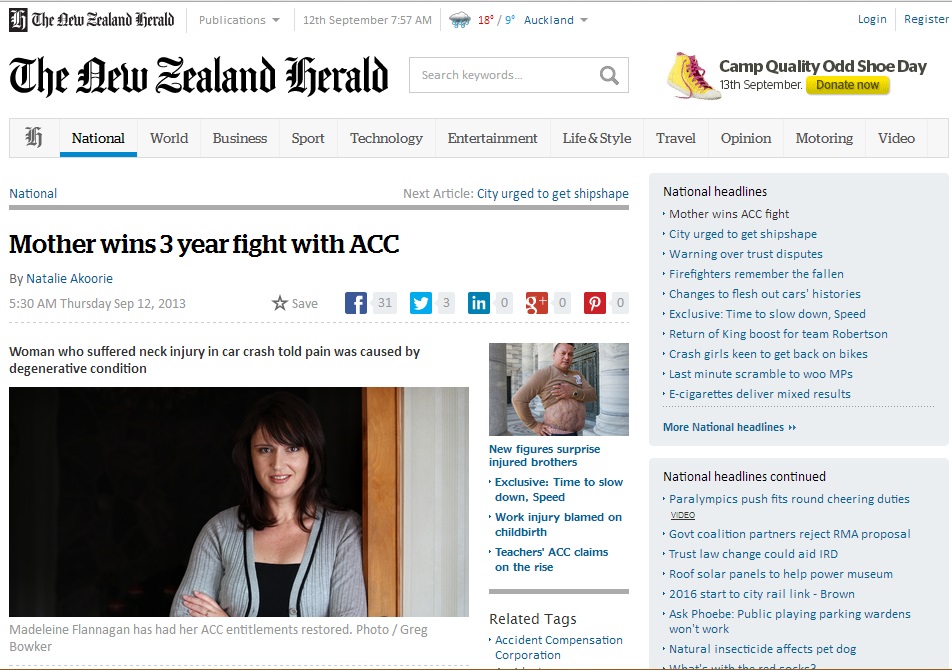
    Mother wins 3 year fight with ACC

    Click to read: Mother wins 3 year fight with ACC

    Mr Otto states in the NZ Herald article, after acknowledging he has no memory of my case, that I “would not have realised he could receive x-rays via email and that he would have seen them before diagnosing her”. I reject this. As I deposed in my affidavit:

    [40] A few minutes after making his opening statement that my condition was degenerative, Mr Otto asked me if I had brought my x-rays, MRI and bone scans. I told him that I had not been asked to and that the other specialists I had seen had all been able to log into some central record holding place and view them so it did not occur to me to bring them. He told me that his office did not have that kind of technology but he would request copies of the reports and films. I offered to send them to him but he said not to bother as ACC had only sent him a letter which didn’t say much so he was going to have to request various things from my file anyway.

    [41] In this moment it was clear that Mr Otto had made his statement about the purpose of the appointment being to discuss my “degenerative condition” in advance of asking me a single question, without having examined my x-rays and scans and on the basis of whatever ACC had communicated to him about me.

    [42] It was also clear that Mr Otto had conducted the appointment with a predetermined purpose: to determine a degenerative condition. He had decided this was my diagnosis before the examination, before being in receipt of the relevant medical evidence. I did not have confidence his diagnosis post-appointment could be objective or unbiased.

    My and Matt’s affidavits are here in full:
    13.03.22 Affidavit of Madeleine Flannagan – Flannagan v ACC
    13.03.22 Affidavit of Matthew Flannagan – Flannagan v ACC

    This is the case I refer to in my affidavit where Mr Otto was found by the Court to prefer his degeneration diagnosis in the face of evidence to the contrary: Lu-v-Accident-Compensation-Corporation-2011-NZACC-45 (A New Zealand Herald article about that case is available here)

    ACC said in the NZ Herald article “An ACC spokesman said it found the consistency and rationale of the two specialists’ opinions “more compelling” than Mr Otto’s report. “As a result ACC decided to reverse its decision.””

    I would like to stress that until ACC insisted (see affidavits) I see Mr Otto, every specialist and doctor who had seen me at that point said my issues were accident related. Mr Otto was the only one who said otherwise. Subsequant to Mr Otto’s report ACC were provided with 2 reports from Greg Finch and 1 from Michael Barnes  – these were the reports ACC found “more compelling” than Mr Otto’s – they were provided the first of these approximately 2 years before they settled, the others they received approximately 1 year before they settled. The service papers for my appeal containing these same reports they received a couple of weeks before they settled.

    Make up your own mind as to whether is was “the consistency and rationale of the two specialists’ opinions” that caused ACC to reverse its decision or whether it was the threat of a court case.

    I have to thank John Miller Law, all those who donated and encouraged me, Greg Finch, Michael Barnes, my church, my family and friends and especially my children and husband who suffered so much along side me – if it wasn’t for Matt going to my lectures and taping my classes and taking notes for me for me to attend to on the couch I would never have finished my law degree. I still live with pain today and it still impacts my life adversely but I am a lot better than I was and I continue to improve.

    Update: For those wondering how I completed a law degree when I could not work, I refer you to Matt’s post Madeleine Admitted to the Bar where he outlines just what it took and how hard it was given my injuries. It is also documented in the affidavits I have published in this post.

    NewstalkZB focussed on Madeleine’s case during the Leighton Smith show.

  • Flannagan v ACC: 5 Years on, an Update

    On Tuesday 26 March 2013 it will be 5 years since I was in a car accident that destroyed a cervical disc and saw me need surgery to have an artificial disc inserted and which left me with an ongoing pain condition and a habit of dropping things and having tingly episodes in my hands – still!

    At the time of the accident I was on track to become an in house counsel for one of NZ’s leading brands; the company were paying for me to complete my law degree.

    Initially ACC covered my income and treatment costs (well, part of them). They did not cover the part of my remuneration which related to my university fees and text books.

    They sent me to see a specialist who is considered by many within his own field and has been found by the court to have, in the face of contrary evidence, “stuck to his tried and true assertion that degeneration is the cause” (read the judgment in Lu v ACC). He made no exception for me stating that was his diagnosis as I entered his rooms, before he asked me a single medical question, before he saw my scans. Matt was with me and saw this.

    ACC cut my cover after he wrote his report. This spun us into significant hardship. So I hired the best ACC lawyers I could find. I took ACC to a review hearing conducted by ACC’s own reviewer. I lost. My lawyer told the court I would appeal. Two other specialists have now examined me and my files, both agree my condition is the result of an accident, both have written evidence for the court stating this. My lawyer has written her submissions. Yesterday Matt and I swore our affidavits, which we wrote ourselves and had my lawyer vet. This coming week my appeal will finally be filed. I hope to have a court date this year.

  • Matt on Radio: Women tells Court of Appeal being pregnant with a defective baby is an injury

    A New Zealand woman has gotten her case against the Accident Compensation Corporation (“ACC”) into the Court of Appeal. The Herald carried the story. Matt was interviewed for his view on Radio Rhema last week.

    The woman was told at her 20-week scan that "no anatomical abnormality" was detected. Photo / Getty Image

    ACC claim mother: I would have aborted

    Woman says she would have terminated pregnancy had she been told baby was disabled.

    A woman who says she would have terminated her pregnancy had doctors properly diagnosed her unborn child with spina bifida is seeking ACC cover for her disabled daughter.

    In what her lawyer says could be a landmark case if she is successful, the woman has won the right to a hearing in the Court of Appeal against the decision by the Accident Compensation Corporation not to grant her cover for her young daughter.

    The Auckland mother says her 5-year-old daughter, who walks mostly with a support frame, may miss out on crucial and costly physiotherapy as she grows older.

    “We want her to have the best possible life that we can give her and with ACC cover it makes it a lot easier for us to be able to provide everything we need to provide,” said the mother, who did not want to be named.

    She said her evidence to the court that she would have chosen to abort the pregnancy if she and her partner had been told of their daughter’s condition at 20 weeks’ pregnancy was difficult testimony to give.

    “Obviously once she’s with us we want and love her,” the mother said yesterday.

    Continues…

  • Macsyna King, Representative of the Coming Race

    We are simple souls, and so find ourselves “conflicted” (to use pop psych jargon) over the public vituperate venting about one Macsyna King.  How we love a mob.  All heat and no light.  A dirty bomb.

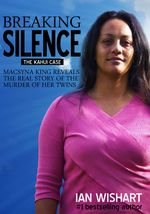
    Macsyna King Breaking Silence: The Kahui CaseMacsyna is coming out of the closet via a book, Breaking Silence: The Kahui Case, written by Ian Wishart.  The mob has called for the book to be banned, via boycott, successfully pressuring booksellers not to carry it.  She was the mother of murdered (or manslaughtered) infant twins, Chris and Cru Kahui.  The court acquitted her then current boyfriend (and father of the twins) of responsibility for their deaths.  No-one else has been charged.  The defence argued that Macsyna herself was their killer.

    If the court evidence is to be believed, King has been both wretched and depraved.

    Asked by Crown lawyer Richard Marchant who was the dominant person in the relationship, Ms King replied “I thought I was”. “I would yell the loudest, I would swear at him (“husband”, Chris) and I just wouldn’t stop till I got my way,” she said. “I’ve kicked him in the shin, I’ve slapped his face before.” Kahui, eight years her junior, was a quiet, softly spoken person who would bottle things up. . . .

    Ms King told the court she had three children to two different fathers prior to meeting Kahui in 2004. All three children were now cared for by their respective fathers and she did not have contact with them. She started living with Kahui shortly after meeting him and quickly fell pregnant, giving birth to a boy, Shayne, in 2005. In September that year, she split with Kahui for several months and went to live with her sister Emily. During that time she got into a relationship with another man but then returned to Kahui. She fell pregnant with the twins soon after her return. . . .

    During her conversation with Ms Ingham, Ms King said she sometimes hit Kahui – but not around the head or face – and occasionally smacked their one-year-old son Shayne with an open hand. She also said she was attending an anger management course. She also said she like to go out with her friends and get drunk but would get the babies “out of her hair” first. . . .

    But, why pick on her? Why the loathing and disgust?  She is hardly atypical.  In fact she accurately and fairly represents the NZ underclass–which is large and growing.  She is a poster girl for the intergenerational welfare dependant.  Maybe that’s why the populist mob is so energized.  It is deeply offended that thousands of people like King, not only exist, not only are the products of New Zealand society, but are funded and paid for by state welfare payments which become more generous according to the number of children one produces.  Their depravity is paid for by the ever generous state.

    Maybe this cuts so bone deep that the mob is having an “I don’t want to know” moment of denial. Disembowelling the messenger is its defensive visceral reaction.

    For our part, the more folk like King get their story out there, the better.  We rely upon Wishart to get the text as close to the truth as possible–but he is rather experienced at it. We would argue for the stories of a hundred of King’s underclass colleagues to be told.

    Most people in New Zealand ardently support state welfare.  We are bored to death by repeated assertions from the Commentariate that the Macsyna King’s of this world simply do not exist.  They are only imaginary febrile figments on the part of beneficiary bashers.  State welfare helps (more…)

  • The Separation of Church and Self: Rethinking Separationism

    Is it just for a pluralistic society to ground its public policy on religious premises? What role should religion play in such a society? Debate over questions like these has figured in theology, philosophy, political science, jurisprudence and popular culture for centuries. In contemporary Western pluralistic society the debate continues. Even for those unfamiliar with its nuances at the higher levels the effect of the standard view, as described by Stephen Carter, is immediately familiar:

    “One good way to end a conversation – or start an argument – is to tell a group of well educated professionals that you hold a political position (preferably a controversial one such as being against abortion or pornography) because it is required by your understanding of God’s will. In the unlikely event that anyone hangs around to talk with you about it, chances are that you will be challenged on the ground that you are intent on imposing your religious beliefs on other people. And in contemporary political and legal culture, nothing is worse.”[1]

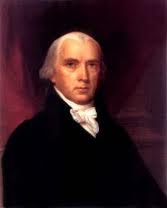
    James Madison

    Carter is referring to the separationist understanding of religion and public life, the idea that in a contemporary pluralistic society significant restraint must be put on the political role of religious reasons. This restraint is negative; when a functionary deliberates over a proposed policy it is not justified for that functionary to decide to support or oppose that policy on grounds derived from religion. A corollary of this is that citizens should not try to influence public policy by appealing to religious reasons. Separationists argue that the public policy of a pluralistic society must be able to be justified by a plausible secular justification in order for it to be just to all. Religious beliefs, while utilised and followed in private, should be kept separate from public policy debates, the administration of public institutions and the deliberation of public functionaries. (more…)

  • Should we Have Faith in the System? The Judge, the Bully & the Bus-Driver

    Sometimes judges get things right, really right, check this from the Herald:

    Judge Turns Tables on Driver’s Schoolboy Accuser

    A schoolbus driver was taken to court for grabbing the arm of a rowdy boy who would not stop pulling a girl’s hair.

    But the judge threw out the charge – and had a policeman take the 12-year-old boy to the police cells as a warning.

    Jim McCorkindale, 70, of Gore in Southland, told the Weekend Herald that while dropping off children last July, he saw two boys pulling the hair of a girl and got out of his driver’s seat to try to stop it.

    “I went over and touched the boy on the arm to attract his attention, and that was the assault.”

    When the boy did not respond to being told to stop, “I threatened to hit him in the ribs, and he flinched and let the kid’s hair go to protect his ribs”, Mr McCorkindale said.

    “But I never touched him again.”

    The boy had continued misbehaving after Mr McCorkindale returned to his seat.

    Children on the bus called the police and he found officers waiting to talk to him when he finished his run.

    When police rejected the option of diversion, Mr McCorkindale received a court summons.

    But in the Gore District Court, Judge Kevin Phillips threw out the charge.

    Instead, he told the boy he should be “thoroughly ashamed” of himself and had a policeman take him to the cells, the Southland Times reported.

    Mr McCorkindale said he found it disgusting that he was charged in the first place.

    “You can’t do a bloody thing,” he said. “It’s better to hop out of the bus and leave them to it. See nothing.

    “The days of sit down, shut up, do as you are told, are gone. When I was going to school, you did what you were told. Now, you sometimes do as you’re asked – if it suits you.”

    More…

    There should be more judges like Kevin Phillip J. Parents and those in charge of children have been castrated by the law and look at the results, little snots like this boy are rampant within our society. No I am not just talking about smacking (I do not believe in loco parentis corporal punishment in any regard and this is a 12 year old in this case) I have in my sights the laws that enable this behaviour and the practice of state authorities telling young people that they can do what they want, that they do not have to do what the adults taking care of them say, the laws that give those young people too much freedom before they are ready for it.

    But speaking of smacking, anyone feeling confident in this exhibit of the police discretion that we’re all supposed to have faith in, in choosing to push this prosecution attempt and oppose diversion?