Category: Atheists

  • Divine Commands and Psychopathic Tendencies

    Sam HarrisThere has been some interesting debate in the blogosphere over Sam Harris’ contention that a divine command theory of ethics manifests “a psychopathic and psychotic moral attitude.”

    Randal Rauser responded to Harris’ contention noting that “if you read through the twenty traits on the Psychopath Checklist you’ll find qualities like callousness, shallow effect, grandiose sense of self-worth, and lack of empathy. But you won’t find adherence to a divine command theory of meta-ethics among them.” Christopher Hallquist rejoins:

    “I almost have a hard time believing Randal is serious here.  When he talks about “adherence to a divine command theory of meta-ethics,” what he means is believing that blowing up a bus full of children is right if that’s what God told you to do. That may not be explicitly listed in the Psychopath Checklist, but neither are things like actually blowing up a bus full of children. And being willing to approve of such an act just because you think God approves certainly sounds like something that would require a shocking degree of callousness and lack of empathy.”

    I plan to address Harris’ original charge in a future post. Here I will limit my comments to Hallquist’s defence of it.  Hallquist suggests that a divine command theory (DCT) is psychopathic for two reasons. First, a DCT entails the following conditional: If God commands you to blow up a bus full of children then you are required to blow up a bus full of children.  Second, accepting the truth of this conditional requires a “shocking degree of callousness and lack of empathy” possessing such callousness and lack of empathy is, a of course, a psychopathic trait.

    Hallquist has considerable confidence in these arguments. So much so he finds it hard to believe Randal’s denial of his conclusion is serious. Note also the rhetorical tactics he uses. The picture of people up blowing up buses full of children brings immediately to pictures of terrorism, sometimes terrorist activities are done for religious motivations, and since 9/11 there has been considerable fear and angst about terrorist acts of this sort. Hence, Hallquist taps deep into people’s fears. Moreover, a long meta-narrative going back to the enlightenment contends religion causes wars, is the source of violence and so on, whether that narrative is historically accurate or not is a matter of considerable dispute. However, prejudices of this sort are widely believed and raw in a post 9/11 environment. The fact a position resonates with people’s fears, emotions and prejudices, however, does not excuse us from asking whether it is true or rationally defensible. In this case I think a little reflection shows it is not. Hallquist’s argument is unsound and, in fact, incoherent. Hallquist’s bravado is therefore strongly misplaced.

    Let us turn to Hallquist’s first premise. A DCT entails the conditional: If God commands you to blow up a bus full of children then you are required to blow up a bus full of children. This conditional is indeed an implication of divine command theories.  Undoubtedly that sounds shocking at first but note two important points which Hallquist skims over:

    First, this is a conditional or hypothetical statement; it states that if God commanded blowing up buses then blowing up buses would be morally obligatory. Nothing about this conditional entails that God actually ever does, or even could, command such a thing, nor does it entail one is ever rationally justified in believing that he does. It simply states that if this situation occurred then the action would be permissible.  It’s a well-known point in logic that a person can affirm that one thing would be true if a certain situation occurred without being committed to claiming it ever occurs. It would be true for example that if I had never been born then I would not be writing this post right now, that does not mean I believe I was never born.

    Second, DCT entails that blowing up buses is morally obligatory only (more…)

  • Contra Mundum: Dawkins and Secular Hypocrisy

    Richard DawkinsWhen I was a non-Christian I was forever hearing about how Christians are hypocrites. When I converted to Christianity at 17, one thing that struck me is how often these charges were often a case of the pot calling the kettle black. While there is undoubtedly some hypocrisy within the church, it is also pervasive outside it. Secular culture often contains absurd ironies and hypocrisy which are conveniently ignored.

    A great example was the media fiasco over William Lane Craig’s visit to the United Kingdom last year. Craig is distinguished philosopher known professionally for his work in philosophy of time and philosophy of religion. Alongside his scholarly work, he has also developed a reputation as a prolific public speaker and debater, debating many of the world’s leading sceptics. His combination of scholarly ability and effective debating skills has earned him a reputation as one of the world’s foremost Christian apologists.

    “Apparently, having two PhD’s, authoring over 100 papers, and writing 30 books on a topic makes you unqualified to speak on it, but being the star of the 80’s TV series “Growing Pains” does.”

    Craig’s visit to the UK attracted media attention when Richard Dawkins, author of the best selling “God Delusion”, publically and resolutely refused to debate him. Dawkins publically stated earlier of his critics that “he did not care” who they were, he would “dialogue” with them and “win the argument”. He also had publically debated numerous critics significantly less qualified than Craig, notably Ted Haggard. These facts, alongside Dawkins implausible and inconsistent reasons lead to accusations of cowardice and hypocrisy from other academics such as Daniel Came a philosophy professor at St Hugh’s College Oxford.

    In the UK newspaper the Guardian Dawkin’s gave two reasons for his refusal. According to Dawkins, Craig “parades himself as a philosopher, but none of the professors of philosophy whom I consulted had heard his name”. Dawkins omitted to mention that this was not the first time he had publicly denigrated Craig’s scholarly credentials. On a previous occasion  Daniel Came,  had e-mailed him stating:

    “Professor Craig has a PhD in philosophy and a PhD in theology. He is Research Professor in Philosophy at Talbot University. He has published more than thirty books and over a hundred papers in reputable peer-reviewed journal. Given your passionate and unconditional commitment to truth, I can only think that you were not aware of Professor Craig’s credentials when you made the above reference.”

    So Dawkins claim that no philosopher he had consulted had ever heard of Craig was less than honest. A less charitable person might describe this as simply slander.

    Dawkins concern about Craig’s alleged lack of scholarly credentials also seems odd seeing that he (Dawkins) had earlier accepted an invitation to debate actor Kirk Cameron.  Apparently, having two PhD’s, authoring over 100 papers, and writing 30 books on a topic makes you unqualified to speak on it but being the star of the 80’s TV series “Growing Pains” does qualify you. It’s also ironic that Dawkins would accuse Craig of lacking scholarly credentials on the matter given that he (Dawkins) is a biologist and not a philosopher of religion.

    Dawkins next excuse was that Craig is “morally unfit” to debate him.  To substantiate this he cites not from any of Craig’s scholarly writings. But two blog posts Craig had written on with the conquest of Canaan. At face value  the early chapters of the book of Joshua portrays God as commanding the killing of every man women and child in Canaan. I say “appears”, here because latter sections of the book of Joshua and its sequel in judges proceed on the assumption this never occurred, and studies into ancient conquest accounts of this genre have noted the widespread use of literary hyperbole whereby victories are described in sweeping rhetoric of killing absolutely everyone when in reality they were (more…)

  • Jerry Coyne on God and Morality Revisited

    Late last year I, wrote a criticism of Jerry Coyne’s piece in USA today. Entitled, As  atheists know, you can be good without God.  My critique attracted some attention. Getting commentary from Mary Ann Spikes, Jason Thibodeau,  Jeffery Lay Lowder, and Brian Zamulinski.  Since the USA today article Coyne has written a follow up article where he purports to address the kinds of criticisms I made in this post. This article is entitled Maybe my Philosophy isn’t so Unsophisticated After All.  However, far from exonerating his poor reasoning, Coyne’s response simply further demonstrates my point.

    In this article Coyne focuses almost exclusively on criticisms I and others have made to his use of the arbitrariness objection. This is significant, for this criticism was just one of several criticisms of Coyne’s article that I raised .  Consequently, even if Coyne’s rejoinder is sound it addresses only one of my objections.  The rest remain untouched.

    As it is, his response is poor.  He begins by noting the response to the arbitrariness objection proposed by William Lane Craig. According to Coyne, Craig’s response is “whatever God orders is good and morally obligatory simply by virtue of the fact that He is God.” He cites this as a quotation but fails to provide a source. His response to this is to refer to alleged atrocities taught in the Old Testament and claim Craig’s response is “too stupid to address”

    Three things are evident, First, this is not Craig’s response to the arbitrariness objection; in his book Philosophical Foundations of  a Christian Worldview, Craig argues that Our moral duties are constituted by the commands of a just and loving God” (emphasis original)   and that

     this fact also supplies the key to the arbitrariness objection.  For our duties are determined by the commands, not merely of a supreme potentate, but of a just and loving God.  God is essentially compassionate, fair, kind, impartial, and so forth, and His commandments are reflections of His own character.  Thus, they are not arbitrary, and we need not trouble ourselves about counterfactuals with impossible antecedents like “If God were to command child abuse . . . .[1]

    So, Craig, in fact, maintains it’s impossible for God to command actions which are cruel, unjust and so on.   He does not, claim such actions can become good merely by God commanding them and Coyne appears to insinuate.

    Second, I actually addressed the Old Testament atrocity argument in my original article . However, Coyne simply repeats his argument.

    Third, calling someone “stupid” is not a rational rebuttal of their position; it commits a fallacy that logicians call the ad hominem fallacy, where one attacks the arguer instead of rebutting his argument. The distinction between attacking a person and refuting their argument is an elementary one in logic; it’s hard to believe Coyne is unaware of it.

    If Coyne thinks misrepresenting people, insulting them and then repeating an argument which has been addressed counts as competent philosophical or theological analysis he is gravely mistaken.

    After setting this tone, Coyne turns specifically to my criticisms. After suggesting that responding to on MandM is “a mugs game” he directs the reader to an article by Jason Thibodeau who Coyne calls a “real” philosopher” and cites two paragraphs which he claims “decisively” refute me.

    Now it doesn’t need saying that simply finding an article that agrees with you and maintaining the author of that article is a “real scholar” is not really a response to anything. Neither is simply asserting that someone has offered a refutation itself a refutation.

    But what’s interesting is Coyne’s selective citation. After noting my point, that a loving and just person would not command the kinds of actions he mentions, Thibodeau states

    There are a few problems with this response. The most important (and the one that I think that Coyne had in mind) is that if we are to understand the reply to mean that a moral God would not issue immoral commands… the response implies that there is a standard of morality that is independent of God against which he and his commands can be judged. But if morality is independent of God, then the DCT [divine command theory] is false.

    Coyne suggests this response “shows pretty definitively that” my argument fails and it “sets the record straight” for all thinking Christian’s

    In fact this response is mistaken. The fact that a loving and just being does not command certain actions does not entail that there is a moral standard independent of that being requiring them to not command those things. This is because it is possible for a person to be loving and just with being obligated to be loving and just. Suppose, for the sake of argument, morality was an illusion and in reality no one really was required to love their children.  Would it follow that all parents would cease to love them, or that they could not exercise love?  Not at all, I can be loving without being under an obligation to be loving. So this objection fails.

    Interestingly however, Thibodeau actually points this out in the very next line of the article which Coyne snips from his quotation. Thibodeau writes:

    In any event, as Flannagan indicated, the debate does not end here because the divine command theorist may concede the point but still insist that all he needs is that God is all-loving, and he will get the same consequence (or at least one that is close enough); namely that God will not issue commands that require us to cause horrible pain and suffering (or do anything that we all agree would be horrendous). If developed in the appropriate direction, this reply can lead to a fully developed response to the arbitrariness objection.

    So, the “real philosopher” Coyne cites actually says this argument is unsuccessful, for reasons I had already indicated in my criticisms.  Coyne’s response therefore appears to be as follows (a) find an article that agrees with his conclusions (b) assert the author (apparently unlike me) is a real philosopher (c)  quote an argument  the author actually says fails to address my point (d) Snip the context so your readers don’t know this (e) assert boldly that his comment refutes me.  Far from showing that my criticisms of Coyne are mistaken these kinds of tactics suggest I was on the mark.  Of course readers of Coyne’s work online or in USA today won’t have the original articles Coyne cites from and so will take his assertions on faith. This is effective propaganda but little else.

    After these dubious manoeuvres, Coyne then asserts that the rest of Thibodeau’s article makes devastating points against me but does not cite or summarise these arguments.

    In fact Thibodeau’s makes two arguments both of which fail.

    Thibodeau’s, first argument appeals to God’s omnipotence, which he defines as the ability to do whatever is logically possible.  If omnipotence is defined this way, then God could command the torture of children.

    Now whether omnipotence should be defined in this way is in fact a matter of dispute. However, suppose we grant Thibodeau’s definition; the argument still fails. Adams’ position is that that moral obligations are constituted by the commands of a loving and just God.  Even if God, being omnipotent could command the torture of children, he could not do so and continue to be loving and just. This is because it’s not logically possible for a loving and just being to command things like this. So this argument does nothing to show that a loving and just God could command torturing children and hence does not refute Adams’ position.

    Thibodeau’s second argument is similarly mistaken. Thibodeau argues that it’s possible that there exists an all-powerful creator that enjoys watching sentient beings suffer, he labels this being Azura. He then notes that Azura could command the torture of children.

    Now assuming that it is possible that Azura exists (which I doubt), this argument is beside the point. The fact that an evil being who is all powerful could command the torture of children, does not entail that a loving and just God could. So Adam’s contention that moral obligations are best accounted for by the commands of a loving and just God remains un-refuted.

    Both arguments fail because they misconstrue the position that Adams and those who follow him defend. These people contend that the nature of moral obligations is best explained by the commands of a loving and just God. Pointing out that they are not explained by a God who lacks these attributes does not address this contention. It ignores it.

    Interestingly,  in  some commentary on Coyne’s exchange with myself arguments philosopher and ethicist  Brian Zamulinski notes that he had pointed this out to Coyne months before he wrote the USA today article. Zamulinski  writes

    Robert Merrihew Adams contended that morality is constituted by the commands of an essentially loving God.  The Euthyphro dilemma collapses because an essentially loving God could not command just anything.  In his USA Today article, Coyne rehearses the Euthyphro dilemma but does not mention the Adams reformulation.  This is odd.  I had an e-mail correspondence with Coyne some months earlier in which I pointed out the Adams reformulation.  Coyne should have taken time to rebut the reformulation.  He did not.

    Coyne’s final riposte is to ask a question, how do you know a loving God exists? And this whole issue is “moot unless you can show that there’s a God to issue moral commands”. This however is to reason in a circle, in his USA today article Coyne was criticising the argument that morality was “strong evidence for [God’s] existence.” People like Adams argue it is because the best account of the nature of moral obligations is that moral obligations are commands issued by a loving and just God.  To contend Adams is wrong because no one has offered an argument for a loving God’s existence is to assume the very issue under dispute. One could just as easily argue Coyne’s argument is flawed on the grounds that his arguments are flawed.

    Nothing in Coyne’s follow up leads me to revisit my initial conclusion. Misrepresenting people’s views, calling people names, quoting from articles out of context, denigrating others’ scholarly qualifications and confidently asserting a position whilst reasoning in a circle, and ignoring objections, are not the same as actually addressing them.  I doubt such sophistry would pass muster in the scientific community when people write on scientific topics, and it does not pass muster when scientists comment on theology or philosophy.

    [1]William Lane Craig and J P Moreland Philosophical Foundations of a Christian WorldView (Downers Grove Il:Intervarsity Press academic), 531,

  • Contra Mundum: When Scientists Make Bad Ethicists

    One thing I find particularly frustrating is reading commentary on theology and philosophy written by scientists. To be fair, some scientists I have read are informed and do offer astute and insightful comments; commonly, however, one finds a person who is undoubtedly brilliant in their own field, writing with confident gusto, articles that fail to understand the most basic theological and philosophical distinctions.

    Jerry CoyneA good example can be seen in a recent USA Today article by influential biologist Jerry Coyne entitled, As atheists know, you can be good without God. Coyne, an outspoken atheist, is disturbed that many Americans, including some prominent scientists, believe that our instinctive sense of right and wrong is “strong evidence for [God’s] existence.” He ventures into moral philosophy to explain why this is clearly mistaken.

    From the get-go Coyne demonstrates he does not understand the issues.

    It is necessary to accurately understand the position Coyne is criticising before we look at the paucity of his critique. The argument that our instinctive sense of right and wrong “is strong evidence for [God’s] existence” found its most important formulation in a 1979 article by Yale Philosopher Robert Adams. In it, Adams noted that we instinctively grasp that certain actions, like torturing children for fun, are wrong; hence, he reasoned, we are intuitively aware of the existence of moral obligations. According to Adams, the best account of the nature of such obligations is that they are commands issued by a loving and just God. Identifying obligations with God’s commands can explain all the features of moral obligation better than any secular alternative. Consequently, the existence of moral obligations provides evidence for God’s existence.

    It is important to note what Adams did not claim. Central to Adams’ argument, and to pretty much every author who follows him, is a vital distinction; this is the distinction between the claim that moral obligations are, in fact, divine commands and the claim that one cannot recognise what our moral obligations are unless one believes in divine commands or some form of divine revelation. Adams illustrates this distinction with the example of H20 and water.

    Contemporary chemistry tells us that the best account of the nature of water is that water is, in fact, H20 molecules. This, of course, means that water cannot exist unless H20 does. However, it does not mean that people who do not know about or believe in the existence of H20 cannot recognise water when they see it. For centuries people recognised, swam in, sailed on and drank water before they knew anything about modern chemistry.

    This distinction has important implications. The claim that moral obligations are, in fact, commands issued by God does not entail that people must believe that God exists and has issued commands in order to be able to recognise right and wrong. These are separate and logically distinct claims.

    Coyne conflates this distinction from the outset. After noting that some people believe that moral obligations provide strong evidence for God’s existence, he claims that this is an oft-heard argument, “‘Evolution,’ many argue, ‘could never have given us feelings of kindness, altruism and morality…’;” to this he rejoins that, “scientists studying our primate relatives, such as chimpanzees, see evolutionary rudiments of morality: behaviours that look for all the world like altruism, sympathy, moral disapproval, sharing — even notions of fairness.”

    This is confused. Apart from the fact that no one who cites morality as evidence for God actually makes the argument about evolution that Coyne sets out, the claim that moral obligations cannot exist independently of God is not the claim that without God people would not have moral feelings. Feeling that one has an obligation to do something and actually having an obligation to do it are clearly different things. People can feel that they have a certain obligation without it actually being the case that they do.

    Coyne makes a similar mistake when he argues that secular European countries like Sweden and Denmark “are full of well-behaved and well-meaning citizens, not criminals and sociopaths running amok.” This  (more…)

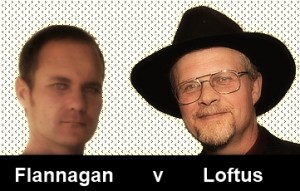
  • Want to see Matthew Flannagan debate John W. Loftus in America?

    Dr Matthew Flannagan v John W LoftusAs you all know, Matt and I are going to the US to speak at 4 conferences in November. John W. Loftus is aware of this and in a comment on this blog has suggested a debate between himself and Matt during the 3 days we have spare between conferences – ideally for us 14 Nov. We have had some email discussion with him about this including agreeing that the topic for debate will be something around Loftus’ Outsider Test for Faith, maybe, “Is Christianity True?” or something like that.

    A couple of groups within the Christian Apologetics Alliance have indicated keeness to see it happen, we have even had small pledges of money towards helping it happen, but so far no one has been able to say “yes, we will organise it” and we need that to happen asap or we are just going to run out of time. So, can you organise it can you offer support towards anyone organising it? Do you want to see it happen? (If it happens it will be videoed)

  • Skepticule Extra – A Podcast on the Euthyphro Dilemma Feat. Matthew Flannagan

    Recently Matt did a podcast on Divine Command Theory and the Euthyphro Dilemma for Skepticule Extra,  aka the “Pauls to the Power of Three Podcast” hosted by Paul Baird, Paul Thompson (“Sinbad”)  and Paul S. Jenkins.

    Click to Listen to Matthew Flannagan on Divine Command Theory and the Euthyphro DilemmaYou can listen to that podcast here.

    Visit Skepticule for more listening options.

  • Divine Commands Post 9/11

    The night of September 11, 2001, was a night we did not get much sleep in. By 4am September 12 (New Zealand time) our two-week old son and 14 month old daughter had woken us twice already. Frustratingly, I awoke again sometime after 4am to a different noise coming from the lounge; it turned out that our eldest son, then aged 6, was up watching television. I stumbled into the room and told him to go back to bed. As I got back into bed I told Madeleine “It’s OK hon, it was just Christian watching some movie about New York” (I’d seen the Twin Towers on the screen as I switched the TV off). Less than an hour later our sleep was interrupted again, this time by the telephone. Madeleine, awoken for the 4th time that night, angrily moaned “who the hell is ringing at this time? Don’t they know we have a newborn?” It was my Dad.

    “Matt” he told me tersely “I am just ringing to say I am alright. I got grounded at Heathrow airport and did not fly into the US as I had intended to this morning and so was not caught up in the drama that’s unfolded.”

    “What drama?” I said bewilderedly “why wouldn’t you be ok?”

    “Haven’t you heard?” he responded “planes have been high-jacked; there has been a terrorist attack in America – the World Trade Centre has been hit, as has the Pentagon”.

    I suddenly was wide awake.

    9/11 World Trade Centre Terrorist AttackOne particularly poignant fact about the events of 9/11 is that the terrorists who carried out the attacks justified their actions by claiming God commanded them to do so. That fact has lead many contemporary commentators to argue that a divine command theory of ethics is indefensible. September 11 is just the most recent example in a series of incidents throughout history such as the Crusades, Inquisition and wars of religion. Divine command ethics is discredited by the fact that people appeal to such commands to justify terrorism.

    At first glance this objection is hard to take seriously; the premise is that some people have appealed to divine commands to commit atrocities. The conclusion is that any appeal to divine commands in ethics should be rejected.  This conclusion does not follow. To be valid the objector must assume a tacit premise: if people appeal to certain reasons to justify atrocities, then appeals to those reasons are always problematic. This premise is false.

    An analogous line of reasoning applies to appeals to right and wrong per se. Take any historical atrocity that people have attempted to justify; in almost every case the justifier will have argued that the action in question was the right action to do, the justifier invariably appeals to the purported rightness of their action. If the tacit premise is true then appeals to right and wrong are always problematic.

    Other examples illustrate the same point. The “reign of terror” during the French Revolution was justified by appeals to liberty, equality, fraternity and the rights of humankind; one victim of the guillotine famously remarked, “Oh, liberty, what crimes are committed in your name?” Millions have been slaughtered by appeals to the greater good of society or the liberation of the oppressed classes and it is well known that people have defended wars on the basis of justice and social peace. Should we therefore avoid liberty, equality, opposing oppression, seeking justice, social peace and so on? Obviously not.

    The fact that people have attempted to offer justifications for atrocities by appealing to some reason does not entail that any or all appeals to such reasons are problematic. This is a fairly innocuous claim. Take any premise you like – secular or theological – it is true that a person could appeal to this premise in an attempt to justify something but this fact does not mean the premise is problematic. For the appeals to atrocities argument to have bite one needs to show more than just that someone has tried to justify an abhorrent action by appealing to God’s commands; one would have to show that they did so successfully, that God actually commands such practises.

    The claim that God commands atrocities appears to be indefensible. We need to remember that we are not talking about the commands of just anyone; we are talking about God, who is typically defined as a being who is omnipotent, omniscient, and morally perfect. So, as the terms are defined, the claim that it is possible for God to command people to torture others for fun is true only if it is possible for a morally perfect person to command an atrocious thing. But this is not possible. The very reason that critics cite atrocities in their arguments against God is because they regard these actions as paradigms of conduct that no morally good person could ever (more…)