Category: Social Commentary

  • ACT Party Launch: Why on a Sunday Morning?

    Given we are exploring our short list of political party’s at the moment attending the ACT Party Official Launch is something we are interested in doing.

    However the details below make the decision to attend difficult, from ACT’s website:

    The official launch of the ACT Party campaign for the 2008 election will held be at the 1st level, Alexandra Park Complex in Greenlane 11 am on Sunday 12 October.Hear ACT leader Rodney Hide and the ACT Candidates explain ACT’s policies.

    When 11 am Sunday 12 October
    Where: 1st level Alexandra Park Complex
    Contact: Margaret 09 912 8633

    Note the time and day of the week? One cynically wonders if ACT are trying to deliberately send Christian supporters a message; to attend one needs to choose between attending church and attending the launch. It probably just didn’t occur to them.

    Maybe we can make both if we take off straight after the service.

  • Voting, the Role of the State and Similarities Between libertarianism and Christianity

    Someone emailed us a while ago asking what the difference was between Matt’s classical liberalism and my libertarianism, where did we part company and why did we define ourselves this way. We never answered because we have never really tried to pin it down before, we knew there we differed on some things and we knew that those difference put us in these particular camps but putting it into words was something we didn’t get to until now.

    We definitely differ; see our respective scores on The World’s Smallest Political Quiz, mouseover to see whose is who’s.

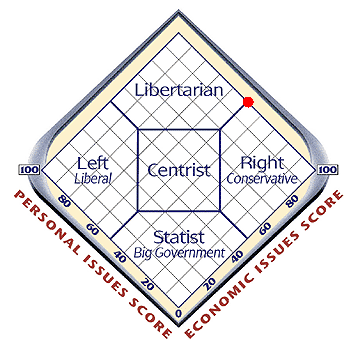
    Madeleine

    Matt

    So I am clearly in the libertarian camp (I am not in the Libertarian camp as in capital L or “Objectivist” (Randian)). Does that mean I can be both Christian and libertarian? Well not if my approach to the role of the state is to simply hold the single absolute principle “that nobody should initiate force against another.” However, yes if the outworking of what I do hold puts me closest to the libertarian perspective than any other position.

    I find the non-initiation of force principle to have no basis in divine or natural law. However, something close to is definitely there and I believe that it is the closest secular position to the correct application of Christianity to the role of state for the following reasons.

    Scripture teaches that it is wrong to kill an innocent human being. This prohibition on killing can plausibly be extended to a prohibition against violence and force in general. This is the heart of traditional Christian positions on war, abortion, euthanasia, capital punishment, etc. The idea is that the state can use retributive force against guilty people but it can never threaten the life, liberty and property of an innocent person unless they engage in unjustified aggression against another. In both situations there are important limits further still, for example, retributive force can only be used by a lawful authority after a impartial trial has found the person guilty the force must be proportionate to the offence and cruel and degrading punishments are illicit. Similarly, with defensive force. It can be used only when it is necessary to stop the aggression and again the force used must be proportionate to the perceived threat.

    A government that limited its use of force to these functions and only taxed its citizens to ensure that these functions were carried out would be severely limited and would look like no current government anywhere, yet this is the Biblical picture and you can see that it does look a lot like the libertarian non-initiation of force principle (and nothing like the strawman-caricature that Rand paints in her books).

    The key passage on the role of the state is Romans 13:1-7:

    Everyone must submit himself to the governing authorities, for there is no authority except that which God has established. The authorities that exist have been stablished by God. Consequently, he who rebels against the authority is rebelling against what God has instituted, and those who do so will bring judgment on themselves. For rulers hold no terror for those who do right, but for those who do wrong. Do you want to be free from fear of the one in authority? Then do what is right and he will commend you. For he is God’s servant to do you good. But if you do wrong, be afraid, for he does not bear the sword for nothing. He is God’s servant, an agent of wrath to bring punishment on the wrongdoer. Therefore, it is necessary to submit to the authorities, not only because of possible punishment but also because of conscience. This is also why you pay taxes, for the authorities are God’s servants, who give their full time to governing. Give everyone what you owe him: If you owe taxes, pay taxes; if revenue, then revenue; if respect, then respect; if honor, then honor.

    This passage spells out the reasons why we are required to obey the government and why we are required to pay taxes. Paul states that governments act as God’s agent, that is on his behalf, to perform a specific function, namely, to punish wrong-doing. Paul emphatically states that the state does not bear the sword, have the power to use force, for nothing but to act as an agent of retributive punishment. It is because it is an agent of God in carrying out this function that it can legitimately demand obedience and financial support. Nothing in this passage provides any basis for claiming that a government that did other things apart from these basic functions and used force to back it up would be acting as God’s agent (in fact the opposite is suggested in 1 Samuel 8:10-22 – any government that taxes its people more than 10% and undertakes functions outside its legitimate mandate is corrupt). If a government steps outside this mandate then it is acting unjustly. The passage states that the government is God’s servant, it is under God and therefore subject to the same laws as its people. In Revelation, written in the latter part as opposed to the earlier part of Nero’s reign, the same ruler is no longer described at God’s servant but as Satan incarnate because he sought to be God, he stepped outside the mandate of legitimate government.

    In summation, if you are a Christian you should either be a libertarian or a classical liberal. You might end up as a conservative if you throw some pragmatism in but if you end up as a centrist or left wing you have failed to understand Scripture, you are placing government in the role of God.

    One of the biggest problems New Zealand faces is the same the world over and was the same at the time of Samuel; the people want a government in the place of God, they want the government to provide welfare, health, education, families commissions, art, television (well maybe not that one at the time of Samuel but you get the picture). It feels and seems easier if we don’t have to take our responsibility to love our neighbour personally.

    Biblically speaking, the state’s role essentially boils down to law, order, justice and defence. Do we then get to forget about all the rest? No.

    “Teacher, which is the greatest commandment in the Law?” Jesus replied: ” ‘Love the Lord your God with all your heart and with all your soul and with all your mind.’ This is the first and greatest commandment. And the second is like it: ‘Love your neighbor as yourself.’ All the Law and the Prophets hang on these two commandments.”

    This means that looking out for others is our responsibility but, contrary to the picture Rand paints, this is strictly qualified. We do not have an obligation to give to everyone who has their hand out. If their own choices and refusal to help themselves has led them to the dire situation they find themselves in then unless they are prepared to get off their buts and help themselves and learn from their mistakes we owe them no charity. If people refuse to help themselves then we are justified in not helping them. The scriptures are full of examples, if people refuse to work then they don’t get to eat (2 Thess 3:10), you left the corners of your crops un-gathered so the poor could come and work and feed themselves – you did not hand them the fruit of your day’s labour while they sunned themselves all day, they had to work for it (Deut 24:19-22), families had to take responsibility for their own, the needy only receive private assistance if they could not work and had no family who would provide for them and were not idle people (1 Tim 5), etc.

    Given this, I have less than a month to decide who I will vote for. The choices below (in the order they appear on the Decision 08 website) are not great because none of them fit the criteria above.

    Resident’s Action Movement
    The Bill and Ben Party
    ACT
    Alliance
    Aotearoa Legalise Cannabis
    Party
    Democrats for Social Credit
    Direct Democracy Party
    Green
    Labour
    Libertarianz
    Maori Party
    National
    New World Order
    New Zealand Pacific Party
    NZ First
    Progressive
    The Family Party
    The Kiwi Party
    The Republic of New Zealand
    Party
    United Future

    Matt and I want to be really careful to not endorse a political party so we are still debating each other as to whether we will publicly state who we vote for but we agree we can take this next step, the first cull, namely getting rid of the no-way, no-how parties and assessing the pro’s and con’s of the remaining possibilities. Our intention is to more thoroughly look at and read up on these parties, their philosophy, their people and their policies. The revised list, and this goes for both of us (at this stage, last election we each voted differently), is this (again the order is the order as above):

    ACT
    Libertarianz
    Maori Party
    National
    New Zealand Pacific Party
    The Family Party
    The Kiwi Party

    Libertarianz and ACT would be the closest to my political position but the points I part ways with them are fairly major. Both parties philosophically adhere to the non-initiation of force but both throw their well reasoned, consistent thinking out the window on the topic of abortion (and a few other issues).

    Rodney Hide spoke at the recent Forum on the Family outlining clear and sensible policies all sharply reasoned, setting aside emotion, appealing to doing what is right, promoting a consistent
    theme of personal responsibility as opposed to state dependency and then when asked for his position on abortion outlined a mushy, soft and sentimental pile of rubbish. Gone was his consistent personal responsibility – non-initiation of force reasoning, suddenly his reasoning skills dropped to that of Sue Bradford’s as he spoke of it being a conscience issue (it is not – abortion is either killing, therefore the initiation of force, 100% homicide or it is not killing and is on par with tonsillectomy’s and there is zero problem with it). Rodney, citing his emotions, said he didn’t want to impose his beliefs onto women (but apparently he can when it is restricting women from, say, theft). [Here are some secular reasons on why libertarians should be pro-life]

    Rodney, ACT and the Libz on this subject are inconsistent. I am not. I have a problem with voting for a party that 1. endorses or is agnostic on homicide (and has no reasoned position that can withstand defeaters justifying their stance) and 2. that is that inconsistent.

    Further, the Libz and to a lesser degree ACT, are riddled with pathological secularists who have a closed, caricatured view of Christianity – extremely closed minded which makes supporting them difficult as many within their ranks refuse to see the similarities and work together. Also the Libz are prone to massive in-house fighting amongst the factions which seriously kneecaps them at times.

    The Maori Party make our list because they get it right on a number of issues, less often than ACT and the Libz, but best demonstrated by their policy on the seabed and foreshore where they are a seemingly lone voice speaking against the Labour government’s worst attack on the right to due process in recent times otherwise known as the Foreshore and Seabed Act 2004 (all Christians should be horrified at the passage of this law). Further we respect Tariana’s daring to cross to Helengrad and the fact that they are, by and large, a party that stands on principles not on popularism and even though many of their principles are too left/statist you have to respect that and you definitely want more politicians like that in parliament.

    National. National is not Labour. If their policies reflected their stated principles I might say more.

    The Christian Parties. First of all, so what if there are three of them? How many secular parties are there? Christians need to get over this. How many denominations of Christianity are there? Demanding that the three merge before you will support them is as ridiculous as refusing to attend church unless every denomination merges. We still somehow manage to be one body despite our differences. As with denomination and church choice, if you want to go there, look at the options and pick the one that best reflects which is right.

    • NZ Pacific. Putting aside the accusations against Taito, remember due process, Taito was part of Labour which makes him left/statist. However, like Tariana he earns brownie points for sticking it to Helengrad and he is a Christian so he makes the cut.
    • The Family Party. Putting aside the Destiny factor, they must be judged on their merits and not a knee-jerk reaction, there have been serious allegations made that they do not adhere to the theological position of separation of church and state, if this is true then they are no go, but again they are a Christian party so we will look at them.
    • The Kiwi Party. Probably the holds the number one spot of the three at this stage but this is the party that has candidates who stood with Labour and were responsible for inflicting the families commission on us and worse they seem to have not learned from their mistakes and are advocating government sponsored marriage promotion. That said their intention is good but like all the other Christian parties they are too statist and fail to understand that only when we get the state out of the lives of good law abiding citizens and when the state stops usurping the role of God can the church really flourish.

    The Christian parties are really disapointing because all of them have access to the truth and have missed it. Contra Celsum writes on the issue of whether Christians should be in politics at all. He outlines four critical reasons why he believes it inappropriate for Christians to seek political office at the present time. His four reasons are right on the button in terms of my issue with our choice of Christian parties, particularly the part on vacuous minds and points 2.d) and e)., I just am really reluctant to concede his conclusion. Am I really in that much of a minority? How did we fall this far?

    1. Whipped parties. In Jerusalem, one of the most important institutions is the believing and confessing heart. In Romans 10: 9,10 we read: “ . . . if you confess with your mouth Jesus as Lord, and believe in your heart that God raised Him from the dead, you shall be saved; for with the heart man believes, resulting in righteousness, and with the mouth he confesses, resulting in salvation.” This means that each individual must be free, as a Christian, to profess and act according to his belief. The institutions of Jerusalem are built on this principle. This is why Luther’s declaration at the Diet of Worms is in accord with the heart of the Gospel and the Kingdom of God:

    Unless I am convinced by Scripture and plain reason – I do not accept the
    authority of the popes and councils, for they have contradicted each other – my conscience is captive to the Word of God. I cannot and I will not recant anything for to go against conscience is neither right nor safe. God help me. Amen.

    But the modern political convention of whipped parties, where one is bound to vote and act, not according to conscience but to the policy of party [this applies equally to parties controlled by churches], means that Christians in the modern political arena are inevitably forced to approbate and vote for actions, laws, and policies which they
    know to be wrong and intrinsically evil.

    Of course, opponents would counter by pointing out that this does not preclude a Christian party from participating, provided that such a party stipulate that all votes would be conscience votes. This is true, as far as it goes, but we immediately see that such an approach would be virtually inconsequential within the current functioning of Parliament itself, contributing little to justice and the legislative task. It would therefore be of little use. There are far more urgent and practical things which Jerusalem should be engaged in at the moment.

    2. The Prevailing Dominant Ethic of Secular Humanism. We have seen in recent history that parties can only win reasonable support if they ground themselves in the incumbent control-beliefs of our day. Every political party can only build appeal if it agrees with the following controlling creed:

    a.) The Living God has no relevance to politics and government.

    b.) All government must be secular.

    c.) Government is the ultimate power in our society.

    d.) Government has a duty to expropriate income from some and extend welfare to others.

    e.) Government has a duty to provide for the health, education and well-being of its people.

    As long as people generally are held in the thrall of this creed, no Christian or Christian party can make any meaningful contribution. However, when sixty or seventy percent of the society are professing Christians who fear and love the Lord, it will be a very different matter. The creed of secular humanism will be seen for what it is and Christian politics and government will come into its own.

    3. The Small Numbers of Believers. Part of wisdom in God’s Kingdom is knowing when something is appropriate, and when it is not. In the end, government and law reflects the heart of the people. When such relatively small numbers are found in Jerusalem, talk of political activities is premature. The priorities before us now are the extension of the Kingdom through the preaching of the Gospel, on the one hand, and the building up a Christians in the faith, on the other. It is only as we act consistently with our God-given duties and responsibilities that we can expect the covenantal blessings of God to fall upon us. As they fall, the cultural power and influence of God’s people in the community will grow as an inevitable result. Eventually, the citadels of unbelief will be surrounded, and the halls of government captured. But we must build an army first—a host of God’s people living, working, serving in the community, doing good to all men, but especially to those of the household of faith.

    4. Vacuous Christian Minds. The majority of professing Christians have been taught all their lives in the state’s secular education system. They have been indoctrinated to think as humanists in almost every area of life. Jerusalem’s great and urgent duty is the reformation of Church, Family and School. Until we are able to educate our children in a manner consistent with our faith, we cannot expect that the Christian community will be able to distinguish between the counsels of secular humanism, on the one hand, and faithful Christian principles, on the other.

    Until our children are properly taught and educated, we will not produce faithful Christians who think and act Christianly in their professions, whether they be in science, medicine, law, the liberal arts, or whatever. It is only upon such a foundation that true, God-honouring political views can emerge.

    If Christians cannot distinguish between the justice of secular humanism and the justice of Jerusalem we are utterly ill-equipped and malformed for roles in politics. If we are not clear according to Scripture on the God-ordained roles and responsibilities of the Church, the Family, the State, the School, the Corporation, how could we distinguish between the policies of God and of Baal in the civic and public sphere? And if we cannot even get our thinking right on these matters, any actual Christian political involvement will end up as an abortion.

  • Electoral Finance Act Threatens Privacy and Family Home

    Imagine coming home to this on your lawn: it’s 1000 knives!

    No this isn’t something from the “only in America” files it is Bob McCoskrie’s front lawn covered in knives, complete with threatening note related to Bob’s political activities! How did they get his address? Compliments of the Electoral Finance Act; law abiding critics of the govt have to give their addresses, anonymous thugs then take advantage and attack.
    When we were prominent in student politics we had to have unlisted addresses and scrape together funds to pay for PO Boxes after Madeleine received a newspaper cut-out message threatening her to shut up or else for speaking up for freedom of association. But thanks to Labour, gone is the luxury of keeping your home safe if you want to speak up politically.

    We have these strict privacy laws, so strict we can’t even get each other’s details from government departments despite the fact we are married, but the minute you want to criticise the government you have to give your details out to the whole world!

    Bob sent us the following email outlining an attack on his home:

    Reality of Battle Hits Home

    Events over the past weekend have reminded me of just how important it is to speak up on family issues.

    Last Saturday night, four women dressed in black came to our family home in South Auckland and placed almost 1,000 plastic knives into our front lawn. They also taped an intimidating note on our front door relating to the knives (anonymous of course!).

    I am very thankful that my family and I were in Tauranga over the weekend and my children didn’t stumble across the display. The police have taken away evidence and are testing for fingerprints etc. and our neighbours kindly helped removed the offending items. My neighbours are wondering what sort of friends I have!!

    Unfortunately, under the Electoral Finance Act, any material put out by Family First has to have an ‘Authorisation Statement’ which contains the residential address of the person authorising the material. Therefore, because of our VALUE YOUR VOTE campaign, it is fairly easy to figure out where we live.

    BUT

    … the need to publish important information relating to these family issues and the upcoming General Election is too important to stay silent on. (We are aware of other groups who have had second thoughts on speaking up because of this requirement.)

    I knew that ’speaking out’ would draw criticism and labelling (and we have been certainly called a number of ‘colourful’ terms!) rather than debating the actual issues being raised – but I always hoped that the debate wouldn’t hit home as it has.THE BOTTOM LINE IS THIS-we will not be silenced.

    Whenever we speak up on issues like marriage, the breakdown of family, the anti-smacking law and the role of parents, the pornography industry and public nudity, prostitution, pro-life issues including abortion and euthanasia, and many other topics that families are concerned about, we are going to make enemies . I’m the first to admit that we don’t always get it right, but we cannot afford towalk away from the opportunity. We have to speak up from a family perspective on these crucial issues.

    What keeps us going is knowing that there are many many of you who are standing with us on these issues.

    Events like this remind me of how much we value your support, words of encouragement (and correction!), financial and moral support, and prayers. (And I would especially ask at this time that you would pray for my family’ protection.)

    William Booth – founder of the Salvation Army – said “50 years hence it will matter very little indeed how these people treated us. It will matter a great deal how we dealt with the work of God.”

    Once again, thanks for standing with us.

    It is your support and encouragement that keeps us going!

    Now we don’t agree with everything Bob stands for but we do agree with a lot and we certainly admire and respect Bob for standing for what he believes in and we absolutely think he should be able to do that without telling the whole world where he and his family live and without being subject to attacks on his home and personal threats.

    Doesn’t he rock though? He and his family are subjected to this and the first sentence he writes speaks of his increased resolve continue speaking out.

    UPDATE – Another email from Bob:

    Another anonymous note..

    This time an apology !

    We have just received this note – from ‘anonymous’.

    I see you didn’t take our little prank as it was intended, just as a little
    bit of harmless fun, just some plastic and spare time, I hope you could see the funny side of it… Never-the-less were truly sorry if this has in
    anyway, offended or scared you emotionally physically or mentally… Were Sorry, We’re very thankful that this seems to be a very badly thought out prank – especially in the light of all the concerns about knife attacks recently.

    Thank you to the hundreds of you who emailed words of encouragement . I t has been very humbling to know the level of support for Family First .

    Fortunately we can smile at this one. But we do ask for your continued prayer as we speak out on sometimes controversial issues affecting families.

    UPDATE: Media are picking up the story everywhere:

    Herald
    DominionPost
    ODT
    Stuff
    Nine News
    Yahoo
    Info News
    AngloINFO Singapore have the unfortunate title: “Knives Stabbed into Family First Leader”

  • Labour Cause Car Accident (Almost)

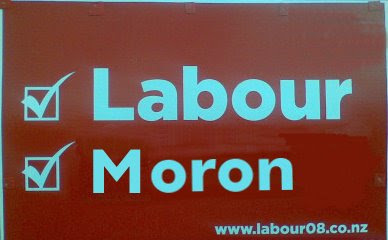
    Whilst driving, through Labour’s Sue Moroney’s territory, on my way back from my weekly lecture at BTI in Tauranga, I laughed so much I nearly drove into a pole.

    Narrowly missing the pole, the laughter saw me nearly swerve into fence.

    This is what I saw on the side of Galloway St in Hamilton:

    I don’t agree with the vandalism of election hoardings and I prefer personal insults are left out of political debate but I did find this very funny!

    UPDATE: Its seems stuff found it funny too.

  • John Key on Religion and Public Life

    A few weeks ago someone gave me a copy of this interview with John Key. Now the first thing to note is that the article was published by Gaynz.com. Gaynz.com are not a terribly reliable media outlet, and Madeleine would say that they are beneath the term “media outlet”. Hence, much of what is written may be highly inaccurate. Despite this, if John Key did say these things, how should one respond to them? I will endeavour to do this in this post.f

    Key states he voted against civil unions because the majority in his electorate were opposed it. This is clearly an inadequate stance, suppose that same-sex sex is wrong, contrary to the laws of God. If this is the case, Key is suggesting that he would follow the beliefs and will of the majority over the beliefs of an omniscient, all knowing, perfectly-good God. This is irrational to say the least. The mistaken views that are popular are more authoritative than the decree of God.

    On the other hand, suppose there is nothing wrong with same-sex sex. Suppose that discriminating against such unions is on par with discriminating against inter-racial unions. Then Key is suggesting he would follow the racial prejudices of the majority even though he abhors this prejudice himself.

    Such a position is bizarre. For my part I expect legislators to be people of integrity and have the courage of their convictions to stand against evil and injustice even when it is unpopular to do so.

    Key dismisses the argument that “civil unions undermine marriage” in a far too cavalier manner. Though I myself do not endorse this argument, I believe a critique of it should be based on an accurate and fair interpretation which must also be a valid argument. Key’s is neither. Key responds by saying, “I have been married for 22 years and the fact that a gay couple may choose to have a Civil Union would have absolutely no impact on my marriage to my wife”. But that is not the issue. Opponents of civil unions claimed it would undermine the institution of marriage not that it would under mine one particular person’s marriage.

    Of course Key is not alone in dismissing the arguments of others simply by a cavalier caricature, but this fact does not alter the spuriousness of doing so.

    Key states “I don’t care what people’s sexual preferences are” and states that a persons sexual preference “is their business and their business alone.” Several things can be said here; first whether Key cares about an issue is irrelevant. The issue is whether certain actions are right or wrong and this is not determined by Key’s personal feelings.

    Second, if a person’s “sexual preferences” are “their business alone” why does he have no problem with the State solemnising and legally recognising a person’s sexual union. If it is no one else’s business then why is it the states business?

    Thirdly, contrary to what Key says, a person’s “sexual preference” is relevant. Some people prefer little children; by definition this is a sexual preference. If Keys’ trite sounding slogan were correct, this is their business alone and no one else’s.

    Similarly Key notes that “We have friends who are gay and lesbian, just as we have dozens of friends who are heterosexual.” This may be true but it is beside the point. The fact that you know people who do something does not mean the State should endorse their activity through recognising and solemnising it. I have had friends who sleep around and regularly get intoxicated. Does that mean that the government should set up state funded clinics for those who want casual sex or provide tax payer funded alcohol?

    In discussing the origins of same-sex attraction Key states “I believe it is innate. I am not an expert in these areas but I have had all these religious groups in my electoral office trying to argue that this is learned behaviour, personally I believe that is crap.” It is not just religious people who make that claim (and not all religious people do anyway). Socially liberal New York University Sociologist, Dr David Greenberg, in his book “The Construction of Homosexuality” concluded that homosexual conduct is socially learned. He based this on a huge survey of cross-cultural studies. This work may be mistaken, but I think Key is reaching if he thinks his credentials warrant writing off such research as “crap” because of what his consciousness tells him.

    Key goes on to note: “I think we largely live in a secular society, I think there are many religions operating in NZ and it is in the best interests of the state to make decisions that are on a secular basis so they don’t discriminate. I’m no supporter of these hard right religions. [For instance,] I was never offered, I would never have accepted any financial support from the Exclusive Brethren. I met them as a constituency MP, as I would meet anyone as a constituency MP on constituency issues as I believe it’s wrong to discriminate.”

    There is so much here it is hard to know where to begin.

    Key states “we live in a secular society”. This mantra is trotted out by politicians of the left and right continually, but it is spurious. The fact that society currently displays a trait does not mean it ought to display that trait, we currently live in a Labour led society, does Key think that means Labour ought to continue to lead?

    Key goes on to state he does not believe in discrimination. However, he then immediately notes that he does not “support hard right religions.” His position is contradictory; unless Key does not support any groups at all (which is clearly false he supports National) he is discriminating against these groups as he is supporting some but not others.

    Moreover, legislation by its nature discriminates. A law regulates human conduct, it states that people who engage in certain actions will be censured (incarcerated or fined) while people who do not engage in those actions will not. This is discrimination. Contrary to what Key states discrimination in and of itself is a morally neutral concept. Some types of discrimination are wrong i.e. depriving people of their life on the basis of their race, and others are not, depriving people of liberty because they have committed murder. The fact that such an elementary and obvious point is lost on someone who seeks to lead the country speaks volumes for the intellectual and moral acumen of today’s politicians.

    However, Key’s core argument is “I think there are many religions operating in NZ and it is in the best interests of the state to make decisions that are on a secular basis so they don’t discriminate.” The argument here seems to be that because there are many differing religious groups in NZ, it would be discriminatory to base the laws on moral principles taught by only some of these groups. Hence legislation should be based on secular (i.e non-religious) values and ideals.

    The problem is that if this argument is not sound. If it were, there is an equally sound argument for the claim that we should not base laws on secular values and ideals.

    Consider, there are many secular philosophies operating in NZ. They disagree on all sorts of matters. Compare the Socialist Workers Party with the Objectivist Society, or both with the New Zealand Association of Rationalists and Humanists. Hence, if we follow Key’s logic, to avoid discrimination we need to base laws on “non-secular aims”.

    In fact one can push this silly argument further, there are numerous different political parties in NZ, hence to avoid discrimination we should not base laws on the aims or values of any political party. Which means that if elected Prime Minister, Key will not support any National Party policies being implemented.

    Does any of the above mean that people should not vote for National? Not necessarily. While Key is clearly mistaken on these issues, it does not follow that he is mistaken on every other issues. Moreover, it could be (lets face it, it is probably the case…) that the alternative to National will contain people who are more mistaken on more issues. John Key has a lot of faults but he has one big tick in his favour, he is not Helen Clark.

  • More on the “Dark Ages” and Other Propaganda

    Those of you who have followed my discussions with Peter Cresswell on the history of Christianity and the relationship between faith and reason in the middle ages may find this abridged article by Dr James Hannam interesting. Dr Hannam has recently completed his PhD on the History of Science at the University of Cambridge.

    UPDATE:
    Dr Hannam emailed me to advise that this article is no longer available online (it had to be removed at his publishers insistence) but is available in full in the book, God’s Philosophers: How the Medieval World Laid the Foundations of Modern Science, which is apparently now available in New Zealand. Bethyada will be interested to hear, “as one of the comments on your blog asked, I have included a discussion of the trebuchet and other weapons developed in the Middle Ages.”

    Some reviews:

    “A spirited jaunt through centuries of scientific development… captures the wonder of the medieval world: its inspirational curiosity and its engaging strangeness.” Sunday Times

    “This book contains much valuable material summarised with commendable no-nonsense clarity… James Hannam has done a fine job of knocking down an old caricature.” Sunday Telegraph

    Guess what I’m adding to my Christmas list? …Madeleine…

    God’s Philosophers: How the Medieval World Laid the Foundations of Modern Science

    Rethinking Science in the Middle Ages
    The most famous remark Sir Isaac Newton (1642 – 1727) made is, “If I have seen a little further then it is by standing on the shoulders of giants.” What most of us assume he meant is that his scientific achievements were built on the discoveries of his predecessors. In the same passage, he alludes to René Descartes (1596 – 1650), the French philosopher and mathematician, so presumably this is one of those whom he meant. Few people realise, however, that Newton’s aphorism was first coined in the twelfth century by the theologian Bernard of Chartres (d. c. 1130). Even fewer are aware that Newton’s science also has its roots embedded firmly in the Middle Ages.

    This book will show just how much of the science and technology that we take for granted today has medieval origins.

    ….

    During the Middle Ages, the Catholic Church actively supported a great deal of science, which it also kept control of when speculation could impinge on theology. Ironically, by keeping philosophers focused on nature instead of metaphysics, even the limitations that the Church set may have benefited science in the long term. Furthermore and contrary to popular belief, the Church never supported the idea that the earth was flat, never banned human dissection, never banned zero and certainly never burnt anyone at the stake for scientific ideas. The most famous clash between science and religion was the trial of Galileo (1564 – 1642) in 1633. Academic historians are now convinced that this had as much to do with politics and the Pope’s ego as it did with science. I will examine the trial fully in the last chapter of this book when I will also explain how much Galileo himself owed to his medieval predecessors.

    ….

    Popular opinion, journalistic cliché and misinformed historians notwithstanding, recent research has shown that the Middle Ages were a period of enormous advances in science, technology and culture. The compass, paper, printing, stirrups and gunpowder all appeared in Western Europe between AD500 and AD1500.

    True, these inventions originated in the Far East, but Europeans developed them to a far higher degree than had happened elsewhere.

    ….

    The development of printing and paper meant that an incredible 20 million books were produced in the first fifty years after Johann Gutenberg had published his printed Bible in 1455. This dwarfed the literary output of the ancient world. Printing probably had an even greater effect than gunpowder, which, like the stirrup before it, revolutionised warfare and allowed Europeans to dominate the rest of the world.

    Meanwhile, the people of medieval Europe invented spectacles, the mechanical clock, the windmill and the blast furnace by themselves. Lenses and cameras, almost all kinds of machinery, and the industrial revolution itself all owe their origins to the forgotten inventors of the Middle Ages. Just because we don’t know their names, does not mean that we should not recognise their achievements.

    They lived much tougher lives than we do and we are the ones reaping the rewards for their hard work.

    Most significantly, the Middle Ages laid the foundation for the greatest achievement of western civilisation, modern science. It is simply untrue to say that there was no science before the ‘Renaissance’. Once medieval scholars got their hands on the work of classical Greeks, they developed systems of thought that allowed science to travel far further than it had in the ancient world. Universities, where academic freedom was guarded against all comers, were first founded in the twelfth century. These institutions have always provided scientific research with a safe home. Even Christian theology turned out to be uniquely suited to encouraging the study of the natural world because it was believed to be God’s creation. Thus, my own research over the last decade has led me to believe that it is a gross injustice to label the Middle Ages as ‘stagnant’, ‘barbaric’, or ‘uncivilised’.

    ….

    Watermills had existed in the ancient world but the Greeks and Romans never adopted them in large numbers. In the Early Middle Ages, they became increasingly common and the Domesday Book lists over 5,000. Tidal mills were adopted on suitable estuaries where a dam harnessed the high tide and released it through a channel containing a watermill. Finally, the first recorded European windmill sprouted in Yorkshire during the twelfth century and the idea quickly spread all over those parts of northern Europe where suitable rivers or estuaries were not available.
    Taken together, these improvements in agriculture led to a population explosion. Estimates for the population of France and the Low Countries rise from three million in 650AD to 19 million just before the arrival of the Black Death in 1350AD. For the British Isles, the equivalent figures are 500,000 people and five million. In Europe as a whole, the population increased from less than 20 million to almost 75 million. These figures must be estimates, if not guesstimates, but the upward trend is clear. For comparison, at the height of the Roman Empire about 33 million people lived in Europe. Well before 1000AD, the population far exceeded what is was when the continent was ruled by Rome and remained above that level even after the Black Death had killed a third of the inhabitants of Europe in the fourteenth century.

    ….

    In some ways, the medieval worldview was closer to ours than we sometimes imagine. For example, Gerbert and all his fellow men and women of any education in 1000AD were perfectly well aware that the Earth was a sphere. They also knew that the universe was very large compared to the Earth. As Boethius wrote in his Consolation of Philosophy:
    It is well known and you have seen it demonstrated by the astronomers, that in comparison to the extent of the heavens, the circumference of the earth has the size of a point. That means that, compared to the heavenly sphere, the earth may be thought of as having no size at all.
    Comments we hear today about people in the Middle Ages inhabiting a ‘poky little universe’ or believing that the Earth is flat are born of modern rather than medieval ignorance.

    ….

    Another modern misconception about the medieval worldview is that people thought the central position of the Earth meant that it was somehow exulted. In fact, to the medieval mind, the reverse was the case. The universe was a hierarchy and the further from the Earth you got, the closer to Heaven you came. At the centre, underneath our feet, the Christian tradition placed Hell. Then, second worse only to the infernal pit was our Earth of change and decay. Above us, acting as a boundary between the earthly and the heavenly, was the sphere of the Moon. This marked the dividing line between the perfect unchanging heavens and the transient sub-lunar region containing ourselves, doomed to die. Next, there were the crystalline spheres of the seven planets – the Moon, the Sun, Mercury, Venus, Mars, Jupiter and Saturn – eternally orbiting with uniform circular motion. The spheres were thought to be made of a transparent and imperishable fifth element called ether or quintessence. Above them were the fixed stars whose positions relative to each other never appeared to change. Above even them was the firmament and beyond that, Christians like Gerbert imagined, was the realm of God. This hierarchical system gave people absolute directions of up and down, one towards the heavens and one down to Earth at the bottom of the celestial ladder. To move the Earth away from the centre of the universe was not to downgrade its importance but to raise it up towards the stars.

    RELATED POSTS:
    The “Dark Ages” and Other Propaganda
    Things They Don’t Teach you in Public Schools…
    The Flat Earth Myth
    Contra Mundum: The Flat-Earth Myth
    Guest Post: Dan Brown’s History of Science

  • The End of Musical Chairs: The Pervasiveness of Political Correctness

    Alistair told me I had to write this so its all his fault!

    Our 7 year old son Noah has a ‘girlfriend’ who he ‘is going to marry one day.’ His ‘girlfriend’ also turned 7 yesterday and had a party. His ‘girlfriend’s’ mum went to a heap of trouble to decorate the house, make the food and plan all sorts of fun activities to make sure their daughter and all her little friends had heaps of fun. She did way more games than I do, I draw the line at decorating the cake and making just one pass-the-parcel (which I make my teenagers wrap and supervise the execution of).

    Back when I was a child (did I really just use that sentence?) pass the parcel was completely random; some kids got to remove 3 layers and other kids missed out completely. The excitement and anticipation when the music stopped was all centred on getting to be the person who got to take the wrapper off and hoping you got to take the wrapper off on the very last layer. If you sulked because you missed out, you were a poor loser and got a lecture from your parents about good sportsmanship. These days, in our PC culture, for the kids its all about getting the lollipop or other goodie taped to each layer and every parent I know – including me (well my teenagers) – ‘cheats’ and makes sure that every kid gets a turn taking off a layer before letting the game run randomly.

    The party progressed to musical chairs. My kids have not really played it that much (as I am slack, see above) but they, along with the others, picked up the rules and with big smiles of anticipation got ready to play.

    Now unlike pass the parcel, musical chairs does not lend itself so well to PC-ising.

    The music stopped, they all scrambled for chairs, one kid missed out, got eliminated from the game and promptly began crying. There were cries of “Oh… poor thing… its just a practice run” and the rules were re-explained and the heat was run again. A different kid missed out this time and promptly began crying. The next round was played and each chair was removed every kid was reduced to tears when they lost, even my children!

    I know the families that were present quite well and I know that all of them despise the PC culture and have tried to raise their kids in a manner counter to it, us included, yet seeing all of our kids fall apart because they lost really gave us pause. The host parents were horrified that all the guest were in tears (barring the kid who won), they had been trying to make the party fun for everyone afterall. They categorically stated they would never play musical chairs at their parties again and apologised to the parents who by then all had at least one crying child on their laps.

    The episode was really disturbing. We all began questioning how the children of today’s culture are going to cope with real loss in life and knocks to their confidence. I wondered what it would mean for their ability to persevere, to believe in themselves when life sent them knocks, Alistair wondered about the impact long term on suicide rates – how will teenagers cope if parents shield them from ‘losing’ or always try to correct situations where their child ‘misses’ out? Obviously the musical chairs is just a symptom and not the cause but I think it made us see that despite our efforts to the contrary we are raising a generation of kids whose definition of ‘fairness’ and ‘equality’ is something quite different from what it should be.

    Last night I really felt for the host parents’ embarassment, completely empathised with it and mentally congratulated myself on my slackness of never having more than one party game and that game never being musical chairs! However, on reflection I have decided I owe it to my kids to add musical chairs to my party-games repertoire and I am going to stop allowing my teenagers to ‘cheat’ at pass the parcel – I might even take the lollipops off the wrappers too!