Category: Theology

  • A Godless Public Square: Do ‘Private’ Christian Beliefs Have a Place in Public Life? @ Auckland Uni

    Mon 1- Friday 5 August marks Jesus Week. A number of events will be held on the University of Auckland campus of which we are part of including this one brought to you by the Evangelical Union and Thinking Matters:

    Godless Public Square

    A Godless Public Square:

    Do ‘Private’ Christian Beliefs Have a Place in Public Life?

    A Jesus Week Panel Discussion
    7-9pm Wednesday 3 August
    Lib B28 (Library Basement) University of Auckland

    Christian theological convictions ought to impact the whole of life both in the private and public spheres; this is what the idea of an “undivided life” means, Jesus is Lord of all aspects of our lives.

    Yet this consequence of Christian faith conflicts with a pervasive contemporary attitude: the view that that religion is fundamentally a private matter. It is accepted that a Christian is free to utilise theological convictions when they make decisions about their own life but in a pluralistic society it is increasingly deemed inappropriate to bring such convictions into public discussions about morality, law, politics, economics, education, scholarship and so on. The desire to influence society with Christian ideals or to convert others to the faith is viewed by many as an intolerant desire to impose one’s private views onto others.

    It is widely accepted that theological convictions can govern churches and the private lives of believers yet we are told that the public square – government, public policy, the courts, the academy, education, business, arts, media, etc – should be secular only.

    This event looks at this issue. The conversation will span Theology, Philosophy and Law led by a panel made up of Christian representatives from each discipline along with you the audience.

    Up for discussion are issues like:

    – Is it wrong for Christians to impose their ‘private’ religious beliefs onto others?
    – Is secularism the neutral perspective it is claimed to be?
    – Are public expressions of religion regulated by law?

    Bring your own questions and ask them at the Q & A session.

    This is a free event open to the public, which will be lay friendly – a university degree is not necessary in order for you to attend!

    Panel:

    Moderator:

    RSVP on Facebook here (or just turn up with your friends)

  • Guest Post: Paul Copan Replies to Hector Avalos – Deuteronomy 25:11-12, an Eye for an Eye, and Raymond Westbrook

    My book review of John Loftus’s The Christian Delusion: Why Faith Fails prompted several responses from Hector Avalos, one of the book’s contributors. Avalos has offered critiques of not just my arguments but also those of my good friend Paul Copan. This Guest Post, written by Paul Copan, responds to some of Avalos’s charges. Paul Copan writes:

    Paul CopanRecently Hector Avalos has responded to a particular argument in my book Is God a Moral Monster? (Baker).  In it, I follow biblical scholar Jerome Walsh’s interpretation of Deuteronomy 25:11-12:[1] If two men, a man and his countryman, are struggling together, and the wife of one comes near to deliver her husband from the hand of the one who is striking him, and puts out her hand[yad] and seizes his genitals, then you shall cut off her hand [kaph]; you shall not show pity.

    I first came across Walsh’s perspective by way of Richard Davidson’s book on sexuality in the Old Testament, Flame of Yahweh (Hendrickson)—a book I highly recommend.  I follow both Walsh and Davidson on the view that this text is not referring to amputating the hand, but rather depilation.  This was a punishment of humiliation involving shaving a woman’s pubic hair in thekaph—the curved region below the waist.  I won’t elaborate on what my book says, but I’ll simply address Deuteronomy 25:11-12 in the bulk of this blog posting.  In the post, I’ll address the question of lex talionis (“an eye for an eye”) and the work of Raymond Westbrook.

    1. Preliminary remarks: I have been in communication with Jerome Walsh, who prefers to stay out of the discussion.  Walsh has read Avalos’s post, though, and noted too that he did not see anything new in Avalos’s arguments that he hasn’t encountered before.  He simply saw nothing linguistically to persuade him to alter his views.

    Avalos’s repeated identification of kaph = “hand” as the “literal” meaning is misleading.  While it may be the commonest meaning, the term has less-common usages too (the bowl of a spoon, the frond of a palm tree).  It’s unproductive to start from the assumption that commonest meaning is the only one allowable unless one can prove otherwise.  The point in the article is that yad tends to refer to the hand without connotation or nuance, or when the hand is envisaged, as an instrument of pointing, hitting, doing.  Kaph, so far as he can see, connotes the hand as an instrument of grasping and holding, thus the curvature and the focus on the palm.

    In Walsh’s estimation, Avalos seems to be operating from the position of a methodological absolutism:  “X” is the common opinion, and unless one can definitively prove not-X, then one must espouse X.  He doesn’t appear to leave much room for “more likely” or “less likely” as the possible evaluation of a hypothesis.

    Avalos cites Marc Cortez for support: “The Law on Violent Intervention: Deuteronomy 25.11-12 Revisited,” Journal for the Study of the Old Testament 30:3 (2006), 431-47.  As I note in my book, though, it is unfortunate that Cortez fails to interact with Walsh’s essay, which had been published two years earlier.

    In correspondence with Walsh (May 2010), he commented on an online version of Cortez’s article.  He pointed out that while Cortez dismisses Eslinger’s attempt to identify kaph with gynecological exactitude (and he can agree with Cortez on that point), Cortez does not deal with the fact that kaph is used not just for the palm of the hand, but for several other curved, arched objects, both corporeal (sole of foot) and not (bowl of a spoon, frond of a palm tree).  Walsh’s argument simply treats kaph as the curve of the groin, a very likely meaning in Song of Solomon, and (pace Cortez) in Genesis as well.

    Cortez wants to retain without discussion the understanding of kaph as “hand.”  But Walsh notes that Cortez’s explanation of why a “talionic” law would equate “hand” as an instrument of offense with “palm of the hand” as the object of “cutting-off” is, basically, “why not?”  That begs the question.  Further, he ignores completely that there is no reason whatsoever for treating the qal of qatsats as if it were the piel.  In the piel, it clearly means “to cut off.”  In the few other instances of its appearance in the qal, it means “to cut (hair).”  Why, in this unique case, should the qal be translated as if it were a piel?

    Now, Walsh readily acknowledges that his article is not the standard reading of the passage, and that Cortez’s evaluation of others’ interpretations of Deut 25:11-12 is judicious, careful, and sober.  He would agree with Cortez completely that the peculiarities of this unique law in the Israelite corpus have led scholars to some truly egregious attempts to make sense of its oddity.  And Cortez is very good indeed at identifying the unpersuasive lengths to which some scholars have gone.  But he, like all of those scholars, has not looked at the words.  This is the contribution that Walsh’s article proposes to make.  Instead of accepting unquestioningly that “you shall cut off her hand” is what the Hebrew words mean, he has argued that that is a misreading of the Hebrew terms.  To put the disagreement in a nutshell, let me quote a line from Cortez’s article.  Cortez says:  “The first and most important question that must be addressed with respect to the woman’s punishment is (more…)

  • Contra Mundum: Pacifism and Just Wars

    Comedian Bill Maher recently berated Christians for being hypocrites for supporting military action against terrorists in his “New Rules” segment on the U.S. TV show Real Time (transcript here). Jesus, Maher contended, was a pacifist; “Jesus lays on that hippie stuff pretty thick. He has lines like, “do not repay evil with evil,” and “do not take revenge on someone who wrongs you.” Here Maher was citing from Romans 12, where Paul formulated Christ’s teaching about loving one’s enemies. In this passage Paul commanded people to “bless those who persecute them,” they are forbidden to “repay evil for evil” and are commanded to “not take revenge” but to “leave room for God’s wrath. For it is written, ‘Vengeance belongs to me. I will pay them back’.”

    Maher scathingly contended that this support contradicted Christ’s clear teaching; he said, “nonviolence was kind of Jesus’ trademark. Kind of his big thing. To not follow that part of it is like joining Greenpeace and hating whales.”

    After saying this Maher quipped, “the next line isn’t ‘and if that doesn’t work, send a titanium fanged dog to rip his nuts off.’” The irony is that it Maher clearly had not bothered to actually read the next line; Romans 13 states that the “governing authorities” are “established by God”; one is morally bound to submit to rulers because “rulers do not bear the sword for no reason. They are God’s servants, agents of wrath to execute vengeance upon evil doers”.

    The Greek words for evil, wrath, and vengeance are the same in both Romans 12 and 13. Paul is stating that the very things Christians are forbidden to do with regard to not repaying evil for evil, are precisely what the State has been given the legitimate authority and right to do.

    Paul here elaborates the basic premise that moral theologians appeal to to reject pacifism and to support the claim that war can be just under certain circumstances. The premise is that a government has the right and duty to use force to uphold within the geographical area over which it has jurisdiction. A just war is simply an extension of a government’s power to pass laws and create police powers.

    If a criminal attempts to rape or kill people within the geographical realm over which a government has authority then the government can justifiably use force to prevent this. And it can also use force to try and punish anyone who does these things; hence, the existence of a legislature, police force, courts and prisons. Just War theorists simply note that there seems no reason why this would not extend to when the person committing the offence is a soldier from another country as opposed to a domestic criminal.

    These theorists argue that for a war to be just it must (more…)

  • The Christian Delusion: Why Faith Fails – A Philosophia Christi Review of John Loftus’ Book

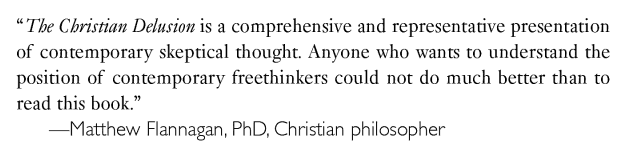
    On the list of blurbs just inside the cover of The Christian Delusion: Why Faith Fails, edited by John W. Loftus (Amherst, NY: Prometheus Books) 2010, the following appears:

    The Christian Delusion Blurb by Matthew Flannagan

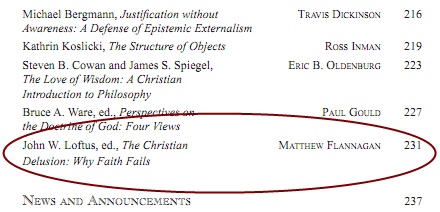
    As a result of being published on the blurb of the book, the current edition of Philosphia Christi, Vol. 13, no. 1 – Summer 2011, shows the following in the table of contents under “Book Reviews”:

    Philosophia Christi Table of ContentsThe Editor of Philosophia Christi has kindly granted Matt permission to reproduce his review of The Christian Delusion: Why Faith Fails here on MandM.

    A Review of The Christian Delusion: Why Faith Fails

    by Matthew Flannagan

    In The Christian Delusion John Loftus brings together a series of articles by contemporary free thinkers all focused around a common epistemological critique. It is the sequel to Loftus’s Why I Became an Atheist: A Former Preacher Rejects Christianity.

    The book is divided into five parts, each addressing a different aspect of Christianity. Part 1 is entitled “Why Faith Fails” and comprises four chapters. In chapter 1, David Eller argues that religions both deeply influence and are deeply influenced by culture; he argues that different cultural contexts lead to different forms of Christianity. In chapter 2, Vallerie Tarico draws on cognitive science to offer naturalistic explanations for why people believe in God. In chapter 3, Jason Long explains how people believe in Christianity despite its obvious absurdity by documenting how humans frequently engage in certain fallacies, have certain biases, believe things that are comfortable and resist changing their minds.

    By themselves it is hard to discern how these chapters provide arguments against Christianity. They appear to assume Christianity is false and provide naturalistic explanations as to why people believe such falsehoods. The relevance is explained in chapter 4, where John Loftus uses them to defend what he calls the Outsider Test for Faith (“OTF”). Loftus argues that a rational person should adopt the same skeptical stance towards her own religious beliefs that she does towards religions she rejects. The OTF (more…)

  • Stark Wars

    Darth VaderThom Stark has written a lengthy response (304 pages!) to Paul Copan’s book Is God a Moral Monster? which he has published on his blog, Religion at the Margins; it is entitled Is God a Moral. Compromiser? A Critical Review of Paul Copan’s. “Is God a Moral Monster?” In it, alongside his criticisms of Copan, Stark makes several criticisms of the work of Richard Hess and Matt.

    Matt has not yet had time to read Stark’s book-length review, much less respond to it, but Copan and Hess have. Copan has published the following blog posts on his blog, Parchment and Pen:

    Is God a Moral Monster Revisited: Preliminary Replies to Thom Stark

    Richard Hess’s Response to Thom Stark

    Matthew Flannagan’s Interactions with Thom Stark

    Stark has responded to these posts with:

    Copan and Company, Part 1: A Brief Introduction

    Copan and Company, Part 2: Response to Matt Flannagan

    Copan and Company, Part 3: Response to Paul Copan

    Copan and Company, Part 4: Response to Richard Hess

    Other blogs have chimed in:

    Thom Stark’s Sweeping Claims by Christopher Copan Scott

    Reflections on the Thom Stark-Paul Copan debate by Randal Rauser

    Matt has on his ‘to do’ list an intention to wade through Stark’s review and write a response, at the very least, to the parts that critique his work. He also intends to answer Stark’s questions put to him on this blog post. However, Matt has several publication, conference and marking commitments to meet first and Matt simply cannot churn material out at the prolific rate Stark can.

    RELATED POSTS:
    Thom Stark on Wolterstorff and Hagiographic Hyperbole
    Is God a Moral Monster? A Review of Paul Copan’s Book
    God and the Genocide of the Canaanites Part I: Wolterstorff’s Argument for the Hagiographic Hyperbolic Interpretation
    God and the Genocide of the Canaanites Part II: Ancient Near Eastern Conquest Accounts
    God and the Genocide of the Canaanites Part III: Two Implications of the Hagiographic Hyperbolic Account

  • Slow Learners: Foolishness Bound Up in the Heart

    Sometimes we Christians find ourselves wondering at the foolishness on display in our society.  Things which to us are so self-evident and obvious appear  beyond the ken of the average Unbeliever.  Take something as basic as whether depravity and perverseness is native to the human soul, or not.  Christians, realizing that this is something about which we cannot be neutral, turn to the revelation of God to find that indeed we are all corrupt.

    The doctrine of Total Depravity is often misunderstood. The Scriptures do not teach that man is corrupt as can be, but that every part of the human being is to some extent corrupted by evil.  The “total” in Total Depravity refers to universality not degree.  The poison of sin is traceable in every part of our being.  In some times and cultures the poison is more advanced than in others.  The ante-diluvian civilization, for example, saw a maturation and flowering of evil everywhere: every intent and thought of the heart of men was only evil continually, we are told (Genesis 6:5).  But at other times the redemptive record reveals that Unbelieving cultures are a long way short of being filled up with evil (Genesis 15:16).

    This being so, it is expected that children, for example, will manifest aspects and manifestations of self-will, disobedience, contumacy, stubbornness, and selfishness from a very early age.  “I was brought forth in iniquity and in sin my mother conceived me” says the Psalmist (Psalm 51: 5).  The Borg is on-board the ship, as it were.  Experience confirms the expectation in spades.  Every parent would have to be blinded by some very opaque glasses indeed not to see this from the very earliest days of their child’s life.

    Yet the general consensus is that children are born righteous and without sin and that it is society which corrupts them.  Man is good and righteous, innocent; it is the environment which makes him evil.  Thus it is generally held that crime is a social construct: if wages were higher, education more effective, and better television programming were to be had, crime would wither on the vine.  The reason folk spend all their life on the dole is not that they are lazy or indigent, but because “society” has not presented them with the right employment opportunity.

    The child-as-innocent view has won the ideological and religious battle in our country now for over fifty years.  If society believes that children are innocent until made sinful by external conditioning parenting immediately becomes child-centric.  The challenge is to impose as little as possible, and to allow the innocence within to come forth and flourish.  Indulgence and permissiveness become the order of the day.

    ChocolateIt is no surprise to Christians that the fruits will be forthcoming generations riven with narcissism, self-indulgence, sociopathic behaviours and dissipation.  So it has come to pass–and we marvel at how society is puzzled by this, as if it were unexpected.  It has led to what is now being called the “New Zealand paradox”: high teenage injury, death rates, and national debt  in such a peaceful, ethical and developed nation.

    Solving this paradox has become urgent.  Now there are claims that (more…)

  • Hear Iain Provan on Why Should we Read the Old Testament, and How?

    Compass Foundation and Regent College are hosting Iain Provan at an event in Auckland next month entitled ‘Why Should we Read the Old Testament, and How?’ Here is the info from their blurb:

    Iain ProvanWhy read the Old Testament? What relevance could this old collection of books have for us today? And how should we read it? How do we approach this text from a very different time and culture?

    Iain will be exploring these questions, drawing on his many years of teaching, study and wrestling with these ancient texts. He will give special attention to the book of Jonah as an example of why we should read the Old Testament and how we should do it.

    When: Monday 4 July, 7pm to 9pm
    Where: Greenlane Christian Centre, 17 Marewa Road, Greenlane, Auckland

    Iain Provan is Marshall Sheppard Professor of Biblical Studies at Regent College, Vancouver, Canada. He is an accomplished Biblical scholar, writer of numerous books and articles, including commentaries on Lamentations, 1 and 2 Kings, Ecclesiastes and Song of Songs, as well as co-author of A Biblical History of Israel. Iain is an ordained minister of the Church of Scotland and was born and educated in the UK. He has taught at universities in England, Wales, Scotland, and most recently Canada.

    More info on how to rsvp for catering purposes @ Compass or on Facebook. To see Iain Provan’s other New Zealand events see his upcoming speaking engagements page.