Category: Speaking Engagements

  • Society of Biblical Literature: Blogger and Online Publication

    The Society of Biblical Literature’s program book for their 2011 meeting in San Francisco is now online. The blogger and online publication session for which Matt and I have had a joint paper accepted shows who we are sharing the session with and provides links to brief abstracts for each talk.

    Society of Biblical Literature Annual Meeting

    Blogger and Online Publication
    Robert R. Cargill, University of Iowa, Presiding
    11/19/2011

    4:00 PM to 6:30 PM
    Room: Room TBD – Hotel TBD

    Robert R. Cargill, University of Iowa
    Welcome and Introduction (5 min)

    Alice Bach, Case Western Reserve University
    Can Blogging at 3 AM Be Considered Scholarship? (25 min)

    Madeleine Flannagan, University of Auckland and Matthew Flannagan, Independent Scholar
    Blogging a Short-Cut to Peer Review: How to do it Effectively (25 min)

    Juhana Markus Saukkonen, University of Helsinki
    Sense and Practicality: Building a Historical GIS Online (25 min)

    Richard Price, CEO Academia.edu
    Academia.edu: The Past, Present, and Future of Scholarly Social Networking (25 min)

    The session will conclude with: Q&A discussion with Richard Price. (25 min)

    RELATED POSTS:
    We’re Going to San Francisco!

     

  • A Godless Public Square: Do ‘Private’ Christian Beliefs Have a Place in Public Life? @ Auckland Uni

    Mon 1- Friday 5 August marks Jesus Week. A number of events will be held on the University of Auckland campus of which we are part of including this one brought to you by the Evangelical Union and Thinking Matters:

    Godless Public Square

    A Godless Public Square:

    Do ‘Private’ Christian Beliefs Have a Place in Public Life?

    A Jesus Week Panel Discussion
    7-9pm Wednesday 3 August
    Lib B28 (Library Basement) University of Auckland

    Christian theological convictions ought to impact the whole of life both in the private and public spheres; this is what the idea of an “undivided life” means, Jesus is Lord of all aspects of our lives.

    Yet this consequence of Christian faith conflicts with a pervasive contemporary attitude: the view that that religion is fundamentally a private matter. It is accepted that a Christian is free to utilise theological convictions when they make decisions about their own life but in a pluralistic society it is increasingly deemed inappropriate to bring such convictions into public discussions about morality, law, politics, economics, education, scholarship and so on. The desire to influence society with Christian ideals or to convert others to the faith is viewed by many as an intolerant desire to impose one’s private views onto others.

    It is widely accepted that theological convictions can govern churches and the private lives of believers yet we are told that the public square – government, public policy, the courts, the academy, education, business, arts, media, etc – should be secular only.

    This event looks at this issue. The conversation will span Theology, Philosophy and Law led by a panel made up of Christian representatives from each discipline along with you the audience.

    Up for discussion are issues like:

    – Is it wrong for Christians to impose their ‘private’ religious beliefs onto others?
    – Is secularism the neutral perspective it is claimed to be?
    – Are public expressions of religion regulated by law?

    Bring your own questions and ask them at the Q & A session.

    This is a free event open to the public, which will be lay friendly – a university degree is not necessary in order for you to attend!

    Panel:

    Moderator:

    RSVP on Facebook here (or just turn up with your friends)

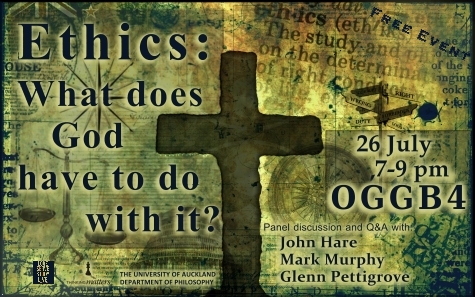
  • Ethics: What Does God have to do with it? @ Auckland University

    World class Ethicists John Hare (Yale Divinity) and Mark Murphy (Georgetown Philosophy) are in town for the Naturalisms in Ethics Conference and the Meeting of the Australasian Philosophy of Religion Association at the University of Auckland where they will be speaking along with New Zealand’s top Ethicists.

    We leaped on the opportunity to organise the following event, brought to you by the University of Auckland Department of Philosophy and Thinking Matters Auckland:

    Ethics: What does God have to do with it?

    Ethics: What Does God have to do with it? 
    A Conversation with Three Christian Philosophers

    7pm Tuesday 26 July
    Room OGGB4/260-073 (Owen Glenn Building)
    University of Auckland

    The question of the relationship between religion and morality has long been the subject of discussion and debate in western culture. Some philosophers and theologians contend the two cannot be separated; theological beliefs about God and the afterlife are needed to explain the existence and nature of moral obligations, and to ground motivation to live a moral life.

    Others contend the opposite. They claim that morality is entirely independent of religion and that religion encourages immorality. Questions have also been raised as to whether religion adds anything to morality in terms of its ideas about atonement, forgiveness and moral faith which are lacking in secular views.

    This panel brings together several of the world’s leading Christian thinkers on this question to discuss issues such as:

    – Why do we have to do what is right?
    – Can someone be a ‘good’ person without belief in God?
    – What role do grace and forgiveness play in morality?

    Bring your own questions and ask them at the Q & A session.

    This will be a free, lay friendly event open to the public – a university degree is not necessary in order for you to attend!

    Panel:
    Prof John Hare – Yale Divinity School
    Prof Mark Murphy – Department of Philosophy, Georgetown University
    Dr Glen Pettigrove  – Department of Philosophy, University of Auckland

    (Click on each of their names – they are each seriously cool!)

    Moderator:
    Dr Matthew Flannagan

    RSVP on Facebook or just turn up – bring your friends. This is soooo not to be missed!

  • The Australasian Philosophy of Religion Association Conference @ Auckland University

    The Australasian Philosophy of Religion Association (APRA) conference will be running at the University of Auckland from 16-17 July and will feature this blog’s own Matthew Flannagan and our good friend Glenn Peoples.

    The APRA conference is an annual event usually taking place over two days in mid July. Speakers include:

    More information at APRA’s website (which includes registration information) or at the Facebook Event page.

    Matt’s paper, “Armstrong on Divine Commands” will be chaired by John Hare of Yale Divinity School. Matt’s abstract is below:

    Abstract for: Armstrong on Divine Commands

    In several debates and addresses, William Lane Craig has defended the conditional,

    1. If God exists then a divine command theory provides a plausible account of the nature of moral obligation.

    In support of 1, Craig has appropriated the divine command theory of Robert Adams. He has identified the property of being morally obligated to do X with the property of being commanded by God to do X. Recently, Walter Sinnott-Armstrong has contended Craig’s conditional is “incredible” and that the divine command theory is “vulnerable to a cavalcade of devastating objections.” Armstrong has claimed that his criticisms do not just call into question Craig’s argument for a theistic based system of ethics; he contends that his arguments are conclusive against any theistic account of ethics compatible with Christian theism. I will argue that none of the objections Armstrong raises are persuasive, much less “devastating”; and that most of them have, in fact, been anticipated and addressed by defenders of divine command theories.

  • Naturalisms in Ethics Conference @ Auckland Uni

    The Naturalisms in Ethics conference will be running at the University of Auckland from 14-15 July and will feature this blog’s own Matthew Flannagan.

    Here is the blurb from organiser Chris Tucker’s page (which includes registration information – see also the Facebook Event page):

    ‘Naturalism’ is a multiply ambiguous term—hence the title Naturalisms in Ethics— but it is related to a range of questions concerning the relationship of morality to science, evolution, biology, religion, and natural properties (whatever those are). Many otherwise disparate moral theories have been labeled as ethical naturalisms, including virtue ethics (both neo-Aristotelian and neo-Humean), moral functionalism, Cornell realism, and natural law theories. Some potential paper topics include the following (but the list is hardly exhaustive):

    • What are the different types of ethical naturalism?
    • Why should we endorse/reject ethical naturalism or some specific version thereof?
    • What can science or evolution tell us about morality, moral psychology, or the rationality of moral judgments?
    • Are naturalistic accounts of morality better off than theistic ones?

    Speakers include:

    Matt’s paper, “Is Ethical Naturalism more Plausible than Supernaturalism? A Reply to Walter Sinnott-Armstrong” will be chaired by Erik Wielenberg of DePauw University. Matt’s abstract is below: (more…)

  • Hear Iain Provan on Why Should we Read the Old Testament, and How?

    Compass Foundation and Regent College are hosting Iain Provan at an event in Auckland next month entitled ‘Why Should we Read the Old Testament, and How?’ Here is the info from their blurb:

    Iain ProvanWhy read the Old Testament? What relevance could this old collection of books have for us today? And how should we read it? How do we approach this text from a very different time and culture?

    Iain will be exploring these questions, drawing on his many years of teaching, study and wrestling with these ancient texts. He will give special attention to the book of Jonah as an example of why we should read the Old Testament and how we should do it.

    When: Monday 4 July, 7pm to 9pm
    Where: Greenlane Christian Centre, 17 Marewa Road, Greenlane, Auckland

    Iain Provan is Marshall Sheppard Professor of Biblical Studies at Regent College, Vancouver, Canada. He is an accomplished Biblical scholar, writer of numerous books and articles, including commentaries on Lamentations, 1 and 2 Kings, Ecclesiastes and Song of Songs, as well as co-author of A Biblical History of Israel. Iain is an ordained minister of the Church of Scotland and was born and educated in the UK. He has taught at universities in England, Wales, Scotland, and most recently Canada.

    More info on how to rsvp for catering purposes @ Compass or on Facebook. To see Iain Provan’s other New Zealand events see his upcoming speaking engagements page.

  • Just Think – Matthew Flannagan Speaking for ProLife NZ @ Waikato University

    Fetus

    Student group ProLife NZ have launched a campaign entitled JustThink (you can read more about it at the link). To kick things off the Waikato branch has invited Matt to speak on their key messages:

    1. Is an unborn child a human being?
    2. Should it have a right to life?
    3. Should our views on abortion affect others?

    This is an open lecture so anyone interested can come. There will be an opportunity for Questions and Answers so bring your questions!

    The talk will be held in Lecture Theatre S.G.03 at the campus of the University of Waikato, Hamilton, New Zealand from 1-2pm on Wednesday 25 May 2011.

    Dr Matthew Flannagan is an Analytic Theologian and Ethicist. His PhD thesis “Is Historical Opposition to Feticide Defensible in the 21st Century?” was just one of many pieces Dr Flannagan has written on the ethics of feticide (abortion).

    Dr Flannagan is no stranger to the Waikato campus. He completed his undergraduate and first post-graduate degrees majoring in Philosophy at the University of Waikato where he and his wife Madeleine met, founded and led the Waikato campus branch of Students Organised to Uphold Life (SOUL). He was later elected and served as President of the Waikato Students Union.

    Click the link to access all posts on this blog pertaining to the ethics of feticide.