Category: Personal

  • Flannagan v ACC – Victory

    Long time readers of this blog will remember than 5 1/2 years ago I was in a car accident that saw me suffer a herniated cervical (neck) disc and require disc replacement surgery. Readers will also be aware that the pain I lived (live) with did not end after that surgery and that when the Accident Compensation Corporation (ACC) went on to cut my entitlements, plunging our family into poverty (NZ definition) as I was the primary earner, I instructed John Miller Law in Wellington to fight their decision.

    Matt and I were terrified at the possible $8,000 + bill we might face if we lost; trying to provide for our 4 children in Auckland on $15,000 p/a was extremely difficult as it was without a debt like that being added to the mix. We appealed on this blog for donations and with the help of those who generously gave, along with the generosity of John Miller Law, who more than once wrote off parts of my bill, we managed to keep the legal proceedings going even after we lost the Review Hearing.

    I pressed on for a number of reasons. I firmly believe that ACC deliberately set about to exit me from cover by sending me to a doctor they knew would say I had degeneration. I believe this on the basis of the Court’s previous findings on Mr Otto and on the basis of his reputation among his peers – I have previously blogged my experience of phoning Orthapaedic Surgeon’s offices and sharing what those offices had to say about him to me. I also believe this on the basis of what happened at the appointment with Mr Otto – his pronouncement of my having a degenerative condition before he’d asked me if a single medical question and shortly before he shared that he had not yet seen my MRI, X-Ray or Bone Scan films and reports. I knew my condition was not degenerative or pre-existing: I was working full-time, studying part-time, raising 4 children, running a house and was engaging in equestrian sport on the weekends immediately prior to the accident.

    The other reason I filed was for all the other people like me. I believed then, and I still do, that ACC did what they did to me (cutting me off by sending me to a specialist they know will say a condition is degenerative when other specialists would not) to many other people and that doing so was a numbers game for them – a way of cutting their bottom line. Cut x number of people off, only teeny proportion y will fight; of those who fight ignore them unless and until you are faced with a court date, then quickly settle before that court date to avoid the public damage the judgment of the Court can deliver.

    We filed my appeal earlier this year. This consisted of three expert reports written by Orthopaedic Surgeons Greg Finch and Michael Barnes. We also filed affidavits from Matt and I, which we wrote ourselves. ACC offered to settle in full shortly after they were served: legal costs, report costs and full reinstatement of my entitlement, the maximum I could have won in Court.

    More than one person said to me ‘but Madeleine, if you settle no light will be shone on ACC’s practices’. While I shared their concerns at the lack of a precedent being set if I settled, as a lawyer I know the Court’s view on people who refuse good settlement offers and press on to hearing. I took the settlement and resolved to shine light another way. I am one of the lead stories today on the New Zealand Herald’s website (and on the website of the Otago Daily Times🙂

    Mother wins 3 year fight with ACC

    Click to read: Mother wins 3 year fight with ACC

    Mr Otto states in the NZ Herald article, after acknowledging he has no memory of my case, that I “would not have realised he could receive x-rays via email and that he would have seen them before diagnosing her”. I reject this. As I deposed in my affidavit:

    [40] A few minutes after making his opening statement that my condition was degenerative, Mr Otto asked me if I had brought my x-rays, MRI and bone scans. I told him that I had not been asked to and that the other specialists I had seen had all been able to log into some central record holding place and view them so it did not occur to me to bring them. He told me that his office did not have that kind of technology but he would request copies of the reports and films. I offered to send them to him but he said not to bother as ACC had only sent him a letter which didn’t say much so he was going to have to request various things from my file anyway.

    [41] In this moment it was clear that Mr Otto had made his statement about the purpose of the appointment being to discuss my “degenerative condition” in advance of asking me a single question, without having examined my x-rays and scans and on the basis of whatever ACC had communicated to him about me.

    [42] It was also clear that Mr Otto had conducted the appointment with a predetermined purpose: to determine a degenerative condition. He had decided this was my diagnosis before the examination, before being in receipt of the relevant medical evidence. I did not have confidence his diagnosis post-appointment could be objective or unbiased.

    My and Matt’s affidavits are here in full:
    13.03.22 Affidavit of Madeleine Flannagan – Flannagan v ACC
    13.03.22 Affidavit of Matthew Flannagan – Flannagan v ACC

    This is the case I refer to in my affidavit where Mr Otto was found by the Court to prefer his degeneration diagnosis in the face of evidence to the contrary: Lu-v-Accident-Compensation-Corporation-2011-NZACC-45 (A New Zealand Herald article about that case is available here)

    ACC said in the NZ Herald article “An ACC spokesman said it found the consistency and rationale of the two specialists’ opinions “more compelling” than Mr Otto’s report. “As a result ACC decided to reverse its decision.””

    I would like to stress that until ACC insisted (see affidavits) I see Mr Otto, every specialist and doctor who had seen me at that point said my issues were accident related. Mr Otto was the only one who said otherwise. Subsequant to Mr Otto’s report ACC were provided with 2 reports from Greg Finch and 1 from Michael Barnes  – these were the reports ACC found “more compelling” than Mr Otto’s – they were provided the first of these approximately 2 years before they settled, the others they received approximately 1 year before they settled. The service papers for my appeal containing these same reports they received a couple of weeks before they settled.

    Make up your own mind as to whether is was “the consistency and rationale of the two specialists’ opinions” that caused ACC to reverse its decision or whether it was the threat of a court case.

    I have to thank John Miller Law, all those who donated and encouraged me, Greg Finch, Michael Barnes, my church, my family and friends and especially my children and husband who suffered so much along side me – if it wasn’t for Matt going to my lectures and taping my classes and taking notes for me for me to attend to on the couch I would never have finished my law degree. I still live with pain today and it still impacts my life adversely but I am a lot better than I was and I continue to improve.

    Update: For those wondering how I completed a law degree when I could not work, I refer you to Matt’s post Madeleine Admitted to the Bar where he outlines just what it took and how hard it was given my injuries. It is also documented in the affidavits I have published in this post.

    NewstalkZB focussed on Madeleine’s case during the Leighton Smith show.

  • Published in Philo: Is Ethical Naturalism more Plausible than Supernaturalism? A Reply to Walter Sinnott-Armstrong

    Jeffery Jay Lowder  has informed me that my article “Is Ethical Naturalism more Plausible than Supernaturalism? A Reply to Walter Sinnott-Armstrong”  was  published in the Spring/Summer 2012 issue of Philo. The abstract is below:

    Is Ethical Naturalism more Plausible than Supernaturalism? A Reply to Walter Sinnott-Armstrong“In many of his addresses and debates, William Lane Craig has defended a Divine Command Theory of moral obligation (DCT). In a recent article and subsequent monograph, Walter Sinnott-Armstrong has criticized Craig’s position. Armstrong contended that a DCT is subject to several devastating objections and further contended that even if theism is true a particular form of ethical naturalism is a more plausible account of the nature of moral obligations than a DCT is. This paper critiques Armstrong’s argument. I will argue Armstrong’s objections do not refute a DCT and the ethical naturalism he defends is not more plausible than Craig’s ethical supernaturalism.”
    You can read “Is Ethical Naturalism more Plausible than Supernaturalism? A Reply to Walter Sinnott-Armstrong” here.

  • Flannagan v ACC: 5 Years on, an Update

    On Tuesday 26 March 2013 it will be 5 years since I was in a car accident that destroyed a cervical disc and saw me need surgery to have an artificial disc inserted and which left me with an ongoing pain condition and a habit of dropping things and having tingly episodes in my hands – still!

    At the time of the accident I was on track to become an in house counsel for one of NZ’s leading brands; the company were paying for me to complete my law degree.

    Initially ACC covered my income and treatment costs (well, part of them). They did not cover the part of my remuneration which related to my university fees and text books.

    They sent me to see a specialist who is considered by many within his own field and has been found by the court to have, in the face of contrary evidence, “stuck to his tried and true assertion that degeneration is the cause” (read the judgment in Lu v ACC). He made no exception for me stating that was his diagnosis as I entered his rooms, before he asked me a single medical question, before he saw my scans. Matt was with me and saw this.

    ACC cut my cover after he wrote his report. This spun us into significant hardship. So I hired the best ACC lawyers I could find. I took ACC to a review hearing conducted by ACC’s own reviewer. I lost. My lawyer told the court I would appeal. Two other specialists have now examined me and my files, both agree my condition is the result of an accident, both have written evidence for the court stating this. My lawyer has written her submissions. Yesterday Matt and I swore our affidavits, which we wrote ourselves and had my lawyer vet. This coming week my appeal will finally be filed. I hope to have a court date this year.

  • Peter Singer on Human Dignity and Infanticide: Part Two

    This is the second half of the paper I presented to the the Evangelical Philosophical Society Annual Meeting in Milwaukee three weeks ago. It is part of a two-part post series; make sure you have read part one Peter Singer on Human Dignity and Infanticide.

    II. Marquis’ Critique
    In my previous post I sketched Singer’s desire account of killing and how it relates to Singer’s preference utilitarianism and position on vegetarianism. Don Marquis has offered two kinds of counter examples to the desire account of killing:[1] take depressed people who are either suicidal or simply don’t care about life, but whom we know will with medication or counselling overcome this. Such people have no desire to live, yet it seems they have a right to life. Killing them is not in their interests and we would wrong them, not just their relatives or society, if we killed them.

    Or consider people brainwashed in a religious cult to commit suicide, or people who, believing they will be rewarded in the afterlife, offer themselves as voluntary human sacrifices. These people lack a desire to live yet they still have a right to life. Morality requires we try and save them from the cult rather than that we kill them. The desire account thus appears false, and given that preference utilitarianism entails the desire account, preference utilitarianism is problematic.

    These counter examples are part of a more general problem. Singer’s position infers a right to continue to exist from a desire to continue existing. However, the inference that “X has a prima facie right to Z” from “X desires Z”, is problematic. Children have rights to medical care, nutritious food, and education, but often children have little or no desire for these things. Often in cases of complicated medical procedures the child lacks a conception of the operation itself, yet it still has a right to such things. This claim is based on it being in their interests to have these things, and they will be harmed by not having them, it’s not plausible to ground these rights in the fact the parents or society want the child to have them.

    III. Singer’s reply
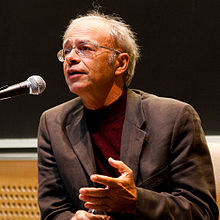
    Peter SingerIn A Reply to Don Marquis,[2] Singer acknowledges the cogency of Marquis’s counter examples and offers a revision to the desire account of killing. He cites the example of a tennis player who desires to drink a bottle he believes is full of water, but in reality contains poison. Singer concludes from this case “if a person’s desire to die is based on a false belief, it does not justify assisting him in satisfying the preference”[3], also ruling out the example of the fanatical religious believer. Similarly, “for a preference to be one we should act upon it should be based not only on accurate information …” but also a “calm and rational assessment of the situation”; this rules out the example of the depressed individual.[4]

    Singer’s revision means the issue is not the actual desires an individual has but rather their ideal desires, i.e. desires the individual would have had if they were reasoning correctly and had correct information. Marquis’s counter-examples therefore fail.

    IV. Critique of Singer’s Reply
    I will offer three lines of response to Singer’s reply.

    Motivation and Arbitrariness
    The first problem is that Singer’s position appears unmotivated. Anticipating Singer’s response, Marquis noted that while infants lack actual desires to continue to exist, it’s not clear they totally lack a rational desire to live because “if a fetus were fully informed and rational, it would desire to live” [5]. Singer’s modification then would appear to undercut his advocacy of infanticide.

    To avoid this, Singer adopts a particular conception of ideal desires. Ideal desires are a being’s actual desires corrected for false information and errors of reasoning. Seeing infants lack any desire to continue existing they cannot in this sense have an idealised desire to exist in the future. Consequently, Singer suggests that preference utilitarianism should be modified so as to involve the maximisation of idealised preferences so defined. The problem is that apart from the fact it enables him to both support abortion and infanticide and avoid the counter examples, Singer offers no reason why one should adopt this particular conception of ideal desires. Various different conceptions of ideal desires have been proposed which will get around the counter examples aforementioned and not all of them involve the modification of actual desires. Consequently, Singer’s position appears unmotivated.

    Singer’s response to this rejoinder is to state,

    “Adjusting a person’s actual desires for errors is one thing; attributing a wholly new desire to a being that is not capable of having any desires  at all, or any desires of the relevant kind is something else altogether, and something for which there is no obvious motivation” [6]

    This is inadequate; Singer asserts that his account is different from one other account and that this other accounts is unmotivated. But the fact other accounts are unmotivated does not entail that Singer’s own account is motivated.

    The Hamlet problem
    A second problem is that even if Singer’s account escapes Marquis’s counter example it seems vulnerable to a new one. Consider the following lines from Hamlet (more…)

  • Back from the USA

    The CrowdMadeleine and I flew back to New Zealand from Milwaukee on Tuesday having both attended the Evangelical Philosophical Society Annual Meeting, the Annual Meeting of the Evangelical Theological Society, and the Evangelical Philosophical Society’s Apologetics Conference. Prior to that I had spent three weeks based in Charlotte, North Carolina. I will speak about the  conferences later in this post but first I will summarise what I did in Charlotte.

    Charlotte
    My work in North Carolina can be divided into several categories.

    First, and this was the bulk of what I did, I did a bit of speaking on a lecture circuit at various campuses in North Carolina on issues relating to God and Morality for Ratio Christi. Formally, this involved, driving to a campus, delivering a lecture and then taking a Q&A.

    Speaking at UNC CharlotteI learned very quickly that there was a lot more to what I was doing than the formal activity of giving lectures; in fact, most of the more important work was the informal stuff that went on behind the scenes.  In addition to presenting lectures, there was often an equally important informal component. Often I would meet with students before the lecture  and discuss the challenges they were facing as Christian students in a secular campus. I would offer advice, counsel, support, etc. On other occasions I would, in addition to giving the lectures, meet with the supporters and financiers of the people running student ministries and discuss with them the importance of Apologetics and of developing an intellectually robust faith among students.  I found that the most important and constructive engagement and interaction with people typically occurred in these informal contexts.

    Speaking at Appalachian State UniversitySecond, in addition to my major task of giving lectures, on the weekends I gave instruction in churches. After my first week I was part of a missions team that spent a weekend teaching at a church in a nearby Cherokee Reservation.  The weekend after that I taught an adult education class in a Community Fellowship Church of North Carolina. The  following weekend I preached from the pulpit.  One Sunday evening I attended a service at a Slavic Baptist church where almost the entire service was in Russian and we needed a translator to follow what was being said. After the service I was one of a team of people who spoke to the youth group; I spent several hours fielding their very astute and intelligent questions about the Christian faith.

    This work was very challenging. It is one thing to give lectures at a university when one has, as I have, spent years studying and working in universities. It is quite another speaking to Cherokee Native American Indians one week, Southern Americans the next and youth from Slavic Immigrant Families the next – especially when my own culture is Kiwi!

    Third, and finally, I worked with the students at Southern Evangelical Seminary. One night when I was not lecturing, I presented an academic paper to students and graduates from the seminary, which was followed by a discussion. Another night I travelled to Belmont Abbey, a Catholic Liberal Arts College to dialogue with a Catholic theologian about the relative strengths of Natural Law Theory verses Divine Command Meta- Ethics.

    Both events were focused on seminary students, to get them to be presented with new or different material to what they were familiar with so they could ask questions and be stretched in their intellectual development.  I found the work over those three weeks very taxing physically, yet I enjoyed it immensely. I was giving lectures at universities, back to back, almost every day; I was often travelling for hours to and from the university in question and sometimes I would have to stay overnight with billets. As noted above the diversity of what I did stretched me.

    Lecturing on campuses to potentially hostile audiences is challenging enough, particularly when one throws in a Q&A. It becomes more so when there are obvious cultural barriers such as my indecipherable New Zealand accident and tendency to speaK too quickly because of the speed of my thoughts!  But, in addition to this, I was required to  give a talk to theology students, to Slavic youth, adult congregants, North American Indians on Reservations, and people from a country not my own in general – these contexts forced me to adapt my material fairly quickly to these new contexts with very little prep time.

    Milwaukee
    Madeleine, Bill Craig and IThe business end of my trip however was the conference in Milwaukee. On Wednesday 16 November 2012. Both Madeleine and I presented papers at the Evangelical Philosophical Society’s Annual Meeting. In the morning I presented my paper “Peter Singer, Human Dignity and Infanticide”; this was a critical look at Peter Singer’s account of the wrongness of killing and some of his attempts to revise his position in light of criticisms by Don Marquis.

    EPS Panel DiscussionIn the afternoon, Madeleine and I were on a panel discussing the  book Being Good: Christian Virtues for Everyday Life along with Mary Jo Sharp, Cristian Mihut and the book’s Editors, Michael W Austin and Doug Geivett. Madeleine offered a response and critique of the chapter on “Courage” by Rebecca Konyndyk DeYoung and I offered a criticism of Charles Taliaferro’s chapter on “Love”.

    Madeleine did extremely well, you would never have guessed, unless you knew to look for things like how she gripped the podium, that she had flown into Milwaukee at 12.05 am the night before, had been living with a pain disability aggravated by sitting for the past 4 years which was on high alert due to almost 24 hours travelling, and that she was completely shattered from working insane hours to be able to leave her litigation schedule and our children, whilst functioning on NZ time. In her typical style she spoke in a clear, articulate and forthright manner, her content was good, and I doubt anyone present could have been aware of the fact that she alone was the only speaker on the panel with no formal philosophy qualifications without reading her bio.

    Panel on Protestant PurgatoryIn addition to our own presentations, we attended a number of sessions such as Mike Austin’s talk on “Analytic Moral Theology”, Frank Beckwith’s response to the recent  “After Birth Abortion” paper published in the Journal of Medicine and Ethics, Paul Copan’s discussion on Acts 17, Charles Taliaferro’s Lecture on Environmentalism, a very stimulating panel discussion on Jerry Wall’s new book which offers a Protestant Defense of Purgatory, among various other presentations including sessions on religious pluralism and the Evangelical Theological Society’s panel discussion on environmentalism.

    Me, Frank Beckwith, MadeleineBy the time the EPS Apologetics conference started both Madeleine and I were knackered. Despite this we attended sessions on God and Morality by Frank Beckwith, Jeremy Evans’ session on Theism and the Meaning and Purpose of Life, David Baggett’s discussion of Moral Scepticism, Mike Austin’s talk on “Evangelical Blogging”, Angus Menuge, the new Evangelical Philosophical Society President’s talk on Religious Language, Gary Habermas’ talk on the Resurrection, and Mary Jo Sharp’s very useful session on effective public speaking.

    Paul Copan, Madeleine and IIn addition to the papers and sessions there was a lot of general networking going on. Paul Copan, Madeleine and I and met with a prospective publisher about co-writing a book on the moral issues surrounding the conquest narrative; it looks likely that Baker Books will accept our proposal, I will keep readers posted. I signed my publishing contract with Baker for an earlier publication. Madeleine had an interesting experience with Lee Strobel, Mary Jo Sharp, Mark Mittelberg and Chad Meister dialoguing with a prospective seeker. Mary Jo Sharp and Madeleine plotted prospective joint debate projects. Frank Beckwith and Madeleine discussed their shared religion in public life/philosophy meets law interests; Frank and I discussed possible joint projects on the abortion issue. Discussions were had with Craig Hazen about the Biola Faculty, Mark Mittelberg, Mary Jo Sharp and William Lane Craig about the possibility of their visiting New Zealand. We also met with Ratio Christi regarding the possibility of  a New Zealand chapter being formed.

    Mary Jo Sharp and Madeleine

    Since we got back, I have been following up on several potential employment opportunities that have arisen from the trip, a couple in New Zealand, a couple overseas, as well as possibility of 3 further books, one co-written with Madeleine, and various other potential projects involving ministry writing and speaking.

    In addition to the scholarly stuff, I got to see the Atlantic Ocean for the first time,  I saw the New York sky line, the Statue of Liberty and the New World Trade Centre. I visited a Nascar Centre, was present in the US during the re-election of Barack Obama and Cyclone Sandy. We discovered Wisconsin Cheese, Wisconsin Frozen Custard and Madeleine got to indulge in her favourite lollie flavours (candy to the US readers): cinnamon and root beer (she is happy to receive donations of either or both via post).

    Needless to say we arrived home on Tuesday extremely tired but extremely grateful to everyone who supported us in making this trip from those who donated – we love you all – through to people like Simon Brace who organised the Charlotte leg, Paul Copan who shared his hotel room with us, Ratio Christi who shouted us meals, our eldest daughter Sheridan who took on the task of primary caregiver to her younger siblings – no mean task given the severe Autistic Spectrum Disorder and Anxiety issues of our youngest child – Mike Austin and Doug Geivett who invited Madeleine and I to speak on their Book Panel, among others (this is by no means an exhaustive list!).

  • Christian Flannagan Placed in The Trusts Art Scholarship 2012

    The Trusts Art Scholarship 2012Matt and I were very proud that last night at the Lopdell House Art Gallery our son Christian Flannagan was awarded 3rd place in the The Trusts Art Scholarship 2012 for West Auckland students who intend to enter go to Art School next year.

    Christian Flannagan

    Christian entered one of his animations as he intends to study animation at tertiary level next year; he has been animating since he was 12. This is the animation that earned him the award.

    You can check out more of Christian’s animations on his You Tube Channel.

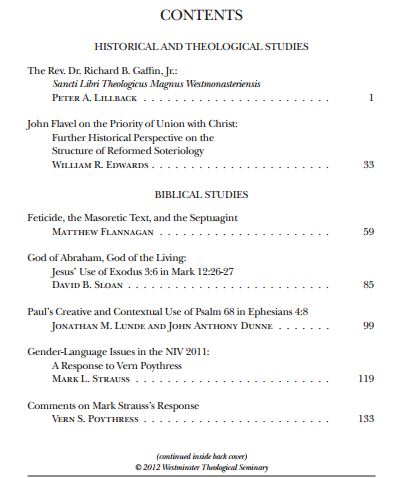
  • Published: “Feticide, the Masoretic Text, and the Septuagint” in The Westminster Theological Journal

    Matt’s article “Feticide, the Masoretic Text, and the Septuagint” is now available in Vol 74, No. 1 – Spring 2012 of The Westminster Theological Journal.

    The Westminster Theological Journal

    An abstract of “Feticide, the Masoretic Text, and the Septuagint” follows:

    A long Christian tradition of moral reflection on feticide interprets feticide, the killing of a formed conceptus, as a violation of  God’s law against homicide. In her book, Our Right to Choose, Beverly Harrison attempts to undercut this tradition of interpretation.

    Harrison alleges that the Alexandrian argument is based on a mistranslation of the Hebrew text. Harrison’s argument is based on apparent discrepancies between the Septuagint (LXX) and the Masoretic Text (MT) over the rendering of Exod 21:22-25. She makes three claims. Firstly, she suggests that Christian prohibition of feticide is based upon the LXX. Secondly, that the MT, which in her view accurately captures the original law, did not consider feticide a major crime. Thirdly, she argues that the LXX mistranslates this law and incorporates a prohibition of feticide into the text that is not there.

    In response I examine whether each of Harrison’s contentions is correct. From the outset I grant Harrison’s assumption that the MT accurately captures the original and that the LXX is the later translation. I also grant her point that the argument has origins in Alexandrian Judaism and the LXX. The discussion then asks whether each of Harrison’s other claims is correct. Does the MT consider feticide a minor crime? And does the LXX misinterpret the original?

    I defend a negative answer to both questions.