Category: Atheism

  • Walter Sinnott-Armstrong and the Moral Scepticism Objection to Divine Commands

    In responding to William Lane Craig’s advocacy of a Divine Command Theory (DCT) Walter Sinnott-Armstrong makes the objection that,“The divine command theory makes morality unknowable.”

    He makes the following argument for this:

    To see why, consider whether or not it is immoral to eat pork. If the divine command theory is correct, we cannot answer this question simply by pointing out that eating pork causes harm to pigs or to us, unless we already know that God commanded us to avoid such harm. We also cannot know wether it is immoral to eat pork on the basis of other’s testimony or our own moral intuitions if we have no reason to think their testimony or our intuitions map onto divine commands, and we cannot have any such reason without knowing what God commanded. Thus, on Craig’s theory we cannot know what is morally wrong, if we cannot know what God commanded. Unfortunately, however we have no sound way to determine what God commanded.1

    Sinnott-Armstrong’s argument here is as follows:

    [1] If DCT is correct then we cannot know an action is wrong unless we know God prohibited it.

    [2] We have no sound way to determine what God has commanded or prohibited.

    From these it is concluded that

    [3] If DCT is correct we cannot know an action is wrong.

    In support of [1] he offers two premises,

    [1a] If DCT is correct then we cannot know an action a is wrong because it has property p, unless we know that God prohibits p

    [1b] If DCT is correct, then we cannot know an action a is wrong, on grounds g, unless we know that g “maps on to divine commands”.

    One serious problem with this argument is that [1] is false, as are the supporting premises [1a] and [1b]. According, to the DCT of Adams, Alston, and Evans, which Craig appropriates, the property of being wrong is constituted by the property of being contrary to Gods commands in the same way that the property of being water is constituted by the property of being H20. Sinnott-Armstrong thinks holding that moral duties are constituted by Gods commands, means, one cannot know if an action is wrong unless one knows it was forbidden by God. This seems to presuppose the following inference :

    I1: If A is constituted by B, then one cannot know if something is an A unless one knows it is a B.

    However, I1 is false. Consider the following counter example; water is constituted by H20. Yet people for thousands of years could perceive water, drink it, detect it, and use it etc without knowing anything about atomic theory. This example shows people can know something is an A (water), A can be constituted by something B (H20) and people not know A is a B.

    The same is true for [1a], the DCT claims that wrongness is constituted by God’s prohibition, Armstrong seems to think this means we cannot know if an action is wrong on the basis of some feature of that action unless we know that feature is prohibited by God. This seems to presuppose a similar inference

    I2: If A is constituted by B then we cannot know something is an A on the basis of it possessing p, unless we know that B has p.

    But again there are obvious counter examples to I2. Water is constituted by H20, if I2 is true it would follow one cannot tell that the cup of liquid I am drinking is water because of its taste unless I know that H20 tastes that way. But this is clearly false. Medieval men could recognize by taste a cup of water as well as any modern person despite not knowing anything about H20.

    [1b] faces similar difficulties, here Armstrong thinks, that if our duties are constituted by divine commands, this entails that we cannot know that an action is immoral on the basis of some ground, such as intuition or testimony, unless we have reasons for thinking that ground “maps onto divine commands”. But why think this? The argument seems to rely on the following inference

    I3. If A constitutes B, then one cannot know B exists on ground g, unless one has reason for thinking g reliably tracks A.

    But this is also false. Take the example I mentioned above. There are people do not know about atomic theory and yet know on the basis of perception that the glass in front of them contains water. These people do not need to have reasons for thinking that their eyesight tracts hydrogen and oxygen atoms before they can rationally trust their senses, they know about water quite independently of any knowledge about hydrogen or oxygen.

    So [1], [1a] and [1b] are all false. The error in each instance is the same, Armstrong assumes that the metaphysical claim that our duties are constituted by God’s commands entails that we cannot recognize or know whether an action is wrong unless we know what God commanded. This however is to conflate moral ontology with moral epistemology.

    Similar problems afflict Sinnott-Armstrong’s advocacy of [2] that “we have no sound way to determine what God commanded.” Immediately after making this claim Armstrong defends it by claiming the arguments from natural theology fail, he then states

    Theists often tell us what God commands, as if they knew, and the commands they ascribe to God are often (though not always) plausible. However, what makes us and them accept that God commands those actions rather than others is that we already and independently had a reason to think that certain acts are immoral. Assuming God is good, of course God would command us not to rape. But the only way we know God would issue that command is that we already know rape is wrong. There is no way to know what God does or would command without already knowing what is right or wrong.2

    Here Sinnott-Armstrong seems to contradict [2] when he contends that it’s plausible to claim God commands us not to rape and seems to countenance the conclusion that we can know what God would command on the basis of justified moral beliefs. But if this is true then [2] is false. Of course Sinnott-Armstrong contends such knowledge is dependent on moral beliefs and not revelation or natural theology. But, that is incompatible with [2], [2] does not state that we can’t know through revelation or natural theology it states we can’t gain such knowledge at all.

    Some of what Sinnott-Armstrong states here suggests he may have a different argument in mind. In “Morality: Religious and Secular”, Patrick Nowell-Smith refers to an argument that is “familiar to philosophers but of which the force is not always appreciated” which Smith contends refutes a divine command theory, the argument is:

    [We] must be persuaded independently of his goodness before we admit his right to command. We must judge for ourselves whether the Bible is the inspired word of a kind and benevolent God or a curious amalgam of profound wisdom and gross superstition. To judge this is to make a moral decision, so that in the end, so far from morality being based upon religion, religion is based upon morality.3

    James Cornman and Keith Lehrer have expressed essentially the same line of critique.4 I think this critique is based on a failure to make an important distinction. Take the claim that right and wrong is independent of God’s commands. This claim is ambiguous; it could mean (a), that ones knowledge of right and wrong is independent of ones knowledge of what God commands or (b), that right and wrong exist independently of God’s commands. The first claim states that beliefs about right and wrong are epistemologically independent of beliefs about divine commands. The second is that the existence of moral properties such as right and wrong are ontologically independent of God’s commands.

    Now the DCT denies (b). Divine command theorists claim that wrongness is constituted by the property of being contrary to God’s commands. Hence it postulates an ontological dependence between divine commands and moral properties such as wrongness. The arguments of Nowell-Smith above however do not refute this claim. If they show anything, they show not that (b) is the case but that (a) is the case. Nowell-Smith and Sinnott-Armstrong show that we can know what is right and wrong independently of knowing or believing in the existence of divine commands. Hence they show at most an epistemological independence.

    Showing that beliefs about right and wrong are epistemologically independent of beliefs about God’s commands does not show that right and wrong are ontologically independent of God’s commands unless epistemological independence entails ontological independence. The objector here assumes that if my knowledge of something does not depend upon my knowledge of something else then the two things can exist independently of each other.

    Again this assumption is false. The property of being water is constituted by the property of being H20; as such H20 and water are not ontologically independent. Yet, as noted, for thousands of years people could perceive water, drink it, detect it, and use it etc without knowing anything about atomic theory. Hence, our knowledge of water is independent of our knowledge of H20. Yet this fact does not mean that water is not constituted by H20. Sinnott-Armstrong’s objection therefore fails; it is hard to avoid Craig’s assessment that Sinnott-Armstrong’s critique is “pervaded by the conflation of moral ontology with moral epistemology.”5

    1. Walter Sinnott-Armstrong “Why Traditional Theism Cannot Provide an Adequate Foundation for Morality” in Is Goodness without God Good Enough: A Debate on Faith, Secularism and Ethics, Eds. Robert K Garcia and Nathan L King (Lanham: Rowan & Littlefield Publishers, 2008) 109.
    2. Ibid 110.
    3. Patrick H. Nowell-Smith, “Morality: Religious and Secular,” in Christian Ethics and Contemporary Philosophy, ed. Ian T. Ramsey (London: SCM Press, 1966) 97.
    4. James W Cornman & Keith Lehrer, Philosophical Problems and Arguments (New York: MacMillan, 1979) 429.
    5. William Lane Craig “This Most Gruesome Guests” in Is Goodness without God Good Enough: A Debate on Faith, Secularism and Ethics, Eds. Robert K Garcia and Nathan L King (Lanham: Rowan & Littlefield Publishers, 2008) 168.

    RELATED POSTS:
    Walter Sinnott-Armstrong on God, Morality and Arbitrariness
    Van Inwagen, Divine Duties and the Deontological Argument from Evil
    Walter Sinnott-Armstrong and Infantile Religious Morality
    Tooley, Plantinga and the Deontological Argument from Evil Part I
    Tooley, Plantinga and the Deontological Argument from Evil Part II

    Tooley, The Euthyphro Objection and Divine Commands: Part I
    Tooley, The Euthyphro Objection and Divine Commands: Part II
    Walter Sinnott-Armstrong, William Lane Craig and the Argument from Harm Part I
    Walter Sinnott-Armstrong, William Lane Craig and the Argument from Harm Part II
    On a Common Equivocation

  • Watch the Video of “The New Atheism, Science & Morality” with Glenn Peoples

    The unofficial video of Glenn Peoples’ talk at Auckland Uni “The New Atheism, Science & Morality” is online.

    Hat Tip: E†B

  • Contra Mundum: Selling Atheism

    New Zealand motorists will have noticed a new genre of advertising billboards, those attempting to sell the concept that there is probably no God. These billboards are the collective efforts of the New Zealand Atheist Campaign, The Humanist Society and the New Zealand Association of Rationalist Humanists. Like all advertising campaigns, these billboards offer clever-sounding slogans, which are indicative of the philosophy of the seller – in this case three variants of popular ‘new-atheist’ arguments. Like any consumer, I want to read the product labelling a little deeper before I consider buying. So here I intend to unpack the slogans and take a look at the implicit reasoning behind each.

    Each billboard has the tagline “There’s probably no God. Now stop worrying and enjoy your life.” My first thought on seeing this was that authors must find atheism psychologically liberating. We do not have to worry that there is a God and that means that we can enjoy ourselves but why would the existence of God be something to worry about? Is it the moral accountability that goes with it? If God exists then we might have to worry that He has seen what we have done in secret, and being free from this worry enables us to enjoy our lives. If this is so then prima facie this suggests that guilt is a major motivation behind, at least some peoples, atheism.

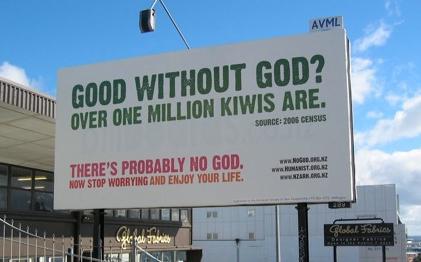
    The tagline aside, let’s look at the three slogans currently affronting us as we navigate our cities. The billboard on Auckland’s Newton Rd states, “Good without God? Over One Million Kiwis Are. Source:2006 Census.”

    Good without god?

    Here we are told that one million kiwis are good without God because the census says so. Now a lot could be said about the appeal to the census here, I don’t recall a question on it asking me if I was good and even if it did I am not sure that we should take too much from self-reported assessments of people’s own integrity. Let’s assume, however, that the billboard makes a fair claim. The inference is still is fallacious. What the census shows is not that one million kiwis are good without God, rather, it shows that one million kiwis are good without believing in the existence of God. But to say that one can be good without believing in God is not the same as saying that one can be good without God. Many people throughout history have been able to live and breath without believing in the existence of hydrogen and oxygen atoms yet it does not follow that they could live without hydrogen and oxygen.

    I am still left wondering how the fact that people do not need to believe in something to do good deeds renders the belief false? For centuries people have done good deeds and lived good lives without believing in heliocentricism or quantum mechanics, should we conclude that these theories are therefore ‘probably false’? Surely we are not being asked to buy that the basis of our beliefs should be what is useful or helpful as opposed to what is true?

    Perhaps the sellers mean to convey something else. Some Christian thinkers such as William Lane Craig, Robert Adams, Stephen Layman, Alvin Plantinga, John Hare and Philip Quinn have argued that moral properties such as right and wrong depend on God for their existence. Atheist writers such as Paul Kurtz and Christopher Hitchens retort that this claim is falsified by the existence of morally upright atheists. I suspect something like this is meant by the slogan on the billboard, it repeats Hitchens’ and Kurtz’s retorts as though they said something insightful or clever.

    This retort misses the point. Craig, Adams, et al are not claiming that one needs to believe in God to be good – a point made several times in the literature (and particularly made so many times to Kurtz that it beggars belief that he keeps repeating it) rather, their claim is that moral properties, such as right and wrong, depend on God for their existence. This is not the same thing, we know that water depends for its existence on the existence of hydrogen and oxygen, this does not mean, however, that we need to believe in the existence of hydrogen and oxygen in order to effectively recognise and use water. Ancient and medieval people were drinking, washing in, swimming in and sailing on water centuries before the discovery of contemporary atomic theory.

    This is a fairly basic and elementary distinction in the literature. How exactly expressing a common philosophical confusion counts as reason for thinking “there probably is no God” is hard to see.

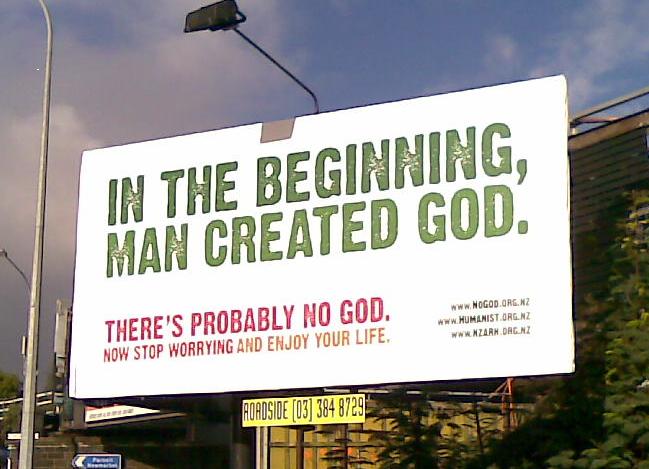
    Parnell Rise’s billboard informs us “In the Beginning Man Created God.”

    In the beginning man created god

    This one asserts that man created God. Now if one takes this statement in an absurdly literal manner (the way many sceptical organisations approach parables, hyperbole and poetry in the Bible) we find that atheists are telling us that God actually exists. I have no issue with the slogan at this juncture, however, the idea that God was created by human beings is clearly absurd. God is typically defined as an all-powerful, all-knowing, immaterial, necessarily-existent being who created the world and who sustains everything in it. Now if one is going to claim that humans actually created an all-powerful, all-knowing, immaterial, necessarily-existent who created and sustains the world, then they are contradicting themselves. Humans are part of the world and therefore cannot have created the being that created the world – otherwise humans would have to exist prior to their own existence.

    Of course to interpret this billboard in this way would be uncharitable. The authors of this billboard probably do not mean to say that humans actually created God, they do not think He exists after all. Their claim is that humans created the idea or concept of God and developed it. This is undoubtedly true. Of course, humans also invented the idea or concept of atoms as well – ancient Greek philosophers came up with the basics of this concept millennia ago – but this fact tells us nothing about whether or not the idea or concept humans developed actually corresponds to anything in reality. To assume that it tells us something about whether the idea or concept is true is a fairly obvious case of what logicians call the genetic fallacy.

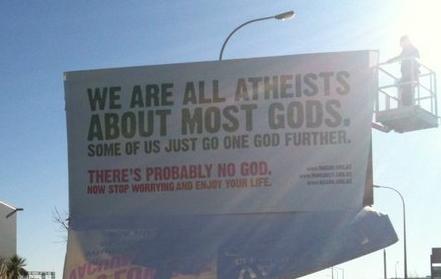
    The last one is my favourite, “We Are All Atheists About Most Gods. Some of Us Just Go One God Further.”

    We are all atheistsTo see the problems with this slogan take out the term “God” in the sign and replace it with some other term such as “non-Christian perspective.” When we do this we get: “We all reject most non-Christian perspectives, some of us just reject one more.” This argument has true premises, do we now have, a knock-down argument for Christianity?

    Similarly, an analogous argument form with true premises gives us an argument for nihilism, the denial that humans have moral duties, the total denial of the existence of morality. “We are all nihilists about some conceptions of morality, some of us are just nihilistic about one more.”

    The same argument for also furnishes a refutation of secularism, “we all reject some secular perspectives on reality, some of us just reject one more.” I could go on.

    Taking a stand on any issue of philosophical substance, whether by affirming, denying or simply being sceptical of it, is to put oneself in opposition to any number of other people and groups who take a contrary stance. That’s life. Such pluralism hardly provides a reason for thinking “there probably is no God” any more than it gives us a reason to doubt any other perspective on the world.

    So what do the atheist billboards do? Well the first one tells us that some atheist groups conflate basic philosophical distinctions and do not really understand the debate they are contributing to. The second shows us that these groups think contradictions and obvious fallacies are some how savvy and smart. The last shows us that they think that invalid argument forms, forms from which you could infer the denial of anything and everything by substituting one true premise with another, are avant-garde. All in all, pretty accurate advertising for these groups.

    I write a monthly column for Investigate Magazine entitled Contra Mundum. This blog post was published in the Sept 10 issue and is reproduced here with permission. Contra Mundum is Latin for ‘against the world;’ the phrase is usually attributed to Athanasius who was exiled for defending Christian orthodoxy.

    Letters to the editor should be sent to:
    editorial@investigatemagazine.DELETE.com

    RELATED POSTS:
    Contra Mundum: Did God Command Genocide in the Old Testament?
    Contra Mundum: Fairies, Leprechauns, Golden Tea Cups & Spaghetti Monsters
    Contra Mundum: Secularism and Public Life
    Contra Mundum: Richard Dawkins and Open Mindedness
    Contra Mundum: Slavery and the Old Testament

    Contra Mundum: Secular Smoke Screens and Plato’s Euthyphro

    Contra Mundum: What’s Wrong with Imposing your Beliefs onto Others?
    Contra Mundum: God, Proof and Faith
    Contra Mundum: “Bigoted Fundamentalist” as Orwellian Double-Speak
    Contra Mundum: The Flat-Earth Myth
    Contra Mundum: Confessions of an Anti-Choice Fanatic
    Contra Mundum: The Judgmental Jesus

  • Recycling The Dawkins Delusion

    Browsing the archives this morning I stumbled accross this gem, The Dawkins Delusion, which Matt originally published here some three years ago back before we had much of a readership so a lot you may have missed it. It is seriously clever and funny – go see!

  • Dr Glenn Peoples on Science and Morality, Sam Harris & the Claims of the New Atheism @ Auckland Uni

    Christian philosopher and blogger Dr Glenn Peoples is coming to Auckland to give a public talk entitled “Science and Morality: Is there a Naturalistic Basis of Moral Truth?” This talk will examine the claims of the new atheism, particularly the work of Sam Harris. Dr Peoples will ask, can the natural world tell us what is right and wrong, without need for God? Can moral facts be grounded scientifically? He will argue that the attempt to ground morality outside of God ultimately fails. An opportunity for questions and answers will follow the talk.

    Science and Morality

    The talk will be held at the University of Auckland on Monday 6 September from 7-9pm in LIB 15 (in the main campus library basement at 5 Alfred St, Auckland City). Admission is free and is open to anyone. We do advise that you arrive early to locate parking and to obtain a good seat.

    If you enjoyed the panel discussions and the debate we organised earlier this year on Auckland’s campus, you should enjoy this event.

    Dr Glenn Peoples is a graduate in theology (BD) from the Bible College of New Zealand and has a masters degree (MTHeol) and a doctorate in philosophy from the University of Otago. For over ten years he has been writing and speaking, both in New Zealand and abroad, on intellectual issues that Christians face, including the place of faith in the public square, justice and human rights and the reasons for Christian belief. He lives in Dunedin with his wife Ruth and their four children and he blogs at “Say Hello to my Little Friend: The Beretta Blog and Podcast“

    This event is brought to you by Thinking Matters, in association with Evangelical Union. Here is the event’s Facebook Page.

  • There’s Probably No God? Fisking Atheist Billboards

    On the way back from Bloggers drinks we drove past one of the controversial atheist advertising billboards, put up by NZ Atheist Campaign, The Humanist Society and NZARH, which have appeared around Auckland. This appears to have come on the back of the Richard Dawkins inspired bus advertising that made headlines earlier this year. It is worth fisking them a bit.

    Here is a pic of the first one.

    Good Without God? Over One Million Kiwis Are.

    Here we are told one million kiwis are good without God because the census says so. This, however, is fallacious. What the census shows is not that one million kiwis are good without God, it shows that one million kiwis are good (although this is granting a lot for the sake of argument) without believing in the existence God. But to say one can be good without believing in God is not the same as saying one can be good without God. Many people throughout history have been able to live and breath without believing in the existence of hydrogen and oxygen atoms, it does not follow that they could live without water.

    Moreover, it is hard to tell what the point of this sociological fact is anyway. Why does the fact that people do not need to believe in something to do good deeds mean that the belief is false? For centuries people have done good deeds and lived good lives without believing in evolutionary theory or quantum mechanics, should we conclude that these theories are therefore ‘probably false’? Surely these atheists are not suggesting that our beliefs should be based on what is useful or helpful as opposed to what is true or false?

    Perhaps the atheists here mean to convey something else. Some Christian thinkers such as William Lane Craig, Robert Adams, Stephen Layman, Alvin Plantinga, John Hare, Philip Quinn have argued that moral properties such as right and wrong depend on God for their existence. Atheist writers such as Paul Kurtz and Christopher Hitchens retort that this claim is falsified by the existence of morally upright atheists. I suspect something like this is behind the slogan on the billboard, it repeats Hitchens and Kurtz’s retorts as though they said something insightful or clever.

    The problem is, as any one familiar with this discussion should know, this retort misses the point (as I pointed out in On a Common Equivocation). Craig, Adams, et al are not claiming that one needs to believe in God to be good (a point made several times in the literature and particularly made so many times to Kurtz that it beggars belief that he keeps repeating it) rather their claim is that moral properties, such as right and wrong, depend on God for their existence.

    This is a fairly basic and elementary distinction in the literature. How exactly expressing a common philosophical confusion counts as reason for thinking “there probably is no God” is hard to see.

    Let’s look at the next one.

    In the Beginning, Man Created God.

    What is asserted here? That man created God. This, however, is clearly absurd. God is typically defined as an all-powerful, all-knowing, immaterial, necessarily-existent being who created the world. Now if one is going to claim that humans actually created an all-powerful, all-knowing, immaterial, necessarily-existent who created the world, then they are contradicting themselves.

    Humans are part of the world and therefore cannot have created the being that created the world – otherwise humans would have to exist prior to their own existence.

    Similarly, one cannot create a necessary being, this would entail it is possible for a necessary being to not exist, in which case it would not be a necessary being. Taken in a straight-forward, literal manner (the way freethinkers are so fond of taking every passage in the Bible) this billboard simply asserts contradictions.

    Of course, the authors of this billboard probably do not mean to say humans actually created God, they do not think he exists after all. Their claim is that humans created the idea or concept of God and developed it. This is undoubtedly true. Of course, humans also invented the idea or concept of atoms as well, ancient Greek philosophers came up the basics of this concept millennium ago. This trivial fact tells us nothing about whether or not the idea or concept humans developed actually corresponds to anything in reality. To assume that it tells us something about whether the idea or concept is true or false is a fairly obvious case of the genetic fallacy.

    So the second billboard either asserts a contradiction or it is a clear case of a logical fallacy.

    The last one is my favourite.

    We are all atheists about most gods. Some of us just go one god further.

    I am inclined to think the argument on this sign is invalid. To see why let’s take out the term “God” in the sign and replace it with some other term such as “non-Christian perspective.” When we do this we get: “We all reject most non-Christian perspectives, some of us just reject one more.” This argument has true premises, do we now have, a knock-down argument for Christianity?

    Similarly, an analogous argument form with true premises gives us an argument for nihilism, the total denial of the existence of morality. “We are all nihilists about some conceptions of morality, some of us are just nihilistic about one more.”

    The same argument for also furnishes a refutation of secularism, “we all reject some secular perspectives on reality, some of us just reject one more.” I could go on.

    Taking a stand on any issue of philosophical substance, whether by affirming, denying or simply being sceptical of it, is to put oneself in opposition to any number of other people and groups who take a contrary stance. That is life. Such pluralism hardly provides a reason for thinking “there probably is no God” any more than it gives us a reason to doubt any other perspective on the world.

    So what do the atheist billboards do? Well the first one tells us that some atheist groups conflate basic philosophical distinctions and don’t really understand the debate they are contributing to. The second shows us that these groups think contradictions and obvious fallacies are some how savvy and smart. The last shows us that they think that invalid argument forms, forms from which you could infer the denial of anything and everything by substituting one true premise with another, are avant-garde.

    All in all, pretty accurate advertising for these groups.

    Hat tip: MCAS

  • Contra Mundum: Fairies, Leprechauns, Golden Tea Cups & Spaghetti Monsters

    That belief in God is on par with belief in fairy tales is a fairly common charge levelled at Christianity. Highly regarded atheist Philosopher Michael Tooley argues,

    If there is no evidence in support of the existence of God, then it is reasonable to believe that God does not exist. The essential line of thought which I would hope to develop later on is that if you consider other things like fairies, leprechauns, golden teacups orbiting around Venus, and so on, I would suggest that we have no evidence against the existence of those sorts of things, but if I asked you whether you were agnostic I think the answer would be “no.” You would believe there are no fairies, no leprechauns, no golden teacups orbiting around Venus. That illustrates the general principle in regard to God’s existence that the burden of proof must fall upon the person who is arguing in support of God’s existence. If there’s no positive support for it, then the other side wins by default.

    Something like Tooley’s argument regularly features in popular discussions of religion where fairies, leprechauns and golden tea-cups are substituted for flying spaghetti monsters. The basic idea remains the same, to believe in God without providing compelling arguments or evidence for his existence is on par with believing in fairy tales and this is something no sensible, educated, intelligent person can take seriously.

    To address this argument it is first necessary to unpack it. Three separate claims are being made; first, it is assumed that the rational stance to take towards the existence of fairies, leprechauns, orbiting golden tea-cups and spaghetti monsters is not a stance of agnosticism but one of certain denial. Second, it is contended that the reason why this stance is correct is not because we have reasons for believing such things do not exist, but rather that we lack any positive evidence for the existence of these things. Third, the objector assumes that a person who advocates or defends belief in God, in the absence of compelling evidence for God’s existence, has no principled way of distinguishing the case for God from the case for the existence of fairies, leprechauns, et al. Now I grant the first of these claims, it is obviously silly and irrational to believe in things like fairies, leprechauns, orbiting golden tea-cups and spaghetti monsters. The real issue is whether the second and third claims are correct; I will argue that they are not.

    Turning to the second claim that the reason it is irrational to believe in fairies, leprechauns, et al is solely because we lack evidence for their existence and not because we have reasons for thinking that they do not exist. I am inclined to think this claim is false. Consider another claim for which we also lack evidence for thinking is true, that intelligent extra-terrestrial life (ET’s) exists somewhere in the universe. We lack compelling reasons for thinking this claim is true yet it seems mistaken to infer from this that such beings absolutely do not exist, at best all that we can say is that we do not know. Moreover, even in face of agnosticism, many scientists take the existence of ET’s quite seriously; for example, the SETI research site in California spends millions of dollars sending messages into outer space and searching the universe for signs of intelligent life. I note that they do not do the same in pursuit of the search for signs of fairies, leprechauns, orbiting tea-cups or spaghetti monsters and I cannot find any evidence of an agency anywhere in the world that does.

    This example suggests that the reason it is rational to deny the existence of the stuff of fairy tales cannot be simply the lack of positive evidence for these things, if it was we would take the same stance towards ET’s yet we do not. This is because there are important differences between ET’s and fairies, leprechauns, et al over and above the mere lack of evidence we have for their existence. ET’s are the sort of things that could exist even if we lack evidence that they do. ET’s fit with the picture of the world we hold, we know that intelligent life can evolve on planets. This is not the case with fairies, leprechauns, orbiting tea-cups, spaghetti monsters and so on.

    Leprechaun’s first appeared in fairy tales and folklore; in such tales they store their wealth in pots of gold at the end of rainbows. We know that the genre of fairy tales is fantasy. We know rainbows do not have ends in the way this picture envisages. Similarly tea-cups we know are artefacts made by human beings, seeing humans have not been to Venus it is unlikely that such things orbit Venus – even if they are made of gold. It is not just that we lack evidence for the existence of such things but that we have evidence against their existence. What we do know about the world provides us with reasons for doubting they can exist. With ET’s, on the other hand, we have no such reasons for doubting they can exist. Hence, in the latter case agnosticism is justified whereas denial is required in the former case.

    The insinuation that belief in God is on par with belief in fairies, leprechauns, et al is equally questionable. In the case of these things we have no evidence for their existence. With God, however, the situation is different. It is not that no evidence exists; on the contrary, sophisticated and rigorous arguments for God’s existence have been offered and are still being offered in the literature today, it is that experts in the field are divided on the cogency of these arguments. The best that sceptics can suggest is that the evidence is inconclusive. However, even if we grant this, those who defend belief in God can and have offered principled distinctions between God and things like flying spaghetti monsters.

    Two examples will suffice. The first stems from a tradition going back to William James and Blaise Pascal is that when one cannot avoid making a choice, one can act in hope or faith that a belief is true, even if there is no evidence for it, if the expected benefits of the thing hoped for outweigh the benefits of the alternatives. James Jordan provides an example,

    A castaway builds a bonfire hoping to catch the attention of any ship or plane that might be passing nearby. Even with no evidence that a plane or ship is nearby, he still gathers driftwood and lights a fire, enhancing the possibility of rescue. The castaway’s reasoning is pragmatic. The benefit associated with fire building exceeds that of not building, and, clearly, no one questions the wisdom of the action.

    Pascal argued that if one acts on the assumption that God exists and that assumption turns out to be incorrect then one has lost little but if one acts on the assumption that God does not exist and that assumption turns out to be incorrect the one has lost everything. Modified versions of this line of argument are still defended by philosophers today.

    A second reason is that even if one has insufficient evidence for the truth of some proposition, one can be rational in believing it if it is grounded directly in one’s experience. There are plenty of things we believe which are not based on evidence, our belief in the existence in the past or our belief that it is wrong to rape women, our belief that other people exist or that basic axioms of logic are true are not based on arguments or proofs. These things are true because we experience or see them to be true, for example, I remember the existence of a past event, I intuitively conclude that rape is wrong, I observe that other people exist, I see that basic axioms of logic are self-evident. Philosophers such as Alvin Plantinga argue that belief in God is like these beliefs; it is something a person directly sees as true via direct experience or intuition of some sort as opposed to the conclusion of an evidentiary proof.

    I am not in a short article like this going to be able to develop and defend these lines of argument further. I mention them only to show that according to two standard ways of defending belief in God in the face of inconclusive evidence a principled distinction between belief in God and the stuff of fairy tales can be made. People tend to not directly experience or perceive the existence of these things nor does one risk losing everything by acting on the assumption they do not exist. Moreover, if belief in fairies, leprechauns, orbiting tea-cups and spaghetti monsters did possess these features then it is no longer obvious that belief in such beings is irrational. Suppose that instead of there being no evidence for the existence of leprechauns there was in fact some evidence but it was not compelling, perhaps experts were in disagreement. Suppose also that if I failed to act on the assumption that leprechauns existed and it turned out that they did then I would lose everything but if it turned out that they did not I would gain little. In addition, suppose that I directly perceived a leprechaun in front of me or I remembered clearly seeing one a few days ago and I had no reason for thinking my perception or memory was unreliable. If these conditions were satisfied then it would cease to be obvious that belief in leprechauns was obviously irrational. The claim that believing in God is on par with believing in “fairies, leprechauns, golden teacups orbiting around Venus” and flying spaghetti monsters is then unjustified.

    I write a monthly column for Investigate Magazine entitled Contra Mundum. This blog post was published in the July 10 issue and is reproduced here with permission. Contra Mundum is Latin for ‘against the world;’ the phrase is usually attributed to Athanasius who was exiled for defending Christian orthodoxy.

    Letters to the editor should be sent to:
    editorial@investigatemagazine.DELETE.com

    RELATED POSTS:
    Contra Mundum: Secularism and Public Life
    Contra Mundum: Richard Dawkins and Open Mindedness
    Contra Mundum: Slavery and the Old Testament

    Contra Mundum: Secular Smoke Screens and Plato’s Euthyphro

    Contra Mundum: What’s Wrong with Imposing your Beliefs onto Others?
    Contra Mundum: God, Proof and Faith
    Contra Mundum: “Bigoted Fundamentalist” as Orwellian Double-Speak
    Contra Mundum: The Flat-Earth Myth
    Contra Mundum: Confessions of an Anti-Choice Fanatic
    Contra Mundum: The Judgmental Jesus