Recently, I gave a talk at New Hope Community Church in East Auckland. This talk was on the topic “Is Jesus the only way? I attach it here.
Category: Faith and Reason
-
Thinking Matters Talk: Does Morality Need God? Part One
This year the New Zealand apologetics organization Thinking Matters, ran a “Confident Christianity Conference” in Auckland. I was asked to speak at this conference on the topic. Does Morality Need God? Below is a slightly streamlined version of the talk I gave.
“If God does not exist, then everything is permissible.” These words from Ivan Karamazov in Dostoevsky’s The Brothers of Karamazov express a widely held intuition that moral requirements depend upon God’s existence. Most contemporary ethicists today would dismiss this intuition. In this talk, I will argue their dismissal is premature. I will defend what philosophers call a divine command theory of ethics. The thesis that moral wrongness is (identical to) the property of being contrary to God’s commands.[1] Where God is understood, in orthodox fashion, as a necessarily existent, all-powerful, all-knowing, essentially loving and just, immaterial person who created and providentially ordered the universe.
Note three things about this thesis:
First, it is a thesis about the nature of moral requirements. It is not a thesis about the nature of goodness. The concept of “good, is ambiguous, as is seen by the following statements “I had a really good dip in the spa pool last night,” Or “going on a low carb diet is good for you.” Or “Carlos the Jakal was a good hitman.” The concept of the morally obligatory, or morally required, is not identical to the concept of what it is good to do. It might be good, even saintly, for me to give a kidney to benefit a stranger, but it is not an act I am obliged to do.[2]
Second, my thesis is that the property of being morally required is
 “identical” to the property of being commanded by God. I am not saying that people cannot know what is right and wrong unless they believe in God. Nor am I claiming that the word “wrong” means “contrary to God’s command.” These are distinct claims. Consider light; Light is identical to a certain visible range of the electromagnetic spectrum. But obviously, that isn’t the meaning of the word “light.” People knew how to use the word “light” long before discovering its physical nature. And they knew the difference between light and darkness long before they understood the physics of light. Analogously, we can know the meaning of moral terms like “right” and “wrong” and know the difference between right and wrong without being aware that the moral requirements are God’s commands.[3]
Third, this is a thesis about the relationship between God and morality. It is not a claim about the relationship between the bible and morality. The thesis I laid out does not mention any sacred text such as the Bible, Quran, Hadith, Torah, or Talmud. While many divine command theorists accept that God has revealed his commands in an infallible sacred text, some do not. The claim that God’s commands are contained in some sacred text is not part of or entailed by a divine command theory itself. It is the result of other theological commitments they have. One could consistently be a divine command theorist without holding this. Divine command theories are ecumenical; they have had advocates within the Christian, Islamic, Jewish, and even deist traditions.
Having clarified my thesis, I will defend three contentions.
- Secular accounts of morality cannot coherently account for our fundamental intuitions about moral requirements.
- If God exists, then a divine command theory can coherently account for our fundamental intuitions about moral requirements.
- Standard objections to divine command theories fail.
I. Four Assumptions about Moral Requirements
But first, what do I mean by fundamental assumptions? Moral theories are tested, in part, by how well they account for various assumptions about morality implicit in our moral thought and practice. [4] I will begin by listing four plausible assumptions about the type of requirements morality imposes upon us.
One is that moral requirements are inescapable: they apply to us irrespective of whether following them contributes to any ends or aims we currently desire. Consider a criminal who stands in the dock convicted of a crime; he openly admits the crime, is unrepentant and informs us that he wanted to kill and torture. Doing so did not frustrate any of his desires. Does our moral condemnation of him depend on us assuming he does not have statistically abnormal desires so that we withdraw this judgment when we discover he really does desire to kill and maim? Moral requirements can’t be escaped or begged off by noting they don’t fulfill one’s goals or ends. [5]
Second moral requirements are requirements that are justified from an impartial point of view. Peter Singer explains:
The ‘Golden Rule’ attributed to Moses, to be found in the book of Leviticus and subsequently repeated by Jesus, tells us to go beyond our own personal interests and ‘love thy neighbour as thyself’ – in other words, give the same weight to the interests of others as one gives to one’s own interests. The same idea of putting oneself in the position of another is involved in the other Christian formulation of the
 commandment, that we do to others as we would have them do to us. The Stoics held that ethics derives from a universal natural law. Kant developed this idea into his famous formula: ‘Act only on that maxim through which you can at the same time will that it should become a universal law.’ Kant’s theory has itself been modified and developed by R. M. Hare, who sees universalisability as a logical feature of moral judgments. The eighteenth -century British philosophers Hutcheson, Hume, and Adam Smith appealed to an imaginary ‘impartial spectator’ as the test of a moral judgment, and this theory has its modem version in the Ideal Observer theory. Utilitarians, from Jeremy Bentham to J. J. C. Smart, take it as axiomatic that in deciding moral issues ‘each counts for one and none for more than one’; while John Rawls, a leading contemporary critic of utilitarianism, incorporates essentially the same axiom into his own theory by deriving basic ethical principles from an imaginary choice in which those choosing do not know whether they will be the ones who gain or lose by the principles they select…. One could argue endlessly about the merits of each of these characterisations of the ethical; but what they have in common is more important than their differences. They agree that an ethical principle cannot be justified in relation to any partial or sectional group. Ethics takes a universal point of view[6]
Third moral requirements have practical authority: agents always have conclusive reasons to do what is morally required and never have sufficiently good reasons for doing what is morally wrong. Someone has conclusive reasons to act in a certain way when the reasons in favor of acting, taken together, are stronger than any set of reasons we may have to act in some other way. If we don’t always have conclusive reasons to do what is right, having total allegiance to morality will be arbitrary and, at worst irrational. We will have no more reason to do what is right than wrong. Or doing the right thing will be doing what we have a most reason not to do.[7]
Moral requirements are supposed to answer questions about what we are to do. They are considerations that guide our actions. When we learn something is wrong, that tells us what we are not to do. They cannot do this if we lack conclusive reasons to do what they say. Suppose you and I are discussing whether it is my duty to donate to the red cross. You convinced me it is my duty to do so. The red cross knocks on my door. I refuse to donate. I suspect this would puzzle you; didn’t I concede that I had a duty to do it? If I responded with “yes, I am persuaded it is my duty to do it, but that doesn’t mean I have reasons to do it,” I suspect you would think I was missing something. I would deny moral requirements have any authority or claim on my behavior and don’t address the question, “what ought I do?”.[8]
Or suppose you heard that I had resigned from my high-paying job. You think I am nuts. How am I going to provide for my family? Why would I give up the career I always dreamt of? I tell you, I discovered the firm was engaging in unethical business practices, and I had to resign to avoid being complicit. On hearing this, wouldn’t it now make sense that I did this? I was justified in doing so. If you do, you are assuming that the fact an action is wrong justifies my refraining from doing it.[9]
Fourth, a final assumption is that if something is morally required, we are accountable for doing it in an important sense. John Stuart Mill famously stated,
“We do not call anything wrong unless we mean to imply that a person ought to be punished in some way or other for doing it—if not by law, by the opinion of his fellow creatures, if not by opinion, by the reproaches of his own conscience. This seems the real turning point of the distinction between morality and simple expediency.”[10]
There is a conceptual link between something being morally obligatory and something being blameworthy. If we do what is morally wrong without excuse, others can legitimately blame us, and guilt is warranted. Moral requirements conceptually are demands people make upon one each, which we can hold each other accountable through demanding an excuse, practices of blaming, criticizing, and guilt.
Robert Adams asks us to imagine a situation in which there are compelling reasons to support you not walking on the lawn. However, these reasons give you no grounds for feeling guilty if you do, and they provide no reasons for other people to make you feel like you must stay off the lawn or to blame and reproach you for doing so. Adams concludes that while there would be a sense in which you ought not to walk on the lawn, you have no obligation not to do so.[11]
So, whatever property moral wrongness is, it is the property of being prohibited by certain standards: standards that are inescapable and justified from an impartial point of view. The fact these standards prohibit an action means agents have conclusive reasons not to do the action in question. Agents are also accountable for actions doing actions prohibited by these standards. Others can blame and sanction me if I act contrary to them without an adequate excuse. A plausible thesis about the nature of moral wrongness should account for these facts.
In my next post, I will defend my first contention: that secular accounts of morality struggle to coherently account for these four assumptions.
[1] Robert M. Adams, “Divine Command Meta-Ethics Modified Again,” Journal of Religious Ethics 7:1 (1979): 76.
[2] Example from C. Stephen Evans, Kierkegaard’s Ethic of Love: Divine Commands and Moral Obligations (Oxford: Oxford University Press, 2004), 16.
[3] This illustration comes from William Lane Craig see “Is Is the Foundation of Morality Natural or Supernatural? The Craig-Harris Debate” available at https://www.reasonablefaith.org/media/debates/is-the-foundation-of-morality-natural-or-supernatural-the-craig-harris-deba/) accessed 19 August 2022.
[4] The implicit method here is described in Richard Joyce’s “Theistic Ethics and the Euthyphro Dilemma,” Journal of Religious Ethics 30 (2002): 68-69;”
[5] Richard Joyce, “Mackie’s Arguments for an Error Theory,” Stanford Encyclopaedia of Philosophy (available at https://plato.stanford.edu/entries/moral-anti-realism/moral-error-theory.html, accessed 20/4/17).
[6] Peter Singer, Practical Ethics (Cambridge: Cambridge University Press, 1993), 11
[7] This argument is adapted from C. Stephen Layman’s “God and the Moral Order” Faith and Philosophy, 23 (2006): 306- 307
[8] This example comes from Michael Smith’s The Moral Problem (Oxford: Blackwell Publishing 1994) 6
[9] This example comes from C Stephen Layman’s “A Moral Argument for The Existence of God” Is Goodness without God Good Enough: A Debate on Faith, Secularism and Ethics eds Robert K Garcia and Nathan L King (Lanham: Rowman & Littlefield Publishers, 2008) 53-54
[10] John Stuart Mill, Utilitarianism, chapter 5 available at https://www.utilitarianism.com/mill5.htm accessed 23 August 2022
[11] Robert M. Adams, Finite and Infinite Goods: A Framework for Ethics (Oxford: Oxford University Press, 1999) 238.
-
Matt Speaks at Orewa Community Church.
I was scheduled to speak on the topic “The Holy Spirit teaches” at Orewa Community Church on Sunday September the 26th. Because the government ordered New Zealand into lockdown six weeks ago, and has maintained Auckland in lockdown since, I had to do the message in an ad hoc manner by video.
The message is available below, the quality is not as good as I would have liked. But I think it is good enough for general consumption.
-
Does the Incommensurability of Prudential and Impartial rationality avoid the dualism of Practical Reason?
I have been discussing the dualism of practical reason. As I understand it, this is an inference from three premises:
[1] We always have most reason to do what is morally required
[2] An act is morally required if and only if it is impartially demanded: demanded by rules justified from a perspective of impartial benevolence.
[3] If there are cases where, what is impartially demanded of a person, is an action contrary to their long-term self-interest, then the strongest reasons do not always favour what is impartially demanded.
The conclusion: unless we assume that requirements of self-interest never substantially conflict with impartial demands, we can only coherently affirm [1] and [2]. Seeing [1] is a plausible thesis about the authority of requirements, and [2] is a plausible thesis about their content. Our fundamental moral intuitions about morality cannot be reconciled.
One response to this argument is to deny [3]. This involves contending that impartial requirements are overriding: If impartial and prudential requirements clash, the former always take precedence. In my last post, I mentioned an argument made by Stephen Layman against this contention. Layman asks us to consider the case of Ms Poore;
Ms. Poore has lived many years in grinding poverty. She is not starving, but has only the bare necessities. She has tried very hard to get ahead by hard work, but nothing has come of her efforts. An opportunity to steal a large sum of money arises. If Ms. Poore steals the money and invests it wisely, she can obtain many desirable things her poverty has denied her: cure for a painful (but nonfatal) medical condition, a well-balanced diet,
 decent housing, adequate heat in the winter, health insurance, new career opportunities through education, etc. Moreover, if she steals the money, her chances of being caught are very low, and she knows this. She is also aware that the person who owns the money is very wealthy and will not be greatly harmed by the theft. Let us add that Ms. Poore rationally believes that if she fails to steal the money, she will likely live in poverty for the remainder of her life. In short, Ms. Poore faces the choice of stealing the money or living in grinding poverty the rest of her life. In such a case, I think it would be morally wrong for Ms. Poore to steal the money; and yet, assuming there is no God and no life after death, failing to steal the money will likely deny her a large measure of personal fulfillment, i.e., a large measure of what is in her long-term best interests[1].
Layman takes this case to illustrate that impartial requirements are not overriding. If there are cases where impartial demands require us to make a great sacrifice that confers relatively modest benefits on others, the strongest reasons do not support complying with impartial demands.[2]
Peter Bryne has criticised Layman’s example. He writes:
Layman’s way of approaching his moral argument suggests the following picture: rational agents are aware of a variety of reasons for action. They see prudential reasons vying with moral reasons. They measure whether moral reasons for doing something outweigh prudential reasons for not doing it, and they follow that set of reasons which is stronger overall. Now it is time to ask the question “From what standpoint does Layman’s rational agent weigh or measure reasons for action?[3]
Bryne thinks this is question raises an important challenge:
The unclarity in the language of weighing reasons for action, and of judging which reasons are stronger than others, lies in the fact that such language implies a common, neutral means of measuring the reasons. The very contrast, however, between morality and self-interest suggests that there can be no such means. The agent is faced with a choice between points of view and perspectives. From within a point of view or perspective, there can be weighing. What remains a mystery is how any agent could measure the relative strengths of the two kinds of consideration from neither the moral or prudential point of view but from a neutral standpoint.[4]
Bryne’s criticism seems to be this. Layman example imagines an agent “weighing” impartial reasons against prudential reasons against each other and attempting to answer the question as to which reasons are stronger or take precedence. This implies there is some rational perspective, which is neutral between prudence and impartial demands, which can weigh and adjudicate them in a conflict.
Bryne thinks this is misleading. The clash between prudential and impartial reasons involves a clash between requirements justified by incommensurable points of “points of view” or “perspectives”. These points of view are perspectives on what interests to take into account and how much weight to give them. The impartial point of view is a perspective that takes into account everyone’s interests and forms a conclusion based on giving these interests equal weight and consideration. From this point of view, you always have decisive reasons to do what is impartially required. By contrast, the prudential point of view is a view that only gives takes into account the interest of the individual agent and gives equal weight to the future and past interests of this individual agent. From this perspective, you should always act in your long-term self-interest.
Because these are differing perspectives on what interests to take into account and how much weight to give conflicting interests, there can be no question-begging way of weighing the conclusions of each procedure against each other. You can weigh reasons for and against actions in accord with one or more of these perspectives. You can have allegiance to one or both perspectives, and weigh from that perspective. One can also give up allegiance to one perspective in favour of another. But, when they clash, you cannot accept both perspectives simultaneously and weigh them against each other.
I am inclined to think Byrne’s response here misses the point. Consider how Ms Poore’s case appears on Bryne’s analysis. Ms. Poore “faces the choice of stealing the money or living in grinding poverty the rest of her life”. However, you analyse this; she still has to choose what to do in this situation; she must act one way or the other. In Bryne’s terms, we can ask Which perspective should she use in making the decision and weighing the relevant factors. Which point of view should she give allegiance to? Which should she give up allegiance to? Bryne’s analysis seems to imply there is no reason one can give for or against either answer. There is no “rational” or “neutral point of view” by which she can make this choice. The implication is that Ms Poore does not have stronger or weightier reasons to do what is impartially required. This isn’t because prudential reasons sometimes outweigh or trump impartial reasons, but because one cannot coherently claim one is weightier than the other without begging the very question at issue.
Concerns about the dualism of practical reason are concerns about a specific sort of practical dilemma. Suppose it is not always in one’s long-term self-interest to act according to impartial demands. This will mean impartial demands sometimes come into conflict with prudential requirements. When they do, we face the question: What reason is there to act impartially, rather than in one’s self-interest. What reason do we have for assuming that impartial demands are always stronger or weightier than prudential requirements when the two clash? The concern is that no answer to this question is forthcoming. If impartial and prudential requirements cannot be weighed against each other, then its hard to see how the former can always be weightier or take precedence in a clash. If they are incommensurable, we cannot have reasons for preferring one to the other.
Several commentators argue that this is precisely Sidgwick’s point when he agonised over the dualism of practical reason[5]. Note the argument Sidgwick gives for [3]
[U]nless the egoist affirms, implicitly or explicitly, that his own greatest happiness is not merely •the rational ultimate end for himself but •a part of universal good; and he can avoid the ‘proof’ of utilitarianism by declining to affirm this. Common sense won’t let him deny that the distinction between himself and any other person is real and fundamental; so it puts him in a position to think: ‘I am concerned with the quality of my existence as an individual in a fundamentally important sense in which I am not concerned with the quality of the existence of anyone else’; and I don’t see how it can be proved that this distinction ought not to be taken as fundamental in fixing the ultimate goal of an individual’s rational action… If an egoist isn’t moved by what I have called proof, the only way of arguing him into aiming at everyone’s happiness is to show that this gives him his best chance of greatest happiness for himself. And even if he admits that the principle of rational benevolence is self-evident, he may still hold •that it is irrational for him to sacrifice his own happiness to any other end;[6]
Here, Sidgwick imagines an “egoist”: someone who has “given allegiance” to the prudential point of view and weighs reasons in accord with this perspective. This egoist discovers that an impartial point of view would prohibit some action. Does the egoist have any reason to heed this prohibition? Sidgwick argues that, unless it can be shown that doing so is in his interest, the answer is no. From the egoist’s “perspective” or “point of view,” the effects of the action on his long-term interests is the only factor that carries weight in the decision. Providing does not implicitly give allegiance to an impartial point of view, or he is willing to give up any allegiance he does have to it; he will have no reason to do what is impartially required. Nor does he have any question-begging reason why he should switch allegiance to this point of view.
On this interpretation: the dualism of practical reason is the problem that impartial and prudential requirements are requirements justified from incommensurable points of view. Because human beings recognise both prudential and impartial reasons for acting in their practical reasoning, they implicitly give allegiance to both. This is not a problem if their requirements are consistent. But if they contradict each other, we will be rationally committed both to both doing and not doing the same action. The incommensurability of these perspectives means there is no rational basis for resolving the contradiction in favour of impartiality. Sidgwick writes:
[W]here we find a conflict between self-interest and duty, practical reason, being divided against itself, would cease to be a motive on either side. The conflict would have to be decided by which of two groups of non-rational impulses had more force. So we have this: •The harmony of duty and self-interest is a hypothesis that is required if we are to avoid a basic contradiction in one chief part of our thought.[7]
We can put it this way: Either prudential and impartial reasons are commensurable, or they are incommensurable. If they are commensurable, then when these requirements clash, we will need some reason for thinking that impartial reasons are always weightier. The Ms Poore case suggests this is not the case. By contrast, suppose that prudential and impartial requirements are incommensurable perspectives, and we cannot weigh them against each other. If they clash, we will have to choose which perspective to follow, and we will have no reason to follow one or the other. It will simply be an arbitrary act of allegiance. Either way, we will lack decisive reasons always to do what is impartiality required.
[1] C. Stephen Layman “God and the Moral Order” Faith and Philosophy, 23 (2006): 307
[2] Layman, “God and the Moral Order” 308
[3] Peter Bryne “God and the Moral Order: A Reply to Layman” Faith and Philosophy, 23:2 (2006): 201
[4] Bryne, “God and the Moral Order: A Reply to Layman” 206-207:
[5] See for example, Derek Parfit On What Matters (Volume 1) (Oxford: Oxford University Press : 2011) 130-134. See also Francesco Orsi, “The Dualism of the Practical Reason: Some Interpretations and Responses” Etica & Politica / Ethics & Politics, 10:2 (2008): 25-26
[6] Henry Sidgwick, The Method of Ethics, 242 available at https://www.earlymoderntexts.com/assets/pdfs/sidgwick1874.pdf accessed 20/3/21
[7] Henry Sidgwick, The Method of Ethics, 284 available at https://www.earlymoderntexts.com/assets/pdfs/sidgwick1874.pdf accessed 20/3/21
-
Divine Command Theory and the Euthyphro Dilemma: Part III
This is a talk I gave to the Philosophy Club at Glendale Community College in Phoenix, Arizona, this weekend. The talk was followed by a long discussion with some faculty, students at the college, and others who zoomed in.
In this talk, I introduced and defended a divine command theory of ethics. I divided the talk into three parts. In section I, I set out what modern divine command theories of ethics typically contend. I distinguished this from some common misunderstandings in section II. In Section III, I discussed the Euthyphro dilemma. I will suggest this objection is not the conclusive rebuttal it is often assumed to be. In my first post, I reproduced sections I and II. My second post began my discussion of the Euthyphro objection in section III. This post continues that discussion.
In my last post, I argued that a divine command theory does not entail the content of morality is arbitrary, in the sense that anything at all could be right or wrong. It entails that an action can only be permissible, only in situations where it is possible for a fully informed, rational, loving and just person to command it knowingly. Far from being absurd, this implication is entirely plausible.
Some have objected that divine command theory makes morality arbitrary in a different sense. It means there is no reason why one action is right or wrong rather than another. Russ Shafer-Landau presses the following dilemma: “Either there are, or there are not, excellent reasons that support God’s prohibitions. If there are no such reasons, then God’s choice is
 arbitrary, i.e. insufficiently well supported by reason and argument.” [1] Alternatively:
If God is, in fact, issuing commands based on excellent reasons, then it is those excellent reasons and not the fact of God’s having commanded various actions, that make those actions right. The excellent reasons that support the requirements of charity and kindness are what make it right to be charitable and kind.[2]
We can summarise this argument as follows, take a paradigmatically immoral action such as rape.
(P1) Either (a) God has a reason for prohibiting rape, or (b) God has no reason for prohibiting rape.
(P2) If God has no reason for prohibiting rape, then God’s commands are arbitrary.
(P3) If God has a reason for prohibiting rape, then that reason is what makes rape morally wrong.
(P4) If something distinct from God’s commands is what makes rape morally wrong, then the divine command theory is false.
(C1) Either morality is arbitrary, or the divine command theory is false
This argument is based on a subtle equivocation. (P3) and (P4) refer to what “makes” something morally right. But the word “makes” is ambiguous.
In this context, Stephen Sullivan has argued that the word “make” can be used in two different senses.[3] The first sense refers to what Sullivan calls a constitutive explanation: On a hot February day, I pour a glass of water to drink it and quench my thirst. There is a legitimate sense in which I can say that what makes me pour a glass of water is the fact that I am pouring a glass of H20. When I speak like this, I use the word “makes” to refer to a relationship of identity. I am explaining one thing (the pouring of the water) but citing the existence of another thing that I take to be identical with it.
The second sense involves what Sullivan calls a motivational explanation, such as when I state that what makes me pour a glass of water is the fact that I am thirsty. Motivational explanations do not explain an action by referring to something taken to be identical with it. Instead, they attempt to tell us why an agent acted the way they did by giving us the reasons and motivations the agent acted upon.
Let’s assume that Landau is using the word “makes” in the “motivational” sense. The inference is:
(P1) Either (a) God has reasons for prohibiting rape, or (b) God doesn’t have reasons for prohibiting rape.
(P2) If God doesn’t have reasons for prohibiting rape, then God’s commands are arbitrary.
(P3)’ If God has reasons for prohibiting rape, then those reasons motivationally explain why rape is morally wrong.
(P4)’ If something distinct from God’s commands motivationally explain why rape is morally wrong, then a divine command theory is false.
(C1) Either morality is arbitrary, or the divine command theory is false.
On this interpretation of the argument (P3)’ is plausible. Suppose God has reasons for issuing the commands he does, and the property of being wrong is identical with the property of being contrary to God’s commands. In that case, these reasons do provide a motivational explanation as to why rape is wrong. However, (P4′) is false. The fact that God’s prohibition does not motivationally explain the wrongness of rape is wrong does not entail that the prohibition is not identical to the moral wrongness of rape. Divine command theories contend that wrongness is identical with the property of being contrary to God’s commands. So it only in the constitutive sense of the word “makes” that they deny anything other than God’s commands “make” actions wrong.
Consequently, For Shafer-Landau’s argument to have a bite, he must use the word “makes” to refer to a constitutional explanation. So interpreted, the argument is:
(P1) Either: (a) God has reasons for prohibiting rape, or (b) God doesn’t have reasons for prohibiting rape.
(P2) If God doesn’t have reasons for prohibiting rape, then God’s commands are arbitrary.
(P3)” If God has reasons for prohibiting rape, then those reasons are identical with the property of moral wrongness.
(P4)” If something distinct from God’s commands is identical with the property of moral wrongness, then a divine command theory is false.
(C1) Either morality is arbitrary, or the divine command theory is false.
On this interpretation (P4)” is plausible, if something distinct from God’s prohibition is identical with wrongness. God’s prohibition cannot be identical with wrongness.
However, now (P3)” turns out to be implausible. Why should the fact that God has reasons for issuing a command mean that those reasons are identical with the property of being morally wrong? The Landau seems to assume the following inference: If A is identical to B, and someone has reasons r for bringing about B, then A is identical with r. However, this inference is invalid. An analogy will show this; A Batchelor is identical to an unmarried man, John has reasons for being unmarried, he dislikes women. Does it follow that the property of being a Bachelor is identical with the property of disliking women?[4]
Landau’s argument, therefore, is unsound. Graham Oppy proposes a more direct argument for the conclusion that a divine command theory makes morality arbitrary:
Could it have been, for example, that murder, rape, lying, stealing and cheating were good because God proclaimed them so? Surely not! But what could explain God’s inability to bring it about, that murder, rape, lying, stealing and cheating are good by proclaiming them so, other than its being the case that murder, rape, lying, stealing and cheating are wrong quite apart from any proclamations that God might make?[5]
However, this is implausible. Suppose God has character traits such as being essentially loving and just. In that case, God can and would have reasons for prohibiting actions like rape, murder, or cheating, quite apart from whether these actions are antecedently wrong. Antecedent to any command on God’s part, these actions won’t have the property of being morally prohibited. But they could still have other properties such as being cruel or harmful or unjust or detrimental to human happiness— or being expressions of hatred, for example. And a loving and just God could prohibit these actions because these actions have these non-moral properties.
Consequently, divine command theories do not entail that morality is arbitrary. If anything, the opposite is the case. A divine command theory entails that actions will be wrong in virtue of certain non-moral properties those actions have. Non-moral properties that would provide an informed, loving and just person with reasons for prohibiting those actions.
[1] Russ Shafer-Landau, “Introduction to Part IV,” in Ethical Theory: An Anthology, ed. Russ Shafer-Landau (Malden MA: Blackwell Publishing, 2007), 237.
[2]Ibid., 238.
[3] Stephen Sullivan, “Arbitrariness, Divine Commands, and Morality,” International Journal of Philosophy of Religion 33:1 (1993): 33-45.
[4] These points are made cogently by Stephen Sullivan, “Arbitrariness, Divine Commands, and Morality,” 37-39. See also Matthew Flannagan’s, “Is Ethical Naturalism More Plausible than Supernaturalism: A Reply to Walter Sinnott-Armstrong,” Philo 15:1 (2012): 19-37.
[5] Graham. Oppy, Best Argument against God (Hampshire: Palgrave Pivot, 2014), 44.
-
Divine Command Theory and the Euthyphro Dilemma: Part II
This is a talk I gave to the Philosophy Club at Glendale Community College in Phoenix, Arizona, this weekend. The talk was followed by a long discussion with some faculty, students at the college, and others who zoomed in.
In this talk, I introduced and defended a divine command theory of ethics. The talk was divided into three parts. In section I, I set out what modern divine command theories of ethics typically contend. I distinguished this from some common misunderstandings in section II. In Section III, I discussed the Euthyphro dilemma. I will suggest this objection is not the conclusive rebuttal it is often assumed to be. In my first post, I reproduced sections I and II. This post will begin my discussion of the Euthyphro objection in section III.
 In my last post, I argued that semantic and epistemic objections to a divine command theory fail. However, the most famous and important objection to divine command theories is an argument known as “The Euthyphro Objection”. After a dialogue written by the ancient Greek philosopher Plato in the 4th century BC. Plato’s original argument is somewhat obscure and applied only to polytheistic religions (those religions that believe in many gods). However, the version used by philosophers today is an adaptation of Plato’s argument for use against monotheistic faiths. Critics of divine command theories appeal to three arguments that are loosely associated with Plato’s dialogue. These are (1) the anything goes objection, (2) the arbitrariness objection, and (3) the vacuity objection. I will take each in turn.
The Anything Goes Objection
One objection is that a divine command theory makes morality arbitrary in the sense that anything at all could be right or wrong. King and Garcia explain the alleged problem in this way:
[Divine command theory] implies that it is possible for any kind of action, such as rape, not to be wrong. But it seems intuitively impossible for rape not to be wrong. So [Divine command theory] is at odds with our common-sense intuitions about rape.[1]
We can formalise the objection as follows:
(P1) If the divine command theory is true, then whatever God commands is morally required.
(P2) God could command rape.
(C1) So, if the divine command theory is true, rape could be morally obligatory.
(P3) But rape could not be morally obligatory.
(C2) Therefore, the divine command theory is false.
In response, divine command theorists have contested (P2) Divine command theorists do not contend that moral requirements are dependent upon the commands of just anyone. They base moral obligations on the commands of God conceived in a particular way. God is an all-powerful, all-knowing, essentially loving, just, immaterial person who created the universe on their conception. Once we realize this, the horrendous deeds objection appears to be unsound.
We can put this in terms of a dilemma: consider (P2): (P2) only holds if it is possible for a fully informed, rational, loving and just person to knowingly command rape. However, this is unlikely. Critics cite examples of rape because they view it as an action that no virtuous person could ever knowingly entertain. So (P2) appears to be false. However, suppose; I am mistaken about this. It is possible for an essentially loving and just person to command rape. Rape, then, would only be commanded in situations where a just and loving person aware of all the relevant facts could endorse it. Under these circumstances, it is hard to see how (P3) could be maintained.
Once we realize that God, as conceived by the divine command theorist, is essentially loving and just, it is difficult, if not impossible, to see how both (P2) and (P3) can be true. Whatever reasons we have for thinking (P2) is true seem to undermine (P3). By contrast, whatever reasons we have for accepting (P3) undermine (P2).
[1]Nathan L King, “Introduction”, in Is Goodness without God Good Enough: A Debate on Faith, Secularism and Ethics, eds. Robert K Garcia and Nathan L King (Lanham: Rowan & Littlefield Publishers, 2008), 11.
-
“Robust Ethics and the Autonomy Thesis” published in Philosophia Christi
Matt’s article, “Robust Ethics and the Autonomy Thesis: A reply to Erik Wielenberg” has been published in the wi
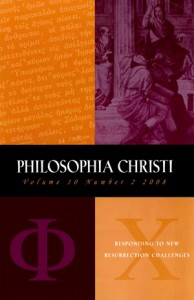 nter issue ( Vol 19 Num. 2 – Winter 2017) of Philosophia Christi. An overview of the contents of the full issue can be found here. The editor has given Matt permission to upload the article in a couple of months. For now here is the abstract:
In his monograph, Robust Ethics: The Metaphysics and Epistemology of Godless Normative Realism, Erik Wielenberg offers arguably one of the most sophisticated defenses of the autonomy thesis to date. Wielenberg argues that (I) the divine command theory is problematic because it cannot account for the moral obligations of reasonable unbelievers; (II) Godless normative robust realism (GRNR) can be formulated in a way that avoids the standard objections to the autonomy thesis; and (III) GRNR provides a better account of intrinsic value. In this paper, I will argue Wielenberg’s defenses of the autonomy thesis fails. I will argue that his objection to divine command theories fails, that he fails to address two standard challenges to the autonomy thesis adequately, and, finally, that Wielenberg fails to show that GRNR better accounts for the intuition that certain things are intrinsically good than various forms of theistic alternatives.


