Category: Religion in Public Life

  • Rawls on Religion and Public Life Part 2

    In part 1, I outlined Rawls’ position on Religion and Public Life and now I will offer some critical comments on this position drawing from Nicholas Wolterstorff.

    There are numerous problems with Rawls’ contention here. Wolterstorff sums some of them up.

    Suppose, then, that someone has followed that strategy; she has analyzed our political mentality into its constituent ideas and has elaborated these ideas into principles of justice. I submit that no matter what those resultant principles of justice may be, the reasonable thing for her to expect is not that all reasonable people who use their common human reason will agree with her results, but that not all reasonable people will agree. It would be utterly unreasonable for her to expect anything else than disagreement. The contested fate of Rawls’ own principles of justice is an illustrative case in point. There’s no more hope that all those among us who are reasonable and rational will arrive, in the way Rawls recommends, at consensus on principles of justice, than that we will all in the foreseeable future, agree on some comprehensive philosophical or religious doctrine.[1] [Emphasis original]

    Here Wolterstorff emphasises two points. Firstly, he suggests that the contents of public reason are such that it is to be expected that reasonable people will disagree over them. Secondly, Wolterstorff hints that this renders Rawls’ position incoherent. Rawls rejects appeals to comprehensive doctrines because people can reasonably reject them and there is a duty to not decide questions of basic justice this way.[2] If this is true then we should reject appeals to public reason as well; in fact, we have a duty to not follow public reason. However, if we cannot follow public reason and we cannot follow comprehensive doctrines, we are left with nothing; few restrictive laws or policies could be morally justified. This is precisely the implication that Quinn suggested.

    Wolterstorff’s argument depends on his claim that it is reasonable to expect disagreement over the contents of public reason. He cites Rawls’ own theory of justice in support of this. In A Theory of Justice, Rawls attempts to develop an account of basic justice based on public reason.[3] However, there is widespread disagreement amongst reasonable people not only over the conclusions reached but the methods and implicit principles themselves.

    Of course, merely appealing to one case is unpersuasive; it is possible this is a single anomaly. However, in an earlier work Wolterstorff cited other examples where public reason appeared unable to be used in a manner that would be agreed upon by reasonable people.[4] In “The Role of Religion in Political Issues,” Wolterstorff cites the work of Kent Greenawalt to illustrate that not only is public reason incapable of resolving questions of contentious political issues but also on many issues it is “simply irrelevant”,[5] public reason has “nothing to say”.[6]

    For example, Wolterstorff refers to the debate about whether the state has a duty to provide social welfare.[7] In this debate not only is there disagreement about the conclusions but also debate about the very basic principles or concepts involved. Both supporters and opponents of state welfare appeal to such things as ‘freedom’ and ‘equality’ but have radically different conceptions as to what freedom and equality are. Also involved in this debate are different assumptions about whether there are property rights and if there are, how such rights are weighed against social utility. It is unlikely that the consensus populi, common sense and uncontroversial science provide answers to these questions that all reasonable people would accept.

    Wolterstorff is not alone in these observations. Christopher Eberle makes similar observations about such things as abortion and freedom of religion.[8] De Marneffe argues that on contentious moral and social issues public reason will fail to offer any substantive answer.[9] Jean Hampton suggests that public reason cannot provide an answer to the question of abortion.[10] Quinn makes similar observations.[11] The point is, that if we genuinely limit ourselves to principles upon which no reasonable person can be expected to reject, what we are left with is inadequate to provide answers to many, if any, substantive questions. Only if we supplement these with premises drawn from some comprehensive doctrine will answers be adequate.

    The case of abortion that these authors refer to is particularly instructive. Rawls’s own comments on this issue unwittingly confirm this. When discussing how public reason would address the question Rawls simply asserts that reasonable people will agree that in the early stages of pregnancy the right to equality overrides our due concern for human life. However, he seems to countenance the idea that reasonable people may limit abortion in the second trimester in certain circumstances. Now this, clearly, is not an obvious intuition shared by all reasonable people – unless one wishes to stipulate ‘reasonableness’ to rule out anyone who does not hold Rawls’s substantive normative views on abortion.

    Moreover, it appears that one cannot adjudicate any dispute between Rawls and a critic on this issue without appealing to a comprehensive doctrine. Suppose, for example, that a fetus is a person in the first trimester of pregnancy then Rawls’s suggestion that the value of equality overrides in the first trimester but may not always in the second is false. Why would it be acceptable in the name of equality for a woman to kill a person in one trimester and not the other in otherwise identical circumstances? It seems that Rawls’s intuition is justified only if one assumes that a first trimester fetus is not human. On the other hand, if one assumes that a fetus is human at this point then Rawls’s position is erroneous. Hence, only by addressing this issue can such a debate be settled.

    However, addressing this issue by appealing to public reason or common sense can hardly provide an answer. As Quinn notes, “common sense is divided on or simply perplexed on the question of abortion”.[12] Uncontroversial science can tell us facts of fetal development but it cannot tell us the moral significance of those facts or what facts are important for determining personhood. In addition, there is no consensus populi on this issue; the political culture of many countries is divided on this question. It seems impossible to offer any argument one way or the other without utilising a premise drawn from some comprehensive doctrine over which reasonable people do not agree.

    Similar points apply to Rawls’ claim that a right to abortion is necessary so as to give the right to equality “substance and force”. This follows only if one assumes a particular understanding of equality yet neither the consensus populi nor common sense will produce this conclusion. In fact, it is arguable that much of the popular appeals to equality are confused and ambiguous.[13] Moreover, even if such a consensus on the nature of equality were available, it does not follow that a right to abortion is necessary for giving it force unless one supplements this concept with understandings of sexuality and gender drawn from some comprehensive perspective.[14]

    I do not think abortion is an isolated case. The same would apply to other substantive questions such as homosexual marriage, affirmative action, capital punishment, welfare, etc. Wolterstorff’s contention that public reason will not, un-supplemented with comprehensive doctrines, provide information that all rational people can be reasonably expected to accept or even provide an adequate base for deciding many substantive issues appears justified. If this is so, Rawls’s position is incoherent or ad hoc.

    [1] Wolterstorff, “Why We Should Reject What Liberalism Tells Us,” 174.
    [2] I am grateful for discussions with Dr Glenn Peoples for helping me to develop this argument.
    [3] John Rawls, A Theory of Justice, (Cambridge MA: Harvard University Press, 1971).
    [4] Wolterstorff, “The Role of Religion in Political Issues,” 102-104.
    [5] Ibid., 102.
    [6] Ibid.
    [7] Ibid., 103-104.
    [8] Eberle, Religious Conviction in Liberal Politics, 217-222.
    [9] de Marneffe, “Rawls’s Idea Of Public Reason,” 232-250.
    [10] Jean Hampton, “The Common Faith of Liberalism,” Pacific Philosophical Quarterly, 75 (1994), 208-209.
    [11] Quinn, “Liberalism and Their Exclusions of the Religious,” 149-150.
    [12] Ibid.,150.
    [13] See Louis Pojman, “Theories of Equality: A Critical Analysis,” Behavior and Philosophy 23:2 (1995): 1-27, and his “Equal Human Worth: A Critique of Contemporary Egalitarianism.” http://72.14.209.104/search?q=cache:CvaEU_1lw5IJ:www.louispojman.com/equalworth.pdf+Equal+Human+Worth+Pojman&hl=en&gl=nz&ct=clnk&cd=8.
    [14] See de Marneffe, “Rawls’s Idea of Public Reason,” 234-235.

    RELATED POSTS:
    Rawls on Religion and Public Life Part 1
    Some More Thoughts on Religion and Public Life: Robert Audi’s Critique of Wolterstorff

  • Rawls on Religion and Public Life Part 1

    In a two part series I will reflect on John Rawls’ widely celebrated discussion on religion and public life. In part 1, I will outline Rawls’ position and then in part 2 I will offer some critical comments on this position drawing from Nicholas Wolterstorff.

    One common line of argument for excluding theological premises from public debate is that not everyone accepts the truth of such premises. Any policy decisions based on such a purported divine law would be binding upon these people in spite of the fact they do not accept such theological doctrines.

    One obvious problem with this line of argument is that exactly the same thing can be said about many secular, non-theological, beliefs. Phillip Quinn articulates this point,

    … if the fact that religious reasons can not be shared by all in a religiously pluralistic society suffices to warrant any exclusion of religious reasons for advocating or supporting restrictive laws or policies, then much else ought in fairness also be excluded on the same grounds.[1]

    Quinn notes correctly that secular moral theories such as Utilitarianism or Kantianism, Intuitionism, Socialism, Libertarianism, can all be reasonably rejected in a philosophically-pluralistic society.

    Indeed, it would seem that the appeal to any comprehensive ethical theory, including all known secular ethical theories, should be disallowed on the grounds that every such theory can be reasonably rejected by some citizens in a pluralistic democracy. And if justification of restrictive laws or policies can be conducted only in terms of moral considerations no citizen of a pluralistic democracy can reasonably reject, then in a pluralistic democracy such as ours very few restrictive laws or policies would be morally justified, a conclusion that would, I suspect, be welcome only to anarchists.[2]

    One influential attempt to avoid these problems is proposed by John Rawls in Political Liberalism.[3] Rawls defends the thesis that it is wrong to appeal to religious or theological beliefs in debates pertaining to “constitutional essentials and questions of basic justice”.[4] Rawls does this on the same grounds that Quinn refers to above; such beliefs can be “reasonably rejected by some citizens in a pluralistic democracy”.[5] Rawls states,

    Our exercise of political power is proper and hence justifiable only when it is exercised in accordance with a constitution the essentials of which all citizens may reasonably be expected to endorse in light of principles and ideals acceptable to them as reasonable and rational.[6]

    On the other hand, Rawls concedes Quinn’s point; “it would seem that the appeal to any comprehensive ethical theory, including all known secular ethical theories, should be disallowed on the grounds that every such theory can be reasonably rejected by some citizens in a pluralistic democracy”.[7] Rawls acknowledges this and argues that it is not just wrong to appeal to theological premises but also, “no comprehensive doctrine is appropriate as a political conception”.[8] [Emphasis added] Rawls maintains that contemporary society,

    [I]s always marked by a diversity of opposing and irreconcilable religious, philosophical, and moral doctrines. Some of these are perfectly reasonable, and this diversity among reasonable doctrines political liberalism sees as the inevitable long-run result of the powers of human reason at work within the background of enduring free institutions.[9]

    In summary, Rawls states there is a plurality of comprehensive doctrines that are irreconcilable with each other. Each doctrine is reasonably held by some people and reasonably rejected by others. Yet, respect for others forbids us to appeal to premises that we can expect reasonable people to reject.[10] It follows then, that in questions of “constitutional essentials and questions of basic justice” that no one should appeal to premises that require the truth of a comprehensive doctrine that some people can and/or do reasonably reject.[11]

    However unlike Quinn, Rawls denies that this has anarchistic implications. He rejects Quinn’s claim, as cited above, that this rationale entails that “in a pluralistic democracy such as ours very few restrictive laws or policies would be morally justified”. Instead, Rawls maintains that one can construct answers to “constitutional essentials and questions of basic justice” by utilising what he calls “public reason” the basic idea is that if a people will address basic questions of “constitutional essentials and questions of basic justice” by appealing only to ideas implicit in the shared political culture of society. Nicholas Wolterstorff calls this the “consensus populi”.[12] Rawls explains this process:

    [B]y looking to the public culture itself as the shared fund of implicitly recognized basic ideas and principles. We hope to formulate these ideas and principles clearly enough to be combined into a political conception of justice congenial to our most firmly held convictions. We express this by saying that a political conception of justice, to be acceptable, must accord with our considered convictions, at all levels of generality, or in what I have called elsewhere, ‘reflective equilibrium.’[13]

    In addition to appealing to the consensus populi, public reason can utilise “presently accepted general beliefs and forms of reasoning found in common sense, and the methods and conclusions of science when these are not controversial”.[14] However, in using public reason people, “are not to appeal to comprehensive religious and philosophical doctrines”.[15]

    Continued in part 2.

    [1] Phillip Quinn, “Political Liberalism and their Exclusion of the Religious,” in Religion and Contemporary Liberalism, ed. Paul Weithman (Notre Dame, IN: University of Notre Dame Press, 1997), 144.
    [2] Ibid.
    [3] John Rawls, Political Liberalism (New York: Columbia University Press, 1993).
    [4] Ibid., 214.
    [5] Quinn, “Political Liberalism and their Exclusion of the Religious”, 144.
    [6] Rawls, Political Liberalism, 217.
    [7] Quinn, “Political Liberalism and their Exclusion of the Religious”, 144.
    [8] Rawls, Political Liberalism, 135.
    [9] Ibid., 3-4.
    [10] Christopher J Eberle argues that Rawls’ rationale here is incoherent as it conflicts with the method that purports to justify it. See Religious Convictions in Liberal Politics (Cambridge: Cambridge University Press, 2002), 140-150.
    [11] I am grateful for discussions with Dr Glenn Peoples for helping me to develop this argument.
    [12] Nicholas Wolterstorff, “The Role of Religion in Decision and Discussion of Political Issues,” in Religion in the Public Square; The Place of Religious Convictions in Political Debate, ed. Nicholas Wolterstorff & Robert Audi (Lanham, Md: Rowman and Littlefield Publishers Inc, 1997), 91.
    [13] Rawls, Political Liberalism, 8.
    [14] Ibid., 224.
    [15] Ibid.

    RELATED POSTS:
    Rawls on Religion and Public Life Part 2
    Some More Thoughts on Religion and Public Life: Robert Audi’s Critique of Wolterstorff

  • More on Christians and Bigotry

    Matt’s post on the practice of throwing the bigot label at Christians as a method to silence debate got me thinking. Some of my thinking came out in the comment I wrote on Half Done and in Matt’s comment in the original post but I still feel I have more to say.

    I’m someone who (stating the obvious perhaps) happily walks into the thick of heated and hostile debate. To be more accurate I am someone who willingly does this; I don’t always find it easy or exciting; in fact, sometimes I am terrified. I still my fears by remembering I fear God more than men and by recalling Saphira’s words in Eragon “without fear there cannot be courage.”

    It is true that I am wired that way more than most people and I do enjoy the intellectual challenge but I am still human; my apparent confidence is not always actual and I do find the abuse and the mud difficult to weather, especially when I am abandoned by those who should be standing with me or I see those who share my views believing the lies said about me or those who will only secretly associate with me lest their public image be tarred by mine (funny, given I think I have more respect in the public square than most Christians and in fact my opponents will often try to tar me by suggesting an association with the very people who are so concerned that their good public image might be damaged by an association with me).

    Then there are those who frown on our and others, attempts to engage culture and deem it pointless for a range of reasons. David Farrar (who I do not include in this list but I quote here because his comment is paradigmatic) wrote in More on Abortion,

    In my experience with abortion debates, no-one who is pro-choice or pro-life is open to persuasion to change their views.

    Where David is right is that when debates go around and around on peripheral points and people are emotive and uncritical and go all over the place no one’s point of view changes, if anything the opposite occurs. However, David is wrong if he means that this never happens. Over the years I have seen many people change their positions on abortion and on a number of other polarising topics, simply through exposure to a rigorously reasoned case irregardless of their worldview. Further, I don’t find it that hard to achieve these changes in heart in other people.

    This is in part because arming yourself with the ability to reason gives you an immediate advantage over the majority because the majority are not practised in it, and also because we live in a culture where propaganda and slogans pass for informed comment. Most people know what they are supposed to believe and have a vague idea of why – typically something emotive that sounds like it is a ‘right’ – but the why is frequently not founded on anything of substance and quickly unravels when exposed to critique.

    The worst though are those who buy the lie and sell out their faith. I get most frustrated at my fellow Christians. I expect to not be on the same page with the left and at times the secular right, but Christians are supposed to get it.

    When the bigot label gets hurled amidst the mud and everyone acts all angry and hurt, far too many Christians immediately assume there is truth in what they are being subjected to; their position must be bigoted or maybe it was the approach they got wrong. They accept the criticism, despite the lack of argument or factual basis and modify their own approach and position.

    I suspect that part of this is that Christians themselves are often nice people and they know they must conduct themselves ethically or answer to God so they make that very human mistake, we all make at times, of transposing how they would conduct themselves onto others; thus they swallow the lie and forget the scripural mandate to not entertain accusations of immoral conduct without corroborating evidence. The other part of it is that Christians, like the majority of society, are too uncritical.

    Now it is always worthwhile to check one’s approach is not overly confrontational and is well reasoned and supported but throwing out one’s position or watering it down just because someone abused you and issued a string of unflattering accusations is ludicrous. To the hardened anti-Christian activist the problem is that your are a Christian and you are breathing. So yes, the problem is bigotry but it’s not coming from the Christians.

    It is not that the Christian position needs modifying, these people will hate regardless. Sure, they’ll sometimes back off if the Christian modifies their stance but that’s because the weak, wishy-washy, emotive, irrational position they have moved to lacks credibility outside Christian circles and is no longer effective. Take a look at this post by Kay about Christian websites and see whether it is bigotry or effective cultural engagement that really scares our opponents. [Apologies for using a self-congratulatory example]

    The M & M blog is scarier because their posts almost make sense. ( http://www.mandm.org.nz/ ) Idiocy can be just funny. Even over the top hatred like http://www.godhatesfags.com/ is so extreme that its hard to take it seriously. M&M sound plausible & reasonable but have gaps in logic twisting their reasoning. Slimy.

    But over on http://www.godhatesfags.com/ – the home page of the Westboro Baptist hurch – they’re thanking God for the $US10.9 Million court verdict against them – because it means their message is being spread around the world! Weird.

    For people whose tactic is to paint anyone who offers a credible response to their position as a bigot it serves their interests to ensure that the public square is either dominated by extremists that they can easily discredit and wishy-washy claptrap that lacks credibility; they want credible reasoned critique to go away and they are not going to be tolerant and respectful unless they can neutralise your message.

    Never underestimate the power of a sound argument, never fear entering a debate, though of course pick your battles wisely. Conduct yourself ethically, never let it be personal and always remember that the price of having Christianity’s abusers stop frothing at the mouth is all too often a failure to engage culture and that is a price that is not worth paying. None of us like upsetting people, but the best way to win respect is not to shy away from the argument but to demolish it without getting nasty or personal.

  • Why am I a Bigot?

    I am a Theologian with a strong background in Philosophy; apart from Philosophical Theology, my particular area of interest is Ethics. Given this, I often post my thoughts and reflections on moral issues of various persuasions on this blog. I have discussed the morality of warfare, whether it is sometimes permissible to lie, the morality of torture, capital punishment, the nature of our obligations to the poor.

    On occasions, I discuss issues related to abortion and homosexual conduct something which, I think, is unavoidable if one is a theologian writing from a relatively conservative evangelical perspective. I believe that homosexual conduct is contrary to divine law and I believe that feticide is homicide. The latter claim is not just a casual opinion; I spent some years writing a PhD thesis on the topic and over the last couple of years I have had articles published in this area.

    Now a pervasive response to my position on these issues is that appeals to divine law to condemn practises like feticide or homosexual conduct are really an expression of bigotry. One would think that it would be fairly obvious to people that you don’t refute a position by calling the person who holds it a bigot and it is tempting to dismiss this response as simply a confused ad hominem; the problem is that people do not appear to find this obvious. In my experience, many people even educated people, recoil from considering any argument against feticide or homosexual conduct or listening to theological concerns on these matters because they perceive such positions to be bigoted.

    It’s worth fisking this objection a bit. A good place to start is to ask what does this charge amount to? When someone claims that another is a bigot, what is meant by this? The Pocket Oxford English Dictionary defines a bigot as someone who is obstinate in his or her beliefs and is intolerant of others. Presumably, the objector claims that one who appeals to the law of God to condemn feticide or homosexual conduct (or some other practise celebrated by contemporary liberal secularists) displays or expresses these features – they are both obstinate and intolerant. The accusation clarified, an obvious question arises, why hold this claim?

    Obstinance
    Turning to the issue of obstinance, why must a person who holds these beliefs do so in an obstinate manner? Could they not have come to these beliefs as a result of careful reflection? Alternatively, could they hold to them because they are not convinced the counter arguments are sound? What is needed here is some argument to preclude such options and none is forthcoming.

    I suspect that what lingers behind this accusation is the belief that theologically-based opposition to abortion is obviously mistaken and the case against it so compelling that no rational, informed person could think otherwise. If so, then this is not so much an argument against such appeals but an assumption that those who make them are mistaken on other grounds. The objector should come clean about what these other grounds are and put forward the compelling, unassailable arguments that everyone else should apparently already know about.

    Let me add further that as a person who studies ethics and aspires to be a professional theological-ethicist, nothing is more frustrating than being told by a journalist or a tax lawyer that it’s an obvious fact that a certain theological ethical stance is mistaken. Further, if I think otherwise I must be misinformed and ignorant of the subject, a subject they often have done little or no study on. Perhaps this is one area where a little humility is needed.

    Intolerance
    Turning to the issue of intolerance, let me here just say that, the concern about intolerance implicit in this objection is mistaken. Even if the proponents of more conservative positions were intolerant, this would only constitute an objection to their behaviour if it were first assumed that people have a duty to refrain from intolerance and this assumption is problematic.

    In many contexts intolerance is appropriate and contrary to popular slogans, a virtue. Imagine a society that tolerated rape, child molestation or infant sacrifice? Moreover if unqualified, the assertion that people have a duty to be tolerant entails that one should tolerate intolerance, is deeply paradoxical.

    For this charge to have any substance, the objector needs to specify what sorts of action he or she thinks one should tolerate and which ones are such that intolerance is inappropriate. He or she needs to justify this distinction and then provide reasons for thinking that appeals to divine law in a subject like feticide fall into the latter category yet no argument of this sort has been forthcoming.

    Here us the rub; if feticide is an action on a par with infanticide then intolerance towards it is justified. In asserting that it is not, the objector implicitly assumes that feticide is not homicide without offering argument. Similarly if homosexual conduct is a serious form of sexual immorality, such as incest, bestiality, polygamy or adultery, then intolerance against it is not necessarily wrong. Our society, for example, has laws against incest and bestiality and few contend for their repeal (though the chipping away has begun). Once again, the objector here, in making their charge, assumes that homosexual conduct is not seriously immoral.

    Now it is possible that these assumptions are correct but it is also possible they are not.
    Anyone who appeals to divine law to condemn practises like feticide or homosexual conduct is denying these assumptions. You don’t provide a cogent objection to a position by assuming it is false at the outset and then using this assumption to prove that it is. What is needed is an actual argument for the assumption in the first place. Until some actual argument is forthcoming that demonstrates the falsity of what has been defended, objections based on the notion of tolerance merely beg the question and have no impact on the thesis being advanced.

    I think there is a kind of irony here; often when someone accuses Theologians of bigotry they themselves are simply obstinately assuming that their position is true and their assumption leads them to castigate and refuse to tolerate the opinions or person who expresses dissent to the secular liberal orthodoxy. Here, as elsewhere, the accusation of bigotry is a form of Orwellian double-speak.

  • Voting, the Role of the State and Similarities Between libertarianism and Christianity

    Someone emailed us a while ago asking what the difference was between Matt’s classical liberalism and my libertarianism, where did we part company and why did we define ourselves this way. We never answered because we have never really tried to pin it down before, we knew there we differed on some things and we knew that those difference put us in these particular camps but putting it into words was something we didn’t get to until now.

    We definitely differ; see our respective scores on The World’s Smallest Political Quiz, mouseover to see whose is who’s.

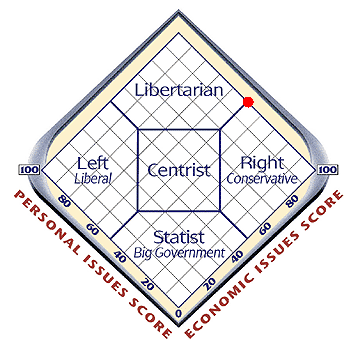
    Madeleine

    Matt

    So I am clearly in the libertarian camp (I am not in the Libertarian camp as in capital L or “Objectivist” (Randian)). Does that mean I can be both Christian and libertarian? Well not if my approach to the role of the state is to simply hold the single absolute principle “that nobody should initiate force against another.” However, yes if the outworking of what I do hold puts me closest to the libertarian perspective than any other position.

    I find the non-initiation of force principle to have no basis in divine or natural law. However, something close to is definitely there and I believe that it is the closest secular position to the correct application of Christianity to the role of state for the following reasons.

    Scripture teaches that it is wrong to kill an innocent human being. This prohibition on killing can plausibly be extended to a prohibition against violence and force in general. This is the heart of traditional Christian positions on war, abortion, euthanasia, capital punishment, etc. The idea is that the state can use retributive force against guilty people but it can never threaten the life, liberty and property of an innocent person unless they engage in unjustified aggression against another. In both situations there are important limits further still, for example, retributive force can only be used by a lawful authority after a impartial trial has found the person guilty the force must be proportionate to the offence and cruel and degrading punishments are illicit. Similarly, with defensive force. It can be used only when it is necessary to stop the aggression and again the force used must be proportionate to the perceived threat.

    A government that limited its use of force to these functions and only taxed its citizens to ensure that these functions were carried out would be severely limited and would look like no current government anywhere, yet this is the Biblical picture and you can see that it does look a lot like the libertarian non-initiation of force principle (and nothing like the strawman-caricature that Rand paints in her books).

    The key passage on the role of the state is Romans 13:1-7:

    Everyone must submit himself to the governing authorities, for there is no authority except that which God has established. The authorities that exist have been stablished by God. Consequently, he who rebels against the authority is rebelling against what God has instituted, and those who do so will bring judgment on themselves. For rulers hold no terror for those who do right, but for those who do wrong. Do you want to be free from fear of the one in authority? Then do what is right and he will commend you. For he is God’s servant to do you good. But if you do wrong, be afraid, for he does not bear the sword for nothing. He is God’s servant, an agent of wrath to bring punishment on the wrongdoer. Therefore, it is necessary to submit to the authorities, not only because of possible punishment but also because of conscience. This is also why you pay taxes, for the authorities are God’s servants, who give their full time to governing. Give everyone what you owe him: If you owe taxes, pay taxes; if revenue, then revenue; if respect, then respect; if honor, then honor.

    This passage spells out the reasons why we are required to obey the government and why we are required to pay taxes. Paul states that governments act as God’s agent, that is on his behalf, to perform a specific function, namely, to punish wrong-doing. Paul emphatically states that the state does not bear the sword, have the power to use force, for nothing but to act as an agent of retributive punishment. It is because it is an agent of God in carrying out this function that it can legitimately demand obedience and financial support. Nothing in this passage provides any basis for claiming that a government that did other things apart from these basic functions and used force to back it up would be acting as God’s agent (in fact the opposite is suggested in 1 Samuel 8:10-22 – any government that taxes its people more than 10% and undertakes functions outside its legitimate mandate is corrupt). If a government steps outside this mandate then it is acting unjustly. The passage states that the government is God’s servant, it is under God and therefore subject to the same laws as its people. In Revelation, written in the latter part as opposed to the earlier part of Nero’s reign, the same ruler is no longer described at God’s servant but as Satan incarnate because he sought to be God, he stepped outside the mandate of legitimate government.

    In summation, if you are a Christian you should either be a libertarian or a classical liberal. You might end up as a conservative if you throw some pragmatism in but if you end up as a centrist or left wing you have failed to understand Scripture, you are placing government in the role of God.

    One of the biggest problems New Zealand faces is the same the world over and was the same at the time of Samuel; the people want a government in the place of God, they want the government to provide welfare, health, education, families commissions, art, television (well maybe not that one at the time of Samuel but you get the picture). It feels and seems easier if we don’t have to take our responsibility to love our neighbour personally.

    Biblically speaking, the state’s role essentially boils down to law, order, justice and defence. Do we then get to forget about all the rest? No.

    “Teacher, which is the greatest commandment in the Law?” Jesus replied: ” ‘Love the Lord your God with all your heart and with all your soul and with all your mind.’ This is the first and greatest commandment. And the second is like it: ‘Love your neighbor as yourself.’ All the Law and the Prophets hang on these two commandments.”

    This means that looking out for others is our responsibility but, contrary to the picture Rand paints, this is strictly qualified. We do not have an obligation to give to everyone who has their hand out. If their own choices and refusal to help themselves has led them to the dire situation they find themselves in then unless they are prepared to get off their buts and help themselves and learn from their mistakes we owe them no charity. If people refuse to help themselves then we are justified in not helping them. The scriptures are full of examples, if people refuse to work then they don’t get to eat (2 Thess 3:10), you left the corners of your crops un-gathered so the poor could come and work and feed themselves – you did not hand them the fruit of your day’s labour while they sunned themselves all day, they had to work for it (Deut 24:19-22), families had to take responsibility for their own, the needy only receive private assistance if they could not work and had no family who would provide for them and were not idle people (1 Tim 5), etc.

    Given this, I have less than a month to decide who I will vote for. The choices below (in the order they appear on the Decision 08 website) are not great because none of them fit the criteria above.

    Resident’s Action Movement
    The Bill and Ben Party
    ACT
    Alliance
    Aotearoa Legalise Cannabis
    Party
    Democrats for Social Credit
    Direct Democracy Party
    Green
    Labour
    Libertarianz
    Maori Party
    National
    New World Order
    New Zealand Pacific Party
    NZ First
    Progressive
    The Family Party
    The Kiwi Party
    The Republic of New Zealand
    Party
    United Future

    Matt and I want to be really careful to not endorse a political party so we are still debating each other as to whether we will publicly state who we vote for but we agree we can take this next step, the first cull, namely getting rid of the no-way, no-how parties and assessing the pro’s and con’s of the remaining possibilities. Our intention is to more thoroughly look at and read up on these parties, their philosophy, their people and their policies. The revised list, and this goes for both of us (at this stage, last election we each voted differently), is this (again the order is the order as above):

    ACT
    Libertarianz
    Maori Party
    National
    New Zealand Pacific Party
    The Family Party
    The Kiwi Party

    Libertarianz and ACT would be the closest to my political position but the points I part ways with them are fairly major. Both parties philosophically adhere to the non-initiation of force but both throw their well reasoned, consistent thinking out the window on the topic of abortion (and a few other issues).

    Rodney Hide spoke at the recent Forum on the Family outlining clear and sensible policies all sharply reasoned, setting aside emotion, appealing to doing what is right, promoting a consistent
    theme of personal responsibility as opposed to state dependency and then when asked for his position on abortion outlined a mushy, soft and sentimental pile of rubbish. Gone was his consistent personal responsibility – non-initiation of force reasoning, suddenly his reasoning skills dropped to that of Sue Bradford’s as he spoke of it being a conscience issue (it is not – abortion is either killing, therefore the initiation of force, 100% homicide or it is not killing and is on par with tonsillectomy’s and there is zero problem with it). Rodney, citing his emotions, said he didn’t want to impose his beliefs onto women (but apparently he can when it is restricting women from, say, theft). [Here are some secular reasons on why libertarians should be pro-life]

    Rodney, ACT and the Libz on this subject are inconsistent. I am not. I have a problem with voting for a party that 1. endorses or is agnostic on homicide (and has no reasoned position that can withstand defeaters justifying their stance) and 2. that is that inconsistent.

    Further, the Libz and to a lesser degree ACT, are riddled with pathological secularists who have a closed, caricatured view of Christianity – extremely closed minded which makes supporting them difficult as many within their ranks refuse to see the similarities and work together. Also the Libz are prone to massive in-house fighting amongst the factions which seriously kneecaps them at times.

    The Maori Party make our list because they get it right on a number of issues, less often than ACT and the Libz, but best demonstrated by their policy on the seabed and foreshore where they are a seemingly lone voice speaking against the Labour government’s worst attack on the right to due process in recent times otherwise known as the Foreshore and Seabed Act 2004 (all Christians should be horrified at the passage of this law). Further we respect Tariana’s daring to cross to Helengrad and the fact that they are, by and large, a party that stands on principles not on popularism and even though many of their principles are too left/statist you have to respect that and you definitely want more politicians like that in parliament.

    National. National is not Labour. If their policies reflected their stated principles I might say more.

    The Christian Parties. First of all, so what if there are three of them? How many secular parties are there? Christians need to get over this. How many denominations of Christianity are there? Demanding that the three merge before you will support them is as ridiculous as refusing to attend church unless every denomination merges. We still somehow manage to be one body despite our differences. As with denomination and church choice, if you want to go there, look at the options and pick the one that best reflects which is right.

    • NZ Pacific. Putting aside the accusations against Taito, remember due process, Taito was part of Labour which makes him left/statist. However, like Tariana he earns brownie points for sticking it to Helengrad and he is a Christian so he makes the cut.
    • The Family Party. Putting aside the Destiny factor, they must be judged on their merits and not a knee-jerk reaction, there have been serious allegations made that they do not adhere to the theological position of separation of church and state, if this is true then they are no go, but again they are a Christian party so we will look at them.
    • The Kiwi Party. Probably the holds the number one spot of the three at this stage but this is the party that has candidates who stood with Labour and were responsible for inflicting the families commission on us and worse they seem to have not learned from their mistakes and are advocating government sponsored marriage promotion. That said their intention is good but like all the other Christian parties they are too statist and fail to understand that only when we get the state out of the lives of good law abiding citizens and when the state stops usurping the role of God can the church really flourish.

    The Christian parties are really disapointing because all of them have access to the truth and have missed it. Contra Celsum writes on the issue of whether Christians should be in politics at all. He outlines four critical reasons why he believes it inappropriate for Christians to seek political office at the present time. His four reasons are right on the button in terms of my issue with our choice of Christian parties, particularly the part on vacuous minds and points 2.d) and e)., I just am really reluctant to concede his conclusion. Am I really in that much of a minority? How did we fall this far?

    1. Whipped parties. In Jerusalem, one of the most important institutions is the believing and confessing heart. In Romans 10: 9,10 we read: “ . . . if you confess with your mouth Jesus as Lord, and believe in your heart that God raised Him from the dead, you shall be saved; for with the heart man believes, resulting in righteousness, and with the mouth he confesses, resulting in salvation.” This means that each individual must be free, as a Christian, to profess and act according to his belief. The institutions of Jerusalem are built on this principle. This is why Luther’s declaration at the Diet of Worms is in accord with the heart of the Gospel and the Kingdom of God:

    Unless I am convinced by Scripture and plain reason – I do not accept the
    authority of the popes and councils, for they have contradicted each other – my conscience is captive to the Word of God. I cannot and I will not recant anything for to go against conscience is neither right nor safe. God help me. Amen.

    But the modern political convention of whipped parties, where one is bound to vote and act, not according to conscience but to the policy of party [this applies equally to parties controlled by churches], means that Christians in the modern political arena are inevitably forced to approbate and vote for actions, laws, and policies which they
    know to be wrong and intrinsically evil.

    Of course, opponents would counter by pointing out that this does not preclude a Christian party from participating, provided that such a party stipulate that all votes would be conscience votes. This is true, as far as it goes, but we immediately see that such an approach would be virtually inconsequential within the current functioning of Parliament itself, contributing little to justice and the legislative task. It would therefore be of little use. There are far more urgent and practical things which Jerusalem should be engaged in at the moment.

    2. The Prevailing Dominant Ethic of Secular Humanism. We have seen in recent history that parties can only win reasonable support if they ground themselves in the incumbent control-beliefs of our day. Every political party can only build appeal if it agrees with the following controlling creed:

    a.) The Living God has no relevance to politics and government.

    b.) All government must be secular.

    c.) Government is the ultimate power in our society.

    d.) Government has a duty to expropriate income from some and extend welfare to others.

    e.) Government has a duty to provide for the health, education and well-being of its people.

    As long as people generally are held in the thrall of this creed, no Christian or Christian party can make any meaningful contribution. However, when sixty or seventy percent of the society are professing Christians who fear and love the Lord, it will be a very different matter. The creed of secular humanism will be seen for what it is and Christian politics and government will come into its own.

    3. The Small Numbers of Believers. Part of wisdom in God’s Kingdom is knowing when something is appropriate, and when it is not. In the end, government and law reflects the heart of the people. When such relatively small numbers are found in Jerusalem, talk of political activities is premature. The priorities before us now are the extension of the Kingdom through the preaching of the Gospel, on the one hand, and the building up a Christians in the faith, on the other. It is only as we act consistently with our God-given duties and responsibilities that we can expect the covenantal blessings of God to fall upon us. As they fall, the cultural power and influence of God’s people in the community will grow as an inevitable result. Eventually, the citadels of unbelief will be surrounded, and the halls of government captured. But we must build an army first—a host of God’s people living, working, serving in the community, doing good to all men, but especially to those of the household of faith.

    4. Vacuous Christian Minds. The majority of professing Christians have been taught all their lives in the state’s secular education system. They have been indoctrinated to think as humanists in almost every area of life. Jerusalem’s great and urgent duty is the reformation of Church, Family and School. Until we are able to educate our children in a manner consistent with our faith, we cannot expect that the Christian community will be able to distinguish between the counsels of secular humanism, on the one hand, and faithful Christian principles, on the other.

    Until our children are properly taught and educated, we will not produce faithful Christians who think and act Christianly in their professions, whether they be in science, medicine, law, the liberal arts, or whatever. It is only upon such a foundation that true, God-honouring political views can emerge.

    If Christians cannot distinguish between the justice of secular humanism and the justice of Jerusalem we are utterly ill-equipped and malformed for roles in politics. If we are not clear according to Scripture on the God-ordained roles and responsibilities of the Church, the Family, the State, the School, the Corporation, how could we distinguish between the policies of God and of Baal in the civic and public sphere? And if we cannot even get our thinking right on these matters, any actual Christian political involvement will end up as an abortion.

  • John Key on Religion and Public Life

    A few weeks ago someone gave me a copy of this interview with John Key. Now the first thing to note is that the article was published by Gaynz.com. Gaynz.com are not a terribly reliable media outlet, and Madeleine would say that they are beneath the term “media outlet”. Hence, much of what is written may be highly inaccurate. Despite this, if John Key did say these things, how should one respond to them? I will endeavour to do this in this post.f

    Key states he voted against civil unions because the majority in his electorate were opposed it. This is clearly an inadequate stance, suppose that same-sex sex is wrong, contrary to the laws of God. If this is the case, Key is suggesting that he would follow the beliefs and will of the majority over the beliefs of an omniscient, all knowing, perfectly-good God. This is irrational to say the least. The mistaken views that are popular are more authoritative than the decree of God.

    On the other hand, suppose there is nothing wrong with same-sex sex. Suppose that discriminating against such unions is on par with discriminating against inter-racial unions. Then Key is suggesting he would follow the racial prejudices of the majority even though he abhors this prejudice himself.

    Such a position is bizarre. For my part I expect legislators to be people of integrity and have the courage of their convictions to stand against evil and injustice even when it is unpopular to do so.

    Key dismisses the argument that “civil unions undermine marriage” in a far too cavalier manner. Though I myself do not endorse this argument, I believe a critique of it should be based on an accurate and fair interpretation which must also be a valid argument. Key’s is neither. Key responds by saying, “I have been married for 22 years and the fact that a gay couple may choose to have a Civil Union would have absolutely no impact on my marriage to my wife”. But that is not the issue. Opponents of civil unions claimed it would undermine the institution of marriage not that it would under mine one particular person’s marriage.

    Of course Key is not alone in dismissing the arguments of others simply by a cavalier caricature, but this fact does not alter the spuriousness of doing so.

    Key states “I don’t care what people’s sexual preferences are” and states that a persons sexual preference “is their business and their business alone.” Several things can be said here; first whether Key cares about an issue is irrelevant. The issue is whether certain actions are right or wrong and this is not determined by Key’s personal feelings.

    Second, if a person’s “sexual preferences” are “their business alone” why does he have no problem with the State solemnising and legally recognising a person’s sexual union. If it is no one else’s business then why is it the states business?

    Thirdly, contrary to what Key says, a person’s “sexual preference” is relevant. Some people prefer little children; by definition this is a sexual preference. If Keys’ trite sounding slogan were correct, this is their business alone and no one else’s.

    Similarly Key notes that “We have friends who are gay and lesbian, just as we have dozens of friends who are heterosexual.” This may be true but it is beside the point. The fact that you know people who do something does not mean the State should endorse their activity through recognising and solemnising it. I have had friends who sleep around and regularly get intoxicated. Does that mean that the government should set up state funded clinics for those who want casual sex or provide tax payer funded alcohol?

    In discussing the origins of same-sex attraction Key states “I believe it is innate. I am not an expert in these areas but I have had all these religious groups in my electoral office trying to argue that this is learned behaviour, personally I believe that is crap.” It is not just religious people who make that claim (and not all religious people do anyway). Socially liberal New York University Sociologist, Dr David Greenberg, in his book “The Construction of Homosexuality” concluded that homosexual conduct is socially learned. He based this on a huge survey of cross-cultural studies. This work may be mistaken, but I think Key is reaching if he thinks his credentials warrant writing off such research as “crap” because of what his consciousness tells him.

    Key goes on to note: “I think we largely live in a secular society, I think there are many religions operating in NZ and it is in the best interests of the state to make decisions that are on a secular basis so they don’t discriminate. I’m no supporter of these hard right religions. [For instance,] I was never offered, I would never have accepted any financial support from the Exclusive Brethren. I met them as a constituency MP, as I would meet anyone as a constituency MP on constituency issues as I believe it’s wrong to discriminate.”

    There is so much here it is hard to know where to begin.

    Key states “we live in a secular society”. This mantra is trotted out by politicians of the left and right continually, but it is spurious. The fact that society currently displays a trait does not mean it ought to display that trait, we currently live in a Labour led society, does Key think that means Labour ought to continue to lead?

    Key goes on to state he does not believe in discrimination. However, he then immediately notes that he does not “support hard right religions.” His position is contradictory; unless Key does not support any groups at all (which is clearly false he supports National) he is discriminating against these groups as he is supporting some but not others.

    Moreover, legislation by its nature discriminates. A law regulates human conduct, it states that people who engage in certain actions will be censured (incarcerated or fined) while people who do not engage in those actions will not. This is discrimination. Contrary to what Key states discrimination in and of itself is a morally neutral concept. Some types of discrimination are wrong i.e. depriving people of their life on the basis of their race, and others are not, depriving people of liberty because they have committed murder. The fact that such an elementary and obvious point is lost on someone who seeks to lead the country speaks volumes for the intellectual and moral acumen of today’s politicians.

    However, Key’s core argument is “I think there are many religions operating in NZ and it is in the best interests of the state to make decisions that are on a secular basis so they don’t discriminate.” The argument here seems to be that because there are many differing religious groups in NZ, it would be discriminatory to base the laws on moral principles taught by only some of these groups. Hence legislation should be based on secular (i.e non-religious) values and ideals.

    The problem is that if this argument is not sound. If it were, there is an equally sound argument for the claim that we should not base laws on secular values and ideals.

    Consider, there are many secular philosophies operating in NZ. They disagree on all sorts of matters. Compare the Socialist Workers Party with the Objectivist Society, or both with the New Zealand Association of Rationalists and Humanists. Hence, if we follow Key’s logic, to avoid discrimination we need to base laws on “non-secular aims”.

    In fact one can push this silly argument further, there are numerous different political parties in NZ, hence to avoid discrimination we should not base laws on the aims or values of any political party. Which means that if elected Prime Minister, Key will not support any National Party policies being implemented.

    Does any of the above mean that people should not vote for National? Not necessarily. While Key is clearly mistaken on these issues, it does not follow that he is mistaken on every other issues. Moreover, it could be (lets face it, it is probably the case…) that the alternative to National will contain people who are more mistaken on more issues. John Key has a lot of faults but he has one big tick in his favour, he is not Helen Clark.

  • Equality or Hegemony: NZARH and Religious Trusts

    Generally I am not a fan of Post Modern ways of thinking; frequently what I see propagated under that banner is irrational and incoherent but made to look profound through the use of sophisticated sounding intellectualised language. However, one idea often touted as “post modern” I find plausible, at least in some contexts. This is the notion that appeals to objectivity (in the sense of neutrality) are not neutral at all. They are rather concealed attempts to ensure hegemony of ones own position.

    I was reminded of this recently when I was reading the webpage of the New Zealand Association of Rationalists and Humanists (NZARH). The latest press realise on this page is as follows:

    Ms McKenzie said that while NZARH would not oppose charitable work that directly
    eases poverty in Melanesia, it is inappropriate for the Government of New Zealand to allow tax exemptions for that part of the Trust’s work which is purely missionary or purely commercial. She said the politicians cited in today’s New Zealand Herald report of the Trust’s activities should understand that Parliament is not a church and elected politicians are not elected to advance the cause of any particular religion’s missionary activities.”Even the poorest people in New Zealand pay tax, yet this multi-million dollar trust doesn’t want to pay tax like the rest of us. If religious trusts such as these paid tax and property rates like the rest of us, it would reduce the individual tax burden considerably. Tax privileges based on religion should be a thing of the past.””If Parliament was passing a Bill advantaging the Scientologists
    or the Destiny Church in this way there would be uproar.

    Elizabeth McKenzie is NZARH’s president and in this release she speaks on speaking on behalf of NZARH. Here argument is worth noting she maintains [1] that government should not advance the cause of “any particular religion’s missionary activities” [2] to grant tax exemption to an organisation whose work is missionary is to give it a privilege not granted to “the rest of us” and constitutes advancing its causes. The appeal seems to be to some concept of impartiality or equality. Religious groups should not get tax relief that everyone else does not get unless their work is purely charitable.

    What I found interesting about this is that a some months ago I picked up NZARH’s journal The Open Society (former called The New Zealand Rationalist Humanist) and on the back page where addresses of various “Humanist organisations” are listed there is reference to a “New Zealand Humanist Charitable Trust’. NZARH’s 2001 journal has an entire article on this charitable trust. It states that “The named beneficiaries in the Trust deed are HSNZ and the New Zealand Association of Rationalists and Humanists (NZARH)” [emphasis mine] This article also tells us that the trusts purpose is not purely charitable, one of its functions is to “Provide funding for seminars and other educational activities to promote public understanding and discussion of ethics and Humanism;” and the article tells us that NZARH could use it to fund visiting speakers.

    So, NZARH apparently have no problem with Humanist Charitable Trusts, will gladly promote them and be the beneficiaries of them, and will use these trusts for promoting their own “particular secular missionary activities”. Despite the fact that “Even the poorest people in New Zealand pay tax,” despite the fact that “If humanist trusts such as these paid tax and property rates like the rest of us, it would reduce the individual tax burden considerably”. It’s interesting two that for all the rampant condemnation of religious charities on their site. NZARH is oddly silent about the New Zealand Humanist Society which, according to the March 2004 issue of the New Zealand Humanist, has tax exempt status and which had an article explaining what they needed to do to maintain this status. In fact NZARH appear on their site to promote the NZ Humanist Society.

    The key phrase word in NZARH’s release is the word “religious trusts”. It apparently has no problem with the state giving tax credits to (and hence by their logic advancing and privileging) humanist organisations. It therefore appears to advocate a situationthe state advances the agendas of opponents of religious belief get state assistance but religious groups get no such assistance and are prohibited from getting it. Ironically it does this in the name of equality. However this is not equality it is rigging the deck in their favour. NZARH is advancing economic discrimination by the state in its favour and against its ideological opponents.