Matt’s article, “Robust Ethics and the Autonomy Thesis: A reply to Erik Wielenberg” has been published in the winter issue ( Vol 19 Num. 2 – Winter 2017) of Philosophia Christi. An overview of the contents of the full issue can be found here. The editor has given Matt permission to upload the article in […]
Entries Tagged as 'Divine Command Theory'
“Robust Ethics and the Autonomy Thesis” published in Philosophia Christi
February 3rd, 2018 Comments Off on “Robust Ethics and the Autonomy Thesis” published in Philosophia Christi
Tags: Divine Command Theory · Erik Wielenberg · God and Morality · Philosophia Christi
Divine Command Theory and Utilitarianism forgotten bedfellows? Paley’s Principles of Moral and Political Philosophy (part two)
January 18th, 2018 1 Comment
In my last post, I explained the position of Theological Utilitarianism as expounded in William Paley’s The Principles of Moral and Political Philosophy. I pointed out The Principles was first published in 1785, four years before Jeremy Bentham published An Introduction to the Principles of Morals and Legislation. In this post, I want to look at the influence Theological Utilitarianism had […]
Tags: Abraham Tucker · Christian History · Divine Command Theory · God and Morality · Jeremy Bentham · John Brown · John Gay · John Locke · John Stuart Mill · Utilitarianism · William Paley
Divine Command Theory and Utilitarianism forgotten bedfellows? Paley’s Principles of Moral and Political Philosophy (part one)
January 16th, 2018 Comments Off on Divine Command Theory and Utilitarianism forgotten bedfellows? Paley’s Principles of Moral and Political Philosophy (part one)
This post is adapted from a short essay I wrote on William Paley’s Ethics In a widely used textbook, James Rachels refers to “revolution in ethics” which occurred in the 18-19th centuries. Referring to upheavals such as the American Revolution, French Revolution, Rachel’s contends that people began to think differently about Ethics. There arose “A […]
Tags: Christian Hist · Divine Command Theory · Utilitarianism · William Paley
Divine Command Theory and The Masked Man Fallacy
October 8th, 2017 10 Comments
In almost every talk I give on divine command theory someone in the audience inevitably will interpret me as saying that atheists can’t believe in moral requirements and will cite the fact unbelievers can know what’s right and wrong as a reason to reject the theory. This happens even when I have spent some time […]
Tags: Divine Command Theory · Epistemology · Paul Kurtz · Richard Carrier · Walter Sinnott-Armstrong · William Lane Crai
Richard Carrier on the Moral Scepticism Objection to Divine Command Theory
October 7th, 2017 13 Comments
In my paper “Is Ethical Naturalism More Plausible than Supernaturalism: A Reply to Walter Sinnott-Armstrong”. I discussed the what I called the “Moral Scepticism objection’ to a Divine command theory (DCT) of ethics. Walter Sinnott-Armstrong had argued as follows: [1] If DCT is true then we cannot know whether an action is wrong unless we know that God has it. [2] We have no […]
Tags: Divine Command Theory · Epistemology · Richard Carrier
Carrier on infantile moral reasoning: one more time
March 16th, 2017 1 Comment
In a previous post, I discussed Carrier’s defence of “The infantile Objection” to divine a command theory (DCT) of meta-ethics. Some comments he makes in the same paper, suggest a slightly different version of the argument. Seeing I have found this version of the objection relatively common in oral discussions. It is worth having a […]
Tags: Divine Command Theory · Historical Atrocities · Richard Carrier
Erik Wielenberg and the Autonomy Thesis: part one Wielenberg’s criticism of Divine command meta-ethics
March 11th, 2017 2 Comments
The autonomy thesis contends that there can be moral requirements to φ regardless of whether God commands, desires, or wills that people φ. In his monograph, Robust Ethics: The Metaphysics and Epistemology of Godless Normative Realism,[1] Erik Wielenberg offers arguably one of the most sophisticated defences of the autonomy thesis to date. Wielenberg argues that: […]
Tags: Divine Command Theory · Erik Wielenberg · God and Morality · Wes Morriston

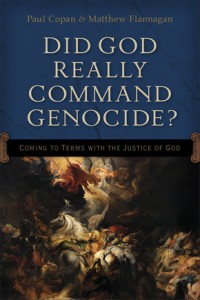 A common objection to belief in the God of the Bible is that a good, kind, and loving deity would never command the wholesale slaughter of nations. In the tradition of his popular Is God a Moral Monster?, Paul Copan teams up with Matthew Flannagan to tackle some of the most confusing and uncomfortable passages of Scripture. Together they help the Christian and nonbeliever alike understand the biblical, theological, philosophical, and ethical implications of Old Testament warfare passages.