Yesterday, I had a long and enjoyable public discussion with Jason Thibodeau on the topic of The Euthyphro dilemma. Jason is a writer for the Secular Outpost and teaches philosophy at Cypress college in California. He also is the author of a recent article entitled “God’s Love is Irrelevant to the Euthyphro Problem” published in Sophia […]
Entries Tagged as 'Euthyphro Dilemma'
Matthew Flannagan (MandM) and Jason Thibodeau (Secular Outpost) Debate God and Morality
September 24th, 2018 4 Comments
Tags: Divine Command Theory · Euthyphro Dilemma · Jason Thibodeau
Skepticule Extra – A Podcast on the Euthyphro Dilemma Feat. Matthew Flannagan
September 16th, 2011 31 Comments
Recently Matt did a podcast on Divine Command Theory and the Euthyphro Dilemma for Skepticule Extra, aka the “Pauls to the Power of Three Podcast” hosted by Paul Baird, Paul Thompson (“Sinbad”) and Paul S. Jenkins. You can listen to that podcast here. Visit Skepticule for more listening options.
Tags: Divine Command Theory · Euthyphro Dilemma · Paul Baird · Paul Jenkins · Paul Thompson · Skepticule
Ethical Naturalism and the Euthyphro Dilemma
April 12th, 2011 10 Comments
Some people argue that moral obligations can be grounded in scientifically verifiable facts about human wellbeing and flourishing. This view is a form of ethical naturalism. For these people moral rightness is just the property of promoting or enhancing human flourishing. Plato refuted this argument over 2,000 years ago in his famous dialogue The Euthyphro. The […]
Tags: Divine Command Theory · Ethical Naturalism · Euthyphro Dilemma · God and Morality · Humour · Plato
Contra Mundum: Secular Smoke Screens and Plato’s Euthyphro
March 2nd, 2010 35 Comments
In “Religion: A Barrier to Clear Thinking,” the final article in the award winning series of lay philosophy articles published in the Christchurch Press, Canterbury based Philosopher Simon Clarke addressed the question, “what is the biggest obstacle to thinking clearly about social and political issues?” Predictably he answered “Several answers suggested themselves but time and […]
Tags: Contra Mundum · Euthyphro Dilemma · God and Morality · Investigate Magazine · Peter Geach · Plato · Simon Clarke · William Lane Craig
Tooley, The Euthyphro Objection and Divine Commands: Part II
March 25th, 2009 8 Comments
In my last post, Tooley, The Euthyphro Objection and Divine Commands: Part I, I made some critical remarks on Michael Tooley’s critique of William Lane Craig’s version of the divine command theory. Tooley contends that this theory implies the conditional that if God had commanded mankind to torture one another as much as possible then […]
Tags: Divine Command Theory · Ethics · Euthyphro Dilemma · God and Morality · Philosophy of Religion · Walter Sinnott-Armstrong
Tooley, The Euthyphro Objection and Divine Commands: Part I
March 23rd, 2009 12 Comments
In a debate with William Lane Craig at the University of Colorado, Michael Tooley stated, There is a theory which has the consequence that there cannot be objective moral laws unless God exists—that’s the so-called ‘divine command theory of morality’. What it says is that an action is wrong because and only because God forbids […]
Tags: Divine Command Theory · Ethics · Euthyphro Dilemma · God and Morality · Philosophy of Religion · Selection · Walter Sinnott-Armstrong
On the Meta-Euthyphro Objection
October 18th, 2008 8 Comments
According to proponents of the Euthyphro Objection, defenders of a Divine Command Theory of Ethics face a dilemma, actions are morally-required either because: (i) God commands them; or, (ii) God commands them because they are morally-required. The latter (ii) entails that actions are right and wrong independently of God’s commands and as such, a Divine […]
Tags: Divine Command Theory · Ethics · Euthyphro Dilemma · God and Morality · Philosophy of Religion

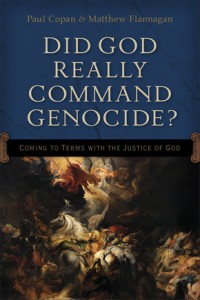 A common objection to belief in the God of the Bible is that a good, kind, and loving deity would never command the wholesale slaughter of nations. In the tradition of his popular Is God a Moral Monster?, Paul Copan teams up with Matthew Flannagan to tackle some of the most confusing and uncomfortable passages of Scripture. Together they help the Christian and nonbeliever alike understand the biblical, theological, philosophical, and ethical implications of Old Testament warfare passages.