This November the 2011 National Meeting of the Evangelical Philosophical Society (“EPS”) will be held in San Francisco, CA from November 16th-18th. The plenary speaker this year will be Dr Dallas Willard from the University of Southern California who will be speaking on moral epistemology. Accordingly, a call for papers has been issued for papers focussing […]
Entries from January 14th, 2011
Not Surprising . . . Gog and Magog are Showing Signs of Life
January 13th, 2011 22 Comments
Desperate times call for desperate measures. Greenists believe that these are desperate times–acutely so. The future of mankind is at stake. Therefore, it is not surprising that they are calling for desperate measures. We are not now talking about the lunatic fringe of the movement. We are referring to those in the Greenist mainstream, the […]
Tags: Climate Change · David Shearman · Enviro Myths · Global Warming
Did Hannibal of Carthage Exist?
January 12th, 2011 11 Comments
Historian James Hannam has written an entertaining article called “Satirising the Christ Myth.” The piece uses similar methods employed by those seeking to make the case for the claim that Jesus never existed to show that Hannibal of Carthage did not exist either. It is written in Hannam’s classicly witty yet accurate style; Did Hannibal Really Exist? To ask […]
Tags: Carthage · Christ Myth · Hannibal · James Hannam
The Importance of Critical Engagement
January 11th, 2011 45 Comments
“’Love the Lord your God with all your heart and with all your soul and with all your mind.’” (Matthew 22:37) “‘You must love the LORD your God with all your heart, all your soul, all your strength, and all your mind.’” (Luke 10:27) “Test everything, hold on to the good.” (1 Thess 5:21) “See to it that […]
Tags: Apologetics · Critical Engagement · Drew Dyck · Faith and Reason · Michael Murray · Nancy Pearcey · Timothy Keller
God and the Genocide of the Canaanites Part II: Ancient Near Eastern Conquest Accounts
January 10th, 2011 14 Comments
This three-part blog series is a modified version of what I presented to the Evangelical Philosophical Society meeting in November 2010. In my previous post, God and the Genocide of the Canaanites Part I: Wolterstorff’s Argument for the Hagiographic Hyperbolic Interpretation, I expounded and adapted Nicholas Wolterstorff’s argument for a hagiographic hyperbolic reading of the book […]
Tags: Alvin Plantinga · Canaanites · Genocide · Hagiography · Hermeneutics · Hyperbole · J Van Seters · James K. Hoffmeier · John Goldingay · Joshua · K Lawson Younger · Kenneth Kitchen · Nicholas Wolterstorff · Old Testament Ethics · Richard Hess · Thomas Thompson · Ziony Zevit
God and Other Unquestioned Authorities
January 8th, 2011 118 Comments
The ultimacy and decisiveness of reason is itself just as vulnerable as the existence of God. That one ought to “justify” one’s thought is to me just another religious-like commandment. If someone does not buy into the god-level authority of reason, especially pertaining to universal and ultimate domains of predication themselves, there is no possible […]
Tags: Authorities · Faith and Reason
God and the Genocide of the Canaanites Part I: Wolterstorff’s Argument for the Hagiographic Hyperbolic Interpretation
January 7th, 2011 42 Comments
Around this time last year I wrote two posts Joshua and the Genocide of the Canaanites I and Joshua and the Genocide of the Canaanites II. These posts attracted a fair amount of attention and debate. I got offers to publish my ideas in several upcoming books and present them before both the Evangelical Philosophical […]
Tags: Alvin Plantinga · Canaanites · Genocide · Hagiography · Hermeneutics · Hyperbole · Joshua · Kenneth Kitchen · Nicholas Wolterstorff · Old Testament Ethics · Selection

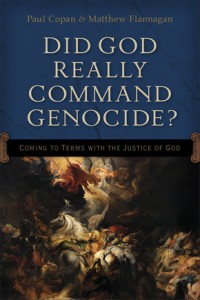 A common objection to belief in the God of the Bible is that a good, kind, and loving deity would never command the wholesale slaughter of nations. In the tradition of his popular Is God a Moral Monster?, Paul Copan teams up with Matthew Flannagan to tackle some of the most confusing and uncomfortable passages of Scripture. Together they help the Christian and nonbeliever alike understand the biblical, theological, philosophical, and ethical implications of Old Testament warfare passages.