Category: Conferences

  • My First Week in Charlotte

    Last week I flew from Auckland to Los Angeles, then to Atlanta and from Atlanta to Charlotte, North Carolina on Wednesday last week. I got in shortly after 12 am on Thursday.

    A few hours later on Thursday morning I was introduced to much of the staff at Southern Evangelical Seminary and then began attending a conference for the new campus based group Ratio Christi. This saw me attend various lectures at the seminary, have dinner with Mark Forman of Liberty University and Paul Gould, get into discussions on theological and moral problems with various students at the conference,  and hear a key note address by John Lennox.

    All day Friday to Saturday I attended the Southern Evangelical Apologetics Conference.

    Monday saw me travelling to a leading Nascar racing team headquarters with John Lennox for a talk Lennox was delivering for engineers at the centre I also attended a lecture that Lennox delivered at Davidson University.  During the trip I also travelled with and discussed God and  Morality and Islam with Keith Small  from the London School of Theology.

    The next day saw me travelling to one of North Carolina’s most prestigious universities, the University of Chapel Hill, to hear Lennox’s final talk.

    Wednesday kicked off my speaking tour; I gave a 60 minute talk on “God and the Canaanite Massacre” on at Queens University. The following night I gave a talk entitled “Defending Divine Commands” at UNC Charlotte on Thursday (last) night. Both events were followed by a good Q&A sessions.

    Cherokee Christian Apologetics Conference

    Today I travel out to the border between North Carolina and Georgia to present at a the Cherokee Christian Apologetics Conference.  I am presenting on the topic of “Morality and Tolerance.”

    I will keep you posted as I can.

  • Madeleine and Matt to speak on “Being Good: Christian Virtues for Everyday Life” at the 2012 Evangelical Philosophical Society Meeting in Milwaukee

    Evangelical Philosophical Society

    I have had to revise my earlier statements about not going to the November 2012 academic conferences in Milwaukee on the grounds that when you are personally invited to participate in a panel discussion by Doug Geivett and Mike Austin at the Evangelical Philosophical Society (“EPS”) you do not say no 🙂

    (If I said “no” I think Andrew would throw things at me and André Z would egg him on)

    Matt has been invited to speak on the same panel too.

    Here is what we know so far:

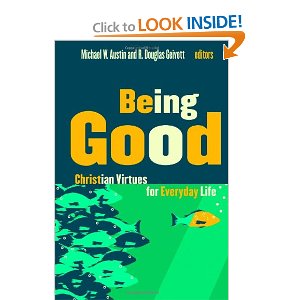
    Being Good: Christian Virtues for Everyday LifeMike and Doug co-edited a book entitled Being Good: Christian Virtues for Everyday Life.  At the EPS meeting in Milwaukee in November 2012 there will be a panel discussion in one of the sessions offering critical discussion of the book and it’s themes. Matt and I are now scheduled to be participants in that panel.

    The panel will discuss different aspects of the book, such as, an analysis of a virtue in the book that a participant disagrees with by giving an extension of the book’s discussion of character in some way.

    Matt was already going anyway as his paper on Singer and Infanticide got through the blind review process and was accepted.

    I had thought I might not go as we in the process of radically changing how I earn money. I am about to swap my regular weekly income for a contract for services that will see me retain most of the money I make my firm but pay my own expenses (and still be supervised and under the umbrella of a firm as all baby-lawyers should be under the law). So this is both exciting as I will have more control over what I earn but it is also scary as there are no guarantees that I will earn consistently; imminent changes to how legal aid is to be paid make that even scarier. The theory is that in the long run I will make more than I was on my very low baby-lawyer income but it is yet to be tested. As I am the primary earner in our house there is a lot riding on this, including the extension to our mortgage to purchase this opportunity. Going to America is not a cheap exercise from New Zealand but we have providentially managed to find a way the last two years with a lot of help from our friends so I am going to stop worrying and focus on trusting in God to whom I am  grateful for this opportunity.

  • Matt to speak on Singer and Infanticide at 2012 Evangelical Philosophical Society Meeting in Milwaukee

    Every November there is about a two week period in America where a number of professional academic conferences are held where the best of the best in the field gather. For the last two years Matt has been either accepted or invited to speak at them (I was accepted to speak at them last year too but had a visa problem at the last minute so Matt went without me). Anyway, this year they are all being held in Milwaukee and I am happy to announce that Matt received this email last week:

    Evangelical Philosophical SocietyCongratulations!  Your paper proposal for the 2012 Evangelical Philosophical Society meeting in Milwaukee (14-16 November) has been accepted for presentation.

    …

    Since there were nearly twice as many proposals as spaces, many fine papers had to be rejected.  If for any reason you will not be able to present your paper after all, please inform the EPS program committee as soon as possible so that we can allow one of the alternates to fill the vacated slot.

    Again, congratulations, and we look forward to hearing your paper in Milwaukee!

    Sincerely in Christ,

    The EPS program committee

    Yay – so proud of him! The abstract he submitted for blind review was as follows:

    Peter Singer, Human Dignity, and Infanticide

    Christian theism has traditionally taught that human beings have equal dignity and worth, a moral status that separates them from other non-human animals. Peter Singer has famously argued that this teaching is problematic; human beings are not any more special than animals and doctrines of human dignity are indefensible.  He contend that killing a new-born infant is, in and of itself, no more problematic than killing a non-human animal such as a cow or a pig, and he defends the permissibility of infanticide.

    This paper will critically assess one important part of Singer’s position: his understanding of why it is wrong to kill.  In part 1 I will sketch Singer’s “desire account” of killing and its relationship to his own preference utilitarianism and project of animal equality. Following Don Marquis, I will argue that this “desire account” is subject to important counter examples. In part 2, I will note Singer’s attempts to modify his position so as to avoid these counter examples and suggest that these modifications undercut his arguments for animal equality. In part 3, I will suggest that, despite this, there is an important truth in Singer’s critique, one that Christian thinkers can appropriate in developing moral arguments for Christian theism.

    Matt did not apply for any other of the conferences this year, although he was invited to give a paper at the Society for Biblical Literature but the session got cancelled. He and I are contemplating applying to Notre Dame’s annual conference on the week before, it’s theme this year is Justice so both of us could, and I still have enough time on my US Visa to go, but I am not sure if I have time to write a paper as my case-load is insane, so it might be just Matt. Anyway – yay Matt!

    Update
    Wow, already in receipt of donation offers to help get him there! We love you guys 🙂 We have just over $1.5k left over from blog donations and fundraising last time which constitutes the refunds from my aborted-lack-of-visa trip. I will price Auckland to Milwaukee and put up a fundraising widget in the sidebar soon – as with previous years accommodation options will be needed so Milwaukee readers if you have a couch talk to me 🙂

  • Is Ethical Naturalism More Plausible than Supernaturalism? A Reply to Walter Sinnott-Armstrong: Part II

    This is the second part of the paper I presented to the Naturalisms in Ethics Conference at Auckland University last year.

    In my previous post, I noted that Robert Adams has argued that if God exists, then divine commands “best fill the role assigned to wrongness by the concept”.[1] He argues that if moral obligations are divine commands this explains the fact, that (i) “wrongness is an objective property of actions,”[2], (ii) it accounts “for the wrongness of a major portion of the types of action that we have believed to be wrong,”[3]   (iii) it “plays a causal role … in their coming to be regarded as wrong”,[4]  (iv) it explains how moral obligations constitute a “supremely weighty reason” for acting or refraining from an action,   and (v) he contends that DCT explains the intuition that moral duties comprise “a law or standard that has a sanctity greater than that of any merely human will or institution”.[5]

    Moreover, in my last post, I also argued that, for Armstrong to conclude his arguments call into question any theistic account of ethics, he must argue that his harm account of moral obligation provides a better explanation of all these features. Failing that, if his account doesn’t preserve these features of moral obligation, then he must provide us with a reason to suppose that they are not part of the concept of moral obligation. Or he must provide reasons for revising our concepts.

    In his monograph “Morality without God” he attempted to do this. It’s my contention that he has failed in this task.

    1. Social Requirements

    Let’s begin with (v), In “Morality without God”, Armstrong purports to address this line of argument, he claims that “the best line of argument-because it is the only argument is that moral laws require a lawgiver”[6]. He attributes to popular writer Dinesh D’Souza. He then proceeds to make short work of D’Souza’s argument.

    However, this is neither the best, nor the only argument offered in favour of a DCT. In subsequent articles and a monograph, Adam’s has developed (v) in some detail.[7] Adam’s proposes a “social requirement theory” of obligation whereby “being obligated to do something consists in being required (in a certain way under certain situations) by another person or groups of persons not to do it”[8]. Obligations are a kind of social relationship where one person makes a demand on another, failure to comply results ruptures in the relationship expressed in terms of blame, censure, punishment and alienation, which can be expiated by forgiveness. Adam’s offers a sustained argument that the role of guilt, censure, punishment, social inculcation, moral motivation, moral knowledge and forgiveness plays in our concept of obligation, make a social requirement theory plausible.[9] Nowhere in Armstrong “Morality without God” does Armstrong even (more…)

  • Society of Biblical Literature: Blogger and Online Publication

    The Society of Biblical Literature’s program book for their 2011 meeting in San Francisco is now online. The blogger and online publication session for which Matt and I have had a joint paper accepted shows who we are sharing the session with and provides links to brief abstracts for each talk.

    Society of Biblical Literature Annual Meeting

    Blogger and Online Publication
    Robert R. Cargill, University of Iowa, Presiding
    11/19/2011

    4:00 PM to 6:30 PM
    Room: Room TBD – Hotel TBD

    Robert R. Cargill, University of Iowa
    Welcome and Introduction (5 min)

    Alice Bach, Case Western Reserve University
    Can Blogging at 3 AM Be Considered Scholarship? (25 min)

    Madeleine Flannagan, University of Auckland and Matthew Flannagan, Independent Scholar
    Blogging a Short-Cut to Peer Review: How to do it Effectively (25 min)

    Juhana Markus Saukkonen, University of Helsinki
    Sense and Practicality: Building a Historical GIS Online (25 min)

    Richard Price, CEO Academia.edu
    Academia.edu: The Past, Present, and Future of Scholarly Social Networking (25 min)

    The session will conclude with: Q&A discussion with Richard Price. (25 min)

    RELATED POSTS:
    We’re Going to San Francisco!


  • On the God Topic: Responding with Reason and Precision

    For anyone for whom Houston, Texas is not too much of a trek to get to, Biola University and Reasonable Faith Houston are running an apologetics conference in April. Speakers include: JP Moreland, Craig Hazen, Mary Jo Sharp, Louis Markos, Micah Parker, Scott Swiggard and more.

    On the God Topic:

    Responding with Reason and Precision

    Details:

    1 – 2 April 2011
    Friday 7:00 pm – 9:30 pm
    Saturday 8:30 am – 4:30 pm

    Gloria Dei Lutheran Church
    18220 Upper Bay Road
    Houston, TX 77058

    Conference Sessions:

    Defending Your Faith Kickoff
    With JP Moreland, Craig Hazen, and more

    The A, B, Cs…Ds & Es of Defending the Gospels
    with Mike Licona

    Did Jesus Really Rise from the Dead?
    with Craig Hazen (more…)

  • Clearing the Air: A Church Leaders Forum on Climate Change

    Matt has been asked to deliver the opening talk at the upcoming Clearing the Air Forum on 16-17 July 2010 at Unitec Institute of Technology, Auckland. The  forum has been organised by New Zealand Christian Network (visionnetwork) and its purpose is to look at the synthesis of science and faith on climate change try to develop a joint communiqué by national church leaders. In addition to Matt, the speakers include:

    • Professor Ralph Sims, Director, Centre for Energy Research, Massey University
    • Dr James Renwick, Principal climate scientist, NIWA
    • Ian Wishart, Editor, Investigate magazine, Author of Air Con: The Seriously Inconvenient Truth About Global Warming
    • Prof Jonathan Boston, Director of the Institute of Policy Studies, Victoria University
    • Barry Brills, President, NZ Climate Science Coalition
    • Dr Andy Reisinger, Senior Research Fellow, NZ Climate Change Research Institute, Victoria University
    • Ken Harrison, Chairman National Church Leaders group, National Superintendant Assemblies of God in New Zealand
    • Archbishop David Moxon, Anglican Church in Aotearoa, New Zealand, and Polynesia
    • Stephen Tollestrup, Executive Director, Tear Fund

    Clearing the AirHere is what it is all about:

    What does the Church have to say to government, society, and itself – if anything – on the topic of climate change? The failure to reach any agreement at the recent Copenhagen conference is regarded as a triumph by some and a tragedy by others.

    This forum – convened by Glyn Carpenter, National Director, NZ Christian Network, visionnetwork, and Associate Professor Jonathan Leaver, Unitec Institute of Technology – will bring together both groups, and look to produce a consensus-based position statement.

    Topics will include (a) epistemology, (b) creation mandate, (c) what position can be reasonably supported by the science, and (d) what can and should we do? The forum is designed primarily for church and public issues leaders, but places are available for students and others to hear a great line up of speakers.

    Matt’s talk is on epistemology and is entitled “Discovering truth in the synthesis of science and Faith.” The idea is that by having Matt talk first he will set the tone as to how we should be approaching and thinking about this synthesis of topics we can then sit back and hear all the speakers speak on their areas of expertise and know how to then grapple with the ideas.

    To see the full programme, click here.