Category: Conferences

  • Oxford Calling… Can you Help Glenn Peoples?

    The 18th Conference of the European Society of the Philosophy of Religion at the University of Oxford is on “Religion in the Public Square” and will feature my favourite philosopher (next to Matt of course) Professor Nicholas Wolterstorff and New Zealand’s own Glenn Peoples who blogs and produces brilliant podcasts at Say Hello to my Little Friend. Back in February Glenn blogged of his interest in giving a paper to this conference and of his intention, if accepted, to find a way there.

    The first hurdle was to get his paper accepted, which is no small feat but one that Glenn has pulled off – well done Glenn!

    The second hurdle is to raise the funds to get there, which is a work in progress…

    Glenn’s situation is much like Matt’s. Glenn holds a PhD in Philosophy and a Masters in Theology (the opposite way around to Matt). He is a very good Christian philosopher; I referenced him in my own philosophy of law paper on the subject, Matt has cited from him also  in several works (see our Glenn Peoples tag) and we both view Glenn’s blog to be MandM’s toughest competition in the NZ blog rankings for our niche .  Like Matt,  since graduating, Glenn has struggled to find work in his field. He currently works for the IRD and earns a very modest wage. Glenn is trying to find a position using his skills, if not in New Zealand, anywhere in the world so this conference is not only an opportunity for him to meet one of the world’s best living philosophers in Glenn’s field, it is not just an opportunity to have New Zealand Christian philosophy showcased at Oxford but it is a chance to help someone with a gift take another step towards using that gift to provide for his family and to support the broader church. Donations are currently being gathered and more information is available here if you would like to help and/or follow his progress.

  • Of Papers, Jobs, Weddings and TV Shows

    We have had, and are in for, an interesting few weeks.

    Last week I finished my studies for 2009 with my Legal Ethics exam and enrolled to complete the final two papers of my LLB (bachelor of law) in 2010. This week Matt handed in his final piece of assessment for his post graduate diploma in teaching and I re-entered the workforce! … Kinda.

    My pre-car-accident (neck injury) employer phoned me out of the blue last week to offer me a small job. They have a project that needs doing, they don’t have anyone spare who can do it and so they thought of me.

    So cool!

    🙂

    They have set it up so there is no need for me to do the drive into work (which can be a good hour or more at the wrong time of the day) I can work from home. They have supplied me with a lap-top so I can work in my bean bag. Its all flexi-hours to get around the bad pain days/parts of the day. It basically works that as long as I finish the project by the specified date I can break the hours down into manageable chunks.

    So I have been thoroughly enjoying myself this week working! The whole thing will be over by Dec 10 but hey it beats sitting around being unproductive!

    In other news I am apparently appearing on a TV panel tonight to discuss parental notification/consent on abortion with Dr Paul Hutchison – MP for Hunua, Bev Adair – Spoke person for Family First, the Principal of either Tangaroa College or Kelston High and the Rev. Tavale Mataia. The show will apparently air on Triangle TV on Tuesday night at 7.30pm also on Wednesday nights at 8pm on Sky Digital channel 89 and on Freeview channel 21.

    Then of course tomorrow Matt will give his paper “Abortion, Harm and Eschatology” to the STAANZ conference. On Sunday I am not only attending Filia Day‘s wedding but I am doing the makeup for her 4 bridesmaids and then the weekend after that Matt and I are flying to wellington to attend the Wellington Bloggers Drinks and to speak at the All for Life Conference.

  • Auckland STAANZ Conference: Eschatology and Pneumatology UPDATED

    The Systematic Theology Association in Aotearoa New Zealand (STAANZ ) are this week holding a conference in Auckland focusing on eschatology and pneumatology.

    What: STAANZ Conference on Eschatology and Pneumatology
    When: Thursday 19 November – Friday 20 November 9:00am-5:30 pm
    Where: Ponsonby Baptist Church, 43 Jervois Rd, Auckland
    Cost: $15

    Pre-conference prayer will be held at 8:00am at All Saints in Ponsonby, 284 Ponsonby Rd, Auckland.
    Dinner at a local restaurant will be organised for the Thursday night.

    Speakers are as follows: [UPDATED]

    Thursday
    “Holy Spirit in the theology of Walter Kasper” – Hugh Bowron
    “Backgrounding Walter Kasper’s Early Thought”- John Dunn
    “Wandering between two worlds: 19th Century Reflections on Hope and Hell” – Carolyn Kelly
    “Conscious Awareness of the Spirit in Symeon the New Theologian” – Jim McInnes
    “Searching for Embers” – Susan Adams & John Salmon

    Friday
    “Abortion, Harm and Eschatology” – Matthew Flannagan
    “Infant Salvation: Is God’s Mercy Enough?” – Myk Habets
    “Participatory Glory : The Eschatological Direction of Karl Barth’s Theology of the Cross”— Rosalene Bradbury
    “The Spirit and Longing” – Judith Brown
    “Filioque, Personhood and Ecclesiology” – Scott Kirkland

    The abstract for Matt’s topic “Abortion, Harm and Eschatology” is as follows:

    In No Harm No Foul: Abortion and the Implications of Fetal Innocence Kenneth Einar Himma offers what I shall call ‘the eschatological argument for abortion rights.’ Himma argues that because a fetus lacks the mental capacity to be culpable for any sin, a plausible Christian eschatology entails that a person who kills a fetus does not actually harm the fetus. Instead feticide benefits the fetus by sending the person killed straight to the afterlife, thus avoiding the possibility of any risk of future sin and consequent damnation. Given abortion does not harm the fetus, and as one should only legally proscribe harmful actions, it follows that abortion should be considered a woman’s right. In this paper I will criticise the eschatological argument for abortion, arguing it has absurd implications that entail infanticide and killing the disabled. Further, that even if one grants the eschatological assumptions implicit in Himma’s critique, abortion does, in fact, harm the fetus.

    Whilst Matt’s paper will find its way onto this blog, it is always nicer to hear it delivered in person so if you are free Friday morning he will be delivering it from 9:00-10:00 am.

  • MandM to hit Wellington: Speaking at the All for Life Workshop

    Matt and I are having a weekend in Wellington.

    On Saturday 28 November we’re speaking at the All for Life Workshop; we’ll be giving a “how to” critique the common philosophical arguments for abortion rights by highlighting the flaws in the reasoning and turning the logic back on itself.

    Also speaking are Brendan Malone, Bob McCoskrie, Andy Moore and Brian Whittaker. Registration is free, details are at the link above.

    We’re keen to do some Wellington bloggers drinks on the Friday night – if others are keen let us know!

  • The 2009 Forum on the Family: A Review

    On Friday Madeleine and I attended the Forum on the Family and the following is our long awaited (and long) review of it.

    The Forum kicked off with an impassioned talk from Bev Adair. Bev gave a harrowing account of her own story of childhood physical and sexual abuse and subsequent encounter with God that transformed her life and character and enabled her to break the cycle in her own life, heal and bring her own experience into her work with the Family and Child Trust. She stressed that the solution to child abuse was that people stopped blaming others or their social context for what happens to them; that they must cease demanding solutions from the state and being reliant on welfare; she called for individuals and communities to take responsibility for their own actions and for an end to the silence; abuse is not invisible, people who see it must act. Bev stated that voluntary organisations that were not funded by the state were doing some of the most effective work in the community and the consensus from them was that poverty does not make people hurt their children, she pointed out that countries with real poverty don’t brutalise their children or have stats like New Zealand’s.

    What was interesting was that later in the program the children’s commissioner, Dr John Angus, gave a much drier facts and figures type talk that reinforced what Bev stated. Relying on data compiled by CYFS, Angus noted that abuse tended to be more correlated to drug and alcohol abuse than poverty and that while reports of child abuse are on the increase, the actual cases are not. Like Bev he also suggested that the solutions were at the family, individual and community levels as opposed to government. Angus noted that one of the biggest problems was that when people were worried about a friend or family member’s conduct they rang CYFS rather than actually confronting or addressing it at a family level. Angus argued that real progress is made when families and communities own the problem and openly confront the issues family members face and offer constructive help instead of just looking to the state. It was at this family/community level, that real change can be made.

    In contrast to this, Labour Leader Phil Goff gave a speech about how poverty and economic hardship were the key issues in child abuse. Goff spoke of the need for a society where no children missed out on health care, education or basic necessities due to economic deprivation. He noted the historic Christian motivation behind the original welfare policies of Labour and suggested a need for all parties to work towards helping families in need. While I am not generally a fan of Labour, it is hard to dispute Goff’s claim that we should work towards having a society where no child misses out on basic necessities due to poverty and God clearly would want Christians should to be committed to achieving such a society, that said, none of this speaks to the question as to how this should be done and what the just and appropriate means of bringing it about are (I have discussed the issue of sustenance rights in a previous post). In the Q&A when I questioned Goff further on this he made it clear that he specifically saw this support as primarily coming from the state and not from the voluntary sector on the grounds that “the state has the money.” (Ironically Goff also justified high taxes on the grounds that it was needed for the state to play this role making his position somewhat circular.) These criticisms aside, Goff is to be commended for being the first Labour leader to front up and address the Forum on the Family and for attempting to build bridges with conservative Christians instead of trying to “marginalise them out of existence.”

    One unfortunate feature of Goff’s talk was the focus in the Q&A on the smacking issue. Goff suggested this was a side issue, not as important as child abuse and that people should focus their energy and passions on more important issues. That is, of course, correct and the fixation by members of the audience on this issue did seem disproportionate. However, at the same time, as members of the audience noted, a large number of the audience were from voluntary organisations that were dealing with domestic violence and child abuse at the coal face; hence, the suggestion they were not addressing this or were not as committed to these issues is inaccurate. Moreover, opponents of the current s59 of the Crimes Act had repeatedly told Labour that laws about smacking had nothing to do with child abuse in the past. Proponents had justified the decriminalisation of reasonable force for the purposes of parental correction on the grounds that it would help to stop child abuse and some had, in fact, equated smacking with child abuse. The previous Labour government’s support of this line of argument was the reason that there was now a Bill before the house, John Boscawen’s Crimes (Reasonable Parental Control and Correction) Amendment Private Member’s Bill. So for Phil Goff to now claim now that concern around s59 was a side issue and the question of child abuse was a different, more important issue that Labour was deeply committed to was more than a tad disingenuous, which is what evoked the scathing (and justified) attack from Christine Rankin that David Farrar referred to on his Facebook page.

    Moreover, with a Bill before the house, Labour really do need to take a stance; it is fine to say s59 is not their main focus but when the bill is actually put before them they will need a position. Their opinion on the now, apparently separate and unrelated to light smacking, issue of child abuse, while commendable, is not what they will be asked to vote on. When Madeleine pressed Goff on this he stated that Labour will be voting against Boscawen’s Bill.

    Not all the speakers spoke on child abuse and s59, Greg Fleming, CEO of the Maxim Institute, gave a good talk entitled “Right Wing, Left Wing. What Does it Mean? Does it Matter?” Fleming made essentially three points; first, he noted that the terms ‘right wing’ or ‘left wing’ often function as labels that are used to pigeon hole or brand a person so as to summarily dismiss their position without actually addressing it or considering its merits. Fleming’s contention that such dismissals often reflect a kind of unjustifiable intellectual laziness is undoubtedly correct and occurs far too often.
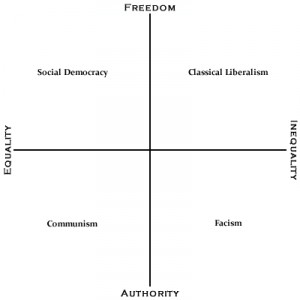
    Political SpectrumFleming’s second point was to suggest that the labels ‘left’ and ‘right,’ when understood correctly, do have a useful descriptive function in highlighting where a person sits on a particular spectrum. For Fleming, this spectrum constituted a horizontal axis whereby equality was at one end, the left and inequality at the other, the right. In addition to the horizontal left-right spectrum is a vertical spectrum with freedom at the top and authority on the bottom. These axes lead to communism being on the bottom left, totalitarian authority to maximise equality; fascism on the bottom right, totalitarian authority to maintain inequality; social democracy on the top left, limited government focused on achieving equality; finally, classical liberalism on the right, limited government for the sake of maximising individual freedom.

    One criticism I have of this is that (more…)