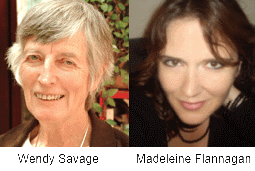
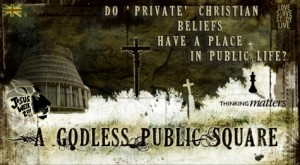
 A few weeks ago, as part of Jesus Week at the University of Auckland, Thinking Matters and Evangelical Union hosted an event entitled A Godless Public Square: Do ‘Private’ Christian Beliefs Have a Place in Public Life? This event was a conversation between Theology, Philosophy and Law and featured Matthew Flannagan – Analytic Theologian, Glenn Peoples – Philosopher and Madeleine Flannagan – Legal Scholar. The video is still being edited and will be available soon but for now, this 3-part series comprises the written speeches of each speaker.
Glenn Peoples – Philosophy
Often the subject of religion and politics is alluded to by way of references to terrorism, vigilantism, totalitarianism and persecution, as though these are the only alternative to a public square stripped of religious conviction altogether. This is about as helpful and honest as the automatic association of secularism with the purges of Stalin. The truth is that the flourishing debate in the Western world over the legitimate role of religious convictions in our public decision making is set within the broad liberal democratic tradition. Within that tradition, taking for granted things like freedom of religion, freedom of speech, clear institutional separation of church and state, freedom of association and so on, we’ve seen that it is clearly possible to hold a variety of views on the proper place of religious belief in politics, policy, public lobbying, your own voting and so on. Of course, there are plenty of religious people in the world and in history who do not cherish liberty and mutual respect (as there are and have been non-religious people who do not cherish these things), but you and I do.
Our popular level discussion here in New Zealand over the proper role of religion in a free society – in the media, in letters to the editor, on talkback radio, in religious speeches, could have been greatly benefited by an exposure to the way that this issue has been dealt with in philosophy, specifically in political philosophy, in ethics and philosophy of religion, which are the areas that really interest me. In particular the following issues need to be seen as central: What is the specific concern that justifies people in identifying religious convictions as an area of worry over and above other convictions? Are these concerns applied consistently and fairly when not thinking in terms of religious convictions? Are they the right concerns to have about public life generally? Secondly, should these concerns really cause us to reconsider the role of religious convictions at all? If so, then how?
Why is religion singled out?
Conflict and Polarisation
Why is there an issue centred specifically around religion in the public square? We don’t hear much, if anything, about the worry of acting on our political beliefs or (usually) our ethical convictions or our scientific findings – at least not because they are political beliefs, ethical convictions scientific findings, yet there is a concern about religious beliefs in the public square, and that concern exists because the beliefs in question are religious. What makes religion special?
Perhaps the more popular reason that people might have for wanting to see religion take a back seat when it comes to public reason is that, in their view, religious beliefs unleashed in public are dangerous in certain ways. American philosopher Robert Audi is not alone in voicing the concern that “religious disagreements are likely to polarize government” leading to irresolvable disputes and political stand-offs.[1] In order to avoid strong polarisation and the associated mischiefs that come with it (lack of co-operation, social unease and mutual suspicion, perhaps even rioting and acts of violence or terrorism as in Northern Ireland), let us keep our religious beliefs well away from our political reason.
Matt has already said a thing or two about this, so I’ll just be brief. Is this fair? For starters, is it really true that as soon as we allow people to lobby, vote or even legislate in certain ways because of their religious convictions, we will witness intractable political stand-offs and social disorder? Not at all. We can easily imagine scenarios in which one person or group lobbies for a given policy because their religious convictions motivate them to do so, and another person or group lobbies for exactly the same policy with quite different motives. I think, for example, of the government’s role in marriage. I know of religious people who maintain that the state has no role in formalising marriage since this is, in brief, “God’s business” that the government should frankly stay out of as a matter of the purity of marriage as a holy institution. I also know of libertarians committed to the doctrine of self-ownership and the priority of personal liberty who also think, without any reference to God, that marriage properly belongs entirely to the private realm. So it can’t be the case that endorsing policies because of one’s religious convictions will inevitably or always lead to social or political polarisation and conflict.
That said, it’s true that different religious convictions (more…)