Category: Public Policy

  • Matt on the Waitangi Tribunal, Confessional Confidence on “The Panel” – with Craig Heilmann

    Radio RhemaIf you tuned in to Radio Rhema at 11:45am (NZ time) on 19 July 2012 you would have heard this blog’s Matthew Flannagan and Craig Heilmann discuss topical issues such as the latest with the Waitangi Tribunal and whether priests should disclose crimes to police after confession, among other issues, on “The Panel” on Pat Brittenden mornings.

    You can listen online here.

  • Freedom of Religion in a Secular Society @ Auckland University this Monday

    Church and StateAs part of AUSA’s Human Rights week at the University of Auckland, and in association with Thinking Matters, Matt and I will be giving a free public lecture with Q&A on the topic “Freedom of Religion in a Secular Society” on Monday 12 September from 7-8.30pm in Clock Tower Lecture Room 032.

    The Facebook page for this event states:

    The New Zealand Bill of Rights Act states:

    13 – Everyone has the right to freedom of thought, conscience, religion, and belief, including the right to adopt and to hold opinions without interference.

    14 – Everyone has the right to freedom of expression, including the freedom to seek, receive, and impart information and opinions of any kind in any form.

    15 – Every person has the right to manifest that person’s religion or belief in worship, observance, practice, or teaching, either individually or in community with others, and either in public or in private.

    • How should we read these sections alongside idea that New Zealand is a secular society?
    • How should we read them alongside the viewpoint advanced most notably by philosophers such as John Rawls that religion should be privatised?
    • Does Separation of Church and State require Separation of Religion from public life?
    • Can we still have Freedom of Religion in New Zealand and hold to these views?
    • What approach is just and fair in a pluralistic society like ours?

    Analytic Theologian and Ethicist, Dr Matthew Flannagan and Legal Scholar, Madeleine Flannagan (a post-graduate student in Law at Auckland) will give a joint lecture followed by a Q&A session on the topic Freedom of Religion in a Secular Society from 7.00-8.30pm on Monday 12 September 2011 in Clock Tower 032.

  • Contra Mundum: Separating Church and State

    Co-authored by Matthew and Madeleine Flannagan

    The late Philosopher Richard Rorty once described religion as a “conversation stopper”, something that polarises discussion and ends or prevents fruitful dialogue. Rorty was an advocate of,

    “the happy, Jeffersonian compromise that the Enlightenment reached with the religious. This compromise consists in privatizing religion — keeping it out of … “the public square,” making it seem bad taste to bring religion into discussions of public policy.”

    The view that the public square – the legal system, economy, public education system, politics and so on – should be secular is now standard in contemporary political theory. When making decisions about their private conduct religious believers can utilise religious reasons in but in public they are morally bound to bracket their beliefs about God and appeal only to secular considerations.

    In an earlier column, “Secularism and Public life”, Matthew criticised this position. He pointed out that a growing number of scholars working in philosophy, political science and law are calling the defensibility of this position into question. We will not repeat those points here instead we will address one interesting feature of Rorty’s comment above; Rorty referred to his position as “the … Jeffersonian compromise.”

    In doing this he reflected a trend that began in the US the mid to late 20th Century and has spread around the Western World. The First Amendment of the United States (US) Constitution asserts that “Congress shall make no law respecting an establishment of religion, or prohibiting the free exercise thereof; …”. In a letter to the Danbury Baptists in 1802, US Founding Father Thomas Jefferson stated that this amendment established a “wall of separation” between church of state. In the mid 20th century the US Supreme court argued that on the basis of Jefferson’s comments the US Constitution required the “separation of church and state”. This was then interpreted to mean that the US Constitution demanded a secular public square, religious ideals and beliefs were not to be allowed in public life.

    It won’t be news to anyone who has watched any US television shows to hear that the Supreme Court has interpreted the First Amendment to mean that religious instruction, prayer, references to God, displays of the 10 Commandments, nativity scenes — even where participation is voluntary — are banned from public institutions.
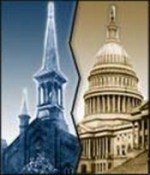
    Separation of Church and StateWhen Rorty referred to his position as “the Jeffersonian compromise” he was alluding to this line of argument. It is an argument we have heard over and over: because our society has a separation of church and state, we are committed to having a secular public square. If one opposes a secular public square and believes, as we do, that religious beliefs should influence public life then one gets accused of denying the separation of church and state.

    We think this inference is wrong-headed. It confuses the separation of two institutions, the church and state, with the separation of religion and public life. These are not the same things.

    To understand separation of church and state some history is necessary.

    Prominent legal scholar, Steven D Smith, observed that the church-state relationship, which would have been familiar to an eighteenth century American, was one where “governments controlled or directly intervened in the internal affairs of churches, and churches claimed and were formally endowed with governmental powers.” He elaborated that,

    “Since the middle ages, scholars and polemicists of all stripes had argued-on both religious and political grounds-that the church should exercise control over the state or-again on both religious and political grounds-that the state should control the church. The common view for centuries had been that an established church was essential to political and social stability. …

    In medieval Europe, for example, kings had claimed, and had exercised, the power to appoint bishops and popes. After the Reformation, the British monarch became the official head of the Church of England, and British government assumed control over both the selection of ecclesiastical officials and the formulation of religious doctrine.

    Medieval popes regularly crowned earthly emperors and kings, and they claimed (and frequently purported to exercise) the authority not merely to excommunicate but actually to depose those kings. Popes sometimes asserted jurisdiction to adjudicate what were essentially political or property disputes. In England, the Church enjoyed-and still enjoys-official representation in Parliament. Immigrants later imported established churches in some form into most of the American colonies.”

    Separation of church and state is the idea that the church should not be formally endowed with governmental powers and that the state should not try to intervene in or control the church. Now many people (including we, the writers) accept this. We do not believe that the government should set up an official state church or have any say in the liturgy, theology, choice of ministers and so on in established churches. Nor do we think that churches should be granted state powers, the right to hold seats in parliament, the ability to pass legislation, prosecute or tax people and so on. We wholeheartedly accept the separation of church and state.

    However, separation of church and state is not separation of religious beliefs from public life – perhaps this confusion arises because both concepts have the word “separation” in them. Church and state are formal institutions; public life is not an institution nor is a religious belief an institution. To assert, as so many commentators do, that separation of church and state commits us to a secular public square is to offer a non-sequitur.

    Some examples will illustrate this point. Suppose New Zealand were to allow the establishment of a completely private university; this university would not be an official state university, it would not be endowed with any political status nor would it does it hold any judicial, legislative or executive powers. The government would not choose its employees or its curriculum and the scholars within it would have total academic freedom. If this were to occur we would say there was an institutional separation between the state and this university.

    Now, imagine that the science department (more…)

  • Career Choices: Our Version of Child Slavery

    The following appeared in a recent edition of Sunday News. As you read this, please bear in mind that what is described here is officially fictional. The line from the Commentariat is that this sort of thing never actually occurs and certainly could not exist. The official Commentariat talking points are that human beings are not like this, and are incapable of acting and thinking as this article describes.

    If, by scintilla of remote probability, there may be some truth in the construct narrated below, it would only be because something (certainly not Unbelief) has made victims of  these unfortunates.

    Pre-Teens Dream of Kids and Dole

    IMOGEN NEALE

    Last updated 05:00 31/07/2011

    Lots of babies, lots of partners, lots of houses and lots of benefits.

    Welcome to the career dream of young boys already failing in the education system.

    Alison Sutherland, who works in Wairarapa schools with children who have behavioural problems, says many of the boys she deals with – who haven’t even reached their teenage years – can only see being the father of children and living with their mothers ahead. “That is their career future,” she said of youngsters who were opting out of education and employment because they saw babies as a source of income.

    But coupled with the desire for children was a complete lack of understanding of what being a good parent might entail. “There is no warmth about loving little children or wanting to be good parents. It is purely about this being a pathway to an income,” the one-time principal of a youth justice facility school said. “They have a perception that their future is to be unemployed. That is their norm. They have no sensitivity for the children – they see it as their form of income.”

    Sutherland said in some cases the children were merely repeating what they saw in their own homes. “They perceive that they’ll get a girl pregnant. She will be on some form of benefit and will get a house, and that they’ll live with them, and that is their income. “They live with mum, who often has a number of children and boyfriends. . . .Their reality is that the men in their lives live off mum, so they say, `Why would I get a job? I don’t need one, I’ll be like whoever the chap is who is living with mum at the moment’.”

    What lessons can we draw from this?  Firstly, these young lads described in the article are being perfectly rational. In terms of the world New Zealand has created for them, they are acting in a perfectly understandable way, merely doing what we all do. They are maximising their economic utility. The State pays unemployed (and even working) people more money if they have children–so, there are financial returns and rewards from “having kids”. It is money for jam, for nothing.

    Cha-chingSecondly, this situation represents our version of child labour and child slavery. Children are being brought into the world as “earners”.  Their worth and dignity only extends to their causing the state-funded “free” money spigots to open for the parents.  To maintain the return, all one needs do is keep them with a semblance of life; as long as they are barely breathing they are useful and tolerable as “earners”. At this point there is simply no difference from the impersonal objectivisation of children for economic gain that we decry in “Third World” countries and the England of Charles Dickens. The children born into the “families” described above are equally destroyed.  They may even (more…)

  • No Special Rights, So . . . One Law for All

    Tama ItiWe remain militantly critical of contemporary Maori ideology. We believe it excuses personal and family accountability by resorting to the fallacy of historical determinism: Maori, their leadership tells them, are victims of predatory exploitation by European or imperial powers; the significant cause of social and cultural and spiritual degradation amongst Maori stems from the unjust extortions of the Pakeha. We believe this ideology enslaves Maori and subjugates them more subtly and more potently than any European migration.

    We believe this ideology is a neo-Marxist variant. Maori represent the exploited poor, the weak, from which the hegemonic Pakeha have extracted their pound of flesh. It makes many within Maoridom sunburnt strawberries: brown on the outside, red on the inside. We have smiled at Hone Harawira’s call to arms: he wants to stand up now for poor and disadvantaged Maori, the working stiffs. He opposes exploitative Pakeha, but also (now) monied tribal interests. Maori neo-Marxism is undressing and exposing itself. This is a false Gospel and will betray those seduced by it to their destruction.

    But, at the same time, we believe there are historical injustices wrought by our government which should be addressed. They should be addressed because it is just to do so. At a personal or communal level, our lives should not be made to depend upon the redress of past wrongs and grievances, whether real or imagined. Evil happens in our sinful world. The Christian call is to accept such without bitterness, seek to begin again under the wonderful aegis of Christ Himself, and arise to serve Him where we are, with what we have.

    But there is an obligation to restitute, where possible, those who have suffered injustices at the hands of the state. (Restitution is not always possible, but if it can be done, it ought to be. The state must at all times be under law, and held to account by the law; if not, then we are governed not by law, but despots.)

    In this regard, we were pleased (whilst saddened, and provoked) by historian Paul Moon’s piece in the NZ Herald on the injustice being perpetuated against the Tuhoe people. (For the benefit of our overseas readers, the Tuhoe is a Maori tribe located on the South Eastern part of the North Island of New Zealand.) Here is a synopsis of Moon’s account:

    At the start of May last year, all the indications were that the Crown and Tuhoe were putting the finishing touches on a deal that would see Te Urewera National Park returned to Tuhoe, with enough caveats to ensure that access and other rights for the public would remain practically unchanged.

    Tuhoe would have what all the evidence shows (more…)

  • More Swamps than Christchurch: The Liquefaction of the Left

    "Scientists say that by 1984 we'll be up to our ears in horse dung if we don't reduce our reliance on horsepower.""One of the most destructive carnards concreted into the mind of greenism and environmentalism is the proposition that natural resources are fixed, finite, and limited. Once gone, they are gone forever. Therefore, conservation of said resources is a moral imperative.

    Statists warm to this proposition reflexively, that is, without thinking. To conserve on a grand scale requires big government: to regulate, limit, control, restrict, order, prescribe, proscribe, and ban. Without such a big intrusion into the lives and endeavours of citizens, disaster will fall upon the entire race. Therefore, statists join the moral crusade. Advocating for big-brother government suddenly makes one morally good. Saving the planet and saving humanity has a nice moral ring to it, making big government itself a moral imperative.

    Socialists likewise find the proposition of limited resources needing to be conserved a convenient doctrine. It justifies pre-emptive property rights of the state over private citizens. It also gives moral cover to advocating for more government taxation and expropriation to fund things like “green industries” and “green energy”. You just have to take a glance at President Obama’s “new” energy strategy. Instead of “drill, baby drill” it is “spin, baby, spin”, referring of course to the windmills he is spending billions of dollars worth of citizen’s property to manufacture and deploy.

    So, we have the ideological Grand Coalition of our times: greenists, environmentalists, statists, and socialists. Ladies and gentlemen put your hands together for “the Left”.

    There is one small problem. This monumental intellectual and political construction is built upon a simple fallacy, known as the fallacy of composition. It beggars belief that in a world self-proclaimed to be so smart and so rational that the very same wise-in-their-own-estimation are actually operating with a grand intellectual and political edifice built on more swamps than Christchurch, or more volcanoes than Auckland.

    The fallacy of composition assumes or asserts that the attributes of the parts must sum to the attribute of the whole. In this case, since each specific natural resource is clearly finite, natural resources as a whole must, therefore, be finite. Once you explode this childish error (more…)

  • The New Zealand Association of Rationalist Humanists and the Privileging of Secularism

    The New Zealand Association of Rationalist Humanists (“NZARH”) has a statement of aspirational ideals for the New Zealand state on their website. Entitled “The Tolerant Secular State” it is anything but.

    The first two sentences of the document exhibit a confusion which is inherent throughout (and commonly found in discussions of church and state):

    Lord Voldemort

    “The NZARH strongly believes that government should be secular; that is dealing with the issues of this world rather than following a religious agenda. Our law should not give one set of beliefs privilege over another and the state should treat religious organisations the same as any other organisation.”

    An equivocation on the meaning of the word “secular” in the very first sentence is immediately apparent.

    Stephen Smith notes that the word secular has two distinct meanings. Etymologically, “secular” refers to things pertaining to this world and life as opposed to the next. In this sense of the word “secular” is not opposed to religion; many religious beliefs and values pertain to life in this world, beliefs about: marriage, sex, human life, killing,  justice for the poor, what one’s duties are in this life, what God’s purposes are in this life and so on are all secular beliefs in this sense. The second and more common meaning of “secular” is to say it excludes, is in opposition to beliefs and values that are religious in nature; this is usually the first definition one will find in a dictionary.

    The NZARH use both meanings in the first sentence of their “Tolerant Secular State” document (more…)