Category: Blogging

  • Back from San Francisco: A Belated Report

    MandM has been quite of late, this is because Madeleine and I have been very busy.  With moving house in the midst of Christmas and New Years and Madeleine working part-time in a law firm and so on, we’ve had little time to blog. We are now set up, to some extent, and so this post will be a belated comment on my recent trip to San Francisco.

    In November I flew to San Francisco where I attended I attended the  Meeting of the Evangelical Theological Society (ETS), The Annual Meeting of the Evangelical Philosophical Society (EPS), The Evangelical Philosophical Society Apologetics Conference and The Annual Meeting of the Society for Biblical Literature (SBL) and American academy of religion.(AAR). While I would love to give detailed commentary on each session, to do so would require several blog posts of inordinate length, instead I will simply summarise what went down.

    I arrived in San Francisco at around 4pm  on the 15th. I presented my first paper at 8:30am the next morning. My paper was a critique of Walter Sinnott Armstrong’s arguments against divine command theory meta-ethics. Armstrong contends that the nature of moral obligation is best explained by identifying moral obligations with the natural property of harming others without justification, and, focusing largely on Craig’s work, argues this is superior to divine command ethics. I argued: (a) his argument fails to note the conditional nature of Craig’s (his main target’s) contention that if theism is true moral obligations are best explained as divinecommands (b) Armstrong’s does not provide a better account of moral objectivity (c) Armstrong’s account is not more economical than a divine command theory. (d) Even if it were an economical account, it does not explain various features of obligation such as (i) the social nature of moral obligations (ii) the fact that moral obligations constitute a decisive reason for acting and (iii) the specific moral content of obligations; as well as a divine command theory. All in around 30 minutes!!! The paper was very well received, with several people asking me to forward them a copy. I plan to get it published later this year.

    The rest of the morning was filled with me hearing various papers on moral theory and philosophy of religion all of which were interesting and stimulating. These panellists all shared similar perspectives yet were astutely critical of each other’s arguments. Particularly interesting was the dialogue between Baggett and Craig. Some of the issues here were technical and deserve further discussion so I plan to blog on this dialogue in more detail in the future. But in sum: Craig has defended a counterfactual: if God did not exist then moral obligations would not exist. Baggett  argued for various reasons that this is too strong; if God, the creator and sustainer of the universe, did not exist, the universe would not exist. To make sense, Craig’s claim needs to envisage a compossible world, which is like the actual world in all respects except that God does not exist, if it’s like the world in all other respects however, then it has all the features of the world God has created – and hence the resources for something like moral obligations to exist. Instead, Baggett contended, one should argue that a world with God provides a better explanation of the nature and existence of moral obligations than a world without God does. This means the theist does not have to argue, with Craig, that there is no adequate secular account of the existence of moral obligations, only that a divine command theory is more plausible than such accounts. Both Craig and Baggett made telling points which I will have to elaborate on some other time. highlight of Wednesday was the afternoon session. A panel discussion of David Baggett and Jerry Wall’s new book “Good God: The Theistic Foundations of Morality”. This book is the latest defence of divine command theory ethics, recently published by Oxford University Press. Baggett and Walls sketched briefly the content of the book and Paul Copan and William Lane Craig offered critical commentary, to which Baggett and Walls responded.

    Thursday started with an excellent critique of evolutionary (more…)

  • Divine Commands Post 9/11

    The night of September 11, 2001, was a night we did not get much sleep in. By 4am September 12 (New Zealand time) our two-week old son and 14 month old daughter had woken us twice already. Frustratingly, I awoke again sometime after 4am to a different noise coming from the lounge; it turned out that our eldest son, then aged 6, was up watching television. I stumbled into the room and told him to go back to bed. As I got back into bed I told Madeleine “It’s OK hon, it was just Christian watching some movie about New York” (I’d seen the Twin Towers on the screen as I switched the TV off). Less than an hour later our sleep was interrupted again, this time by the telephone. Madeleine, awoken for the 4th time that night, angrily moaned “who the hell is ringing at this time? Don’t they know we have a newborn?” It was my Dad.

    “Matt” he told me tersely “I am just ringing to say I am alright. I got grounded at Heathrow airport and did not fly into the US as I had intended to this morning and so was not caught up in the drama that’s unfolded.”

    “What drama?” I said bewilderedly “why wouldn’t you be ok?”

    “Haven’t you heard?” he responded “planes have been high-jacked; there has been a terrorist attack in America – the World Trade Centre has been hit, as has the Pentagon”.

    I suddenly was wide awake.
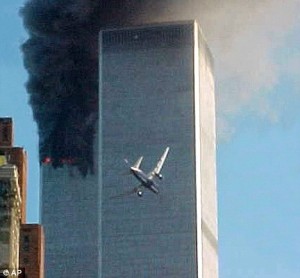
    9/11 World Trade Centre Terrorist AttackOne particularly poignant fact about the events of 9/11 is that the terrorists who carried out the attacks justified their actions by claiming God commanded them to do so. That fact has lead many contemporary commentators to argue that a divine command theory of ethics is indefensible. September 11 is just the most recent example in a series of incidents throughout history such as the Crusades, Inquisition and wars of religion. Divine command ethics is discredited by the fact that people appeal to such commands to justify terrorism.

    At first glance this objection is hard to take seriously; the premise is that some people have appealed to divine commands to commit atrocities. The conclusion is that any appeal to divine commands in ethics should be rejected.  This conclusion does not follow. To be valid the objector must assume a tacit premise: if people appeal to certain reasons to justify atrocities, then appeals to those reasons are always problematic. This premise is false.

    An analogous line of reasoning applies to appeals to right and wrong per se. Take any historical atrocity that people have attempted to justify; in almost every case the justifier will have argued that the action in question was the right action to do, the justifier invariably appeals to the purported rightness of their action. If the tacit premise is true then appeals to right and wrong are always problematic.

    Other examples illustrate the same point. The “reign of terror” during the French Revolution was justified by appeals to liberty, equality, fraternity and the rights of humankind; one victim of the guillotine famously remarked, “Oh, liberty, what crimes are committed in your name?” Millions have been slaughtered by appeals to the greater good of society or the liberation of the oppressed classes and it is well known that people have defended wars on the basis of justice and social peace. Should we therefore avoid liberty, equality, opposing oppression, seeking justice, social peace and so on? Obviously not.

    The fact that people have attempted to offer justifications for atrocities by appealing to some reason does not entail that any or all appeals to such reasons are problematic. This is a fairly innocuous claim. Take any premise you like – secular or theological – it is true that a person could appeal to this premise in an attempt to justify something but this fact does not mean the premise is problematic. For the appeals to atrocities argument to have bite one needs to show more than just that someone has tried to justify an abhorrent action by appealing to God’s commands; one would have to show that they did so successfully, that God actually commands such practises.

    The claim that God commands atrocities appears to be indefensible. We need to remember that we are not talking about the commands of just anyone; we are talking about God, who is typically defined as a being who is omnipotent, omniscient, and morally perfect. So, as the terms are defined, the claim that it is possible for God to command people to torture others for fun is true only if it is possible for a morally perfect person to command an atrocious thing. But this is not possible. The very reason that critics cite atrocities in their arguments against God is because they regard these actions as paradigms of conduct that no morally good person could ever (more…)

  • Christian Carnival 31 August 2011

    A New Zealander comes out of his home to play rugbyThe Christian Carnival comes down under to New Zealand – the home of Rugby, Lord of the Rings, many sheep and yours truly at MandM.

    This edition features a good selection of blog posts across an array of interesting topics. Have a browse and enjoy 🙂

    Apologetics
    Greg West presents Liars, Lunatics, or Pathetic Gullible Dupes? Greg updates CS Lewis’ famous trilemma from Mere Christianity to account for other options posted at The Poached Egg.

    Mikel Del Rosario presents 3 Essential Elements of Everyday Apologetics, a useful piece addressing the often neglected topic of the practical how-to of Christian Apologetics a posted atApologetics Guy.

    Matthew Flannagan presents Response to William Lane Craig’s Question 225: “The ‘Slaughter’ of the Canaanites Re-visited” Part I and Part II; William Lane Craig referred to Matt in his question of the week, Matt responds to Craig’s criticisms of his argument. Posted at MandM.

    Biblical Studies
    Richard H. Anderson presents One Way Indicators, a discussion on the dating and intended audience of the Gospel of Luke posted at dokeo kago grapho soi kratistos Theophilos.

    Counselling
    Jonathan presents 5 Anger Management Techniques That Work posted at Simple Life Habits.

    Devotional
    Jim Klingenberger presents The Potter and the Clay, reflections on the potter’s house in Jeremiah 18:1-10 posted at Xulonjam’s Blog.

    Brandon Peters presents Everything is Beautiful posted at INSPIKS.

    Ethics
    Tim Fraticelli presents Should Churches Use Taxpayer Money? Tim asks some questions about tax payer funding of faith-based initiatives posted at Faith and Finance.

    Madeleine Flannagan presents A Godless Public Square: Do ‘Private’ Christian Beliefs Have a Place in Public Life? Madeleine provides the text of her recent talk at the University of Auckland on this topic which includes examples of  recent cases in the Western World where Christian faith has been privatised by public policy. Posted at MandM.

    Evangelism
    Rev Bruce Jackson presents Sharing Your Testimony posted at Revbruce’s Blog.

    Philosophy of Religion
    Randy Everist presents Disproof of God Disproved, Randy offers a rebuttal of an attempt to show that the concept of God is incoherent posted at Possible Worlds.

    Theology
    Glenn Peoples presents Nuts and Bolts 012: Kenosis, an explanation of Kenotic views of Christiology posted at Say Hello to my Little Friend.

    Zowada presents The Existence of Evil: Continuance; some thoughts on why God allows evil posted at Zowada Blog.

    Bruce at Cyberia

    Thankyou everyone who submitted entries. The next Christian Carnival will be hosted at Thinking in Christ; you can submit a post to it here. Don’t forget to check out the Carnival’s Facebook page.

  • Society of Biblical Literature: Blogger and Online Publication

    The Society of Biblical Literature’s program book for their 2011 meeting in San Francisco is now online. The blogger and online publication session for which Matt and I have had a joint paper accepted shows who we are sharing the session with and provides links to brief abstracts for each talk.

    Society of Biblical Literature Annual Meeting

    Blogger and Online Publication
    Robert R. Cargill, University of Iowa, Presiding
    11/19/2011

    4:00 PM to 6:30 PM
    Room: Room TBD – Hotel TBD

    Robert R. Cargill, University of Iowa
    Welcome and Introduction (5 min)

    Alice Bach, Case Western Reserve University
    Can Blogging at 3 AM Be Considered Scholarship? (25 min)

    Madeleine Flannagan, University of Auckland and Matthew Flannagan, Independent Scholar
    Blogging a Short-Cut to Peer Review: How to do it Effectively (25 min)

    Juhana Markus Saukkonen, University of Helsinki
    Sense and Practicality: Building a Historical GIS Online (25 min)

    Richard Price, CEO Academia.edu
    Academia.edu: The Past, Present, and Future of Scholarly Social Networking (25 min)

    The session will conclude with: Q&A discussion with Richard Price. (25 min)

    RELATED POSTS:
    We’re Going to San Francisco!


  • Auckland Bloggers Drinks – This Thursday

    The first Thursday of the month means Bloggers Drinks! The event for bloggers, blog trolls, blog groupies (bloupies) and blog readers who happen to be in Auckland.

    Past blogging celebrities in attendance include bloggers and blog readers from:

    Galbraiths21st Century Renaissance, And All These Things, Annie Fox, As Yourself Hermitage, Barnsley Bill, Beretta, Blondie, Bowalley Road, The Fairfacts Media Show, Stephen Franks, Fundy Post, Hard News, Island Life, Garfield Herrington, Bernard Hickey, Cactus Kate, Kiwiblog, MandM, No Minister, No Right Turn, Not PC, Roar Prawn, Lolly Scramble, SOLO, The Standard, Born on State Highway One, Whale Oil, WHOAR! and Wonderful Now.

    Come along, unwind, catch up and meet your favourite bloggers you never know who’ll turn up – The Prosblogion‘s Trent Dougherty will be there all the way from Waco, Texas.

    What: Auckland Bloggers Drinks
    When: Thursday 7 July, from 6.30pm
    Where: Galbraith’s Alehouse, 2 Mt Eden Rd, Auckland
    Who for: Bloggers, blog readers, blog trolls
    What for: The talking of nonsense and telling of lies

    RSVP on Facebook or just turn up.


  • Easy Dupes: Amina Abdallah Arraf al Omari “Gay Girl in Damascus”

    Free Amina Abdallah Arraf al Omari Narratives are powerful.  They control what we identify as significant data or facts, how we empirically apprehend the data, what interpretations and shades of significance we place upon the evidence, and the conclusions drawn.  Absolute objectivity is impossible.  Only relative neutrality and disinterestedness are possible.  The cut of our jib determines the winds we catch and the sailing progress we make. True objectivity consists only in this: full disclosure of the jib’s cut whilst our sailing exploits narrative unfolds.

    Post-modernism has challenged our culture to face up to the inevitable and intrinsic cant in everyone’s understanding.  That is why it is despised by those still claiming absolute objectivity, operating just by the facts, only the facts.  Every so often we see the pervasive power of narrative on ridiculous display.  It can lead to an easy gullibility and childish credulity.

    “Gay Girl in Damascus” had been lionised by the Commentariate–which, as it happens, relentlessly denies the cut of its own sailing rig–both to itself and its audience.  Therefore it is an easy mark.  The Commentariate is deeply invested in the narrative of secular human rights.  All human beings on the planet basically think the same way about demand rights and civil rights; so much so that if external repressions were to be removed, the people would rise up to claim and enjoy their rights–and the demand rights of others.  To put it crassly, were authoritarian regimes to be removed, a hundred blooms of western-style secular democracy would inevitably and naturally spring forth.

    “Gay Girl” purported to be a lesbian blogger in Syria.  The narrative of the Commentariate has for a long time failed to “see” the evidence of Islamic repression against women.  Certainly it exists–but it is not intrinsic to Islam itself or to the native heart of Islamic people.  It is therefore not really real.  Remove the oppressive regimes and hey-presto, Islam will suddenly look and act like a secular Western culture, complete with nude beaches soaking up loooove and tolerance.  “Gay Girl” became a cause celebre because she described her experience of the natural, easy tolerance of homosexuality in Syria: the oppression against homosexuals was a foreign imposition originating from an oppressive regime.  She also was an enthusiastic supporter of the oppressed Palestinian story, and an astringent foe of Israel.  Once again, she fell neatly into the predispositions of credulity in the Commentariate.

    “Gay Girl” was Amina Abdallah Arraf al Omari, a Syrian-American woman living in Damascus.  According to Jonah Goldberg,

    People desperately wanted to believe in this “hero”: a saucy, sage, left-wing member of the LGBT community who likes to wear the hijab, can’t stand Israel or George W. Bush, and who parrots every cliché about the romantic authenticity of the Arab people and their poetic yearning for democracy, peace, and love. . . .  Amina’s assertions succeeded with little effort. For instance, (more…)

  • Not the Real Slim Shady

    After weeks of trying to tell Facebook that our MandM Facebook Page is not, in fact, a “community page about Eminem” we are finally back to being listed as us. Yay!

    It was kinda funny though:

    Eminem or MandM?
