This post is adapted from a short essay I wrote on William Paley’s Ethics In a widely used textbook, James Rachels refers to “revolution in ethics” which occurred in the 18-19th centuries. Referring to upheavals such as the American Revolution, French Revolution, Rachel’s contends that people began to think differently about Ethics. There arose “A […]
Entries Tagged as 'Ethical Theory'
Divine Command Theory and Utilitarianism forgotten bedfellows? Paley’s Principles of Moral and Political Philosophy (part one)
January 16th, 2018 Comments Off on Divine Command Theory and Utilitarianism forgotten bedfellows? Paley’s Principles of Moral and Political Philosophy (part one)
Tags: Christian Hist · Divine Command Theory · Utilitarianism · William Paley
Contemporary Philosophy of Religion and NCEA Religious Studies: Part one
October 17th, 2017 Comments Off on Contemporary Philosophy of Religion and NCEA Religious Studies: Part one
This is a talk I gave to the New Zealand Association of Philosophy Teachers annual conference at St Cutherberts College in September this year. Several people have asked me to make this talk available. I have broken my talk up into four parts. Part One introduces what philosophy of religion. In part two I will […]
Tags: Anselm · Augustine · Bentham · David Hume · James Rachels · Jeremy Bentham · John Locke · Philosophy of Religion · Utilitarianism · William Paley
Richard Carrier on the Moral Scepticism Objection to Divine Command Theory
October 7th, 2017 13 Comments
In my paper “Is Ethical Naturalism More Plausible than Supernaturalism: A Reply to Walter Sinnott-Armstrong”. I discussed the what I called the “Moral Scepticism objection’ to a Divine command theory (DCT) of ethics. Walter Sinnott-Armstrong had argued as follows: [1] If DCT is true then we cannot know whether an action is wrong unless we know that God has it. [2] We have no […]
Tags: Divine Command Theory · Epistemology · Richard Carrier
Erik Wielenberg and the Autonomy thesis: part four Intrinsic goodness
March 31st, 2017 23 Comments
In my last two posts, I argued that Erik Wielenberg fails to show that Godless Normative Robust Realism (GRNR) avoids some of the standard objections to the autonomy thesis. This brings me to Wielenberg’s third claim III, Wielenberg suggests that GRNR is prima facie preferable to various theistic accounts of axiological properties. Several authors have […]
Tags: Erik Wielenberg · God and Morality · Intrinsic Value · Linda Zagzebski · Mark Murphy · Moral Realism · Robert Adams · supervenience · Thomas Carson
Erik Wielenberg and the Autonomy Thesis: Part Three Standard Objections to the Autonomy Thesis, Human Rights and Dignity without God
March 25th, 2017 1 Comment
In my last post I looked at Erik Wielenberg’s response to the objection that, in the absence of God, people lack compelling reasons to comply with morality’s demands. A second objection Wielenberg briefly addresses is that without certain theological doctrines, one cannot provide a plausible basis for human rights and dignity. Wielenberg, here again, takes Craig […]
Tags: David Boonin · Erik Wielenberg · Infanticide · Loius Pojman · Nicholas Wolterstorff · Peter Singer · Rights · William Lane Craig
Carrier on infantile moral reasoning: one more time
March 16th, 2017 1 Comment
In a previous post, I discussed Carrier’s defence of “The infantile Objection” to divine a command theory (DCT) of meta-ethics. Some comments he makes in the same paper, suggest a slightly different version of the argument. Seeing I have found this version of the objection relatively common in oral discussions. It is worth having a […]
Tags: Divine Command Theory · Historical Atrocities · Richard Carrier
Video: The Smith-Flannagan Debate “Morality Does Not Need God”
July 6th, 2016 Comments Off on Video: The Smith-Flannagan Debate “Morality Does Not Need God”
On Wednesday 21st May at the University of Waikato retired Philosophy and Political science lecturer Dr Ron Smith and Dr Matthew Flannagan (of this blog) debated the resolution “Morality Does not need God”. Here is the video of that debate.
Tags: Debates · Divine Command Theory · God and Morality · Ron Smith · Waikato University

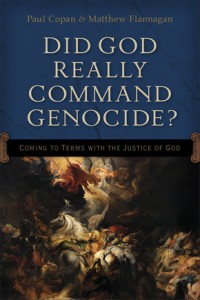 A common objection to belief in the God of the Bible is that a good, kind, and loving deity would never command the wholesale slaughter of nations. In the tradition of his popular Is God a Moral Monster?, Paul Copan teams up with Matthew Flannagan to tackle some of the most confusing and uncomfortable passages of Scripture. Together they help the Christian and nonbeliever alike understand the biblical, theological, philosophical, and ethical implications of Old Testament warfare passages.