In my last post, I explained the position of Theological Utilitarianism as expounded in William Paley’s The Principles of Moral and Political Philosophy. I pointed out The Principles was first published in 1785, four years before Jeremy Bentham published An Introduction to the Principles of Morals and Legislation. In this post, I want to look at the influence Theological Utilitarianism had […]
Entries Tagged as 'God and Morality'
Divine Command Theory and Utilitarianism forgotten bedfellows? Paley’s Principles of Moral and Political Philosophy (part two)
January 18th, 2018 1 Comment
Tags: Abraham Tucker · Christian History · Divine Command Theory · God and Morality · Jeremy Bentham · John Brown · John Gay · John Locke · John Stuart Mill · Utilitarianism · William Paley
Divine Command Theory and Utilitarianism forgotten bedfellows? Paley’s Principles of Moral and Political Philosophy (part one)
January 16th, 2018 Comments Off on Divine Command Theory and Utilitarianism forgotten bedfellows? Paley’s Principles of Moral and Political Philosophy (part one)
This post is adapted from a short essay I wrote on William Paley’s Ethics In a widely used textbook, James Rachels refers to “revolution in ethics” which occurred in the 18-19th centuries. Referring to upheavals such as the American Revolution, French Revolution, Rachel’s contends that people began to think differently about Ethics. There arose “A […]
Tags: Christian Hist · Divine Command Theory · Utilitarianism · William Paley
Annihilationism and the Infinity of Hell: Bawulski and the Disproportionality Argument
January 5th, 2018 10 Comments
This is part of a talk I gave at the Rethinking Hell Conference in Auckland earlier this year. Evangelical Annihilationist’s such as John Stott, Edward Fudge, John Wenham, and various others challenge the traditional view that hell is a place of eternal conscious torment. They contend that biblical language such as “eternal fire,” “eternal destruction,” “death,” […]
Tags: Annihilationism · Hell · Shawn Bawulski
Annihilationism and the Infinity of Hell: Bawulski and the Experience Argument
October 25th, 2017 7 Comments
This is part of a talk I gave at the ReThinking Hell Conference in Auckland earlier this year. The traditional conception of hell understands the punishment of the finally impenitent to be conscious eternal torment. The punishment of hell is eternal in the sense of it being of an unending duration, and it involves conscious […]
Tags: Annhilationism · Eschatology · Hell · Shawn Bawulski
Contemporary Philosophy of Religion and NCEA Religious Studies: Part one
October 17th, 2017 Comments Off on Contemporary Philosophy of Religion and NCEA Religious Studies: Part one
This is a talk I gave to the New Zealand Association of Philosophy Teachers annual conference at St Cutherberts College in September this year. Several people have asked me to make this talk available. I have broken my talk up into four parts. Part One introduces what philosophy of religion. In part two I will […]
Tags: Anselm · Augustine · Bentham · David Hume · James Rachels · Jeremy Bentham · John Locke · Philosophy of Religion · Utilitarianism · William Paley
Divine Command Theory and The Masked Man Fallacy
October 8th, 2017 10 Comments
In almost every talk I give on divine command theory someone in the audience inevitably will interpret me as saying that atheists can’t believe in moral requirements and will cite the fact unbelievers can know what’s right and wrong as a reason to reject the theory. This happens even when I have spent some time […]
Tags: Divine Command Theory · Epistemology · Paul Kurtz · Richard Carrier · Walter Sinnott-Armstrong · William Lane Crai
Richard Carrier on the Moral Scepticism Objection to Divine Command Theory
October 7th, 2017 13 Comments
In my paper “Is Ethical Naturalism More Plausible than Supernaturalism: A Reply to Walter Sinnott-Armstrong”. I discussed the what I called the “Moral Scepticism objection’ to a Divine command theory (DCT) of ethics. Walter Sinnott-Armstrong had argued as follows: [1] If DCT is true then we cannot know whether an action is wrong unless we know that God has it. [2] We have no […]
Tags: Divine Command Theory · Epistemology · Richard Carrier

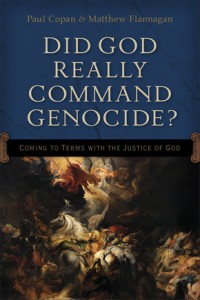 A common objection to belief in the God of the Bible is that a good, kind, and loving deity would never command the wholesale slaughter of nations. In the tradition of his popular Is God a Moral Monster?, Paul Copan teams up with Matthew Flannagan to tackle some of the most confusing and uncomfortable passages of Scripture. Together they help the Christian and nonbeliever alike understand the biblical, theological, philosophical, and ethical implications of Old Testament warfare passages.