Category: Personal

  • Philosophia Christi: Abstract Objects and Divine Command Ethics Down-Under

    In December we were told that Matt’s article “Tooley, Plantinga and the Deontological Problem of Evil”  had passed peer review and would be published in Philosophia Christi.  Issue, 13: 2  is  now out and if you look at the contents page you’ll see Matt’s article has now been published.

    The abstract to Matt’s article is as follows:
    Philosophia ChristiThis article criticises the deontological argument from evil proposed by Michael Tooley  in The Knowledge of God. I sketch Tooley’s distinction between deontological and axiological arguments from evil. Tooley rejects the axiological version because it rests  on “controversial ethical claims”, claims that are “likely to be rejected by many theists” and formulates a deontological version in its place. I argue that Alvin Plantinga’s criticism of the moral premises of this argument can be reformulated by appealing to a divine command theory of ethics. So reformulated, I argue that Tooley’s argument relies on controversial moral assumptions that many theists reject. I defend this response against potential criticisms found in the writings of Linda Zagzebski,  Tooley’s debate with William Lane Craig, and Peter Van Inwagen.

    Much of the focus of this issue is the topic of God and Abstract Objects. However, fortuitously, our good friend and fellow Kiwi, Glenn Peoples from Say Hello to My Little Friend,  has also been published in the same issue of Philosophia Christi immediately after Matt. His abstract is below:

    Of the objections to divine command ethics that still circulate in the literature, the epistemological objection is one of the two most common (the other being the objection from abhorrent commands). If morality is based on divine commands, the objection goes, then those who do not believe in God cannot know what is right or wrong. In this paper I explain the way in which this objection has been answered in the past (especially by Philip Quinn and Robert Adams) and I then look at a new attempt by Wes Morriston to resurrect and re-state the epistemological objection.  I explain the way in which this objection succumbs to responses that have already been made in the literature and is not new at all in spite of appearances, and I explain how it misconstrues the social nature of obligation in Robert Adams’ account of divine commands. In giving this explanation I flesh out the potentially difficult notion of a “sign” as an epistemic indicator of moral duty, and I argue that all the epistemological objections to divine command ethics this far fail because they have an underdeveloped concept of a “sign” as a central component of a command.

    Perhaps the theme for this issue should have been God, Abstract Objects and Divine Command ethics Down Under?

  • Alvin Plantinga Calling for an Argument

    NoahWe moved house recently but before we got the telephone services disconnected at our old house we rescued this answer-phone message left by our then 9 year old son Noah for Matt – note the attempted American accent:
    Alvin Calling

    (Noah had no idea how we worked out it wasn’t really Alvin Plantinga.)

  • Another Day, Another Publication

    Matt is having a good day.

    Presently he is in San Francisco where this morning he gave the first of his talks, “Can Traditional Theism Provide an Adequate Foundation for Morality? A Reply to Walter Sinnott-Armstrong’s Critique of William Lane Craig” to the Annual Meeting of the Evangelical Philosophical Society. By all accounts it was well received with Matt already being in receipt of several requests from scholars in his field for copies of the paper.

    This afternoon he attended a panel discussion  featuring William Lane Craig, Paul Copan, David Bagget and Jerry Walls on divine command theory and the moral argument. Regular readers will know how much he would have enjoyed that!

    Tonight an email came through from the Westminster Theological Journal, a rather prestigious journal, informing him that his article “Feticide, the Masoretic Text and the Septuagint” has been accepted for publication.

    No prizes for guessing that I am extra proud of him today 🙂

  • Madeleine Grounded

    As regular readers will know we have spent a good chunk of this year focussed on planning and fundraising to get to the USA to speak at conferences in South Bend, Indiana and in San Francisco. Yesterday we should have been on a flight heading to the USA but we had to make the tough call to cancel Madeleine’s planned when Madeleine’s non-immigrant visa failed to come through in time.

    Twenty years ago, when Madeleine was 18 and not a Christian, she committedwhat she calls “an act of teenage stupidity” and was convicted of theft and had to do some community service. In New Zealand this conviction is covered by clean slate law but this law does not apply to other countries and the US ask all their visitors seeking visa waivers “have you ever been convicted of a crime of moral turpitude?” Anyone answering “yes” has to apply for a non-immigrant visa. Now Madeleine applied for one of these last time she went to the US some 13 years ago and was granted it in 2 days. This time she phoned up and was told provided she applied about 4 weeks out from her planned date of travel she should be fine – especially as her conviction is now 20 years old and she has never been in trouble since and she has been granted a visa before. She applied with nearly 6 weeks in hand but at the point we had to make the call, her application was still “pending” (and it still is as I write this). In addition, the American Consulate are still holding her passport so they can put her visa in it… With no passport and no visa she could not get on the plane.

    Given that we were going to Indiana because Madeleine was speaking at Notre Dame and now she is not we decided to change my trip so that I will now just go to San Francisco and deliver all my planned talks (I will now give our joint talk to the SBL by myself). I now will not leave New Zealand until Tuesday 15 Nov.

    We have been able to get a lot of refunds thankfully with not too much in the way of penalty fees and we were able to get a new flight for me at the same ticket price so once we know what it will cost for me to go, any left-over donated monies will be held over to next years cluster of EPS and SBL conferences, as at the very least I expect to be travelling to the US to speak at them – Madeleine will come with me if the US Department of State have actually processed her visa application by Nov 2012… (You can check the status of her application by going here and clicking on the link in the right hand column under “CASE STATUS CHECK” and using “control F” and entering: 20112782761 – that is her)

    As you can imagine we are deeply disappointed by this turn of events and we have had a fairly flat few days as a result. I am pleased to be able to share that there is some good news to among the bad, Madeleine was last week offered a job in a law firm working part-time for an employer who understands and is willing to accommodate her pain disability caused by her car accident in 2008. Her trip being cancelled has meant she has been able to start proper this week so that has given her something to focus on.

  • The Nominations for Evangelical Philosophical Society Executive are in…

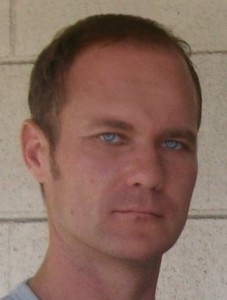
    Matthew FlannaganVoting for the 2011 Executive Committee of the Evangelical Philosophical Society (EPS) has begun today. I am pleased to announce that this blog’s Matthew Flannagan has been nominated as one of the seven candidates for the three vacant executive committee positions. Matt is the only New Zealander to have been nominated – so proud of him 🙂

    If you are a member of the EPS make sure you check out the full candidate list and vote!

  • Contra Mundum: When Scientists Make Bad Ethicists

    One thing I find particularly frustrating is reading commentary on theology and philosophy written by scientists. To be fair, some scientists I have read are informed and do offer astute and insightful comments; commonly, however, one finds a person who is undoubtedly brilliant in their own field, writing with confident gusto, articles that fail to understand the most basic theological and philosophical distinctions.

    Jerry CoyneA good example can be seen in a recent USA Today article by influential biologist Jerry Coyne entitled, As atheists know, you can be good without God. Coyne, an outspoken atheist, is disturbed that many Americans, including some prominent scientists, believe that our instinctive sense of right and wrong is “strong evidence for [God’s] existence.” He ventures into moral philosophy to explain why this is clearly mistaken.
    From the get-go Coyne demonstrates he does not understand the issues.

    It is necessary to accurately understand the position Coyne is criticising before we look at the paucity of his critique. The argument that our instinctive sense of right and wrong “is strong evidence for [God’s] existence” found its most important formulation in a 1979 article by Yale Philosopher Robert Adams. In it, Adams noted that we instinctively grasp that certain actions, like torturing children for fun, are wrong; hence, he reasoned, we are intuitively aware of the existence of moral obligations. According to Adams, the best account of the nature of such obligations is that they are commands issued by a loving and just God. Identifying obligations with God’s commands can explain all the features of moral obligation better than any secular alternative. Consequently, the existence of moral obligations provides evidence for God’s existence.

    It is important to note what Adams did not claim. Central to Adams’ argument, and to pretty much every author who follows him, is a vital distinction; this is the distinction between the claim that moral obligations are, in fact, divine commands and the claim that one cannot recognise what our moral obligations are unless one believes in divine commands or some form of divine revelation. Adams illustrates this distinction with the example of H20 and water.

    Contemporary chemistry tells us that the best account of the nature of water is that water is, in fact, H20 molecules. This, of course, means that water cannot exist unless H20 does. However, it does not mean that people who do not know about or believe in the existence of H20 cannot recognise water when they see it. For centuries people recognised, swam in, sailed on and drank water before they knew anything about modern chemistry.

    This distinction has important implications. The claim that moral obligations are, in fact, commands issued by God does not entail that people must believe that God exists and has issued commands in order to be able to recognise right and wrong. These are separate and logically distinct claims.

    Coyne conflates this distinction from the outset. After noting that some people believe that moral obligations provide strong evidence for God’s existence, he claims that this is an oft-heard argument, “‘Evolution,’ many argue, ‘could never have given us feelings of kindness, altruism and morality…’;” to this he rejoins that, “scientists studying our primate relatives, such as chimpanzees, see evolutionary rudiments of morality: behaviours that look for all the world like altruism, sympathy, moral disapproval, sharing — even notions of fairness.”

    This is confused. Apart from the fact that no one who cites morality as evidence for God actually makes the argument about evolution that Coyne sets out, the claim that moral obligations cannot exist independently of God is not the claim that without God people would not have moral feelings. Feeling that one has an obligation to do something and actually having an obligation to do it are clearly different things. People can feel that they have a certain obligation without it actually being the case that they do.

    Coyne makes a similar mistake when he argues that secular European countries like Sweden and Denmark “are full of well-behaved and well-meaning citizens, not criminals and sociopaths running amok.” This  (more…)

  • The Christian Delusion: Why Faith Fails – A Philosophia Christi Review of John Loftus’ Book

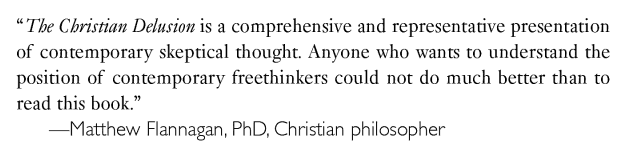
    On the list of blurbs just inside the cover of The Christian Delusion: Why Faith Fails, edited by John W. Loftus (Amherst, NY: Prometheus Books) 2010, the following appears:

    The Christian Delusion Blurb by Matthew Flannagan

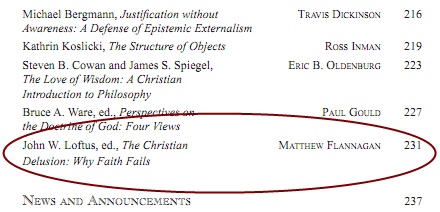
    As a result of being published on the blurb of the book, the current edition of Philosphia Christi, Vol. 13, no. 1 – Summer 2011, shows the following in the table of contents under “Book Reviews”:

    Philosophia Christi Table of ContentsThe Editor of Philosophia Christi has kindly granted Matt permission to reproduce his review of The Christian Delusion: Why Faith Fails here on MandM.

    A Review of The Christian Delusion: Why Faith Fails

    by Matthew Flannagan

    In The Christian Delusion John Loftus brings together a series of articles by contemporary free thinkers all focused around a common epistemological critique. It is the sequel to Loftus’s Why I Became an Atheist: A Former Preacher Rejects Christianity.

    The book is divided into five parts, each addressing a different aspect of Christianity. Part 1 is entitled “Why Faith Fails” and comprises four chapters. In chapter 1, David Eller argues that religions both deeply influence and are deeply influenced by culture; he argues that different cultural contexts lead to different forms of Christianity. In chapter 2, Vallerie Tarico draws on cognitive science to offer naturalistic explanations for why people believe in God. In chapter 3, Jason Long explains how people believe in Christianity despite its obvious absurdity by documenting how humans frequently engage in certain fallacies, have certain biases, believe things that are comfortable and resist changing their minds.

    By themselves it is hard to discern how these chapters provide arguments against Christianity. They appear to assume Christianity is false and provide naturalistic explanations as to why people believe such falsehoods. The relevance is explained in chapter 4, where John Loftus uses them to defend what he calls the Outsider Test for Faith (“OTF”). Loftus argues that a rational person should adopt the same skeptical stance towards her own religious beliefs that she does towards religions she rejects. The OTF (more…)