To formulate a statement that reduces a universal domain that includes myself and my thoughts or statements, to one or more factors that affect truth-value domain-wide, I must nevertheless transcend that universal domain so that I can make that factor-exempt statement itself, as well as any factor-exempt arguments that I might want to offer for […]
Entries Tagged as 'Philosophy of Religion'
Alexander Pruss on Scientific Rigour
January 19th, 2011 166 Comments
Given the debate raging on JT’s Progressive Enslavement: The Seductions of Scientism I thought it timely to share this comment left on The Prosblogion by Baylor University Associate Professor of Philosophy and blogger Alexander Pruss, “Given the pessimistic meta-induction, or given the fact that we know that at least one of the two central theories in […]
Tags: Alexander Pruss · Humour · Science and Religion
God and the Genocide of the Canaanites Part III: Two Implications of the Hagiographic Hyperbolic Account
January 16th, 2011 21 Comments
This three-part blog series is a modified version of what I presented to the Evangelical Philosophical Society meeting in November 2010. In a recent Conference at Notre Dame Alvin Plantinga suggested that the commands to wipe out the Canaanites, recorded in the book of Deuteronomy, might be hyperbolic; they should be understood more like how […]
Tags: Alvin Plantinga · Canaanites · Christopher J H Wright · Genocide · Gordon Wenham · Hagiography · Hermeneutics · Hyperbole · J McConville · J P U Lilley · Joshua · Nicholas Wolterstorff · Old Testament Ethics · Paul Copan
Did Hannibal of Carthage Exist?
January 12th, 2011 11 Comments
Historian James Hannam has written an entertaining article called “Satirising the Christ Myth.” The piece uses similar methods employed by those seeking to make the case for the claim that Jesus never existed to show that Hannibal of Carthage did not exist either. It is written in Hannam’s classicly witty yet accurate style; Did Hannibal Really Exist? To ask […]
Tags: Carthage · Christ Myth · Hannibal · James Hannam
The Importance of Critical Engagement
January 11th, 2011 45 Comments
“’Love the Lord your God with all your heart and with all your soul and with all your mind.’” (Matthew 22:37) “‘You must love the LORD your God with all your heart, all your soul, all your strength, and all your mind.’” (Luke 10:27) “Test everything, hold on to the good.” (1 Thess 5:21) “See to it that […]
Tags: Apologetics · Critical Engagement · Drew Dyck · Faith and Reason · Michael Murray · Nancy Pearcey · Timothy Keller
God and the Genocide of the Canaanites Part II: Ancient Near Eastern Conquest Accounts
January 10th, 2011 14 Comments
This three-part blog series is a modified version of what I presented to the Evangelical Philosophical Society meeting in November 2010. In my previous post, God and the Genocide of the Canaanites Part I: Wolterstorff’s Argument for the Hagiographic Hyperbolic Interpretation, I expounded and adapted Nicholas Wolterstorff’s argument for a hagiographic hyperbolic reading of the book […]
Tags: Alvin Plantinga · Canaanites · Genocide · Hagiography · Hermeneutics · Hyperbole · J Van Seters · James K. Hoffmeier · John Goldingay · Joshua · K Lawson Younger · Kenneth Kitchen · Nicholas Wolterstorff · Old Testament Ethics · Richard Hess · Thomas Thompson · Ziony Zevit
God and Other Unquestioned Authorities
January 8th, 2011 118 Comments
The ultimacy and decisiveness of reason is itself just as vulnerable as the existence of God. That one ought to “justify” one’s thought is to me just another religious-like commandment. If someone does not buy into the god-level authority of reason, especially pertaining to universal and ultimate domains of predication themselves, there is no possible […]
Tags: Authorities · Faith and Reason

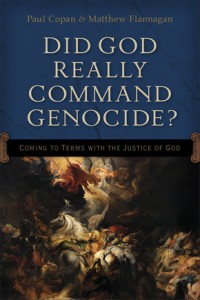 A common objection to belief in the God of the Bible is that a good, kind, and loving deity would never command the wholesale slaughter of nations. In the tradition of his popular Is God a Moral Monster?, Paul Copan teams up with Matthew Flannagan to tackle some of the most confusing and uncomfortable passages of Scripture. Together they help the Christian and nonbeliever alike understand the biblical, theological, philosophical, and ethical implications of Old Testament warfare passages.