Category: International Politics

  • An Interesting Comparison

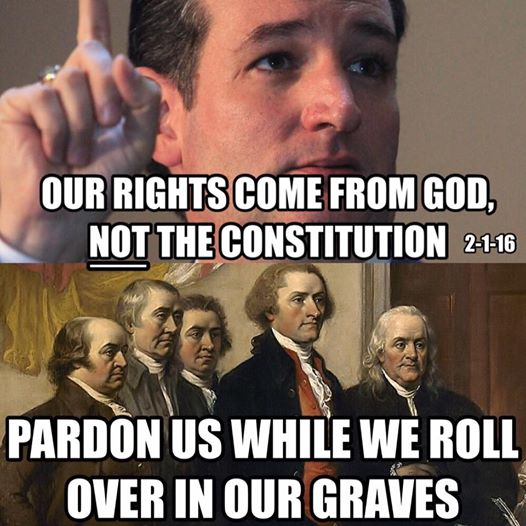
    This from Occupy Democrats:

    12647129_1058653647561022_4746717199189857381_n

    This from the Unites States Founding Fathers:

    When in the Course of human events, it becomes necessary for one people to dissolve the political bands which have connected them with another, and to assume among the powers of the earth, the separate and equal station to which the Laws of Nature and of Nature’s God entitle them, a decent respect to the opinions of mankind requires that they should declare the causes which impel them to the separation.

    We hold these truths to be self-evident, that all men are created equal, that they are endowed by their Creator with certain unalienable Rights, that among these are Life, Liberty and the pursuit of Happiness.–That to secure these rights, Governments are instituted among Men, deriving their just powers from the consent of the governed, –That whenever any Form of Government becomes destructive of these ends, it is the Right of the People to alter or to abolish it, and to institute new Government, laying its foundation on such principles and organizing its powers in such form, as to them shall seem most likely to effect their Safety and Happiness. Prudence, indeed, will dictate that Governments long established should not be changed for light and transient causes; and accordingly all experience hath shewn, that mankind are more disposed to suffer, while evils are sufferable, than to right themselves by abolishing the forms to which they are accustomed. But when a long train of abuses and usurpations, pursuing invariably the same Object evinces a design to reduce them under absolute Despotism, it is their right, it is their duty, to throw off such Government, and to provide new Guards for their future security…

    We, therefore, the Representatives of the united States of America, in General Congress, Assembled, appealing to the Supreme Judge of the world for the rectitude of our intentions, do, in the Name, and by Authority of the good People of these Colonies, solemnly publish and declare, That these United Colonies are, and of Right ought to be Free and Independent States; that they are Absolved from all Allegiance to the British Crown, and that all political connection between them and the State of Great Britain, is and ought to be totally dissolved; and that as Free and Independent States, they have full Power to levy War, conclude Peace, contract Alliances, establish Commerce, and to do all other Acts and Things which Independent States may of right do. And for the support of this Declaration, with a firm reliance on the protection of divine Providence, we mutually pledge to each other our Lives, our Fortunes and our sacred Honor. (emphasis mine)

    Oceania is at war with Eastasia. Oceania has always been at war with Eastasia.

  • Internationalism is Dead: Boneparte’s Descendants

    OK, so we thought that you would want to hear it here first. Internationalism–the idea that nation states are subject to a higher “sovereignty”– is dead. The corpse is rotting. The Libyan “adventure”, called for by the UN, is growing madder than a March Hare. All the problems and faults of internationalism are now clearly displayed. We hear Joan Baez in the background, intoning “when will they ever learn?” Not in a hurry would be our bet.

    Muammar Muhammad al-Gaddafi

    Though internationalism may be dead, the foolishness that is bound up in the heart of unconverted man is likely to keep flogging that particular equine corpse for decades to come.

    Consider the mess that the internationalists are now in. The UN has passed a resolution directing that a no-fly zone be established in Libya. The internationalist community has spoken. Man, the universal overlord of the globe, has determined that what was happening in Libya ought not to be; some kind of nebulous higher ethic was appealed to which mean that “humanity” or “the international community” had to step up and into Libya to sort things out.

    The echoes in the UN Security Council chamber had not died away before they were drowned by arguments between those who voted over what the meaning and application of the resolution. This from Al Jazeera:

    International criticism of the coalition enforcing the no-fly zone has continued to grow, with India joining China in publicly calling for an end to the airstrikes. Jiang Yu, a spokeswoman for China’s foreign ministry, said on Tuesday that the government opposed “the wanton use of armed force leading to more civilian casualties and more humanitarian disasters”. China had already called for a ceasefire.

    S M Krishna, the Indian foreign minister, called for a “cessation of armed conflict”. His office had previously issued a statement on Monday expressing “regret” for the military intervention. Pranab Mukherjee, the country’s foreign minister, said in a speech to parliament that “no external powers” should interfere in Libya. “Nobody, not a couple of countries, can take that decision to change a particular regime,” he said

    The Sydney Morning Herald reports that the Brits cannot even agree amongst themselves as to what the resolution means: can they take Gaddafi out or not? Some say yes; others nay-say. Neither can the French agree amongst themselves. Does the resolution mean that Gaddafi can legitimately stay in power. Yes. No. Maybe. All of the above. Meanwhile, Turkey a member of NATO has announced that it will not allow its airspace to be used in enforcing the no-fly zone, if it goes beyond the UN resolution–whatever it might mean, and no-one knows.

    The announcement came after Turkey, a member of the NATO, warned on Tuesday that it could not agree to the military alliance taking over the enforcement of the no-fly zone if their mission went “outside the framework” of the UN decision.

    Meanwhile in the US, President Obama, a committed internationalist, appeared deeply reluctant to (more…)

  • The Theology of the Declaration of Independence

    As I write this it is just beginning to be the 4th of July in the United States now, though its been 4th July for some time here in New Zealand.

    The 4th of July is, of course, Independence Day. Typically in New Zealand, those members of the secular blogosphere, who consider themselves to be classical liberals, have an annual rant on the 4th of July about the Declaration of Independence, praising the philosophy expounded in this document.

    Declaration of IndependenceNot PC’s Peter Cresswell, for example, states in Happy July 4th! that “with the exception of just a few words, the words could hardly be bettered today;” the declaration is, “A wonderful, wonderful anthem to freedom that rings down through the years.”  He bemoans, “if only the real meaning of those words could be heard and understood.”

    A few years ago Kiwiblog’s David Farrar made similar claims, he stated he would often “marvel at those marvelous words, written in the heat of oppression…Marvelous, absolutely marvelous.”

    I agree. I would simply point out to my secular, liberal, country-men what the words in this document actually say, and some of the philosophical ideas they expound.

    First, the declaration refers to God; it does so four times. Maverick Philosopher has an excellent analysis of the theological content;

    In the initial paragraph, we find the phrase “…Laws of Nature and of Nature’s God….” This phrase rules out pantheism: God is distinct from Nature. In the second paragraph, there is the phrase, “…endowed by their Creator with certain unalienable rights….” Putting these two references together, we may infer that the God being referred to is not merely a deistic initiator of the temporally first segment of the physical universe, but a being involved in the creation of the human race. For if God endowed human beings with rights, this endowment had to occur at the time of the creation of human beings, which of course occurred later than the beginning of the physical universe. In traditional jargon, God is a creator continuans rather than a mere creator originans. He is not a mere cosmic starter-upper, but a being who is continuously involved in maintaining the universe in existence.

    …

    The other two references are in the final paragraph. There we find the phrase, “…Supreme Judge of the World for the Rectitude of our Intentions….” near the beginning of the paragraph, and near the end, “…a firm Reliance on the Protection of divine Providence….” Now if God is the Supreme Judge, then he is more than a mere metaphysical cause responsible for the universe’s beginning to exist; he is also the supreme moral arbiter. And since he endows human beings with rights, as opposed to being merely a judge of rights antecedently possessed, then it seems we may infer that God is the source of moral distinctions (as opposed to a mere judge of them).

    The reference to divine providence is further evidence that the conception of God in the Declaration is non-deistic. For if God provides and protects, then God has an ongoing involvement with the world and its inhabitants such as would be ruled out by a deistic view. It should also be obvious that talk of providence (from the Latin, pro-videre) implies divine foreknowledge which implies intelligence and perhaps omniscience on the part of the deity. The God of the Declaration is not a blind metaphysical cause posited to explain why the universe began to exist, but a being with such attributes as moral goodness and intelligence…. So if by ‘deism’ is meant the doctrine that God is a mere metaphysical cause of the universe’s beginning to exist who is thereafter uninvolved in its continuing to exist, then the God of the Declaration is non-deistic.

    Second, the declaration claims that belief in a creator is self-evident; that is, it is a properly basic belief, which is rationally acceptable to hold in the absence of any proof.

    We hold these truths to be self-evident, that all men are created equal, that they are endowed by their Creator with certain unalienable Rights, that among these are Life, Liberty, and the pursuit of Happiness.

    Third, the declaration makes political pronouncements about public policy on the basis of these theological claims and expects these pronouncements to be taken seriously.

    Fourth, the declaration says that various rights, such as the right to life and liberty, are unalienable. That is, a person cannot alienate one’s life or freedom as they can legally alienate a piece of property. You can’t take my property if I do not consent to you having it but if I do consent, you can take it; property is alienable, life and liberty are not. The argument of the declaration reflects John Locke’s argument in the Second Treatise of Civil Government;

    To understand political power right, and derive it from its original, we must consider, what state all men are naturally in, and that is, a state of perfect freedom to order their actions, and dispose of their possessions and persons, as they think fit, within the bounds of the law of nature, without asking leave, or depending upon the will of any other man.[1]

    …

    But though this be a state of liberty, yet it is not a state of licence: though man in that state have an uncontroulable liberty to dispose of his person or possessions, yet he has not liberty to destroy himself, or so much as any creature in his possession, but where some nobler use than its bare preservation calls for it. The state of nature has a law of nature to govern it, which obliges every one: and reason, which is that law, teaches all mankind, who will but consult it, that being all equal and independent, no one ought to harm another in his life, health, liberty, or possessions: for men being all the workmanship of one omnipotent, and infinitely wise maker; all the servants of one sovereign master, sent into the world by his order, and about his business; they are his property, whose workmanship they are, made to last during his, not one another’s pleasure[2]

    …

    This freedom from absolute, arbitrary power, is so necessary to, and closely joined with a man’s preservation, that he cannot part with it, but by what forfeits his preservation and life together: for a man, not having the power of his own life, cannot, by compact, or his own consent, enslave himself to any one, nor put himself under the absolute, arbitrary power of another, to take away his life, when he pleases. No body can give more power than he has himself; and he that cannot take away his own life, cannot give another power over it.[3]

    The point here is that because your right to life and liberty are from God, no one can legitimately enslave or kill you, even if you consent to it. This was not a mere incidental addendum idea, it was central to Lockean political philosophy, which maintained (as the declaration does) that the government derives its powers from the consent of the governed. If a person can consent to be killed or enslaved then they can consent to the government enslaving them also to having the arbitrary power to kill them and hence tyranny can be legitimate. The reason tyranny is illegitimate is because, “No body can give more power than he has himself; and he that cannot take away his own life, cannot give another power over it.”

    The declaration then makes a metaphysical claim: God exists. It makes an epistemological claim about faith and reason: that belief in God is rational independent of proof. It makes an implicit claim of political philosophy: religion is not a private thing that should not influence public life but rather, theological claims should influence public life. Finally it makes a moral claim; that consenting adults do not have a right to do whatever they like with their own bodies, rather there are “Laws of Nature and of Nature’s God” that bind all human beings, that they are compelled to follow even if all parties consent otherwise. Governments are legitimate to the extent in which they respect these laws.

    I agree with PC, it is hard to improve on this philosophy; I have defended it in several places on this blog.

    Ironically, however, the militant secular liberals in NZ who parrot the declaration seem committed to attacking these ideas and rejecting them on every point. They argue that belief in God is irrational because it cannot be empirically proven, they claim that the public square should be secular, that religion should be private and not influence public policy and they argue that liberty means consenting adults can do whatever they like with their own bodies and lives. Far from being unalienable, a person’s life and freedom is his property to alienate as that person sees fit.

    It is also hard to disagree with PC’s sentiments that the declaration is “A wonderful, wonderful anthem to freedom that rings down through the years. If only the real meaning of those words could be heard and understood.” “Indeed, if only.”

    [1] John Locke Second Treatise of Civil Government Section II 4.
    [2] Ibid II6.
    [3] Ibid IV 23.

  • Chai Feldblum: “We Should not Tolerate Private Beliefs”

    In “Diatribe: To All Da Haters” (originally entitled “Queers and Destiny: Who Hates Who”) an article published a few years ago in Critic (the student magazine of Otago University) I wrote the following:

    … If teaching that homosexual conduct is wrong is akin to racism or propagation of apartheid, then the aforementioned religious organisations are the moral equivalent of the Ku Klux Klan. Those who propagate such arguments need to reflect on the implications of what they affirm. Imagine a society where the local synagogue or Mosque is treated as though it were the local Klan headquarters. Or where Muslim students are perceived and treated the way we currently relate to white supremacists. It is not difficult to see that the widespread dissemination and acceptance of this argument would lead to an atmosphere of pervasive religious intolerance – such intolerance is the very antithesis to what many of those protesters ostensibly claim to stand for.

    The solution to intolerance is tolerance. Tolerance of those ideas you may fervently disagree with and recognition of another’s right to freely hold and express them. Tolerance requires one to respond to disagreement with rational persuasion, not vilification. This cuts both ways.

    I was widely vilified and ridiculed for my comments and denounced as hate filled and bigoted. It is interesting to compare what I said with the comments of Chai Feldblum, the Georgetown University law professor nominated by Obama to serve on the Equal Employment Opportunity Commission.

    Just as wYes we can!e do not tolerate private racial beliefs that adversely affect African-Americans in the commercial arena, even if such beliefs are based on religious views, we should similarly not tolerate private beliefs about sexual orientation and gender identity that adversely affect LGBT [lesbian, gay, bisexual, and transgender] people,” the Georgetown law professor argued…

    For those who believe that a homosexual or bisexual orientation is not morally neutral, and that an individual who acts on his or her homosexual orientation is acting in a sinful or harmful manner (to himself or herself and to others), it is problematic when the government passes a law that gives such individuals equal access to all societal institutions.

    Of course those religions that believe homosexual conduct is sinful include Roman Catholicism, Eastern Orthodoxy, evangelical Protestantism, many neo-orthodox Protestants, Islam, Orthodox Jews, Mormons, Jehovah’s Witness’s, Seventh Day Adventists and so on. So presumably, if we are to take Feldblum at her word, none of these groups should be tolerated in Obama’s society and all should be denied equal access to societal institutions.

  • September 11

    Today I reflect, as do many, where I was and what I was doing when I first heard about the attacks on the World Trade Tower. Like my parents generation’s remembrance of where they were and what they were doing when Kennedy was assassinated and their parents remembrance of the news of V-Day this was a moment in time that is burned in the minds of those of us who were old enough to remember.

    I was asleep. Our son Noah was just 2 weeks old and the phone rang at about 4am. I recall angrily thinking ‘who in their right minds phones parents of a 2 week old in the middle of the night’ as Matt stumbled to the phone. His father was ringing from overseas and his first words were “I’m alright.” Matt says it took him a few minutes to work out that it wasn’t that he’d missed something his father had said in sleepy stupor but that when he’d woken up an hour earlier hearing Christian, then aged 6, moving around and had found him in the lounge watching ‘some war movie about New York’ that it wasn’t a war movie that he’d turned off when he sent Christian back to bed.

    When Matt came into the room and turned the lights on he didn’t give me time to throw anything at him for being woken me up for the 5th time that night because what he was saying just didn’t make any sense.  I went from sleep-deprived-anger to what is he on about? Something about the World Trade Towers? Some business thing his father was doing? Hang on, hijacked planes? What? Why do I have to get up right now? He had to pull me out of bed and take me to  the television to get it to sink in. Then I was wide awake and it was some time before I wanted to sleep again.

    When I reflect on that day eight years later one thing that never fails to stun me is the way some leftists seem to back radical Islam and excuse their actions as that of victims, minimising the role of their religious ideology. Frequently I hear Matt inform said lefties that secular media often fail to understand religion or religious history. This failure to take religion seriously as a motivating force in peoples lives, coupled with Marxist critiques of religion, mistakenly reduces religion to economics. This thoroughly discredited error leads otherwise intelligent people to explain away religious terrorism as simply the “sigh of the oppressed creature.”

    The evil we saw on this day eight years ago should have shaken everyone from this naivety. I am not buying into the Hitchens-Dawkins, ‘religion-is-evil secular-is-beneficent myth;’  secular ideologies also lead people to commit atrocities. However, 9/11 reminded us that there are people out there who want to engage in the random killing of  innocent men women and children and believe it a religious duty to do so; this is scary and those who don’t get it need to wake up.

  • Senator Jim Demint on the Proposed Hate Crimes Amendment

    Wintery Knight has posted the video below from a debate of Senator Jim Demint speaking on the proposed hate crimes amendment currently before the US Senate.

    I do not agree with all of the Senator’s arguments; the Senator seems to oppose the idea that some crimes or assaults are worse than others; however, having distinctions between manslaughter and murder, having defences such as provocation and permitting discretion in sentences, and so on, is premised on the fact that some crimes are more severe than others. I also contest his notion that determining the severity of the crime does not depend on the status of the victim; surely a person beats to death a little child has done something worse than a person who beats to death a person of equal strength in a pub brawl?

    However, where I think his argument is poignant is when he notes that the proposed hate crimes amendment will take into account a person’s political and religious beliefs in determining the severity of the crime. In other words, a person can be prosecuted for what they believe, provided they engage in a criminal activity. The Senator rightly highlights the proposed wording that no one shall be prosecuted “solely” on the basis of their religious beliefs; this seems to imply that one might be able to be prosecuted partly on the basis of their religious beliefs. I also agree with his questioning why, if the bill is simply about criminal activity, this amendment even needs to be there especially in light of the First Amendment of the US Constitution?

    Anyway watch the video. If nothing else you’ll enjoy the refreshing change of a watching a politician speak in the house, using arguments to support his claims and those in opposition are not screaming abuse and insults in the background or being ejected!

  • Bush’s Legacy

    I am always slightly disturbed when I encounter Bush-haters amongst my friends. Disturbed not because it surprises me that Bush-hater exist but because my friends are otherwise smart, informed, thinking people who have a healthy degree of scepticism towards the left-wing, anti-conservative values of the media and hollywood; I just don’t get how they can navigate other issues well but then buy into all the conspiracy, anti-Bush hysteria.

    They in turn, of learning that I think Bush is one of greatest US Presidents of my life time and that I firmly believe he will be remembered up there with Reagan, Lincoln, Roosevelt and Washington as one of the best, think I am insane and are invariably shocked. They start throwing all the conspiracy theories at me, they talk about his motives, his war-mongering and the rest. Typically each demonstrates a superficial understanding of the issues and even when they have read up on some of these issues they still fall into the error of failing to understand the nature of politics and the necessity of spin demonstrating that despite their protests they have and do buy into the media and hollywood’s portrayal of Bush.

    In New Zealand, even among a Christian or politically conservative constituency, I am very aware that in making these statements I am amongst a minority and that many regular readers will be baffled to discover that I think Bush rocks. If you are such a person but you otherwise generally like what I have to say, please read the following article that appears in today’s Herald as it summs up pretty much everything I would like to say.

    This article, unlike today’s Herald editorial claiming the opposite, was written by a political historian, educated at Cambridge.

    Legacy the Bush-Haters Will Loathe
    NZ Herald 16 Jan 09

    The American lady who called to see if I would appear on her radio programme was specific. “We’re setting up a debate,” she said sweetly, “and we want to know from your perspective as a historian whether George W Bush was the worst president of the 20th century, or might he be the worst president in American history?” “I think he’s a good president,” I told her, which seemed to dumbfound her, and wreck my chances of appearing on her show.

    In the avalanche of abuse and ridicule that we are witnessing in the media assessments of President Bush’s legacy, there are factors that need to be borne in mind if we are to come to a judgment that is not warped by the kind of partisan hysteria that has characterised this issue on both sides of the Atlantic.

    The first is that history, by looking at the key facts rather than being distracted by the loud ambient noise of the 24-hour news cycle, will probably hand down a far more positive judgment on Mr Bush’s presidency than the immediate, knee-jerk loathing of the American and European elites.

    At the time of 9/11, which will forever rightly be regarded as the defining moment of the presidency, history will look in vain for anyone predicting that the Americans murdered that day would be the very last ones to die at the hands of Islamic fundamentalist terrorists in the US from that day to this.

    The decisions taken by Mr Bush in the immediate aftermath of that ghastly moment will be pored over by historians for the rest of our lifetimes. One thing they will doubtless conclude is that the measures he took to lock down America’s borders, scrutinise travellers to and from the United States, eavesdrop upon terrorist suspects, work closely with international intelligence agencies and take the war to the enemy has foiled dozens, perhaps scores of would-be murderous attacks on America. There are Americans alive today who would not be if it had not been for the passing of the Patriot Act. There are 3,000 people who would have died in the August 2005 airline conspiracy if it had not been for the superb inter-agency co-operation demanded by Bush after 9/11.

    The next factor that will be seen in its proper historical context in years to come will be the true reasons for invading Afghanistan in October 2001 and Iraq in April 2003. The conspiracy theories believed by many (generally, but not always) stupid people – that it was “all about oil”, or the securing of contracts for the US-based Halliburton corporation, etc – will slip into the obscurity from which they should never have emerged had it not been for comedian-filmmakers such as Michael Moore.

    Instead, the obvious fact that there was a good case for invading Iraq based on 14 spurned UN resolutions, massive human rights abuses and unfinished business following the interrupted invasion of 1991 will be recalled.

    Similarly, the cold light of history will absolve Bush of the worst conspiracy-theory accusation: that he knew there were no WMDs in Iraq. History will show that, in common with the rest of his administration, the British Government, Saddam’s own generals, the French, Chinese, Israeli and Russian intelligence agencies, and of course SIS and the CIA, everyone assumed that a murderous dictator does not voluntarily destroy the WMD arsenal he has used against his own people. And if he does, he does not then expel the UN weapons inspectorate looking for proof of it, as he did in 1998 and again in 2001.

    Mr Bush assumed that the Coalition forces would find mass graves, torture chambers, evidence for the gross abuse of the UN’s food-for-oil programme, but also WMDs. He was right about each but the last, and history will place him in the mainstream of Western, Eastern and Arab thinking on the matter.

    History will probably, assuming it is researched and written objectively, congratulate Mr Bush on the fact that whereas in 2000 Libya was an active and vicious member of what he was accurately to describe as an “axis of evil” of rogue states willing to employ terrorism to gain its ends, four years later Colonel Gaddafi’s WMD programme was sitting behind glass in a museum in Oakridge, Tennessee.

    With his characteristic openness and at times almost self-defeating honesty, Mr Bush has been the first to acknowledge his mistakes – for example, tardiness over Hurricane Katrina – but there are some he made not because he was a ranting Right-winger, but because he was too keen to win bipartisan support. The invasion of Iraq should probably have taken place months earlier, but was held up by the attempt to find support from UN security council members, such as Jacques Chirac’s France, that had ties to Iraq and hostility towards the Anglo-Americans. History will also take Mr Bush’s verbal fumbling into account, reminding us that Ronald Reagan also mis-spoke regularly, but was still a fine president. The first MBA president, who had a higher grade-point average at Yale than John Kerry, Mr Bush’s supposed lack of intellect will be seen to be a myth once the papers in his Presidential Library in the Southern Methodist University in Dallas are available.

    Films such as Oliver North’s W, which portray him as a spitting, oafish frat boy who eats with his mouth open and is rude to servants, will be revealed by the diaries and correspondence of those around him to be absurd travesties, of this charming, interesting, beautifully mannered history buff who, were he not the most powerful man in the world, would be a fine person to have as a pal.

    Instead of Al Franken, history will listen to Bob Geldof praising Mr Bush’s efforts over Aids and malaria in Africa; or to Manmohan Singh, the prime minister of India, who told him last week: “The people of India deeply love you.” And certainly to the women of Afghanistan thanking him for saving them from Taliban abuse, degradation and tyranny.

    When Abu Ghraib is mentioned, history will remind us that it was the Bush Administration that imprisoned those responsible for the horrors. When water-boarding is brought up, we will see that it was only used on three suspects, one of whom was Khalid Sheikh Mohammed, al-Qaeda’s chief of operational planning, who divulged vast amounts of information that saved hundreds of innocent lives. When extraordinary renditions are queried, historians will ask how else the world’s most dangerous terrorists should have been transported. On scheduled flights?

    The credit crunch, brought on by the Democrats in Congress insisting upon home ownership for credit-unworthy people, will initially be blamed on Bush, but the perspective of time will show that the problems at Fannie Mae and Freddie Mac started with the deregulation of the Clinton era. Instead Bush’s very un-ideological but vast rescue package of $700 billion (£480 billion) might well be seen as lessening the impact of the squeeze, and putting America in position to be the first country out of recession, helped along by his huge tax-cut packages since 2000. Sneered at for being “simplistic” in his reaction to 9/11, Bush’s visceral responses to the attacks of a fascistic, totalitarian death cult will be seen as having been substantially the right ones. Mistakes are made in every war, but when virtually the entire military, diplomatic and political establishment in the West opposed it, Bush insisted on the surge in Iraq that has been seen to have brought the war around, and set Iraq on the right path. Today its GDP is 30 per cent higher than under Saddam, and it is free of a brutal dictator and his rapist sons.

    The number of American troops killed during the eight years of the War against Terror has been fewer than those slain capturing two islands in the Second World War, and in Britain we have lost fewer soldiers than on a normal weekend on the Western Front. As for civilians, there have been fewer Iraqis killed since the invasion than in 20 conflicts since the Second World War. Iraq has been a victory for the US-led coalition, a fact that the Bush-haters will have to deal with when perspective finally – perhaps years from now – lends objectivity to this fine man’s record.

    Andrew Roberts is the author of Masters and Commanders: How Roosevelt, Churchill, Marshall and Alanbrooke Won the War in the West
    RELATED POST: