Category: Theology

  • Theology, Morality and Reason

    In my previous post I mediated on the morality of lying. I suggested that a divine command theorist: a person who believes that the property of moral wrongness is the property of being contrary to God’s commands does not need to affirm that lying is wrong in any and all circumstances. In updating the post to which I was replying PC writes.

    UPDATE 2: Matt Flannagan agrees with my conclusion, but disagrees with both my reasoning and my assertion that the religionist is obliged to follow divine commandments without question. On behalf of her own religious beliefs, Lucyna
    disagrees with us both
    . It’s hard to keep up with a religionist!

    PC here conflates two separate issues. He is not alone in this, something like it often comes up amongst people I dialogue with for this reason its worth clarifying the issues here. There is a distinction between [1] Questioning a command one believes to be from God and [2] questioning the claim that a particular action is commanded by God. One can do [2] without doing [1] and doing [1] does not commit one t do doing [2].

    Contrary to PC I don’t support doing [1]. I accept that if God commands an action then one should obey it without question. Note this is a conditional statement, it states “if God commands an action” one does not need to accept that God has commanded an action, or even that God exists to accept this statement. In fact advocates of an ideal observer theory can (and do) hold to this conditional without accepting that God exists at all.

    The reason I accept this conditional is that it seems impossible for a person to coherently and rationally accept that God commanded and action and also to believe the action should not be done. The concept of God is that he is (i) rational, (ii) perfectly good and (iii) omniscient. Hence if God commands something then a rational fully informed perfectly good person commands the action. Under what circumstances then could it be rational to question the command of a fully rational perfectly good fully informed person. Is it that the commander is mistaken.? No, the commander is omniscient ( see (iii) . Is that he informed but is malicious? No it’s stipulated that the person is good (see (ii). Is that he has made a mistaken inference of some sort No, its stipulated that the commander is rational (see (i)) Is it that ones own judgement about what rules need to be inacted are just as good or better that God’s? Unless one is omniscient never ever irrational and morally perfect this will also be false. Hence I simply cannot see any sense in [1]. In fact I find the snarky insinuation that “accepting Gods commands without question” is obviously irrational simply puzzling. How could it be irrational to accept a command which is required by a perfectly rational being? Doesn’t the fact that a perfectly rational, good, fully informed being endorse this rule show that accepting it is compatible with being rational good and informed.

    Nor does denying that [1] is a viable option involve an uncritical, unreflective dogmatic, blind acquiescence to authority. Even if one rejects [1] it does not follow that one reject [2]. The fact that if God commands X we should obey it, does not mean we uncritically accept every claim that God has commanded X. Nor does it mean one does not utilise reason, facts, critical judgement etc in determining what God does command.

    Consider the issue of lying, which PC and I were discussing, it is not that I accept that God commands us to never lie under any circumstances but I have sometimes decide God is mistaken and so adopt a different rule. It is rather that I do not think that a perfectly good, rational being, does command us to never lie. If, as PC contends, its irrational or contrary to human flourishing to accept a rule forbidding lying to the Gestapo, then this entails that a rational being , informed of the facts who cared about our flourishing would not endorse such a rule. If then one is to maintain that God does endorse such a rule one needs to address the kind of arguments PC provides.

    I don’t think this is necessary because I don’t think God issues such a rule. I think that a careful exegesis of scripture provides evidence that they do not teach a non-contextual absolute prohibition on lying. That’s a critical judgement; reading and interpretation requires thinking, sometimes hard thinking. Moreover I think a reflection on the logic of rules suggests there is a kind of implicit exception of this sort, seeing I think that moral rules are divine commands that means I think God has made this exception.

    A final comment worth noting PC seems to insinuate that because Lucyna and I disagree on this issue, religionists ( by which I assume he means theists) are in some kind of trouble. It somehow calls into question theism or “religion” (whatever the term religion means). I often hear this line of argument but have never understood why any one would endorse it. After all don’t atheists sometimes disagree over specific moral issues. In fact don’t Libertarians and Randian’s sometimes disagree amongst themselves. But then why does not this disagreement call atheism and libertarianism into question?

    Today scientists agree that nature exists, they agree over the basic structure of nature and types of laws that govern its behaviour. However despite this they do disagree over numerous issues of how nature behaves, exactly what laws operate or how they operate in a given context. The same is true of Theology, one can accept that God exist and one can even agree on the basics of what God commands and yet still have disagreements over how these commands apply in specific circumstances. This no more provides a reason to denigrate theology and deny the existence of God than scientific reasoning provides reason for denying the existence of the natural world and denigrating science.

    Moral Theology does not involve people blindly accepting authority never reasoning or thinking that is a gross caricature, one who holds it has never read Aquinas, or Augustine, or Calvin, or Locke or Kant, or Berkeley or numerous other contributors to this enterprise. Why people who clearly have so little understanding of the subject pontificate on it in the name of critical informed reason, is frankly, beyond me.
  • Permissible Lies

    In wake of the return of the stolen victoria crosses and the Police claiming they are “honour bound” to pay the thieves the promised reward not PC argues that it is permissible to lie to an agressor. The standard example in the literature (which PC utilises) goes something like this: You are hiding someone fleeing for their life (modern examples use Jews in Nazi occupied territory). A murderer (modern examples usually use the Gestapo) come knocking on your door. They ask you if you know the whereabouts of their prey. Do you tell the truth?

    I agree with not PC that the correct answer to this question is no. I agree that the rule to not lie is restricted in scope, prohibiting lying to competent adults who are not violating our rights or threatening such a violation.

    Interestingly, not PC seems to think I am committed to rejecting this conclusion. He insinuates that Kantian and Divine Command approaches to ethics entail that one can never lie under any circumstances. He writes for example “that moral principles are neither “divine commandments” nor “categorical imperatives” — they are guides to action applying within a certain framework of conditions;”and latter he is more explict

    Unlike the ethics of religionists, Objectivism derives its moral principles not from stone tablets or burning bushes or caliphate commandments — not on what’s needed to live in heaven or paradise in some supernatural realm — but from from the needs of man’s survival and flourishing right here on this earth. The contrast with religious morality could not be greater: for the Objectivist, moral principles are guides to action intended to enhance and sustain one’s life. For the religionist however, moral principles are divine commandments that act like a ball and chain — a dogmatic straitjacket commanding one’s obedience, even if when talking to a Gestapo officer it could lead to your own death or that of a loved one. For the Objectivist, the answer to a Gestapo chief is outside the bounds of morality altogether: morality ends when the Gestapo chief’s gun begins. But for the religionist, telling the truth is an absolute necessity even if it entails the sacrifice of your life and that of your loved ones.

    Here PC is just plain wrong. While it is correct that many Catholic moral theologians support an unqualified prohibition on lying PC misunderstands the rationale they propose for this verdict. Catholic teaching on natural law as (expounded by people like Thomas Aquinas) is precisely that the moral law is derived from what conduces to human flourishing. Lying is prohibited because it is believed to be conducive to human flourishing. It is not prohibited because such a rule makes one fit for heaven or because its set down in tablets of stone promulgated by burning bush (apart from slander lying is not mentioned in the ten commandments) nor is it held to be correct because a priest or caliphate says so. Catholic theologians argue for this thesis from Aristotelian understandings of human flourishing. I think they are incorrect, but thats not an excuse for misrepresenting their position.

    Similar things can be said about Divine Command Theories (and contrary to PC not all “religionists” are divine command theorists) . Divine command theories (DCT) as propounded by Locke, Berkley, Paley, Suarez etc typically affirm that right and wrong are determined by God’s prescriptive will. However these thinkers go on to stress that God is a rational being who wills the flourishing of human beings and hence what God’s will is rational and God commands what promotes or leads or respects human flourishing in some way.

    But to the more substantive point.

    A DC theorist is committed to claiming that it is never wrong to lie in any circumstance, only if believes God has commanded this. Such a claim is often attributed to the Hebrew and Christian scriptures, but this is debatable to say the least. The Hebrew scriptures contain several passages where God approves of lying in certain contexts. One obvious example is the case of the Hebrew midwives in the book of Exodus. In the narrative Pharaoh orders that all Hebrew male children are to be killed at birth. The midwives respond by lying to Pharaoh about the births in order to protect them and are commended by God for their actions. There has been a huge amount of discussion of these passages and their application to moral theology on lying within Christian casuistry. So it is surprising people so often attribute naïve absolutism to moral theologians who take scripture seriously.

    Nor does a person sympathetic (as I am) to Kantian understandings of morality have to embrace the conclusion that’s its never wrong to lie. According to some Kantian’s (such as Alan Donagan) ethical principles have a logic such that one person cannot appeal to a principle for protection as a shield for breaking that principle or another equally as grave. Self defence is perhaps the clearest paradigm: a person cannot rationally appeal to an absolute right to not be killed if he uses that right as a shield to cover his killing of someone else. Such a position involves a contradiction of the will. And it rejects the universalizability of moral principles; the idea that what rules one lays down for others must, if they are moral principles, also apply to oneself.

    I am inclined to think that without something like this condition ethical principles would become incoherent. If one cannot justifiably use force to repel an attacker when the only way the attacker can be repelled is by force then the attacker has a freedom right to attack his victim. But surely if the claim it’s wrong to kill entails anything it entails that people do not have a freedom right to do kill others. Now, if one can use force against a person to protect ourselves and others from their attacks it seems hard to see why we can’t lie or deceive them to do so.

    What does this mean in the present context? It means that not PC is correct that the police are not bound by a promise to pay the reward to those who stole the Victoria Crosses. The Police would be acting licitly if they refused to pay. And nothing about being a divine command theorist or Kantian precludes one drawing this conclusion

    Let me add a final point in defence of PC’s conclusion. The standard argument against lying in this context takes a rule consquentialist line. It’s contended that accepting a rule that permits the police to renege on paying such rewards has bad consequences. Criminals in future cases may not divulge information necessary to solve crimes and hence peoples property will not be returned. The problem here, as with many appeals to consquentialism, is that there are other consequences of accepting this rule which point the other way. A rule where criminals get paid for returning what they steal makes stealing and ransoming pay and hence encourage stealing, kidnapping, ransoming etc.

    Consequently, if one is to appeal to positive consequences in a plausible way one needs to examine the total consequences of accepting the rule. One need’s to examine both how many crimes will be solved by accepting this rule and how much crime will be encouraged if we don’t and it needs to be shown that former good results outweigh the latter. To the best of my knowledge no one has ever done this calculation. Until they have the claim that consequences justify honouring agreements to thieves is unsubstantiated.

  • More on Faith and Reason

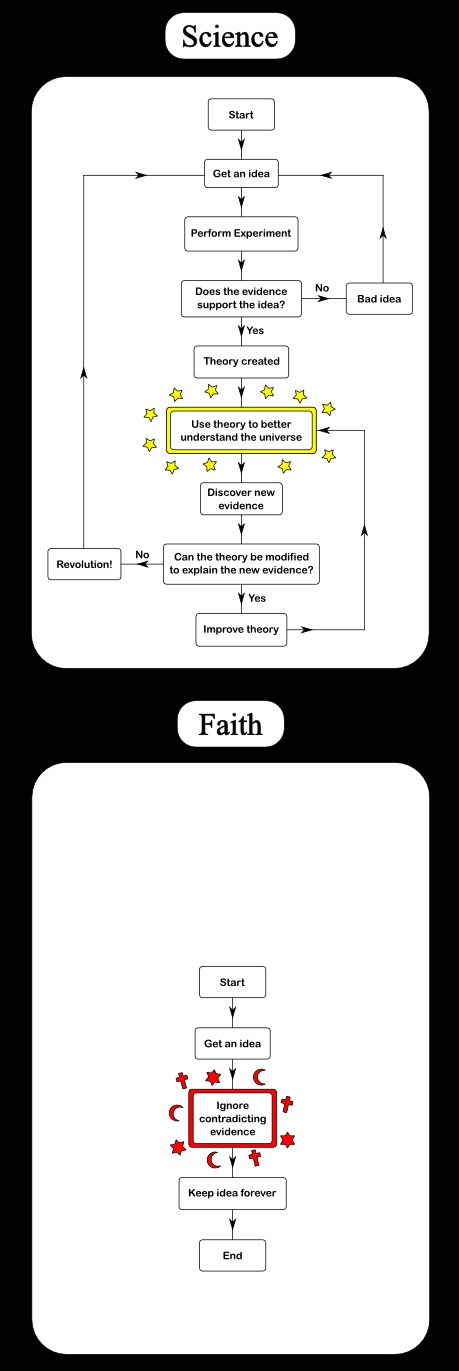
    A correspondent of mine sent me a copy of this faith and science flow chart and asked me to comment on it. My thoughts are as follows.

    1. The flow chart on faith appears to be a caricature. According to the chart faith is a three fold process, (a) one just comes up with an idea (out of nowhere it seems) (b) one ignores all the contrary evidence and (c) one continues to believe it. I don’t know who has ever held this model of religious epistemology certainly no one is cited as a representative. Whats noteworthy is that it differs from the model I have found in the writings of Christian Philosophers like Alvin Plantinga or Bill Craig or Roy Clouser. In these peoples writing the process faith involves some thing like the following: (a’) one finds the central message of Christianity to be self evident (to use Clouser’s terminology) (b’) one takes seriously evidence against Christianity and offers refutations of such arguments Finally (c’) one uses Christian beliefs as premises by which one develops a coherent perspective of the world that answers to various philosophical ethical existential questions on the basis of this message.

    Now it’s simply false on this model to suggest that faith is an idea a person simply “gets” and then believes ignoring all contrary evidence. In fact several ideas a person “gets” will not be accepted on faith according to this model. Any ideas one does not find self evident and which one has no reason or arguments for believing, any ideas which are self evidentially absurd, any ideas there are good arguments against and any ideas which are incoherent or which do not provide coherent perspectives or answers to existential and philosophical problems.

    Now it may be the case that Christianity fails on one or more of these criteria. However this needs to be argued. One cannot simply assume it and then define faith so as to assume this is true.

    2. While Philosophy of Science is not my area the little I have read suggests the science flow chart is excessively simplistic. Two initial observations suggest themselves. The first is the issue of under-determination of theories by the empirical evidence. On the model in the above flow chart. One adopts any idea that is consistent with the evidence. However, one thing Philosophers of Science often point out is that the empirical evidence alone is frequently compatible with several mutually incompatible theories. What leads one to choose one of these theories over another are non empirical assumptions about what types of theories are an are preferable to others. The second issue is that the flow chart suggests that if a person discovers empirical evidence that is contrary to the theory it’s rejected. But this also is not how science actually operates. Scientists frequently stick to a theory is spite of evidence against it until a better or more comprehensive one emerges. Most major theories in science have trouble with some empirical data, and the problems the empirical data provide are often not resolved till many decades after the theory is adopted.

    3. Finally I want to note a few things about the model of science that are relevant to the faith science issue. Accepting the account in the chart for the sake of argument three points suggest themselves. First note that for the theory to work there needs to already believe certain things. One first needs to “get an idea” now one can only get an idea if they already have a set of beliefs about the world if one believed absolutely nothing then they would have no ideas at all. Second, one needs to test this idea against evidence, which means there will already be a body of information which the scientist already accepts as true by which ideas are tested. Finally one needs to use the theory to better understand the universe. This means that prior to the theory one already has a set of beliefs about reality and that generate various questions about it that one wants answers to and which create puzzles that need explaining. Hence prior to any scientific theorizing one needs to already to have quite a bit of beliefs about the reality. These beliefs are needed for the process in the flow chart to be followed hence they cannot be discovered or based on science in the first place. Moreover if the process in the chart is to be effective these beliefs will need to be beliefs which it’s rational for the scientist to accept. Hence the chart itself suggests that a large number of beliefs are rationally accepted, despite being unable to be scientifically proven, it also suggests that without these beliefs scientific theorizing will be impossible.

    So my conclusion is this, first the account of faith is a caricature very different to the accounts actually proposed by Christian epistemologists. Second the account of science seems excessively simplistic and third even if the account of science is correct it shows that that science requires a body of beliefs which are rationally believed prior to and hence independently of the scientific method. This account then is quite compatible with the idea that there are some things one knows which cannot be proven scientifically. In fact this model requires such beliefs to get off the ground.

    Finally let me make a final suggestion. Perhaps on some issues what divides believers and non believers is not that one follows science and the evidence and the other does not. But rather both start with different presuppositions by which the evidence is assesed. If this is true, a mere appeal to evidence or science will not resolve the dispute, one needs to have a deeper debate about the various presuppositions employed in assessing the evidence.

  • Mayra Veronica and the Troops in Iraq: Where the Islamists Have a Point

    I am a fan of Bill Vallicella’s blog. A few days ago I found a post of his which is worth reproducing [link to post now broken Jan 2011]. He led with a picture of a scantily clad and busty Mayra Veronica and wrote:

    Don’t expect any more ‘eye candy’ on this site, but now that I have your attention I want to make a serious point. The well-endowed lass a picture of whom you see to the left has a name as beautiful as her body, Mayra Veronica. She was a guest on the O’Reilly Factor last night. She supports the troops in Iraq by going there and meeting with them, hugging and kissing them (that’s what she said!), signing photographs and posters, and distributing calendars. The ‘pin-up girl’ is of course nothing new — our fathers and grandfathers gawked at Grable — but one has to ask how much we have to teach the Iraqis. Islamic culture is in many ways benighted and backward, but it is not clear that our trash culture is much of an improvement. If they think that our decadent culture is what democracy is all about, and something we are trying to impose on them, then we are in trouble.

    Militant Islam’s deadly hatred of us should not be discounted as the ravings of lunatics or psychologized away as a reflex of envy at our fabulous success. For there is a kernel of insight in it that we do well to heed. Sayyid Qutb (Milestones, 1965, emphasis added): “Humanity today is living in a large brothel! One has only to glance at its press, films, fashion shows, beauty contests, ballrooms, wine bars and broadcasting stations!Or observe its mad lust for naked flesh, provocative pictures, and sick, suggestive statements in literature, the arts, and mass media! And add to
    all this the system of usury which fuels man’s voracity for money and engenders vile methods for its accumulation and investment, in addition to fraud, trickery, and blackmail dressed up in the garb of law.”

    A wild exaggeration in 1965, the above statement is less of an exaggeration today. But setting aside the hyperbole, we are in several ways a sick and decadent society getting worse day by day. On this score, if on no other, we can learn something from our Islamist critics. The fact that a man wants to chop your head off does not mean that he has nothing to teach you. The decadence of the West is a huge and many-sided topic. I’ll mention just two trends. One is the degeneration of popular music, especially black music. There is a huge difference between Sam Cooke and the rap ‘artists’ popular today. Another is the drive to push all vestiges of religion out of public life. Since religion is the means whereby most people learn morality, the assault on religion is also an assault on morality.

    Of course, when I say that there is something to be learned from our Islamist critics, that in no way implies that their actions can be justified. They are murderous terrorists who need to be hunted down and killed, and the governments that support them need to be toppled. What I am opposing is a certain thoughtless attitude that says, “They are demons, I don’t want to understand them, and I shut my ears to everything they say.”

  • Perigo on Faith, Reason, and Tertullian

    In a recent issue of Salient Lindsay Perigo laments the “power wishful thinking”. Predictably he cites Christianity as a paradigm of such thinking. However, like many in the media who take swipes at orthodox or conservative expressions Christianity his analysis is superficial. Perigo writes.

    Two thousand years of Christianity have been based on a lie, in which countless millions have blithely and willingly believed, notwithstanding its absurdity—in fact, because of its absurdity, as Tertullian proclaimed:
    “The Son of God was born: there is no shame, because it is shameful. And the Son of God died: it is wholly credible, because it is inappropriate. And, buried, He rose again: it is certain, because impossible.”
    He might have added: “and because something perverse in us makes us want to believe nonsense.”

    Perigo here asserts that Christianity is absurd. Of course merely asserting some thing is absurd hardly constitutes a compelling objection to it. Perigo however suggests that, not only is Christianity absurd, but its practioners actually recognise it’s absurdity and believe because of it. The idea is that they deliberately go against what reason tells them and choose a path recognised as irrational He cites the famous “Credo quia absurdum” popularly attributed to Tertullian to substantiate this claim.

    There are a couple of problems here: First, even if it’s true that one Theologian (Tertullian) has suggested that Christianity is absurd and commended belief in it for this reason it does not follow that all Christians or even many follow suit. To establish this Perigo would need to show that Tertullian’s position was the dominant mainstream one for most of Christian history. He does not even attempt to do so. Moreover, the suggestion Tertullains views, as Perigo interprets them was the mainstream views is very dubious .

    Second, Perigo’s picture of Tertullian is inaccurate. Its was once common for people to Tertullian as a proponent of extreme fideism a position defined by Alvin Plantinga as “the exclusive or basic reliance upon faith alone, accompanied by a consequent disparagement of reason” and the “Credo quia absurdum” passage is the usual reason for this attribution of fideism to Tertullian.

    The problems with the extreme fideist interpretation of Tertullian are nicely set out in an article by Robert Sider published in Classical World 73 (April-May 1980), pp.417-9. Sider notes two problems; first, the comment Credo quia absurdum is in fact a misquote and second, he notes that when understood in its context Tertullian was actually commending the Christian faith as rational and philosophically defensible. What Tertullian does in the passage Perigo cites is utilize a line of argument from Aristotle’s Rhetoric. Aristotle (who is something of a hero to Perigo) argues that if something is contrary to current expectations and highly improbable its unlikely that a rational intelligent person will believe it unless they actually witnessed it. Tertullian then is not saying we should believe what reason shows to be absurd because it is absurd. He is utilizing the best epistemological theories of his day to argue that belief in the Gospel is not absurd. Perigo relies on a popular but erroneous stereotype of Tertullian to make his point. A little reading on the issue would cleared have this up. In fact a Google search would have revealed it straight away.

    After caricaturing Tertullian as an extreme fidest Perigo goes on to offer another caricature. He states

    Taborites of Bohemia predicted that Christ would return to earth in February 1420. Believers in the prophecy braced themselves. ..As the date drew near, mass hysteria took hold, much as it is doing now over global warming. Expecting a huge flood, many people built boats or moved to higher ground. The flood never came. But all over the world, folk carried on believing whatever they wanted to believe.
    The Puritans were especially enthused about an imminent apocalypse, notwithstanding Jesus’ singular failure to keep any of his previous appointments, and exported their enthusiasm to America, where it’s had a ready audience ever since.

    Perigo cites the example of the Taborites a millennial sect who falsely predicted the imminent return of Christ. Perigo then suggest that Puritans held the same view and imported it to America and hence to contemporary American evangelicals. This is dubious In a study of Puritan Eschatology entitled The Puritan Hope Iain Murray notes that mainstream Puritan Eschatology was not millennial. Looking, at primary sources he argued that the Puritans developed the position that Christ’s return was not imminent the world had to be converted and the institutions of the world Christianised before Christ would return. Nor is it true that the Puritans view has had “wide audience ever since” in fact most American evangelicals today do not except Puritan eschatology ( some would say to their detriment).

    Apart from caricature Perigo does provide the occasional argument for his claim that Christianity is absurd. He notes that “in her newly-released letters that Mother Teresa felt she was praying to no one all those years might give [Christians] some cause for pause” but why should it? Does the fact that a prominent apologist of Atheist Anthony Flew relatively recently decided that his advocacy of atheism for numerous years was mistaken and that a God exist give Perigo pause.

    Perigo then notes that Kerry Packer after being dead for 15 minutes testified that “there’s nothing there” but again one wonders why this should bother Christians. Christianity teaches a resurrection of the dead at the parousia not popular the stories associated with “near death experiences” the movie ghost or the TV series Medium.

    Perigo often says some thoughtful and interesting things. On theology and religion however he does not. Like most in the media he simply spouts stereotypes provides facile arguments and backs this up with ad hominem abuse.

  • The Question of Islam

    An interesting discussion of Islam has been occurring at Kiwiblog. Up until now I have merely chipped in to correct inaccurate claims about Christian beliefs and practices. However, for what its worth I’ll add my two cents worth here.

    Here is what I think the issues are.

    We are familiar with Christian teachings on the morality of violence. The just war theory of Augustine, Aquinas, Gratian, Vitoria, Calvin, Luther and Grotius have been pretty much codified into international law and things like the Geneva accords. They are now at least held up as the correct rules ( even if they are not always followed in practice) by liberal democratic societies. We are also familiar with various other ideas which come from Christianity the idea that individuals have inalienable rights which the state cannot transgress. Those non believers should be tolerated. That Government should be limited. That Church and state are separate institutions with degrees of autonomy from each other. That the state should be concerned with the temporal welfare of its citizens and not their welfare in the life to come. While it’s fashionable for people to attribute to these things to the enlightenment, in reality, much of this in is found in Medieval Theology and even in earlier writers like the Church fathers. The basic premises of course come from the scriptures.

    Now when we confront Islam we confront (a) a religion we know less about (b) a religion which historically has threatened parts of Europe with invasion and hence has been feared and (c) whose high profile practitioners seem to have very different understandings of these things. Some of them appear to believe direct killing of non combatants is permissible and they seem to not respect the Geneva accords. They appear to have more absolute governments. Have clerics exercising vetoing legislation and they seem to threaten people with death if they don’t convert etc.

    I guess the question is this: does this historically feared tradition have the same moral teachings about these things Christianity does? And if it does not what does that mean for religious tolerance? How far can a religion disagree with our current consensus on these types of questions before tolerance is no longer acceptable? And finally, if we tolerate it and large numbers of the population embrace this religion how will that change the cultural values and assumptions which our liberal institutions are based on?

    I do not know the answers to these questions. but I think they need to be asked and debated. Not dismissed as Islamiphobia. I also think that the debate should be informed not a banding about of stereotypes and caricatures about either religion.

    This latter point requires emphasis. If we see the discussion as it occurs today one side dregs up stereotypes of Muslims and attempts to quote the Koran out of context without examining the tradition, critical commentaries that responsible study of this document requires. Another side dregs up stereotypes of Christians and argues they are the *real* problem and predictably do the same thing. They argue that the scriptures support rape, torturing heretics we are told. Any debate on the question of religious tolerance which relies on slander, ignorance and prejudice towards religious minorities scares me. The alternative to tolerance is supression; which involves violence. If it comes to that then lets make sure we have been informed enough to make the right decision.

    I would also add that these questions are not new. Medieval Theologians like Aquinas supported religious tolerance for Jews and Muslims but and not for Heretics. This is because he perceived heretics to threaten the institutions of society whereas other monotheistic minorities did not. Latter, John Locke suggested that religious dissenters (what Aquinas would have called Christian heretics) should be tolerated provided they did not challenge the moral values essential to a free and just society. Locke advocated suppressing Christian groups that taught contracts could not be kept with heretics because that would undermine the co-operation needed to maintain a free and just society. He also supported the suppression of atheists because he felt belief in a moral law giver was a necessary foundation for such a society. Some contemporary Gay rights advocates seem to believe we should not tolerate evangelical Christianity because opposing homosexual conduct inevitably incites violence. Or is opposed to certain understandings of equality which they think justice requires. Libertarians draw the line at aggression, because they believe freedom needs to be based on everyone refraining from the initiation of force.

    The irony of this, of course, is that many of defenders of one position view the others as being opposed to tolerance. As though tolerance did not come in degrees. Everyone is for tolerance of some religions and no one to my knowledge tolerates all religions. Because we have conducted the debate in this manner few people have been able to ask the real question : How far should tolerance extend?

    Aquinas’s question is still with us. When does error in Theology become serious enough for the state to step in?

  • Contra Christopher Hitchens

    Christopher Hitchens’ critiques of religion get a thorough rebuttal here.


    My favourite paragraph is this expose,

    The effectiveness of Hitchens’ book is also undermined by the large number of errors it contains, many so glaring that they will be picked up by even a casual reader with some knowledge of history and theology. The Gnostic gospels are not of the “same period and provenance” as the canonical Gospels, but were written several decades later; the “synoptic” Gospels are not synonymous with the “canonical” Gospels; “Q” is an assumed source for the Gospels of Luke and Matthew, but not Mark and John; the process of deciding which books to include in the New Testament was not one in which “many a life was horribly lost;” “the Vulgate” was what the Reformers were trying to get away from, not what they were attempting to translate the Bible into; Luther declared “Here I stand, I can do no other” at Worms, not Wittenberg; John Adams was not a slaveholder, nor was T.

    S. Eliot a Catholic; the amount of wood from relics of the True Cross would not be sufficient if gathered together to recreate the Cross, much less create a “thousand – foot cross;” Christians have never practiced animal sacrifice, nor did the Arian heresy teach that the Father and the Son were “two incarnations of the same person;” the dogmas of the Immaculate Conception and the Assumption were promulgated in 1854 and 1950, not 1852 and 1951; the Lateran Treaty was signed seven years after Mussolini marched on Rome, not after he “had barely seized power;” Maryland never prohibited Protestants from holding office, and condoms are not a “necessary” condition for preventing the transmission of AIDS, or else celibates would all be infected. Given all these errors (and many more), there is no reason to accept anything Hitchens writes on his own authority, and he offers no authority other than his own for most of what he writes.