Tag: Bad Reasoning

  • Turning the Tables

    “The gentleman in the red shirt” shows us a simple lesson in why you should think through what your argument entails before you state it on national television and in front of a live audience.

    Too often we get tied up in knots trying to answer all the objections hurled at us, especially the specious ones. The tactic of turning the argument back on your opponent, holding them to the very standard they have laid down, is very simple and very powerful.

  • What Atheists Could Learn from Legal Interpretation 101

    At the beginning of each semester my lecturers would remind students of the fire policy, “if the alarm sounds leave the lecture theatre immediately through the nearest exit and reassemble outside the Davis law library.” Now if during class one day my lecturer had said to me, “Madeleine, do not leave class today until you have spoken with me about your brilliant essay which simply must be included in my upcoming book” [what? it is a thought experiment ok? It could’ve happened…] but then half-way through class the fire alarm rang and the smell of smoke wafted into the lecture theatre – would anyone seriously expect me to remain in my seat? Should I be paralysed with confusion by the contradictions – did my lecturer mean me to be burned alive or overwhelmed by smoke inhalation because he told me to not leave class that day until I had spoken to him or should I follow his earlier instruction to exit the classroom on hearing a fire alarm and go to the area outside the Davis Law Library? What should I do? Oh the confusion! Perhaps I should simply conclude that due to the contradictions inherent in trying to read both sets of instructions together that my lecturer, in fact, does not exist.

    Is anyone buying this? I mean, clearly what I should do is leave with the rest of the class and talk to my lecturer later. [Doh!]

    Illustrations of this sort are often used in conflict of laws or legal interpretation classes to show that what prima facie appears to be a contradiction between two pieces of legislation actually is not. This is because imperatives occur in contexts where commonly accepted qualifications, riders, priorities, idioms, etc are assumed to be understood; implicit background beliefs are in play.

    We can see this clearly in the example above. I know it is unlikely my lecturer wants his students to obey his instructions to the extent that they burn to death. I know this because I know something of his purposes and of his character. I know him to be fairly decent, humane and not one to issue arbitrary, irrational commands. I know also something of the weights involved in the issues. For example, I know the fire policy is university policy and it concerns the issue of safety – both the physical safety of students as well as its own, it does not want to be sued or prosecuted or subject to critical public scrutiny. I know that the lecturer’s authority is derived from university authority and so his instructions cannot contradict or override it. I also know that the reason he gave the instruction for me to stay behind in class was because he wanted to work with me in the future to ensure the sales of his book make the top 10 list. So from all of this I can safely conclude that he did not mean for me to follow his instructions on pain of death today.

    Of course if I already believed my lecturer to be a petty, arbitrary, narcissistic, cruel bully, capable of anything who routinely issued commands with the purpose of harming, maiming and destroying students (and if I suspected he wanted to take my essay and publish it as his own so as to keep all the book royalties for himself) I might take a different approach as to how I read his instructions together. But it would be uncharitable of me in excelsis to adopt this assumption of his character as the default one to reason from.

    Taking these contextual factors together, along with a basic grasp of the English language, its idioms and a dose of common sense it is not that hard to navigate apparently conflicting instructions.

    I raise this because a site ironically called “Common Sense Atheism” recently put up a short post entitled 6 Questions with which to Stump Conservative Christians. I was extremely underwhelmed by the questions and was left wondering if the author had actually read any Christian works above Sunday School level on Christian ethics, biblical interpretation and so on (and clearly had not read very far into this blog) but I found one of the questions stood out en stupidus maximus (that’s a legal latin maxim meaning it was so stupid it had to be taken out). Question 4 asks,

    “The Bible says to worship God (obviously) and to obey your mother and father, but what do you do if your parents tell you to worship other gods?”

    Here, the atheist is trying to establish a contradiction in the commands God issues and from this contradiction we are presumably supposed to concede that Christians are irrational or that God does not exist or some such thing (and, of course, any Christian reading it is supposed to be “stumped”).

    No Christian I know would be even momentarily stumped by this because the answer is obvious: in such a case you should disobey your parents and worship God; end of. I find it no more paralysing than the issue of whether I should leave class when the fire alarm sounds or stay to talk to my lecturer. In both cases, I understand that the command cannot sensibly be understood as an absolutely unqualified imperative. I doubt very much that God, out of allegiance to Him, wants us to give up allegiance to Him.

    Of course if one wanted to make God look silly and arbitrary one could interpret it this way, just as you could attribute silly interpretations of what my lecturer meant such as intepreting his instructions as a command to wait for him even if I get burned alive in a fire or that my lecturer does not exist, but why would you?

    If you think I am just picking on one unfortunate atheist’s example I beg to differ. When Matt was an undergrad at the University of Waikato a leader of the campus rationalist society confronted him with Isaiah 30:26,

    The moon will shine like the sun, and the sunlight will be seven times brighter, like the light of seven full days, when the LORD binds up the bruises of his people and heals the wounds he inflicted.

    The rationalist then informed Matt as to what the temperature of the sun was. He multiplied that number by seven and then noted that if it were to become that hot then world would burn to a crisp. He concluded that the Bible taught that heaven was hotter than hell. Matt’s initial inclination was to laugh and asked the guy if the exchange had “brightened up his day and warmed his heart.” It turned out that the example came from a highly regarded book by a scientist critiquing creationism, ironically entitled “Telling Lies for God: Reason vs Creationism” [scientists really really shouldn’t pontificate on theology]. The book had recieved endorsements from leading Australian Clergy. [I am reminded of Rob Muldoon’s position on Australians]

    Then there was a discussion I had on Debunking Christianity’s “Madeleine Flannagan is Happy to be Treated as Women Were in the Bible!” where John Loftus pointed to Deuteronomy,

    “Deuteronomy 22:23 If a man happens to meet in a town a virgin pledged to be married and he sleeps with her, 24 you shall take both of them to the gate of that town and stone them to death—the girl because she was in a town and did not scream for help, and the man because he violated another man’s wife. You must purge the evil from among you.

    Deuteronomy 22:28 If a man happens to meet a virgin who is not pledged to be married and rapes her and they are discovered, 29 he shall pay the girl’s father fifty shekels of silver. [c] He must marry the girl, for he has violated her. He can never divorce her as long as he lives.”

    Now Matt had written several posts on this atheist chestnut which saw me get embroiled in an exchange with both Loftus and Stephen Carr. Carr surmised that,

    “If a woman is threatened with a knife, told she will be killed if she screams out, and does not scream out, there will always be a Christian to say , and I quote ‘isn’t she a part of the problem’?”

    Apparently the non-offensive-to-God way to rape a woman is to simply render her incapable of screaming because God’s issue is with the screaming and not the raping…

    Apparently when the bible lays down case laws, it cannot simply lay down a paradigm. It must spell out every possible nuance, qualification, exception, situation, application to analogous situations and so on.

    Apparently if it does not do this then it is denying opposition to the act – now even modern case law precedents do not function like this and legislation is never drafted this way but apparently this is the way to read Biblical law.

    Seriously.

    Perhaps Carr is a too easy a target. Atheist philosopher Michael Martin makes a similar interpretation of Deuteronomy,

    “it is assumed that in all cases that a rape victim could cry for help and if she did, she would be heard and rescued. Both of these assumptions are very dubious and sensitive to the contextual aspects of rape.”

    I am at a loss to understand why atheists insist on reading these texts like a lawyer with Aspergers Syndrome in search of a convincing technicality by way to circumvent the spirit and intendment of the law? I mean why? We can all handle instructions that conflict with fire alarms going off, we don’t interpret modern laws like this, so why do atheists (and some Christians) switch to such silly anachronistic readings when the instructions are attributed to God?

    I suspect the issue is the background factors I mention above. Many atheists believe God is a petty, arbitrary, narcissistic, cruel bully, capable of anything who routinely issues commands with the purpose of harming, maiming and destroying people. They believe that the bible is obviously silly, irrational, oppressive and supports contradictory absolutism in the family, is anti-women (and so obviously supports rape) is full of scientific absurdities (and so Isaiah was talking about cosmology) and so on.

    When you have a pre-conceived notion as to what you want the text to mean – be it an uncharitable reading or what you think or have heard that the text teaches – I suppose the silly reading is congenial. What this tells us is that the reading of the text is not what leads atheists (and some Christians) to their conclusions, rather it is their conclusions lead them to read the text this way.

  • There’s Probably No God? Fisking Atheist Billboards

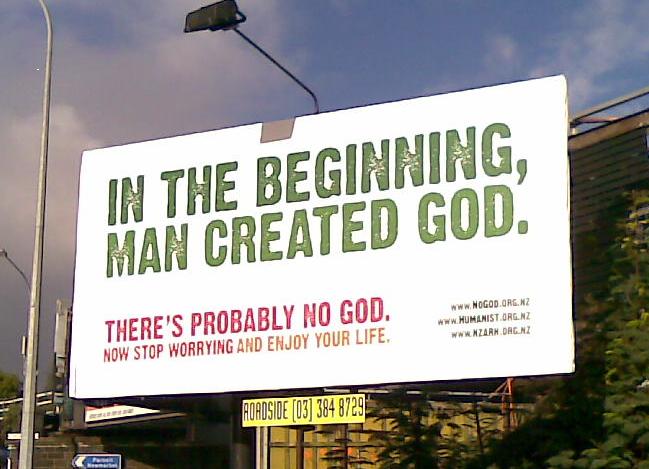
    On the way back from Bloggers drinks we drove past one of the controversial atheist advertising billboards, put up by NZ Atheist Campaign, The Humanist Society and NZARH, which have appeared around Auckland. This appears to have come on the back of the Richard Dawkins inspired bus advertising that made headlines earlier this year. It is worth fisking them a bit.

    Here is a pic of the first one.

    Good Without God? Over One Million Kiwis Are.

    Here we are told one million kiwis are good without God because the census says so. This, however, is fallacious. What the census shows is not that one million kiwis are good without God, it shows that one million kiwis are good (although this is granting a lot for the sake of argument) without believing in the existence God. But to say one can be good without believing in God is not the same as saying one can be good without God. Many people throughout history have been able to live and breath without believing in the existence of hydrogen and oxygen atoms, it does not follow that they could live without water.

    Moreover, it is hard to tell what the point of this sociological fact is anyway. Why does the fact that people do not need to believe in something to do good deeds mean that the belief is false? For centuries people have done good deeds and lived good lives without believing in evolutionary theory or quantum mechanics, should we conclude that these theories are therefore ‘probably false’? Surely these atheists are not suggesting that our beliefs should be based on what is useful or helpful as opposed to what is true or false?

    Perhaps the atheists here mean to convey something else. Some Christian thinkers such as William Lane Craig, Robert Adams, Stephen Layman, Alvin Plantinga, John Hare, Philip Quinn have argued that moral properties such as right and wrong depend on God for their existence. Atheist writers such as Paul Kurtz and Christopher Hitchens retort that this claim is falsified by the existence of morally upright atheists. I suspect something like this is behind the slogan on the billboard, it repeats Hitchens and Kurtz’s retorts as though they said something insightful or clever.

    The problem is, as any one familiar with this discussion should know, this retort misses the point (as I pointed out in On a Common Equivocation). Craig, Adams, et al are not claiming that one needs to believe in God to be good (a point made several times in the literature and particularly made so many times to Kurtz that it beggars belief that he keeps repeating it) rather their claim is that moral properties, such as right and wrong, depend on God for their existence.

    This is a fairly basic and elementary distinction in the literature. How exactly expressing a common philosophical confusion counts as reason for thinking “there probably is no God” is hard to see.

    Let’s look at the next one.

    In the Beginning, Man Created God.

    What is asserted here? That man created God. This, however, is clearly absurd. God is typically defined as an all-powerful, all-knowing, immaterial, necessarily-existent being who created the world. Now if one is going to claim that humans actually created an all-powerful, all-knowing, immaterial, necessarily-existent who created the world, then they are contradicting themselves.

    Humans are part of the world and therefore cannot have created the being that created the world – otherwise humans would have to exist prior to their own existence.

    Similarly, one cannot create a necessary being, this would entail it is possible for a necessary being to not exist, in which case it would not be a necessary being. Taken in a straight-forward, literal manner (the way freethinkers are so fond of taking every passage in the Bible) this billboard simply asserts contradictions.

    Of course, the authors of this billboard probably do not mean to say humans actually created God, they do not think he exists after all. Their claim is that humans created the idea or concept of God and developed it. This is undoubtedly true. Of course, humans also invented the idea or concept of atoms as well, ancient Greek philosophers came up the basics of this concept millennium ago. This trivial fact tells us nothing about whether or not the idea or concept humans developed actually corresponds to anything in reality. To assume that it tells us something about whether the idea or concept is true or false is a fairly obvious case of the genetic fallacy.

    So the second billboard either asserts a contradiction or it is a clear case of a logical fallacy.

    The last one is my favourite.

    We are all atheists about most gods. Some of us just go one god further.

    I am inclined to think the argument on this sign is invalid. To see why let’s take out the term “God” in the sign and replace it with some other term such as “non-Christian perspective.” When we do this we get: “We all reject most non-Christian perspectives, some of us just reject one more.” This argument has true premises, do we now have, a knock-down argument for Christianity?

    Similarly, an analogous argument form with true premises gives us an argument for nihilism, the total denial of the existence of morality. “We are all nihilists about some conceptions of morality, some of us are just nihilistic about one more.”

    The same argument for also furnishes a refutation of secularism, “we all reject some secular perspectives on reality, some of us just reject one more.” I could go on.

    Taking a stand on any issue of philosophical substance, whether by affirming, denying or simply being sceptical of it, is to put oneself in opposition to any number of other people and groups who take a contrary stance. That is life. Such pluralism hardly provides a reason for thinking “there probably is no God” any more than it gives us a reason to doubt any other perspective on the world.

    So what do the atheist billboards do? Well the first one tells us that some atheist groups conflate basic philosophical distinctions and don’t really understand the debate they are contributing to. The second shows us that these groups think contradictions and obvious fallacies are some how savvy and smart. The last shows us that they think that invalid argument forms, forms from which you could infer the denial of anything and everything by substituting one true premise with another, are avant-garde.

    All in all, pretty accurate advertising for these groups.

    Hat tip: MCAS

  • A Response to The Dunedin School’s “Thinking in Tatters: Moral Relativism and So-Called ‘Counter-Examples’”

    In my previous post, A Response to The Dunedin School’s “Thinking in Tatters: Moral Relativism and Hidden Objectivist Assumptions”, I addressed some criticisms levelled at a talk I gave on moral relativsm by Deane from The Dunedin School (TDS) blog. In a follow up post, which, once again, I cannot link directly too as TDS seem to have deleted it and successfully removed it from the caches of Google, Bing and Yahoo (not to worry, I have pasted a full copy of the original below) Deane took issue with one the arguments I gave against relativism. In my talk, following Francis Snyder, I defined relativism as follows:

    Cultural Ethical Relativism: An action is wrong for a person, if and only if, that person’s society or cultural group condemns that action.

    Individual Ethical Relativism: An action is wrong for a person, if and only if, that person believes that the action is wrong.[1]

    In the final section of my talk I gave several arguments against relativism so defined. One argument went as follows:

    [1] If Cultural Ethical Relativism is true then an action is wrong for a person, if and only if, that person’s society or cultural group condemns that action.

    [2] Some societies or cultural groups do not condemn practices like wife beating, racism, religious persecution and rape.

    Therefore,

    [3] If Cultural Ethical Relativism is true, it is right for a person in those societies to beat their wife, be racist, engage in religious persecution and commit rape.

    I gave a parallel argument against individual relativism:

    [1]’ If Individual Ethical Relativism is true then an action is wrong for a person, if and only if, that person believes that that action is wrong.

    [2]’ Some people do not believe it is wrong to rape women and chop them up.

    Therefore,

    [3]’ If Individual Ethical Relativism is true then it is not wrong for such people to rape women and chop them up.

    Now I maintain that the contention that it is permissible for a person to beat their wife, be racist, engage in religious persecution, commit rape and chop people up is false. It is not morally permissible to do these things; hence, as both cultural ethical relativism individual and ethical relativism entail false conclusions they themselves are false.

    Deane contends this argument is “confused” and constitutes a “tirade.” Of course merely describing an argument in pejorative rhetorical language does nothing to actually refute it. It is also worth noting that if Deane is correct, it does little to turn back the critique I offered because, as I noted, this is just one of several arguments I against relativism. Showing that one argument against a position fails does not show that all do.

    That said, I do not accept that Dean has shown that my argument fails in this instance. His claim that this argument is obviously “confused” appears to be mere bluster; it remains unclear as to exactly which premise Deane rejects. My argument is formally valid; the conclusion follows from the premises. Moreover, premise [1] and [1]’ are true by virtue of the definitions of relativism, definitions widely accepted in the literature. Premise [2] and [2]’ are also clearly true. It is historically undisputable that there have been societies and people who accepted the practices outlined in both. Finally, [3] and [3’] follow from [1] [2] and [1]’ [2]’ respectively. So it seems then that the only remotely plausible way a person could escape this argument is by biting the bullet and contending that sadist nihilists who chop women up and rape them are not acting wrongly and that members of societies that persecute religious minorities, permit wife bashing, racism and rape are not doing anything wrong when they do these actions. I, myself, find this conclusion extremely implausible.

    The first two arguments Deane offers actually avoid addressing this argument at all and instead attack my character and alleged motives. Deane’s first argument is the insinuation that I oppose relativism because it produces “equality for women, freedom of homosexuals from legal persecution.” Two things can be said in response to this. First, even if this claim were true, it would show only that my motives for offering the argument were dubious; it would not show the argument itself is dubious. To do that Deane would have to actually address the premises and offer some actual argument supporting his assertion that they are false. Second, the claim is false. In fact, the argument [1] [2] [3] above, opposes relativism precisely on the grounds that it entails that certain forms of oppression of women are not wrong. It is an undisputed fact that many societies permit and even enjoin the oppression of women, Deane himself claims that 50 years ago New Zealand society approved of wife bashing, but if is wrong for someone to engage in conduct, if and only if, their society does not approve of it, as cultural ethical relativism maintains, then it follows that there was in fact nothing wrong with wife bashing 50 years ago. The New Zealand male who beat his wife black and blue in the 1950’s was acting perfectly appropriately. I find this claim to be clearly absurd. Deane is welcome to support an ethical theory that entails this if he wishes but if he does I strongly suggest that it is him and not I that supports and justifies the oppression of women.

    Deane’s second line of argument fares no better. Responding to the second of the arguments mentioned above, Deane insinuates that I fantasise about raping women and chopping them up,

    When Matt fantasizes about some weird behavior (and his favourite suggestion, for some reason, is a person who rapes, tortures and ‘chops up’ women…)

    Deane here appears to reason that because I mention an activity as an example of unjust conduct that I must fantasise about doing it. The problem is that Deane in both his blog posts mentioned the persecution of gays and women as unjust practices; by his own logic then Deane is a misogynist homophobe who fantasises about harming women and homosexuals. Clearly this is not a valid response to the arguments above on Deane’s part here but an example of him engaging in another fallacious ad hominen.

    Nether of Deane’s first or second arguments then actually call any of the above into question. Nothing he says gives us the slightest reason for thinking that people who bash their spouse or persecute religious or ethnic minorities with cultural approval are acting justly when they do. Nothing he says leads us to dispute that there are societies which do approve of these things, and these facts jointly entail that cultural ethical relativism is false. If he is to actually rebut this argument as opposed to simply vent his disgust for me, Deane needs to address these claims.

    Later in the post Deanne does attempt to offer some arguments against the inference [1] [2] [3] above. However, these arguments quite evidently fail. At one point Deane argues,

    Moreover, there is no absurdity in the fact that a person or sector of society with very unusual morals might consider their behaviour to be morally good. To the contrary, if morality depends on cultural norms, the examples he provides are exactly as we would expect. Only a few people would openly claim moral rectitude for really weird or kinky behaviour. For if everybody openly claimed it was morally good, then – culturally – it wouldn’t be considered weird or kinky in the first place!

    Deanne here points out that it is not absurd to suggest “that a person or sector of society with very unusual morals might consider their behaviour to be morally good.” I agree entirely, the problem is that nowhere in my arguments above is this denied. I did not deny that some societies will claim that certain actions they engage in are morally permissible. In fact [2] explicitly affirms that some societies will claim that wife beating, religious persecution, rape and racism are permissible; hence, far from denying this claim I explicitly affirmed it. What I maintain as absurd is the contention that these societies’ assessments of their own norms are correct, that a person whom, with cultural approval, persecutes another or beats his wife actually is acting rightly and justly. Deane’s criticism here then attacks a point I did not make and fails to address the one that I did.

    There is a hint at a criticism of [2] in the latter part of this paragraph where Deane suggests that societies that approve of abhorrent behaviour are rare. Unfortunately, this response is inadequate. First, even if it is true, it fails to address my argument. In [2] I maintained that some societies or cultural groups do not condemn practices like wife beating, racism, religious persecution and rape, not that many societies do. Second, with regards to the explicit examples I gave, it is untrue that only a few cultures and societies would support these things, a large number of societies have supported certain forms of rape, such as marital rape or raping women in war. Further, more than a few societies have supported religious persecution. Think, for example, of the execution of Socrates for heresy in ancient Athens, the persecution of Christians by the Romans, the inquisitions and the religious wars of Europe and the religious persecution in many Muslim countries today. Many have supported racist policies such as South Africa and the American South, not to mention the colonial and social Darwinist policies of the 19th century as well as the documented acceptance of racism in many ancient cultures such as ancient Greece and Egypt. Premise [2] is very clearly true. Further [2], when conjoined with the definition of cultural ethical relativism spelled out in [1], entails that these policies were justified and that those who carried them out and advocated them were correct.

    It is this latter claim that I think is evidentially mistaken. Instead of evading the issue Deane owes us an answer. Does he believe, for example, that Inquisitors who burned heretics to death at the stake were right to do so given that their society approved of this practice? Does he believe that when wife bashing was accepted that men who smashed in their wives faces acted rightly? If he does not then he cannot consistently maintain that an action is wrong for a person, if and only if, their society or culture does not condemn it.

    Deane’s fourth line of criticism is to state,

    Matt adds, “If you accept cultural relativism, essentially the norms of your society become infallible. They can’t be wrong. Because right and wrong is just what your society says it is.” As Matt concludes that is it implausible that societies can be morally infallible in their judgments, he concludes that moral relativism is not true.

    Here, again, Deane does not actually address the argument [1] [2] [3] above but instead addresses a different argument that I made elsewhere in the same talk. This was the argument that cultural ethical relativism entails that a society can never be mistaken in its moral judgements. So, once again, even if Deane’s criticisms of this argument are correct they do not actually address [1] [2] [3] above. However, once again, even in response to this line of argument Deane fails to be cogent. He notes,

    Matt’s reference to ‘infalliblity’ here is interesting. For infallibility is a normal trait of divine commands. Once again, it seems that Matt is assuming that moral relativism must have the characteristics of moral objectivism. He just cannot appreciate how moral relativism works. For moral relativism is not some monolithic system across society, but a variety of different views, some coalescing together, some in conflict to some degree or another. Moral relativism is not some stationary edifice, as Matt pretends, but is always developing, always reacting to material circumstances and prior ideologies. Once one removes the imaginary characteristics of divine command theory – infallibility, immutability, universality, etc – from the description of moral relativism, then Matt’s conclusions are exposed as unsound.

    Deane here states that I “assume” that a society’s norms are infallible. This, however, is false. In the quote he cites, I argued for this conclusion. I stated explicitly that the norms of a society “can’t be wrong because right and wrong is just what your society says it is.” The ‘because’ here notes an inference. If the property of ‘being right’ is the property of ‘being approved by society’ then it is impossible for society to approve of an action and for that action to be wrong. Deane is welcome to address this inference but ignoring it and then stating that I merely assumed the conclusion does not address my argument.

    Deane does go on to offer some arguments to the effect that societal norms are not monolithlic and static, rather they are rather fluid; the societal norms change, develop, evolve, etc. However, nowhere did I deny any of these things. What I argued for was that relativism entails that these norms are infallible. No matter how fluid or changing cultural norms are, the fact remains that, according to cultural ethical relativism, at any given time T, if a society approves of an action then that action is right for any member of the society who performs it at T. At no point in time can a society be mistaken about what right and wrong is if right and wrong are identified with the norms of a society. Of course at T+1 the societal norm may change but if this is the case then this simply means that society has changed from one correct assessment of right and wrong to another. For the reasons I stated, which Deane ignored, Deane’s position commits him to the view that societies’ norms are never mistaken, and this, I maintain, is absurd. Clearly throughout history societies have made mistakes in their moral judgements and this fact shows us that societal norms and moral norms are not the same thing.


    [1] Frances Howard-Snyder “Christianity and Ethics” in Reason for the Hope Within, ed Michael J. Murray (Grand Rapids MI: Eerdmans Publishing co, 1999) 376-377.

    RELATED POSTS:
    A Response to The Dunedin School’s “Thinking in Tatters: Moral Relativism and Hidden Objectivist Assumptions”
    Video of Matthew Flannagan Speaking on Moral Relativism
    Cultural Confusion and Ethical Relativism I
    Cultural Confusion and Ethical Relativism II
    Cultural Confusion and Ethical Relativism III

    The original blog post, “Thinking in Tatters: Moral Relativism and So-called ‘Counter-examples’”, by Deane Galbraith of The Dunedin School is below (more…)

  • A Response to The Dunedin School’s “Thinking in Tatters: Moral Relativism and Hidden Objectivist Assumptions”

    A while ago I did a series of semi-popular posts on moral relativism beginning with Cultural Confusion and Ethical Relativism I. These posts grew out of a talk I gave in Tauranga in 2008. Later I presented essentially the same talk at Laidlaw College for Thinking Matters Auckland which was posted on You Tube and is available for viewing here. This video drew a response from Dean of The Dunedin School (TDS) blog (a full copy is pasted below as it has disappeared offline then reappeared more than once). In this post I will address Deane’s critique of my discussion of some arguments for moral relativism. In the next I will respond to his criticism of my arguments against relativism.

    Deane’s critique appears to consist of three lines of argument. The first is a string of assertions about my alleged motives combined with pejorative terms to describe my conclusions. Deane insinuates that I am a “frustrated atavistic reactionists who want to take away rights from women, homosexuals, and other minorities and restore power to the patriarchy” and smugly contends that my arguments are “a mish-mash of illogical nonsense and rhetorical scaremongering.”

    Unfortunately one does not refute a person’s arguments by simply asserting that their arguments are illogical. Even if Deane’s assertions about my motives were correct, and he offers no evidence to suggest that that they are, this would show only that I have terrible motives in making the arguments in question, not that the arguments themselves were problematic. Hence, this first line of argument can be dismissed as mere rhetoric.

    The second line of argument is only marginally more substantial. Deane suggests that I spent more than half my talk “presenting obviously unsound arguments for relativism and then (marvelously!) disproving them to [my] captive evangelical audience”. Deane describes this as a “sleight of hand” on my part. Now exactly what this objection amounts to is unclear. Deane clearly dislikes the idea that my audience were evangelicals (which not all were) but the fact that my audience may hold to a particular religion does not show the arguments I presented to this audience were mistaken; in fact, Deane in conceding that the arguments I criticised were “obviously unsound” seems to agree with my conclusions about the merits of these arguments. Given this, it is hard to know what the problem is. Of course Deane describes my criticisms in a sarcastic tone but simply describing something sarcastically does not constitute an argument against it nor does deeming it “sleight of hand” show that it is mistaken.

    What I think Deane is driving at is something more substantial. Some of what he says suggests he is accusing me of attacking a straw-man; he seems to be suggesting that I chose some really bad arguments, which anyone familiar with the discussions on relativism will know are not actually made by proponents of relativism and I criticised these arguments. I got away with it only because my audience are evangelicals, and hence, unaware that a straw-man has been presented.

    Now apart from the suggestion that all evangelicals are ignorant, gullible people with no background in ethics and the assumption that the audience was made up of evangelicals (I suspect that the atheists present probably would not describe themselves as “evangelical”) the obvious problem with this claim is that it is false. The arguments I put forward come from the literature on relativism (as anyone familiar with the discussions on relativism can attest to).

    In the talk I cite two arguments, an argument from tolerance and an argument from diversity. These arguments are often cited in secular ethics text books. Alan Bloom in The Closing of the American Mind, for example, notes that the appeal to tolerance is one of the most common reasons proposed for relativism. The arguments I mentioned are also cited by Harry Gensler in his book Ethics: A Contemporary Introduction,  Louis Pojman notes these arguments in Ethics Discovering Right and Wrong and James Rachels raises them in The Elements of Moral Philosophy. Hence, far from being a straw-man that only an ignoramus would cite in the context of relativism, these are arguments for relativism cited in leading mainstream ethics textbooks.

    The third of Deane’s arguments is more substantive. He suggests that one point I make in my talk is circular. Now the first thing to note is that this claim is, to some extent, fairly irrelevant. In the section in question I noted two arguments commonly put forward in favor of relativism and offered several lines of criticism against them, one of them Deane claims is circular. Now even if Deane were correct, pointing out that one line of criticism is fallacious does nothing to address the overall case I made. If one of several arguments are mistaken it does not follow that the rest are.

    That said, Deane’s attribution of circularity to me is mistaken. In my talk I noted that one argument for relativism implicitly appeals to the following premise:

    [2] All people have a duty to not be intolerant

    At one point I made the following comment about this premise, “And notice too that the second premise is making a what? An objective moral statement. It is saying that all people have a duty to be tolerant. But according to relativism there are no objective moral statements”

    It is here Deane thinks I have argued in a circle. He states,

    Now, indulging Matt for a while, let’s ask this question: if a moral relativist did happen to hold to this premise, what would be the nature of the ‘duty’? Too obvious, you say? Well yes, the answer would seem to be too obvious. The  ’duty’ would clearly be relative for a moral relativist… Matt falsely attributes moral objectivism to a moral relativist, because he just cannot grasp the concept of moral relativism. However, in moral relativism, a duty, even if applicable to everybody in a particular society, would by definition be morally relative. A prevalent problem with moral objectivists such as Matt is that they haven’t ever grasped what a purely subjective morality looks like, how it operates. They keep trying to sneak back in assumptions of moral objectivity – the very thing that moral relativists deny. And so their attempt to raise an argument against it – by assuming the objectivity of morality – is revealed as a piece of illogical and circular nonsense.

    Several things can be said about this. First, even if I did (as Deane contends) assume the objectivity of morality in my criticism here, this would not make my argument circular. A circular argument is one where the conclusion is assumed in the premises. To be circular then I would have to be making an argument for the conclusion that moral relativism is correct. But I was not. At this point in the talk I was criticising one argument for moral relativism. But criticising one argument for moral relativism is not the same thing as offering an argument for objectivism. Hence, even if one grants Deane’s substantive point, my argument is not circular.

    Second, and more importantly, Deane is wrong to claim that I was, at this point, assuming the objectivity of morality and sneaking this assumption into my interpretation of [2]. If Deane had bothered to listen to the passage he cited in its context he would see that I immediately went on to argue that [2] should be interpreted as affirming an objective principle. What I said was:

    if relativism were true [2] would actually be wrong. You would only have a duty to be tolerant if you yourself believed in tolerance. If you were a bigot you’d be perfectly entitled to be intolerant. And if your society was a bigoted society it would be perfectly appropriate for you to be intolerant. So the person who makes this claim actually shows that they believe in objective morality, they believe there is an objective value of tolerance.

    Hence it is simply not the case that I assumed moral objectivism and sneaked this assumption into my reading of [2]. What I did was offer an argument that [2] had to be interpreted this way because unless one interpreted [2] in an objectivist manner, [2] would be false.

    Now if Deane thinks that [2] can be interpreted in a relativist manner then the burden is on him to show that my argument is mistaken. To ignore the argument and simply state that I assumed the position I argued for and then assert that the position is wrong establishes nothing at all (well, it establishes nothing about my argument).

    Ironically, if we accept Deane’s contention that [2] should be interpreted as asserting a relative duty and not an objective duty then, in fact, it is the relativist that is engaging in circular reasoning. Remember, at this point in the talk I was criticising an argument for relativism, [2] was a premise of this particular argument for relativism. If [2], therefore, expresses or presupposes that moral claims are to be interpreted in a relativist fashion then the relativist is presupposing the truth of relativism in the premises of one argument for relativism, and this clearly would be circular.

    For the relativist to offer a non-question begging argument for his position he must appeal to premises that non-relativists are likely to accept and hence the premises of his argument cannot be interpreted in a relativist fashion.

    There is a final point to make here, Deane makes heavy weather out of the contention that I cannot conceive of what a relativist morality would look like. He states,

    Matt’s criticism reveals that he has failed to appreciate what a thoroughgoing moral relativism would look like. He just doesn’t get it. He cannot conceive of moral duties that are not objective. I suspect that this is an all-too-frequent barrier for moral objectivists. Their commitment to moral objectivism is such that they fail to properly conceive of a world in which every moral duty is simply the result of cultural norms.

    It is evident that an unjustified leap is being made here. Suppose, contrary to fact, I did err in one criticism I made of one argument for relativism. It hardly follows from this that I cannot conceive of what a thorough-going relativism would look like. All it would show is that on one point I made a mistake. But more importantly, even if it did establish what Deane claims, that I failed to appreciate what a thoroughgoing moral relativism would look like, it is not clear how this would constitute a criticism of my position. After all there are many things which I cannot conceive of that are perfectly rational for me to reject. I cannot conceive of what a square triangle would look like, it does not follow from this that I cannot defensibly claim that anyone who affirms that square triangles exist is mistaken and is uttering a nonsense. So once again Deane’s criticism amounts to nothing at all.

    Of course Deane makes his points in a rhetorical, sarcastic, snarky manner and I am sure that for those who dislike evangelical Christianity, such writing is highly entertaining. Entertaining rhetoric, however, is never a substitute for substantive content; notwithstanding the entertaining rhetoric in this instance, the arguments Deane offers fail.

    RELATED POSTS:
    A Response to The Dunedin School’s “Thinking in Tatters: Moral Relativism and So-Called ‘Counter-Examples’”
    Video of Matthew Flannagan Speaking on Moral Relativism
    Cultural Confusion and Ethical Relativism I
    Cultural Confusion and Ethical Relativism II
    Cultural Confusion and Ethical Relativism III

    The original blog post, “Thinking in Tatters: Moral Relativism and Hidden Objectivist Assumptions”, by Deane Galbraith of The Dunedin School is below (more…)

  • St Matthews in the City: Progressive Irrationality

    It was a typical chilly Dunedin morning. I was standing in line at the Otago University Post Shop, about to send an important document overseas, when the student in front of me, oblivious to his audience, announced to the girl beside him “I’ve got a doll of Jesus in my car, I have tied a noose around its neck and hanged it. It’s hilarious. It really pisses those Christians off.” Laughter ensued. Now I was outwardly restrained but in my mind I contemplated a come back; it went like this, as soon as the guy had spoken I would call him an “asshole” in front of everyone in the line. When he looked bewildered and offended that a complete stranger had insulted him for no reason at all, I would respond, “What’s your problem, you just said that it was funny to insult people for no reason at all other than the fact that you find it funny to piss them off.”

    Now I did not do this, and for good reason. It is generally not a good look for a doctoral student to go around insulting other students simply because they said things about my religion that I disagreed with – people would justifiably be outraged at me and denounce me as bigoted. But, isn’t this the point?

    I recalled this event this morning as I heard that the controversial Christmas billboard, put up by St Matthews in the City, has been taken down. For those outside of Auckland, St Matthews in the City is an Anglican congregation that propounds, what they like to call, “progressive Christianity.” They recently put up a billboard showing Mary and Joseph in bed, not looking too happy, with the line “poor Joseph, God was a tough act to follow.” The billboard implies quite clearly that God not only literally had sex with Mary, was a fantastic orgasmic lover but it also, by implication, entails that God committed adultery, and so did Mary.

    Mary and JosephI am glad the billboard is down (though I will not endorse the  reported method) for the obvious reason that it is insulting to other people and, prima facie, it is wrong to insult other people. Of course, there can be situations, such as where a person does something wrong, that the appropriate response is to insult them but absent such situations, charity dictates that we refrain from doing so. Millions of people world-wide worship God and millions of Roman Catholic venerate Mary, this billboard affirmed that persons they love and adore are adulterers.

    Of course some are saying that this is just a joke and we Christians should get a sense of humour. I always find this response disingenuous. Suppose I, for a joke, put a picture of the vicar of St Matthews, Glyn Cardy and his wife, outside my Church, made both of them look not so happy, and added the phrase “Glyn Cardy is as soft and floppy as his theology,” right there, in public – outside my church let’s not forget – for all to see. Would the response, ‘oh come on it’s only a joke, get a sense of humour,’ wash with anyone? I doubt it. If I were a gambler I would bet we would hear another of Cardy’s little sermons about how this is proof of the narrow-minded intolerance that non-progressive Christians like me expound. But then wouldn’t it be evident that neither Cardy nor anyone else believes that humor justifies making insulting personal comments of this nature?

    Of course in many ways this whole event shows up the intellectual shallowness that so called “progressive Christians” show towards others. Take Cardy’s justification for the billboard according to Stuff, Cardy states,

    St Matthew’s church says the aim is to provoke conversation about spiritual matters by lampooning the literal Christian conception story and inviting people to think again about what a miracle is … He said the idea behind the billboard was to move a debate that was inside the church to outside it ”and certainly people in all sorts of places are talking about it”. He didn’t doubt that some people had been offended by the billboard, but ”the literalness of a male God impregnating Mary needs to be laughed at”.

    Note two things here, first Cardy clearly caricatures the “literal conception story” yet mainstream Christendom, who believes this story, do not hold that God is literally a man and that he had sex with Mary. God in traditional theology is immaterial, he has no sex organs and the story of a virginal conception is just that, a virginal conception. Cardy, of course, being theologically trained, knows this. Second, Cardy on calling for “debate” means that people who hold orthodox Christian views “needs to be laughed at.” So Cardy’s understanding of theological debate apparently involves deliberately distorting and caricaturing the views of other people and then responding, not with reasoned argument, but ridicule.

    I might be a bit too conservative and old fashioned but in my book theological argument involves trying to understand another’s position by trying to grasp the best representative examples of it so one can articulate it accurately and then offer sound arguments or reasons for rejecting it or for showing where and why it is flawed. It also involves treating ones interlocutors with respect. Of course I do not always live up to this ideal but it is one that I think Theologians should aspire to.

    The fact that Cardy and St Matthews thinks otherwise tells us a bit about them and their “progressive Christianity.” People who think it is ok to ridicule and insult people simply because they hold a different religious perspective to them, who will dishonestly distort other’s views and responds to being challenged on this, not by reason, but by self-confident ridicule is not “progressive” and no amount of relabeling it will change this fact.