This blog’s Matthew Flannagan has had his paper “Divine Commands and Biblical Authority: The Problem of Gen 22” accepted for the National Annual Meeting of the Evangelical Philosophical Society (“EPS”). The abstract for Matt’s paper is as follows:
“One perennial objection to divine command meta-ethics is the possibility that God might command something abhorrent. Divine command theorists have responded that God is essentially good, as such, it is impossible for him to issue an abhorrent command. One challenge to this response, for those divine command theorists who accept a robust view of biblical authority, is the story of the binding of Isaac in Genesis 22. In this story God is said to have commanded human sacrifice; given that human sacrifice is abhorrent, and it is impossible for God to command the abhorrent, Biblical authority seems incompatible with the acceptance of a divine command theory.
This paper responds to this challenge. First, I will argue that a careful reading of Genesis 22 in its literary context suggests God issued the command in a particular context. Second, drawing from discussions of the problem by Robert Adams Immanuel Kant, and Philip Quinn, I will discuss the circumstances under which a divine command theorist can rationally and coherently attribute a seemingly immoral command to an essentially loving and just God. I will argue that the context of God’s command in Genesis 22 is such that a divine command theorist can defensibly attribute it to an essentially good God without abandoning a robust view of biblical authority; the story of the binding of Isaac does not provide a divine command theorist with a defeater for belief in biblical authority.”
The conference theme will be “Revelation and Authority.” The Plenary Speaker is Richard Swinburne of Oxford University. The draft copy of the ETS-EPS program is available here.
Matt has also had a paper accepted for the Evangelical Theological Society’s Annual Meeting which is also in Baltimore around the same time – see Matt to speak at the 2013 Evangelical Theological Society in Baltimore on Feticide.
As with previous years we will be fundraising to raise the $2,500 NZD to get him there . Donations greatly appreciated.
 Note that behind this critique is the presupposition that there are moral duties. People have a duty to not engage in wars or acts of terrorism, religious people who promote sexist or homophobic practices are wrong for doing so. I think this is nonsense as it assumes there is such a thing as a moral duty, it assumes things religious people do can be wrong. This is false and here is why:
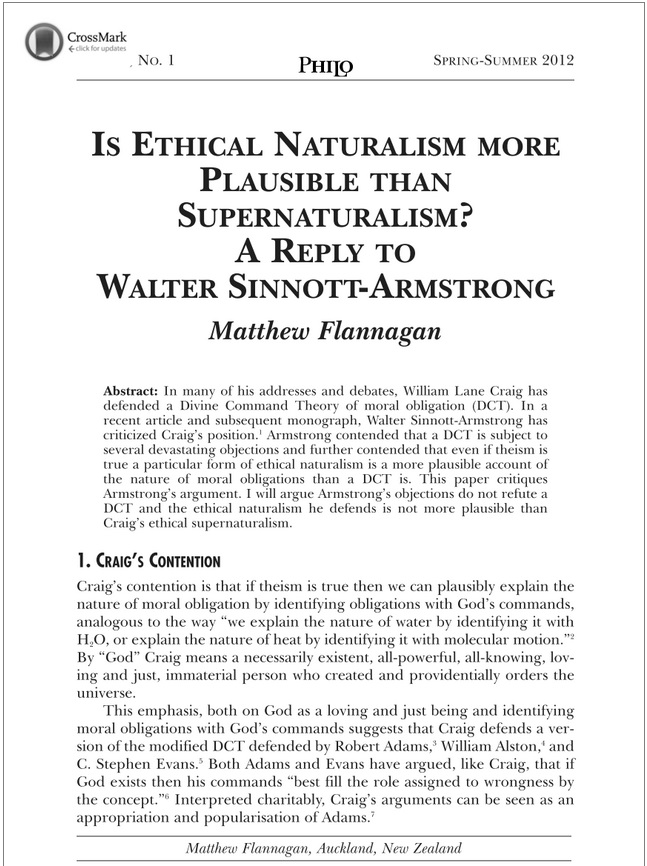 “In many of his addresses and debates, William Lane Craig has defended a Divine Command Theory of moral obligation (DCT). In a recent article and subsequent monograph, Walter Sinnott-Armstrong has criticized Craig’s position. Armstrong contended that a DCT is subject to several devastating objections and further contended that even if theism is true a particular form of ethical naturalism is a more plausible account of the nature of moral obligations than a DCT is. This paper critiques Armstrong’s argument. I will argue Armstrong’s objections do not refute a DCT and the ethical naturalism he defends is not more plausible than Craig’s ethical supernaturalism.”
 In my last post,

 This paper will critically assess one important part of Singer’s position: his understanding of why it is wrong to kill. In I I will sketch Singer’s “desire account” of killing and its relationship to his own preference utilitarianism and project of animal equality. Following Don Marquis, I will argue in II, that this “desire account” is subject to important counter examples. In III I note Singer’s attempts to modify his position so as to avoid these counter examples and suggest that these modifications are problematic. In IV, I will suggest that, despite this, there is an important truth in Singer’s critique, one that Christian thinkers can appropriate in developing moral arguments for Christian theism.