
Below is the second part of a talk I delivered at Crossroads Presbyterian Church. 3. What Did Jesus Mean So if Jesus did not command us to refrain from judging others, what does he teach in this passage? I think Jesus is not, in this passage, telling us to “not judge.” He is instead telling […]
Entries Tagged as 'Ethics'
To Judge or not to Judge: Part Two
August 27th, 2025 Comments Off on To Judge or not to Judge: Part Two
Tags: Judging · Sermon on the Mount · Sermons
New publication: “Can a Divine Command Theory Vindicate the Objectivity of Morality?”
August 26th, 2025 Comments Off on New publication: “Can a Divine Command Theory Vindicate the Objectivity of Morality?”
My paper, “Can a Divine Command Theory Vindicate the Objectivity of Morality?” has been published in the latest issue of Philosophia Christi. Abstract:Defenders of divine command metaethics (DCM) often argue that one of its key advantages is its ability to vindicate the objectivity of moral judgments. Critics, however, contend that DCM is a subjectivist theory […]
Tags: David Brink · Divine Command Theory · Elizabeth Tropman · Michael Huemer · Objectivism
To Judge or not to Judge?: Part One
August 25th, 2025 Comments Off on To Judge or not to Judge?: Part One
Below is part one of a sermon I presented at Crossroads Presbyterian Church in Pokeno. “Do not judge, or you too will be judged. 2 For in the same way you judge others, you will be judged, and with the measure you use, it will be measured to you. 3 “Why do you look at […]
Tags: Judging · Sermon on the Mount · Sermons
Published: Theological Utilitarianism, Supervenience, and Intrinsic Value
April 14th, 2023 Comments Off on Published: Theological Utilitarianism, Supervenience, and Intrinsic Value
My paper, “Theological Utilitarianism, Supervenience, and Intrinsic Value” has been published in a special issue of Religions, devoted to the topic God and Ethics. The abstract is as follows: Erik Wielenberg has argued that robust realism can account for the “common-sense moral belief” that “some things distinct from God are intrinsically good”. By contrast, theological stateism […]
Tags: Erik Wielenberg · George Berkeley · God and Morality · Intrinsic Value · supervenience · Theological Utilitarianism · Theological Voluntarism · William Paley
Is Theism Incompatible with the Pauline Principle? Comments on James Sterba’s Argument from Evil
November 3rd, 2022 Comments Off on Is Theism Incompatible with the Pauline Principle? Comments on James Sterba’s Argument from Evil
My paper, “Is Theism Incompatible with the Pauline Principle?” has been published in a special issue of Religions, devoted to the topic Do We Now Have A Logical Argument From Evil? The abstract is as follows: This paper criticises James Sterba’s use of the Pauline principle to formulate a logical version of the problem of […]
Tags: Alvin Plantinga · Deontological Argument from Evil · Divine Command Theory · George Berkeley · James Sterba · John Mackie · Pauline Principle · Problem of Evil · Theological Utilitarianism · Utilitarianism
Thinking Matters Talk: Does Morality Need God? Part Three:
September 8th, 2022 3 Comments
This year the New Zealand apologetics organization Thinking Matters ran a “Confident Christianity Conference” in Auckland. I was asked to speak at this conference on the topic. Does Morality Need God? Below is a slightly streamlined version of the talk I gave. This brings me to my second contention: If God exists, a divine command theory […]
Tags: Anything goes Objection · Arbitrariness Objection · Divine Command Theory · Euthyphro Dilemma · God and Morality · Graham Oppy · Nathan L King · Plato

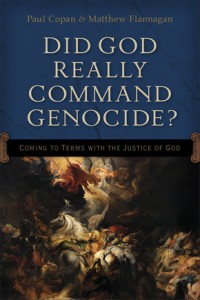 A common objection to belief in the God of the Bible is that a good, kind, and loving deity would never command the wholesale slaughter of nations. In the tradition of his popular Is God a Moral Monster?, Paul Copan teams up with Matthew Flannagan to tackle some of the most confusing and uncomfortable passages of Scripture. Together they help the Christian and nonbeliever alike understand the biblical, theological, philosophical, and ethical implications of Old Testament warfare passages.

When bigots call out “bigots”
April 13th, 2023 Comments Off on When bigots call out “bigots”
Albert Giubilini and I would not agree on a lot. Giubilini has defended not only abortion rights but what he calls “after-birth abortion”( which of course is a reference to infanticide). He also opposes religious conscientious objection in medicine. I disagree with him on both topics and disagree strongly. I find his conclusions repugnant. However, […]
Tags: Bigotry · Free speech