Category: Faith and Reason

  • William Lane Craig, Raymond Bradley and the Problem of Hell Part One

    During the Q & A at the recent Auckland Cooke – Craig debate, Professor Raymond Bradley (Bradley), Emeritus Professor of Philosophy at Auckland University, offered an argument, which he has laid out in more detail in his article A Moral Argument for Atheism, as follows:

    Christians accept that:

    [1] Any act that God commits, causes, commands or condones is morally permissible;
    [2] It is morally wrong to torture people endlessly for their beliefs;
    [3] The bible teaches that God will torture people endlessly for their beliefs;

    From this he inferred that:

    [4] God does not exist.

    Dr William Lane Craig (Craig) responded that the conclusion does not follow from the premises unless one assumes that the Bible is infallible. [1] and [2] entail that God will not endlessly torture people for their beliefs. However, [3] entails the negation of this only if one adds the further premise, that whatever the bible teaches about God is true. If one does not grant this assumption, the fact that the bible records that God will do something does not entail that he actually will do this. Hence, even if Bradley’s argument is sound it is really an argument against theism conjoined with biblical infallibility, not against theism per se.

    In his article, Bradley argues that this option is unavailable to the Christian theist. He writes:

    this would be to be to abandon the chief foundation of religious and moral epistemology (ways of obtaining religious and moral knowledge) … the question arises as to how we are supposed to know of God’s existence let alone look to him for moral guidance. After all, it is a distinguishing feature of theism, as opposed to deism, to hold that God reveals himself to us and, from time to time, intervenes in human history. And the Bible, according to theists, is the principal record of his revelatory interventions. If the Bible, with its stories of Moses and Jesus, is not his revealed and presumptively true word, then how are we to know of him? If God doesn’t reveal himself through the Old Testament Moses and the New Testament Jesus, then through whom does he reveal himself? To be sure, a theist could well claim that God also reveals himself through other channels in addition to the Bible: reason, tradition, and religious experience all being cases in point. But to deny that the Bible is his main mode of communication would be to deny that the principal figures in Judaism and Christianity can really be known at all. Apart from the scriptural records, we would know little, if anything, of Moses or Jesus, it being doubtful that secular history has anything reliable to say about either. Apart from the scriptural records we would know nothing of the so-called Ten Commandments that God supposedly delivered to Moses, or of the ethical principles that Jesus supposedly delivered in his sermons and parables.

    Bradley is mistaken. He confuses the claim (i) that scripture is reliable, with the claim (ii) that scripture is infallible. In order for the Bible to give us reliable, trust-worthy information about God, (i) needs to be the case. However, (i) is compatible with admitting that on some issues scripture is mistaken.

    Therefore, Bradley’s argument does not have the bite he (and some members of the audience on Tuesday) thought it did. Nether-the-less as an evangelical, Craig is committed to some form of scriptural infallibility and I share this commitment with him. So it is best to see if another line of attack is available.

    Craig’s second point alluded to an ambiguity in [2]. [2] states it is wrong to endlessly torture people for their beliefs. However, this could be interpreted two possible ways, it could be interpreted as:

    [2a] It is wrong for human persons to endlessly torture people for their beliefs;
    [2b] It is wrong for any person including God to endlessly torture people for their beliefs.

    Now in order for Bradley’s argument to follow, [2b] needs to be the case. It needs to be the case that God is engaging in wrongdoing if he tortures people for their beliefs. However, in the article Bradley cites in support of this argument, he provides reasons only for [2a]. He argues that to deny principles such as do not torture people endlessly for their beliefs,

    … would be to ally oneself with moral monsters like Ghenghis Khan, Hitler, Stalin, and Pol Pot. It would be to abandon all pretense to a belief in objective moral values. Indeed, if it is permissible to violate the above principles, then it isn’t easy to see what sorts of acts would not be permissible. .. [It] would be tantamount to an embrace of moral nihilism. And no theist who believes in the Ten Commandments or the Sermon on the Mount could assent to that.

    What Bradley fails to appreciate is that these absurd consequences follow from the rejection of (2a) and not from the rejection of (2b). Moreover, as Craig noted there are good reasons for thinking that it is (2a) and not (2b) that is true. This is because (2b) assumes that God has duties. Both, Craig and I believe in a meta-ethical view known as the Divine Command Theory (DCT). According to this position, it is wrong for a person to perform an action, if and only if, God commands them to not perform this action. It follows from a DCT that God has duties only if he issues commands to himself. Given he does not issue commands to himself, it follows that God cannot have duties.

    God does issue commands to human beings. One command is to not torture people for their beliefs. It follows that (2a) is true and (2a) prevents us allying ourselves with moral monsters such as Pol Pot, Stalin, Hitler, etc.

    Craig’s response, then, is correct. I am inclined to think, however, that Bradley’s argument can be recast without presupposing that God has duties. It is essential to theism and to the defensibility of a divine command theory to maintain that:

    [1’] God is good (where good is referred to in terms of virtues as opposed to (duties).

    And a person, following Bradley’s lead, could argue that:

    [2’] A good person does not torture people for their beliefs.
    [3] The bible teaches that God will torture people endlessly for their beliefs.

    And [1’], [2’] and [3’], when conjoined to a commitment to biblical infallibility, entail a contradiction.

    The best response to Bradley is to attack [3]. Now note that [3] asserts at least two things; first: (a) scripture states that God will torture people forever; second, (b) God does so because of what such people believe. The crucial question then is what reasons Bradley offers for the truth of (a) and (b)? In my next post William Lane Craig, Raymond Bradley and the Problem of Hell Part Two I will examine some of these reasons and argue that they are mistaken.

    RELATED POSTS:
    William Lane Craig, Raymond Bradley and the Problem of Hell Part Two
    The Battle of the Bill’s: A Review of the Craig – Cooke Debate

  • Just in – the Palmy Debate

    I have an initial report from the Palmerston North Bill Craig v Bill Cooke debate held last night:

    There was a massive turnout of 1399 exactly in attendance. The word is that Cooke stepped it up and performed better than in Auckland but that Craig still won. Feedback from those in attendance was that it was a fantastic evening, thoroughly enjoyed by all.

    I have been promised a more thorough report later today so will update this post accordingly.

    Madeleine

    UPDATE:

    Author of Confusion wrote this review, reproduced in part below:

    William Lane Craig & Bill Cooke Public Debate (Palmy)

    Last night (19th June, 2008) I attended the debate which I talked about in a previous post.
    I was astounded at the attendance – the Regent Theatre in Palmerston North has a capacity of about 1,400 and it was easily 90% full for most of the night. There was an impressive diversity of age, gender, and race evident in the audience and I would say it was a fairly accurate cross-section of adult society (it certainly wasn’t an old white men’s club!). From responses to the speakers the audience was polite but predominantly Christian and this reinforces my impression is that there is a growing religious movement pushed by several of fairly active church groups in Palmerston North and it is something I am going to start keeping a closer eye on.

    My overall impressions of the debate were disappointing, and pretty much match Damian’s initial impressions. Craig had a definite game plan in the debate, and it was clearly a game plan from a skilled formal debater. Set up premises and then defend them. Sadly Cooke’s game plan was to dismiss the moot, largely ignore Craig’s premises (begrudgingly discussing them, almost as after thoughts) and mostly talking to three points almost despite whatever Craig said. I will raise these first and then go on to discuss Craig’s arguments:

    Cooke’s Approach

    1. Atheists do not assert there is no god but that they do not see the case for god as compelling or even a coherent claim (based on weak definitions). Unfortunately, while an interesting point, Craig never really tried to pin this on Cooke so it was really not a point worth making in the debate.
    2. He used Lloyd Geering’s idea that the notion of “God” is a barrier to understanding the world around us, and that focusing too much on god gets in the way of rational discourse and promotes undue authority amongst those who claim to understand it. This was an interesting tactic but it failed against the so-called “logic” of Craig because most people (including Craig) missed the connection.
    3. Cooke’s final point was that we should stop arguing about our differences and instead focus on our similarities and on solving real problems. This sort of argument, while noble, is not the way to win debates. He talked about how he was happy that Craig was a Christian and that he encouraged diversity of opinion. Again very noble, but in debates it is about point scoring not nobility (one reason I dislike the format) and this counted against Cooke especially in an audience of largely opposing views.

    So overall it didn’t really seem like Cooke came to debate. The only life really came from him during the Q&A when some quick witted answers did score some points, but by then it was far too late. If the debate was scored he would have clearly lost.

  • The Battle of the Bills: A Review of the Craig – Cooke Debate

    My small idea of getting Dr William Lane Craig to have a debate at Auckland University ended up being an event that far exceeded my expectations. Despite the New Zealand Association of Rationalists and Humanists (NZARH) booking a larger lecture theatre at the last minute we still had to open up three additional lecture theatres with live video feeds and we still had people sitting on the floor! Question time had to be extended because of the interest. The range of people in attendance was excellent; hardened skeptics, evangelical Christians and everyone in between, young and old, high school students through to tertiary faculty.

    My experience within the tertiary sector and NZ Christiandom has lead me to believe that despite the secular and popular veneer one sees in New Zealand culture and often in the church, there is a real interest in questions about God, religion and morality. The reaction last night to a civil, rational, intellectual exchange over these issues confirms my suspicion that not only are people hungry for articulate and well thought out answers to these questions but that they can handle these answers coming in a sophisticated and academic manner; the trend of dumbing down these issues in order to be seeker friendly or to have lay appeal is misguided.

    Anyway to the debate; the moot was “Is God a Delusion?” Bill Craig opened by defining a delusion, in accord with the dictionary, as a false belief. He then contended (A) there are no good reasons for thinking atheism is true; and, (B) there are good arguments or reasons for believing in God.

    In support of (B), he summarised five arguments which he has defended in more detail in the Philosophical literature, very briefly they were: (i) the Kalam Cosmological argument (God is the best explanation for the origin of the Universe); (ii) The New Teleological argument (God is the best explanation for the fine-tuning of the Universe); (iii) The Meta-Ethical Moral argument for theism (God is the best explanation for the existence of objective moral norms); (iv) God is entailed by the best explanation of certain facts about the historical Jesus and his resurrection; and, finally, (v) a brief summary of Plantinga’s thesis that immediate experiences about God provide prima facie grounds for affirming that God exists.

    Cooke’s opening was disappointing. I am not saying this because I am a theist and he is not, I have read many skeptical Philosophers who provide brilliant and powerful arguments for atheism (Paul Draper and Michael Tooley are obvious examples) and although I disagree with them I think they provide challenging cases that I can respect. However, Cooke did not follow their lead. Instead Cooke opened by defining atheism as the claim that “we do not know what the word God means.” Cooke then went on to state he does not think Thiesm is false but is rather a distraction. His argument then appeared to consist of claims that the concept of God has evolved throughout history, that this belief has been used by some to commit atrocities and to not follow important social and political reforms. He stated that there are numerous other accounts of God and there are non-cognitive forms of Liberal Christianity which are more helpful to the humanistic aims he shares.

    Cooke also stated his distaste for a debate format where there were rebuttals. He alluded briefly to the problem of evil; however, he did not offer or defend any of the rigorous probabilistic arguments from evil proposed in the literature by people such as Tooley, Draper and Rowe. A crucial premise of many probabilistic arguments from evil is that God has no adequate reasons for allowing the evils which exist in the world. Craig (along with many Philosophers of Religion such as Wykstra, Plantinga, Van Inwagen, Tooley, Alston) has argued this premise is unwarranted as no reasons have been given for thinking the premise is true. The arguments on this topic are fairly detailed but not complex. Cooke did not offer a rebuttal but simply declared Craig’s position as distasteful.

    In rebuttal, Craig noted that Cooke’s definition of atheism was incorrect. He quoted from a standard philosophical encyclopedia a definition of atheism as the belief that God does not exist which is quite different to Cooke’s definition which is actually something more like verificationism. Craig also offered a definition of what he means by God so Cooke could be clear on the meaning of God for the purpose of the debate. Craig then pointed out that Cooke had not offered any arguments for atheism in his speech. He had dismissed a response to the problem of evil but had not argued for it.

    Much of the rest of Cooke’s speech was irrelevant as the question was not whether God had good political consequences but whether theism was true. Even if a belief is the result of social evolution over time, it does not entail that it is false (people’s understanding of democracy has evolved over time, it does not follow that democracy is mistaken because it has evolved and developed over time). Craig also noted that the truth or falsity of a belief is a separate issue from the conduct of those who hold to the belief. Similarly, the fact that a belief distracts some people from certain causes does not necessitate that it is false.

    Craig also pointed out contradictions in Cooke’s speech. Cooke had stated that he did not contend that theism is false but later on he had stated that God was a human invention. Craig also noted that merely pointing out that other theologians disagree with Craig’s cognitive theism and offer alternative accounts of God does not show Craig’s position is false. The existence of differing opinion on a matter does not render the matter false, the reasons offered are what must come under scrutiny.

    Cooke’s rebuttal of Craig was weak. Cooke responded briefly to the meta-ethical moral argument noting that theists and atheists are both aware of certain moral truths and should work together on certain worthy projects. This response, as Craig pointed out, confuses the question of whether an atheist can know moral truths with the question of whether atheism can provide an adequate meta-physical foundation for these truths. Cooke’s position that human beings have no real significance, that morality was simply an evolved convention of some sort, was, in essence, a concession of the meta-ethical argument.

    Cooke addressed the Kalam Cosmological argument and New Teleological argument by stating that he was not a cosmologist and neither was Craig. He also suggested Craig’s knowledge of the historical facts surrounding Christ were mistaken, that scholars disputed the alleged facts Craig appealed to. He suggested that Craig was not familiar enough with Gerd Ludemann whose later works Cooke himself had read.

    Unfortunately for Cooke, Craig was able to counter these claims. First, as noted Craig has studied contemporary cosmology; he did his doctoral work on the theological implications of big bang cosmology and has authored a book on it as well as several published articles. In addition, he has debated Gerd Ludemann and co-written a book with him and so could point out that Ludemann in fact did accept the facts he appealed to. Moreover, Craig could produce published review articles that surveyed the voluminous literature on the subject and the results showed that the consensus was as Craig had suggested. Craig also produced a fairly amusing illustration from Kai Neilson (perhaps more ironic given that Cooke frequently cites Kai Neilson in his debates) which illustrated the counter-intuitive nature of asserting that something could come out of nothing by nothing.

    Cooke did make another claim that Craig did not counter, which was that scientific discoveries are subject to change and so it is questionable to base theological claims on such an unstable foundation. This may be a valid point, the problem is it would appear to uncut a key motif of Cooke’s rationalism. After all, don’t rationalists promote science as a source of knowledge and often attack Christian belief because it allegedly conflicts with science?

    So in my opinion Craig was the clear winner. He offered five arguments, Cooke offered weak responses to which Craig adequately responded. Cooke at times refused to argue at all and kept trying to address side issues and did not really offer a case for atheism.

    Of course it needs to be noted in fairness, that in many respects this was a mismatch. Craig is one of the best Philosophers of Religion in the world. He has published hundreds of articles defending arguments for God’s existence in the philosophical literature and is an extremely experienced debater. Cooke is a historian of the history of free thought with little or no publications in this area. Some of Craig’s previous debate with philosophical heavyweights like Michael Tooley and Quentin Smith were less one-sided.

    I thought some of the real interesting issues and arguments came out in the Q&A. Robert Nola from the Philosophy department made an important point about the New Teleological argument noting that the fact that something is highly improbable does not mean it is irrational to hold to. Craig’s response was probably not as clear as it could be, he noted that the fine-tuning argument is not based merely on the claim that fine-tuning is improbable but rather that fine-tuning constitutes an improbable sequence of patterns. (Craig has made this point more thoroughly in the literature.)

    Ray Bradley, a retired Philosophy Professor, raised a version of the deontological problem of evil noting that God seems to violate certain moral duties such as do not kill. Craig’s response was that if one holds to a divine command (DCT) theory of ethics then right and wrong are constituted by God’s commands. From this, it follows that because God does not issue commands to himself, he does not have duties. If God has no duties then God cannot violate any.

    However, this is not the full story; one powerful objection to a DCT is to note that God could command abhorrent things like torture and hence a DCT would entail the counter-intuitive conclusion that torture is morally required. Divine Command theorists (like Craig and myself) typically avoid this objection by noting that God is perfectly virtuous and hence there are certain things he would not command. Bradley’s question could be rephrased in terms of whether a virtuous person would command or do these things and Craig’s initial response would not settle this but there are plenty of lines of thought in the literature which could.

    In another exchange Bradley raised the issue of Hell noting that the book of revelation portrays this as a place of eternal torment in fire. Craig pointed out that such passages are in fact highly metaphorical and do not in fact say what Bradley thinks they do. Cooke responded by stating that Craig was being inconsistent he sometimes takes the bible literally and sometimes figuratively and Craig (who has a DTheol in New Testament studies) does not understand that the genre of the new testament is myth.

    In fact Cooke is wrong and Craig is right. Revelation has a particular genre, it is Jewish Apocalyptic and this genre is known to use special types of recognisable symbolism. Burridge has shown the gospels are written in the genre of greek biography and not myth. Moreover, the implicit assumption on Cooke’s part that when reading a piece of writing with multiple genres (such as the bible) one should either reads everything literally or everything figuratively is absurd. Even in every-day conversation one uses a mixture of both literal and metaphorical phrases and things like context and genre determine which reading one engages in. As Madeleine pointed out to me, one of her favourite books is a sci-fi fantasy novel that contains an index of characters and terms at the back. Despite the fact the index and the story are contained in one book, she would be in error to read the index figuratively or the story literally; it is not uncommon for one book to have more than one genre. Unfortunately in the short exchange, before an audience untrained in biblical hermeneutics, these points may not have been grasped. As a result I think Cooke came across the better in this exchange despite the fact he was wrong.

    Critical questions were raised about Craig’s theodicy as well. Craig’s position is that God allows certain evils because they are the best way to bring about greater good that otherwise would not be achieved. Some members of the audience found this counter-intuitive. Craig responded that the goods he envisaged infinitesimally outweigh the evil permitted. Craig’s position is utilitarian; one can allow (or cause) evil in order to bring about greater good. Of course utilitarianism is a sophisticated ethical theory and there have been numerous sophisticated defenses of a utilitarian framework in the literature but of course Craig was not able to go into it in sufficient depth last night.

    Overall the night was excellent, a huge turnout and a stimulating discussion of some really deep and important issues. As we left we heard people all around us discussing the ideas offered by both sides and lots of positive feedback about how much they had enjoyed the evening. NZARH arranged to have the event filmed and a copy should be online over the weekend.

  • The “Dark Ages” and Other Propaganda

    Perhaps I am a glutton for punishment, but I have been having an interesting dialogue with Peter Cresswell about the history of theology.

    To sum up PC follows the 20th century novelist Ayn Rand. Rand’s followers view Aristotle as the “father of the enlightenment,” they appear to hold a view of history that is extremely common in popular history. The story goes like this: prior to the rise of Christianity was the “classical period” where science and reason flourished among the ancient Greek thinkers (of which Aristotle is the par excellence). This learning was extinguished by the rise of Christianity, which hated reason and science in favour of a superstitious faith. This brought about a period called the ‘dark ages’ where all progress and science were suppressed. The discovery of Aristotle’s works in the late middle ages changed this, people began following reason again and as a result liberated themselves from the shackles of dark age superstitions most notably Christianity. It was this liberation from religious superstition that brought about the rise of science, a rise contested unsuccessfully by the Church, which resulted in the enlightenment where secularism prevailed. Such things as liberty and freedom come from the enlightenment, not from Christianity, which opposed it.

    I have maintained for some time now that this story is mistaken and based on simplistic and often caricatured readings of the history of theology. PC on the other hand demurs, he thinks this is clearly true and anyone who thinks otherwise is simply spouting religious propaganda. The exchange is below. PC’s comments are in italics my responses follow each one.

    1. You see, at the root of the Enlightenment was the knowledge that reason is capable of explaining existence — that is, that reason is our means of acquiring knowledge, and it is knowledge of this world, not of the next one. Knowledge of nature, not of “super-nature,” is that promotes life on earth.

    Actually, no. Many of the major enlightenment figures did not limit reason to nature. Descartes’ defended the ontological argument, Locke, defended Christianity and theism and in fact his epistemology was motivated by the desire to be able to come to correct conclusions about God (this is according to what his friend wrote on one of the earliest manuscripts of Locke’s essay). Berkley was a theist who wanted to refute materialism, Hume’s religious affinities are a matter of debate but many view him as a theist or deist. Reid was a Presbyterian minister who wanted to use reason to fight skepticism about religion. Berkley defended the ontological and cosmological arguments and used reason to develop a theodicy. Kant wanted to make room for faith and immortality and defended the moral argument. Newton’s preface states that his basis for adopting the scientific method was theological (and anti-Aristotelian btw) and he developed his physics, in part, to defend the existence of God. I could go on.

    Moreover, one of the major problems with the epistemology of the enlightenment (known as classical foundationalism) is that it had trouble providing a basis for knowledge of an external world. This is a central issue in Descartes through to Locke, Berkley, Hume, Reid, etc. Locke believed that much of what we perceive are secondary qualities, created by our mind. Hume took the skepticism to its conclusion. Berkley, Reid and Descartes appealed to theology to solve these skeptical problems. Kant used this skepticism to defend theology.

    2. The fact is that since the rediscovery of Aristotle’s writings, the Church has sought to reconcile reason and mysticism, and to appropriate the pagan Aristotle as some sort of patron saint.

    Actually the project of using reason to defend, develop and refine faith predates Aristotle and goes all the way back to Philo of Alexandria. Then there are the early Church fathers like Justin (a Greek philosopher), Origen, Athanasius, Augustine, Athenagoras, Clement, Gregory of Nazianius, Basil, to name a few. Moreover, classical Greek philosophy and learning was promoted prior to Aquinas by people like Boethius, Isidore, Anselm, Bede, Peter Damian, Abelard and so on. Some early Christian thinkers were hostile to Greek Philosophy or hostile to it in certain contexts but many were not and the suggestion that the anti-philosophy camp was main-stream is simply false.

    3 Aristotle’s method of observation-based rationality was so utterly at odds with the religionist thinking that had dominated the Dark Ages, and was responsible for those Ages being Dark, that they struck even religious thinkers like a bombshell when they were rediscovered after a millennia of darkness.

    Wrong again, Numbers and Lindberg note that recent historical research suggests that this portrayal of the early middle ages as “the dark ages” is a caricature. (David C Lindberg “The Medieval Church Encounters the Classical Tradition: Saint Augustine, Roger Bacon and the Handmaiden Metaphor” in When Science & Christianity Meet, ed. David C. Lindberg & Ronald L. Numbers (Chicago: Chicago University Press, 2003) 7-8). A conclusion shared by the studies of Henri Pirenne (A History of Europe from the End of the Roman World in the West to the Beginning of Western States, (New York: Doubleday Anchor, 1958)) and Marc Bloch (Feudal Society, (Chicago: Chicago University Press, 1961)) and Richard Hodge (“The Not So Dark Ages,” Archaeology 51 (September/October 1998).

    Contemporary encyclopaedias bear this out; the 1975 New Columbia Encyclopaedia states that the term “dark ages” is no longer used by historians because this period is “no longer thought to have been so dim.’ Similarly the Encyclopaedia Britannica states the term “dark ages” is “now rarely used by historians because of the unacceptable value judgment it implies,” the term “dark ages” incorrectly implies this was “a period of intellectual darkness and barbarity.”

    3 [W]hen the works of Aristotle—the master of natural science and secular philosophy—were rediscovered in 12th-century Islamic Spain, it is no mystery that Western European thinkers—after centuries of suppression and penury.

    Actually the suppression of heretical views rarely occurred in the, so called, dark ages. The early church supported freedom of religion until the fifth century when Augustine reluctantly supported suppression of the dontatists. Some Roman emperors put in place laws against heresy which were enforced sporadically in the late roman period (often with protests from the church) but these laws fell out of use and were not enforced in the period mistakenly called the dark ages.

    It was not until after the ‘dark ages’ that heresy was suppressed by Inquisitional courts. In fact it was the heavily Aristotelian Dominican order which carried this suppression out and who justified it. This is all well documented in Joseph Lecler Toleration and the Reformation, trans. by TL Weslow (New York: Association Press, 1960); Edward Peter’s, Inquisition, (London: Collier Macmillan, 1981) and also by Stark (For the Glory of God: How Monotheism Led to Reformations, Science, Witch-Hunts, and the End of Slavery (Princeton NJ: Princeton University Press, 2004).

    4. In fact the the scientific revolution came about because of a rejection of the Church’s intellectual domination.

    The thesis that the Church for centuries consistently suppressed science and prevented its flourishing (known as the conflict thesis) originates in two works, John Draper’s History of the Conflict between Religion and Science (1874) and Andrew Dickson White in his book A History of The Warfare Between Science and Theology in Christendom. The conflict thesis is now widely rejected by historians of science. Several people such as Stanley Jaki, (The Road to Science and the Ways to God (Chicago: University of Chicago Press, 1978)); Alfred Whitehead, (Science and the Modern World (New York: Macmillan, 1925); Peire Duhem, (L’Aube du savoir: épitomé du système du monde (histoire des doctrines cosmologiques de Platon à Copernic), ed. Anastasios Brenner, Paris, Hermann, selections from Duhem 1913-59). Michael Foster (“The Christian Doctrine of Creation and the rise of Modern Natural Science,” Mind 43 (1934), 446–468 “Christian Theology and Modern Science of Nature (I)” Mind 44 (1935) 439–466; “Christian Theology and Modern Science of Nature (II)” Mind 45 (October, 1936), 1–27. Also, Reijer Hookykaas (Religion and the Rise of Modern Science (Grand Rapids, MI: William B Eerdmans, 1972) and Stark have all called this thesis into question and argued that Christian ways of understanding lead to the rise of Science.

    Other’s, most notably Numbers and Lindberg, while not wanting to defend the claim that Christianity fostered the rise of Science, also question the conflict thesis. In an anthology they edited, entitled God and Nature, Numbers and Lindberg suggest a more nuanced thesis; that the relationship between theology and science has been too complex over the ages for either generalisation to be correct.

    However both schools, as far as I can tell, reject Whites work as a piece of propaganda. As Collin Russel notes “Draper takes such liberty with history, perpetuating legends as fact, that he is rightly avoided today in serious historical study. The same is nearly as true of White, though his prominent apparatus of prolific footnotes may create a misleading impression of meticulous scholarship.” (“The Conflict of Science and Religion” in The Encyclopedia of the History of Science and Religion, New York 2000). John Hedley Brooke, the Andreas Idreos Professor of Science and Religion at the University of Oxford, writes in Science and Religion – Some Historical Perspectives (1991), “In its traditional forms, the [conflict] thesis has been largely discredited”. Similarly, Edward Grant Professor Emeritus of the History and Philosophy of Science at Indiana University writes, “If revolutionary rational thoughts were expressed in the Age of Reason [the 18th century], they were only made possible because of the long medieval tradition that established the use of reason as one of the most important of human activities” In the same vein Steven Shapin Professor of Sociology at the University of California, San Diego writes, “In the late Victorian period it was common to write about the ‘warfare between science and religion’ and to presume that the two bodies of culture must always have been in conflict. However, it is a very long time since these attitudes have been held by historians of science.”

    5. Need I mention Galileo? That Galileo saw Aristotle as an adversary was wholly due to the Church’s appropriation of The Philsopher, but in evey important respect Galileo’s method of observation-based rationality was Aristotle’s, whether Galileo knew it or not.

    Actually the Galileo example does not fit PC’s picture. As William Shea notes Galileo was part of a Platonic revival in Florence. (“Galileo and the Church” in Ronald Numbers and David Lindberg (eds). God and Nature Historical Essays on the Encounter between Christianity and Science ( Berkley: University of California Press, 1986) 124). He rejected an Aristoleian view of science in favour of a more Platonic view. As a result, Stillman Drake (Galileo (Oxford: Oxford University Press)) notes that Galileo’s strongest opponents were supporters of Aristotle and it was more his calling into question Aristotle that got him into trouble than his disagreements with the Church.

    Interestingly, the Copernican theory that the earth revolves around the sun originates with fourteenth century theologians Burdian and Nicolas d’Oresme; their theories were based in part on Theological condemnations of Aristotelian Philosophy that had occurred in the previous century.

    Finally Galileo in developing his views followed the teachings on religion and science propounded by “dark age” writer Augustine of Hippo.

    Its amusing to see PC cite a Platonist anti-Aristotelian thinker persecuted by the Aristotelian scientists for following the views of science and religion expounded by a “dark age” philosopher as evidence that Aristotelian ways of thinking liberated science from the shackles of platonist and “dark age” theologians.

    6. Newton is not revered for his mystic rambklings or his alchemy; he is revered because his physics integrated and explained such a wealth of actual observations of reality.

    Newton’s physics in fact were based on the theological voluntarism of the late middle ages which rejected Aristotelian theories on the ground that God, being sovereign, freely choose the create the world. This is evident from the preface of Newton’s Principia.

    7. Locke is revered not for wanting to exclude Catholics from the throne and supporting the suppression of atheists, but for explaining that the protection of individual rights is the only legitimate job of governments, and explaining and integrating the method by which individual rights are best protected.

    Actually Locke’s argument in the The Two Treatises of Government is very different from this. Unlike so many Libertarians I encounter I have actually read the book several times. Locke, in fact, grounds rights not in the sovereignty of the individual but in the sovereignty of God. Moreover, his moral theory is based on the voluntarist accounts of natural law which were developed in opposition to Aristotelian natural law theory and which were based on theological concerns about Aristotle limiting God’s freedom and omnipotence.

    8. Ockham and Scotus and Albertus Magnus are properly revered not because they were Christians, but for their enormous contributions to the popularisation of logic and reason in an age of Christian darkness.

    Actually none of these thinkers lived in the so called “dark ages;” the first two you mention lived in the the later Middle Ages. Moreover, Scotus and Ockham in fact were voluntarists. Voluntarism was a movement based in part on the theological condemnations the Church had made of Aristotle. As Edward Grant notes, in many cases what we see is not Aristotle bringing light to a superstitious church but a Church offering theologically based objections to Aristotle and the scientific progress being the result of attempts to find theologically acceptable alternatives to Aristotle.

    9. Aquinas is revered not because he was part of the newly founded the Dominican Order set up to combat heresy in Europe, but because he opened the door to intellectual freedom in the west, however inadvertently.

    Unfortunately, again the facts do not support this. During the “dark ages” the official policy towards Jews pagans and heretics was de facto tolerance. As I noted most of the early church supported freedom of religion. It was the later middle ages which saw the establishment of Inquisitions to prosecute heresy. Interestingly, Aquinas supported these Inquisitions and used his Aristotelian reason to defend them. However, Aquinas did support tolerating Jews and non-believers citing the authority of “dark age” theologians for support of his position.

    ***
    Ironically when I broached some of these issues, one of PC’s supporters has stated that people like me are analogous to “communists” and not worth reasoning with. I leave my readers to ponder who here represents the stereotyped categories of “the dark ages” versus the “enlightenment.”

    RELATED POSTS:
    More on the Dark Ages and Other Propaganda
    Things They Don’t Teach you in Public Schools…
    The Flat Earth Myth
    Contra Mundum: The Flat-Earth Myth
    Guest Post: Dan Brown’s History of Science
  • Theology, Morality and Reason

    In my previous post I mediated on the morality of lying. I suggested that a divine command theorist: a person who believes that the property of moral wrongness is the property of being contrary to God’s commands does not need to affirm that lying is wrong in any and all circumstances. In updating the post to which I was replying PC writes.

    UPDATE 2: Matt Flannagan agrees with my conclusion, but disagrees with both my reasoning and my assertion that the religionist is obliged to follow divine commandments without question. On behalf of her own religious beliefs, Lucyna
    disagrees with us both
    . It’s hard to keep up with a religionist!

    PC here conflates two separate issues. He is not alone in this, something like it often comes up amongst people I dialogue with for this reason its worth clarifying the issues here. There is a distinction between [1] Questioning a command one believes to be from God and [2] questioning the claim that a particular action is commanded by God. One can do [2] without doing [1] and doing [1] does not commit one t do doing [2].

    Contrary to PC I don’t support doing [1]. I accept that if God commands an action then one should obey it without question. Note this is a conditional statement, it states “if God commands an action” one does not need to accept that God has commanded an action, or even that God exists to accept this statement. In fact advocates of an ideal observer theory can (and do) hold to this conditional without accepting that God exists at all.

    The reason I accept this conditional is that it seems impossible for a person to coherently and rationally accept that God commanded and action and also to believe the action should not be done. The concept of God is that he is (i) rational, (ii) perfectly good and (iii) omniscient. Hence if God commands something then a rational fully informed perfectly good person commands the action. Under what circumstances then could it be rational to question the command of a fully rational perfectly good fully informed person. Is it that the commander is mistaken.? No, the commander is omniscient ( see (iii) . Is that he informed but is malicious? No it’s stipulated that the person is good (see (ii). Is that he has made a mistaken inference of some sort No, its stipulated that the commander is rational (see (i)) Is it that ones own judgement about what rules need to be inacted are just as good or better that God’s? Unless one is omniscient never ever irrational and morally perfect this will also be false. Hence I simply cannot see any sense in [1]. In fact I find the snarky insinuation that “accepting Gods commands without question” is obviously irrational simply puzzling. How could it be irrational to accept a command which is required by a perfectly rational being? Doesn’t the fact that a perfectly rational, good, fully informed being endorse this rule show that accepting it is compatible with being rational good and informed.

    Nor does denying that [1] is a viable option involve an uncritical, unreflective dogmatic, blind acquiescence to authority. Even if one rejects [1] it does not follow that one reject [2]. The fact that if God commands X we should obey it, does not mean we uncritically accept every claim that God has commanded X. Nor does it mean one does not utilise reason, facts, critical judgement etc in determining what God does command.

    Consider the issue of lying, which PC and I were discussing, it is not that I accept that God commands us to never lie under any circumstances but I have sometimes decide God is mistaken and so adopt a different rule. It is rather that I do not think that a perfectly good, rational being, does command us to never lie. If, as PC contends, its irrational or contrary to human flourishing to accept a rule forbidding lying to the Gestapo, then this entails that a rational being , informed of the facts who cared about our flourishing would not endorse such a rule. If then one is to maintain that God does endorse such a rule one needs to address the kind of arguments PC provides.

    I don’t think this is necessary because I don’t think God issues such a rule. I think that a careful exegesis of scripture provides evidence that they do not teach a non-contextual absolute prohibition on lying. That’s a critical judgement; reading and interpretation requires thinking, sometimes hard thinking. Moreover I think a reflection on the logic of rules suggests there is a kind of implicit exception of this sort, seeing I think that moral rules are divine commands that means I think God has made this exception.

    A final comment worth noting PC seems to insinuate that because Lucyna and I disagree on this issue, religionists ( by which I assume he means theists) are in some kind of trouble. It somehow calls into question theism or “religion” (whatever the term religion means). I often hear this line of argument but have never understood why any one would endorse it. After all don’t atheists sometimes disagree over specific moral issues. In fact don’t Libertarians and Randian’s sometimes disagree amongst themselves. But then why does not this disagreement call atheism and libertarianism into question?

    Today scientists agree that nature exists, they agree over the basic structure of nature and types of laws that govern its behaviour. However despite this they do disagree over numerous issues of how nature behaves, exactly what laws operate or how they operate in a given context. The same is true of Theology, one can accept that God exist and one can even agree on the basics of what God commands and yet still have disagreements over how these commands apply in specific circumstances. This no more provides a reason to denigrate theology and deny the existence of God than scientific reasoning provides reason for denying the existence of the natural world and denigrating science.

    Moral Theology does not involve people blindly accepting authority never reasoning or thinking that is a gross caricature, one who holds it has never read Aquinas, or Augustine, or Calvin, or Locke or Kant, or Berkeley or numerous other contributors to this enterprise. Why people who clearly have so little understanding of the subject pontificate on it in the name of critical informed reason, is frankly, beyond me.

  • More on Faith and Reason

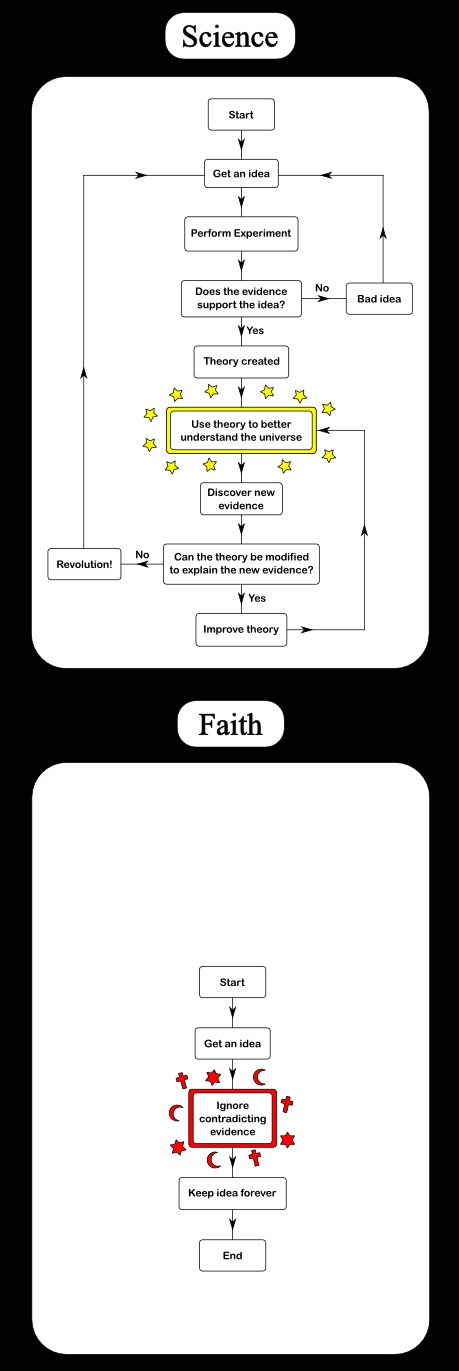
    A correspondent of mine sent me a copy of this faith and science flow chart and asked me to comment on it. My thoughts are as follows.

    1. The flow chart on faith appears to be a caricature. According to the chart faith is a three fold process, (a) one just comes up with an idea (out of nowhere it seems) (b) one ignores all the contrary evidence and (c) one continues to believe it. I don’t know who has ever held this model of religious epistemology certainly no one is cited as a representative. Whats noteworthy is that it differs from the model I have found in the writings of Christian Philosophers like Alvin Plantinga or Bill Craig or Roy Clouser. In these peoples writing the process faith involves some thing like the following: (a’) one finds the central message of Christianity to be self evident (to use Clouser’s terminology) (b’) one takes seriously evidence against Christianity and offers refutations of such arguments Finally (c’) one uses Christian beliefs as premises by which one develops a coherent perspective of the world that answers to various philosophical ethical existential questions on the basis of this message.

    Now it’s simply false on this model to suggest that faith is an idea a person simply “gets” and then believes ignoring all contrary evidence. In fact several ideas a person “gets” will not be accepted on faith according to this model. Any ideas one does not find self evident and which one has no reason or arguments for believing, any ideas which are self evidentially absurd, any ideas there are good arguments against and any ideas which are incoherent or which do not provide coherent perspectives or answers to existential and philosophical problems.

    Now it may be the case that Christianity fails on one or more of these criteria. However this needs to be argued. One cannot simply assume it and then define faith so as to assume this is true.

    2. While Philosophy of Science is not my area the little I have read suggests the science flow chart is excessively simplistic. Two initial observations suggest themselves. The first is the issue of under-determination of theories by the empirical evidence. On the model in the above flow chart. One adopts any idea that is consistent with the evidence. However, one thing Philosophers of Science often point out is that the empirical evidence alone is frequently compatible with several mutually incompatible theories. What leads one to choose one of these theories over another are non empirical assumptions about what types of theories are an are preferable to others. The second issue is that the flow chart suggests that if a person discovers empirical evidence that is contrary to the theory it’s rejected. But this also is not how science actually operates. Scientists frequently stick to a theory is spite of evidence against it until a better or more comprehensive one emerges. Most major theories in science have trouble with some empirical data, and the problems the empirical data provide are often not resolved till many decades after the theory is adopted.

    3. Finally I want to note a few things about the model of science that are relevant to the faith science issue. Accepting the account in the chart for the sake of argument three points suggest themselves. First note that for the theory to work there needs to already believe certain things. One first needs to “get an idea” now one can only get an idea if they already have a set of beliefs about the world if one believed absolutely nothing then they would have no ideas at all. Second, one needs to test this idea against evidence, which means there will already be a body of information which the scientist already accepts as true by which ideas are tested. Finally one needs to use the theory to better understand the universe. This means that prior to the theory one already has a set of beliefs about reality and that generate various questions about it that one wants answers to and which create puzzles that need explaining. Hence prior to any scientific theorizing one needs to already to have quite a bit of beliefs about the reality. These beliefs are needed for the process in the flow chart to be followed hence they cannot be discovered or based on science in the first place. Moreover if the process in the chart is to be effective these beliefs will need to be beliefs which it’s rational for the scientist to accept. Hence the chart itself suggests that a large number of beliefs are rationally accepted, despite being unable to be scientifically proven, it also suggests that without these beliefs scientific theorizing will be impossible.

    So my conclusion is this, first the account of faith is a caricature very different to the accounts actually proposed by Christian epistemologists. Second the account of science seems excessively simplistic and third even if the account of science is correct it shows that that science requires a body of beliefs which are rationally believed prior to and hence independently of the scientific method. This account then is quite compatible with the idea that there are some things one knows which cannot be proven scientifically. In fact this model requires such beliefs to get off the ground.

    Finally let me make a final suggestion. Perhaps on some issues what divides believers and non believers is not that one follows science and the evidence and the other does not. But rather both start with different presuppositions by which the evidence is assesed. If this is true, a mere appeal to evidence or science will not resolve the dispute, one needs to have a deeper debate about the various presuppositions employed in assessing the evidence.

  • Contra PC

    Not PC has taken exception to my recent criticism of his blog. He also takes issue with my comments on faith and reason. His responses I think are illustrative of the popular secular mindset so it’s worth responding here.

    PC expounds a great deal of rhetorical energy describing my work in pejorative terms. I committed to arguing that “black is white” if the hierarchical Church says so. My reasoning consists merely of “word games” my standards of debate are “low” and my writing is a “tangled thicket” of “misdirections”. Unfortunately simply using pejorative names to describe a position does not provide any reason for rejecting it. A rational person, and PC claims to be a follower of reason, provides arguments. It is to these that I will turn.

    1.) PC objects to my comments in a previous blog where I criticised the statement that it is irrational to believe something without proof. (a proposition which was labeled [2] in the original post) PC writes:

    Now he may or may not have been referring to exchanges here at Not PC, but if he is then proposition 2 is misstated. What I’ve said here is that a proposition without proof is flatly arbitrary, and the arbitrary is out. Arbitrary statements don’t even get to be called irrational; they don’t even get to the table. Matt then goes on to base a whole post on this misstatement.

    Now the key word here is *if*.In fact I was not referring to exchanges in not PC. However it’s worth noting that even if I was, PC’s rejoinder could be easily responded to. One could simply change the word “irrational” with the word “arbitrary” in my argument and everything else would still follow. My conclusion would be that it’s not always “arbitrary” to believe things without proof and each of my arguments would be reasons for this altered conclusion.

    Not PC clearly takes issue with this conclusion. Latter in his post he states:

    Matt himself provides us with an tip that is like a signpost for those of us curious about christian epistemological standards. Says Matt: “you can rationally believe certain things, in certain situations, without evidence.”

    Oddly PC thinks that simply noting the existence of my thesis refutes it. However, in reality, PC merely demonstrates his lack of understanding of the issues. I am not in this comment defending “Christian” epistemological standards. The thesis that one can rationally (or non arbitrarily) believe some things without proof is largely uncontroversial amongst secular epistemologists. In fact Aristotle, whom not PC attempts to follow, accepted this claim for some of the very reasons I provided in my blog. Roy Clouser summarizes the problems:

    If everything needs to be proven then the premises of every proof would need to be proven. But if you need a proof for every proof, you need a proof for your proof, and a proof for your proof of a proof and so on-forever. Thus it makes no sense to demand a that everything be proven because an infinite regress of proofs is impossible( Knowing With the Heart p 69)

    As the above citation shows, there are arguments for the position I advanced. There are serious philosophical problems with claiming that all beliefs need to be proved. Strangely PC does not even attempt to address these arguments. Instead he merely asserts my position, calls it “Christian epistemological standards” and thinks that’s enough to rebut it. Unfortunately it is not.

    2.)PC goes on to state

    as all assiduous listeners of Monty Python are aware, “an argument is a connected series of propositions intended to establish a conclusion.” What I posted above was not an argument. It was one post with four quotes, one point and an invitation to think about it; some thoughts for a Sunday on how faith undercuts reason. It was not an argument,

    I had assumed that when PC was contending that faith destroys knowledge he was actually attempting to provide reasons for his conclusion instead of several assertions. That I though was a more charitable interpretation of PC’s work Apparently, I was mistaken, my contention that he provides a weak argument for his conclusion is mistaken, I should have said he provided none at all. Does this make his position more defensible, No

    3.) PC also contents I misinterpreted his position on Tertullian, he states “. I do not “cite” Tertullian as “a Fideist.” I simply quoted what he said.” Well what according to PC did Tertullian say? PC contends that Tertullian is one of several thinkers who “held the view that faith is antagonistic to knowledge and reason, a divorce which [Tertullian] approved.” However, as I pointed out in my blog, fideism is the name given to the view that faith is antagonistic to reason. Hence PC, by his own admission did contend that Tertullian is a fideist. He simply was unaware the position he attributed to Tertullian has a name and that name is fideism.

    4.) PC continues that

    He[Me] carries on in this manner, acribing to me all sorts of things I haven’t said and positions I haven’t taken, eg,”First, [PC] provides some counter examples to anti-evidentialism…” and “Second, he offers some criticisms of the Kalam Cosmological Argument…”. In other words, he faults me for insufficiently countering in the comments section two very specific theological sallies, when my response was simply to two fairly general and poorly argued points.

    PC states that he was not attacking the Kalam Cosmological Argument and anti-evidentialism. He was rather attacking some general and poorly argued points. Well what were those points? One was the claim that God provides the best explanation of the origin of the Universe. In Philosophy of Religion this argument is known as the Kalam Cosmological Argument. The second, was PC’s contention that its *arbitrary* to believe without evidence. In the literature this is known as evidentialism which is of course the anti-thesis of anti-evidentialism.

    Hence, contrary to what PC affirms, he in fact did comment on these issues. It’s just that PC is so unfamiliar with the literature as to know that the positions he criticized had these names. Moreover the arguments he raised were in fact general arguments against these positions not criticisms of specific popularized versions. Hence everything I said stands. PC offered dubious arguments against both positions.

    Finally, PC continues to make some questionable claims. He states that I am a doctoral student training to be a theologian. In fact I am a professional theologian with a doctorate. He asserts, that the Gospels were probably written in the second century and third centuries despite the fact the few NT scholars accept such a late date, and again without any evidence. He ignores the numerous scholarly debate about what Kant’s views on religion actually were. He seems unaware for example of Kant’s rationalistic methods in Religion within the bounds of reason or Kant’s attempt to argue for God’s existence in the Critique of Practical Reason. He seems unaware of the debate over whether Kant was a deist, a closet atheist or a Lutheran and he, oddly, seems to think that Kant’s position in the First Critique is clear and obvious (has he read it?) He refers to Mr Alvin Plantinga as a Theologian when it’s Dr Alvin Plantinga and he is a Philosopher.