Category: Philosophy of Religion

  • Turning the Tables

    “The gentleman in the red shirt” shows us a simple lesson in why you should think through what your argument entails before you state it on national television and in front of a live audience.

    Too often we get tied up in knots trying to answer all the objections hurled at us, especially the specious ones. The tactic of turning the argument back on your opponent, holding them to the very standard they have laid down, is very simple and very powerful.

  • Georgia on my Mind

    On Tuesday 10 November 2009 I was in Tauranga. I had been commuting from Auckland to Tauranga every Monday to attend lectures for the teaching diploma I was studying towards and then on Tuesdays I would deliver lectures for the adjunct position I had at the same institution in Tauranga. I remember that particular Tuesday well as, during the several hours that elapsed between the lectures I was giving, I listened to a talk by Nicholas Wolterstorff, which had been delivered during a Conference at the University of Notre Dame. The paper was entitled “Reading Joshua.” Wolterstorff noted that the book of Judges proceeded on the assumption that the events of Joshua 6-11 never literally happened. He then argued that taking Joshua in its context as the first of a sequence of Canonical books, which included Judges as the sequel, the account of the “conquest”  should not be taken literally.

    Atlanta, Georgia - my home for the next 10 daysLooking at internal textual evidence, Wolterstorff  argued that the accounts of genocidal slaughter recorded in Joshua were hyperbolic and should not be taken literally. Joshua was a hagiographic account of various skirmishes Isreal had and it was a mistake to read it as saying God actually commanded Genocide.

    Wolterstorff’s paper fascinated me because it resonated with another book I had read in 2006. In, On the Reliability of the Old Testament,  Kenneth Kitchen wrote a comprehensive critique of biblical minimalism, addressing the charge that archaeology showed that the total conquest and genocide the book of Joshua records never happened. Kitchen contended that Joshua did not teach a total conquest. Kitchen pointed out that it was common in Ancient Near Eastern historiography to write highly hyperbolic accounts of battles involving the gods sending meteors onto the enemy, campaign’s  being completed in a day and victories involving the  killing of every single member of the enemy. Both Mernphath and Mesha had written in the 1200’s and 600’s, respectively had used similar language to claim they had destroyed Israel. Such accounts were hyperbolic.

    I heard this talk just over a year ago. Since then my adjunct contract has finished, I graduated with a teaching diploma in May and have been earning a living on the short term contracts to teach here and there, all of which dried up with the close of the school year, donations from speaking engagements and those received via this blog. It has been a tough year. Yet what  began on that November Tuesday back in 2009 has proved extremely fruitful. I began turning thoughts around in my mind, asking questions and piecing ideas together.  A month later, in December, I began discussing some ideas with Paul Copan. A philosopher in Poland wrote to me out of the blue asking me what I thought of the Canaanite Genocide he then passed my thoughts onto others. I had an interesting exchange on the issues with Lydia McGrew. I began chasing down Kitchen’s sources and in January I tentatively wrote up some of my ideas in Joshua and The Genocide of the Canaanites Part I and Part II.

    These posts have been extremely well read. The huge number of backlinks received make those posts some of the most linked to pages on this blog and the critical comments have been overwhelming, almost impossible to keep up with especially as they began to spread out on the net turning up on other blogs, message boards, facebook pages and so on. I suddenly found, people from all over the world contacting me on facebook and by e-mail to ask me questions and talk to me on my ideas. The secular blogosphere increasingly began to take notice of what I had written.

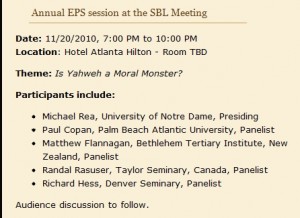
    In just a few months, offers to publish on this issue in upcoming anthologies began to come in. I discovered I was appearing in footnotes of major publications. I found myself debating Raymond Bradley, an Emeritus Philosopher of Philosophy and a world class logician. I received offers to speak at the annual meetings of the Evangelical Philosophical Society (EPS) and the Society of Biblical Literature (SBL); the latter will be in the form of a panel discussion where I am taking the place of Christopher Wright (!)

    SBL Panel Discussion

    This all seemed to me to be quite ridiculous. Here I am, an unemployed theologian, a relatively recent graduate who wrote some ideas in a blog, suddenly I was being asked to speak alongside William Lane Craig, Alvin Plantinga and over 20 of the world’s top evangelical scholars?

    In addition to having published a more popular version of the work in a mainstream magazine, I have now updated the original post into an article which has been given a solid offer of publication as a chapter in an edited book. In addition, I have four other publications on the issue forthcoming next year and in less than 24 hours I will fly to Atlanta, Georgia, USA to deliver my EPS and SBL talks. I am terrified, humbled and overwhelmed by how providence has moved in the last 12 months. The practical support I have received from people all over the world, as well as the untold comments from people all over the world who have stated appreciation for what I had written has been truly overwhelming.

    It is so hard to fathom that I am at this point. In 1997 I completed a masters thesis on Alvin Plantinga’s reformed epistemology. At that time I dreamed of going to the US at some point to hear Plantinga speak. It never eventuated, I got married, had kids and heard Plantinga was retiring. I figured it would never happen. I saw an advertisement for the Atlanta EPS conference last year and saw that Plantinga was the key note speaker. I did not even submit a paper because I was convinced it was too much of a long shot, they’d never want me and how would I raise the funds to get there? In 2008 I was involved in organising some speaking engagements for Bill Craig in Auckland. After the last event I walked Bill and Jan back to their hotel and said goodbye. Half jokingly I said to Bill, I’ll see you at a conference in a few years. At the time I was employed to stack shelves in local supermarkets and I thought to myself that what I said was probably wishful thinking. If you had told me 12 months ago that my ideas on hearing Wolterstorff’s lecture would see me speaking at a conference alongside these people and that I would be publishing with them – just one year later – I would have told you you were nuts.

    Fundraising for my US trip

    I have no idea what the future holds, or where this all is going. Tomorrow, I leave New Zealand to head to Atlanta to spend 10 days with some of the best Christian Philosophers in the world. People whose works I’ve been reading and admiring for years are now treating me, at least for a time, as a collegue. I really do not know what this means, what God is doing or what his plans are. I really hope and pray that some employment working in my field will eventuate from this but all I can say at this stage is thank you to all readers of MandM who have believed in my work. Without your daily visits and comments and links MandM would not have risen to its current prominence in the blogosphere or its position in Google, which it needed to to get my work noticed. (I am also very aware of the no-small efforts and skill of my wife on this front). I must thank Paul Copan for making this happen and opening doors for me – his support and encouragement has been tremendous. Thank you again to those who have supported us financially, kept us in your prayers, believed in me, encouraged me and who have recommended this blog to others. I feel overwhelmed and humbled by your support. The prospect of sharing some of my ideas to audiences that contain scholars of this magnitude is probably one of the scariest undertakings I have done to date, and I have addressed some scary audiences! Thank you everyone for this opportunity.

    I’ll try to pop into the blog from Atlanta and I will definitely write an update when I get back. Please continue to pray for me and for Madeleine back in New Zealand holding down the fort with the kids, the blog and sitting her final Certificate of Professional Legal Studies examinations (the NZ equivalent of the US Bar Exams) while I am away. Please also pray that the conferences happening in Atlanta touch people’s hearts and minds and draws them into a closer and more thorough knowledge of God.

  • Contra Mundum: Pluralism and Being Right

    Recently I attended a lecture on science and religion at the University of Auckland. As is normal after such talks students stayed and discussed issues raised by the presentation. One student brought up a fairly common chestnut, he objected to the claim made by some Christians that their religion was true and that other religions were false. It was not the first time I have heard someone contend that it is arbitrary, dogmatic, irrational, bigoted, etc to claim that Christianity is true in the face of pervasive religious pluralism. Frequently I have been accused of these things for making similar claims.

    This objection is often exasperated by another stance I hold to. In an earlier column (“God, Proof and Faith,” Investigate, Oct 09) I argued that one is rational in accepting certain Christian beliefs even if one cannot prove that they are true to a sceptical inquirer. The fact that so many other people do not hold these beliefs, and often hold contrary beliefs, often attracts accusations of arrogance. Isn’t it arbitrary for Christians like the student at the talk and me to assume that our particular faith is true and everyone else’s worldview is incorrect?

    I think the answer is no.

    However, before I explain my reasons for this assessment let me first address one assumption that sometimes undergirds it. It is not unusual to hear that affirming that one’s position is right and that those who disagree are wrong is itself arrogant. However, this belief is not only mistaken, it is incoherent. My wife, Madeleine Flannagan, put it well in a blog post entitled “Of course I think I’m right!“

    “The statement, “you think you are right” is always asserted by someone who themselves thinks they are right to assert that I think I am right. However, if their objection is cogent, then I should reject their objection. This is because the person who objects that I think I am right is suggesting that I adopt an irrational stance, that I should believe something that I think is incorrect; but if I think it is incorrect then I am not going to believe it.

    No sane person holds to a belief they think is wrong or inferior to other viewpoints. I mean, why would you? You would hardly rank the differing views and then decide to hold the second or third most plausible view. You hold the view you think is the most plausible – the correct view – and by doing that you tacitly reject the other views.”

    So merely saying you are right and others are wrong by itself is unremarkable, we all do it.  I find though that objectors like those I encountered at the science and religion talk frequently want to say more than this. They contend that it is arbitrary, dogmatic, irrational, bigoted, etc to believe that your position is right, in the absence of proof, if numerous other people do not agree with you.

    I think there are two problems with this contention.

    First, note that the contention itself is one that many people do not hold to; hence, if the claim is true, it is arbitrary, dogmatic, irrational, bigoted, etc to believe it without proof. Further,  the proponent of this contention has not offered any proof  – simply asserting we should adhere to this contention is not proof – so it must be arbitrary dogmatic, irrational, bigoted, etc for the objector to accept this contention.

    Turning to the second problem, suppose I do accept this contention and I (wanting to avoid being arbitrary, dogmatic, irrational, bigoted, etc) cease to believe the Christian faith is correct. In doing so I will be adopting a stance that is contrary to that held by numerous other people – Christians.  It seems that I cannot escape the problem. Unless I can offer proof that Christianity is wrong, I will be being arbitrary, dogmatic, irrational, bigoted and so on.

    The reality is that in the pluralistic world we live in, a person cannot avoid taking a stance on ultimate questions, such as, “does God exist?” “What is the place of human beings in the cosmos?” What is ultimately real?” “Is there life after death?” “Is there such a thing as sin?” “Is there a highest good for human beings?” “What is it?” And so on. Even being agnostic or apathetic is to take up a stance towards these questions, it is to implicitly hold that they are unimportant or if they are important that one has insufficient grounds for getting an accurate answer. Not only is taking a stance unavoidable, it is also unavoidable that any stance taken will differ from that taken by numerous other people, and that any stance taken will be such that one cannot prove it from premises that all people accept. In this respect religious perspectives are no different from secular ones and it is arbitrary, dogmatic, irrational, bigoted to pretend that they are.

    I write a monthly column for Investigate Magazine entitled Contra Mundum. This blog post was published in the Nov 10 issue and is reproduced here with permission. Contra Mundum is Latin for ‘against the world;’ the phrase is usually attributed to Athanasius who was exiled for defending Christian orthodoxy.

    Letters to the editor should be sent to:
    editorial@investigatemagazine.DELETE.com

    RELATED POSTS:
    Contra Mundum: Abraham and Isaac and the Killing of Innocents
    Contra Mundum: Selling Atheism
    Contra Mundum: Did God Command Genocide in the Old Testament?
    Contra Mundum: Fairies, Leprechauns, Golden Tea Cups & Spaghetti Monsters
    Contra Mundum: Secularism and Public Life
    Contra Mundum: Richard Dawkins and Open Mindedness
    Contra Mundum: Slavery and the Old Testament

    Contra Mundum: Secular Smoke Screens and Plato’s Euthyphro

    Contra Mundum: What’s Wrong with Imposing your Beliefs onto Others?
    Contra Mundum: God, Proof and Faith
    Contra Mundum: “Bigoted Fundamentalist” as Orwellian Double-Speak
    Contra Mundum: The Flat-Earth Myth
    Contra Mundum: Confessions of an Anti-Choice Fanatic
    Contra Mundum: The Judgmental Jesus

  • God, Morality and Abhorrent Commands: Part II Robert Adams

    In this three-part series I will look at some different ways of adjudicating conflicts between apparent divine commands and moral beliefs. I started with Immanuel Kant, now I will look at Robert Adams’ position.

    In “God, Morality and Abhorrent Commands: Part I Kant” I mentioned Phillip Quinn’s observation that theists can face a particular dilemma,

    “[I]t seems possible that a theist should have both good reasons for believing that God has commanded him to perform a certain action and good reasons for believing that it would be morally wrong for him to perform that action. Thus a theist can be confronted with moral dilemmas of a peculiar sort.”

    Immanuel Kant argued that when faced with such a dilemma the theist should reject the belief that God has commanded the action and accept the moral belief. This was due to his belief that moral beliefs are more certain that theological beliefs. I contested this claim. More recently Robert Adams has defended Kant’s conclusion. Consider the structure of the kind of dilemma Quinn cites,

    [1] Whatever God commands is morally permissible;

    [2] God commands X;

    [3] It is wrong to do X.

    These three claims contradict each other; like Kant, Adams suggests that the rational person should reject [2]. However, his reasons are somewhat different. Adams persuasively reasons that [1] is true only if God is understood as perfectly good, in the sense of being loving, just and so on. If God were evil or morally indifferent then it would be possible for him to command wrongdoing and so [1] would be false.  This means that a person who accepts [1] must presuppose that God is good.

    Adams argues that God cannot be meaningfully said to be good if what he commands drastically departs  from what we consider to be right and wrong. Human beings have some grasp of what constitutes goodness and some grasp of what constitutes right and wrong and it is part of our concept of what is good that a good being does not command wrong doing. Moreover, to call a being good is to attribute to it a character trait that is incompatible with certain other actions, attitudes and so on. Raymond Bradley made the point succinctly in his debate with William Lane Craig “Can a Loving God Send People to Hell?“

    “If we were to describe someone such as Hitler as perfectly good despite all his evil doings, we’d be playing word games which are intellectually dishonest as they are morally pernicious. … it would be to deprive the word “holy” of its ordinary meaning and make it a synonym for “evil.”

    This supports Adams’ conclusion that one cannot rationally accept [1] as one implicitly assumes that God does not issue commands at variance with our conception of morality. In Finite and Infinite Goods: A Framework for Ethics he concludes,

    “Our existing moral beliefs are bound in practise, and I think, ought in principle, to be a constraint on our beliefs about what God commands. We simply will not and should not, accept a theological ethics that ascribes to God a set of commands that is too much at variance with the ethical outlook we bring to our ethical thinking.” [Emphasis original]

    As with Kant there is a lot of truth to this; however, Adams’ position has certain limits.  As critics of Adams have pointed out his conclusion is limited. In the paragraph above Adams concludes that “our existing moral beliefs” must be a constraint on our beliefs about what God commands. His justification for this is that we “should not, accept a theological ethics that ascribes to God a set of commands that is too much at variance with the ethical outlook we bring to our ethical thinking.” The phrase “too much” suggests that one can accept ascription of a set of commands that is somewhat at odds with the outlook we bring to our ethical thinking.

    Two points Adams makes elsewhere in Finite and Infinite Goods suggest that this limitation on his conclusion is necessary. First, while we do have some grasp of what is good and some grasp of what is right and wrong it is evident that our moral judgements are fallible. Adams calls this the “transcendence” of the good. He states,

    “All of God’s commands and judgments are right; God is the ethical standard. But our beliefs (even the most cherished) about them must be distinguished from God’s commands and judgments themselves. To fail to make that distinction is idolatry.”

    Adams is surely correct here. While God does not command wrongdoing. It is quite likely that a perfectly good omniscient being would command something contrary to what we think is wrong.  Our moral intuitions are fallible, hence it is possible that some of God’s commands would clash with our own moral judgements. In fact to suggest that God would never command something which we consider to be wrong expresses an incredible hubris. It is to dogmatically assume that we are such good judges of morality that God could never disagree with us. It is to put our own moral judgements beyond question. The existence of some commands that strike us as strange or immoral does not count for much.

    Second, our concept of goodness and our judgement about particular cases can be and sometimes is subject to revision. We change our opinions about the goodness and rightness of certain things without “playing word games which are intellectually dishonest” or depriving “the word ‘holy’ of its ordinary meaning and make it a synonym for ‘evil.’”  If this were not the case, one could never honestly or rationally change ones mind on an ethical issue. Nor could people coherently disagree with or persuade one another about moral issues. Adams’ notes this when he writes that he accepts “the possibility of a conversion in which one’s whole ethical outlook is revolutionized, and reorganized around a new center” but “we can hardly hold open the possibility of anything too closely approaching a revolution in which, so to speak, good and evil would trade places”.

    These points, however, quite evidently limit Adams’ conclusion. What his argument, in fact, shows is not that “our existing moral beliefs must serve as a constraint on our beliefs about what God commands” but rather that certain types of our existing beliefs do this, those so central to our concept of goodness that accepting them would be “approaching a revolution in which, so to speak, good and evil would trade places.” In “A Psychological Constraint on Obedience to God’s Commands: The Reasonableness of Obeying the Abhorrently Evil” James Rissler notes,

    “In such an instance, obedience requires that one give up everything one previously believed about morality… one has been commanded to relinquish everything one understands about the nature of goodness, one will have no concept of the good with which to identify Gods command, there will be complete breakdown of between everything one currently affirms about goodness and everything one is asked to believe about goodness.”

    Rissler gives two examples; the first is where God issues a command to reverse one’s conception of right and wrong or issues a set of commands, each one of which negates every moral imperative one currently accepts. Second, he suggests that a moral belief might be “sufficiently integral to one’s conception of morality” that abandoning it would force such a radical revision as to destroy one’s concept of goodness all together. Imagine a command to kill everyone around you purely for entertainment or a command that said harming, hurting and inflicting suffering on people for no reason at all is permissible. Consider a command to hate God and despise all other human beings. One cannot accept a system of divine commands where every duty we believe in is declared false nor can we accept a system which suggests that the vast majority of our moral beliefs are mistaken. This would come too close to the problematic revolution Adams talks of.

    To sum up, in Part I and II, I have looked at the Kantian approach to the kind of dilemma Quinn sketches. Neither Kant or Adams, I think, establish the claim that in “our existing moral beliefs must serve as a constraint on our beliefs about what God commands.” They did, however, lend support for a weaker thesis. Kant’s argument, for example, does suggest that those moral claims about which we are certain, should serve as such a constraint and I mentioned several beliefs which I consider to be fairly certain as examples.

    Adams’ argument on the other hand suggests that we cannot coherently “accept a theological ethics that ascribes to God a set of commands that is too much at variance with the ethical outlook we bring to our ethical thinking.” He argues that we cannot coherently or defensibly accept a theological ethics which, in effect, makes good and evil trade places and which so radically transforms our concept of goodness so that good becomes a synonym for what we call evil or calls our concept of goodness so radically into question that it breaks down. Certain beliefs such as it is prima facie wrong to inflict pain and suffering on others or it is prima facie wrong to treat others with contempt” or it is prima facie wrong to lie, steal and kill are so central to our account of goodness that we cannot coherently accept that a perfectly good being has issued commands that negate them.

    In my next post I will look at Philip Quinn’s alternative.

    RELATED POST:
    God, Morality and Abhorrent Commands: Part I Kant
    God, Morality and Abhorrent Commands: Part III Philip Quinn

  • God, Morality and Abhorrent Commands: Part I Kant

    In this three-part series I will look at some different ways of adjudicating conflicts between apparent divine commands and moral beliefs starting with Immanuel Kant.

    In “Commonsense Atheism and the Canaanite Massacre” I addressed a question put to me by Luke from Commonsense Atheism,

    “If Matt did think these events happened literally as described in the Bible, would he then conclude that God was an evil monster to command them? Or would he, in the end, agree with Bill Craig that genocide is okay as long as God feels like it?”

    In my response I pointed out Craig claims that killing non-combatants in war is permissible if a loving and just God commands it (which is an implication of a divine command theory). This conditional is arguably true. Either it is possible for a just and loving omniscient person to command genocide or it is not. If it is then genocide would only be commanded in situations where a just and loving person, aware of all the relevant facts, could endorse it; under these circumstances it is hard to see how genocide could be evil. On the other hand, if it is impossible for a just and loving omniscient person to ever command genocide then the situation Luke mentions is one with an impossible antecedent. On the standard accounts of counter-factual logic, conditionals with impossible antecedents are true. So far from being absurd there are reasons for thinking this conditional is true.

    The question Luke asks is really a species of a larger and important question in theological ethics. In Finite and Infinite Goods Robert Adams notes “A convincing defense of a divine command theory of the nature of obligation must address our darkest fear about God’s commands–the fear that God may command something evil.” Philip Quinn makes a similar point,

    “[I]t seems possible that a theist should have both good reasons for believing that God has commanded him to perform a certain action and good reasons for believing that it would be morally wrong for him to perform that action. Thus a theist can be confronted with moral dilemmas of a peculiar sort.”

    I suspect Luke is really asking how a theist can rationally respond to a dilemma of this sort. While I do not know what Luke’s opinion on this issue is, a common view is that if a theist has good reasons for believing an action is wrong then any claim that God has commanded should be rejected. The locus classicus for this position is Immanuel Kant; in Reason within the Bounds of Religion, Kant stated:

    “Abraham should have replied to this supposedly divine voice: “That I ought not kill my good son is quite certain. But that you, this apparition, are God — of that I am not certain, and never can be, not even is [read: if] this voice rings down to me from (visible) heaven.”

    Similarly, in the Conflict on the Faculties he states he states,

    “That to take a human being’s life because of his religious faith is wrong is certain, unless (to allow the most extreme possibility) a divine will, made known to the inquisitor in some extraordinary way, has decreed otherwise. But that God has ever manifested this awful will is a matter of historical documentation and never apodictically certain. After all, the revelation reached the inquisitor only through the intermediary of human beings and their interpretation, and even if it were to appear to him to have come from God himself (like the command issued to Abraham to slaughter his own son like a sheep), yet it is at least possible that on this point error has prevailed.”

    Kant, here, is discussing the kind of dilemma Quinn refers to. The dilemma can be spelled out as follows, in certain situations a theist might find him or herself with reason to affirm the following three propositions,

    [1] Whatever God commands is morally permissible;

    [2] God commands X;

    [3] It is wrong to do X.

    These three claims cannot all be true, so a rational person must reject one of them; the question is which one? Kant’s answer is that when faced with a dilemma of this sort the theist should reject [2].  It is worth elaborating on his position a bit.

    First, note that Kant accepts [1] he grants that if we knew that God commanded the killing of a particular human being, it would be permissible to kill that human being. Kant’s objection is that one cannot be rational in believing that God has, in fact, issued such a command. Philip Quinn notes that Kant’s argument involves an appeal to an epistemic principle: whenever two conflicting claims differ in epistemic status, the claim with the lower status is to be rejected.  Kant contends that moral claims such as “it is wrong to kill innocent people” are certain. However, claims that God commands or forbids a certain action are not certain and never can be. From these points it follows that a rational person will accept [3] and reject [2].

    Despite its appeal Kant’s argument is flawed for several reasons. Philip Quinn notes two problems. First, “Kant has an extremely optimistic view of our ability to attain epistemic certainty about principles of moral wrongness,” he thinks we can be certain of moral claims. This, however, is dubious. There are some moral claims of which I am fairly certain. I am certain, for example, that it is wrong to inflict as much pain on another as I can merely for my own entertainment. I am fairly certain that killing, assault, theft and lying are prima facie wrong and can only be justified if some overriding moral reason applies. However, many moral claims are highly controversial and are far from certain at all. Consider, for example, the debate over whether the bombing of Hiroshima was justified because it saved a huge number of lives by ending a war early. While I myself do not share this opinion, I would not say I am certain about it. Similarly, consider moral debates about capital punishment or euthanasia or affirmative action. While I believe there are defensible and justified answers to these questions, I doubt we can claim certainty about answers to these questions.

    Second, Kant claims that we can never be certain that God has prohibited a certain action. Quinn notes, “It would thus seem to be well within God’s power to communicate to us a sign that confers on the claim that God commands some intolerant behavior, for example, issuing threats to heretics, a fairly high epistemic status.” If God were to do this then we would have certainty that he had commanded the action. So it is not clear that beliefs about what God wills are always less certain than moral beliefs.

    I am inclined to push this criticism further. It seems to me that many sceptical worries that are raised about God and his commands apply with equal force to moral beliefs. Consider three common concerns sceptics raise about religion. One is the claim that the existence of God is not necessary to explain any empirical phenomena. The second is the concern that the claim God exists and has commanded a particular action cannot be empirically demonstrated or proven to exist. The third is the widespread pluralism with regard to both the existence of God and his nature. All three of these worries apply to moral beliefs. The existence of moral properties appears unnecessary to explain any empirical phenomena, almost any empirical phenomena can be explained equally well by accepting that moral beliefs are all false but that people think they are true. Attempts to prove that moral beliefs are true from non-moral premises alone are probably more controversial than any argument for the existence of God. And there is widespread pluralism over whether moral properties exist; nihilists and non-cognitivists deny such properties exist and amongst believers in the truth of moral beliefs, there is widespread disagreement over the nature of morality. Intuitionists contend it is a non-natural property, naturalists contend it is a natural property but disagree over what the natural property in question is, supernaturalists contend it is a divine command or a theological property and so on.

    In fact, Kant’s own argument provides an example of this point. Kant argues in The Conflict in the Faculties that we can never be certain that God has commanded an action because,

    “the revelation reached the inquisitor only through the intermediary of human beings and their interpretation, and even if it were to appear to him to have come from God himself (like the command issued to Abraham to slaughter his own son like a sheep), yet it is at least possible that on this point error has prevailed.”

    But this is equally true of many moral beliefs, a good amount of what people believe with regards to morality comes to them through the intermediary of human beings and their interpretation. Most westerners belief’s in liberal ideals, such as, the equality of women, opposition to slavery and so are mediated through human beings. Moreover, even if we directly intuit moral properties, it is possible that we are mistaken. Human moral intuitions and judgements are fallible and can err. So in many instances I am inclined to think that the sceptical worries people raise to conclude that theological beliefs are uncertain apply also to moral beliefs. To appeal to these concerns, so as to claim that belief about God’s will is less certain than moral beliefs, is to engage in special pleading.

    In my next post I will look at Robert Adams’ defence of Kant’s position and then I will look at Philip Quinn’s alternative.

    RELATED POSTS:
    God, Morality and Abhorrent Commands: Part II Robert Adams
    God, Morality and Abhorrent Commands: Part III Philip Quinn

  • Podcasts on Christian Physicalism and The Probability of Christianity

    Matt and I have been listening to podcasts in the evening lately. These two, featuring two of our friends, who are both philosophers and bloggers, are really worth a listen.

    Glenn on Physicalism
    Glenn Peoples, of Say Hello to my Little Friend: The Beretta Blog and Podcast, recently spoke at the University of Oxford at the annual conference of the European Society for the Philosophy of Religion on the topic “Raising the Justificatory Hurdle: How to Make Sure Religion Stays Out of Politics No Matter What” and while he was there he appeared on the UK’s Unbelievable? radio show to debate the issue of physicalism with John Haldane.

    Listen to: Christian Physicalism: Do we have a soul? – Unbelievable? 04 Sep 2010

    Christians have traditionally held that humans comprise two things – a body and a soul. Christian Philosophers have written in defence of the soul against a reductive atheism that claims we are material beings alone.

    But a new movement in Christian philosophy claims that the atheists are correct, at least when it comes to humans.

    Dr Glenn Peoples is a Christian philosopher who subscribes to physicalism – that humans are only physical and they have no immaterial soul. He explains how he arrived at that view from Scripture and how he defends it philosophically, without giving up an evangelical Christian view.

    Prof John Haldane is a Christian philosopher at St Andrews University in Scotland. He believes that Christian faith and Philosophy bear witness to an immaterial soul – though his “Thomistic” view defends it differently to the prevailing trend.


    Lydia on The Probability of Christianity
    Dr Lydia McGrew, of What’s Wrong With the World and Extra Thoughts, has recently co-authored a Bayesian defence of the historicity of the resurrection in The Blackwell Companion to Natural Theology, and so Luke Muehlhauser, of Common Sense Atheism, interviewed her for his podcast, Conversations from the Pale Blue Dot.

    Listen to: Lydia McGrew – The Probability of Christianity – CPBD episode 071

    Lydia describes herself as ‘a homemaker and home schooling mum who does analytic philosophy in some of her spare time.’ She is very good at it, as you will quickly pick up in her discussion with Luke. They talk about, among other things:

    • The probability of the Resurrection v the probability of witchcraft at Salem and the Hindu milk miracle
    • The practice of Christian philosophy
    • The fine-tuning argument
    • God as an explanation

    Listen carefully to work out which blogger from this blog gets cited in an example 😉

  • What Atheists Could Learn from Legal Interpretation 101

    At the beginning of each semester my lecturers would remind students of the fire policy, “if the alarm sounds leave the lecture theatre immediately through the nearest exit and reassemble outside the Davis law library.” Now if during class one day my lecturer had said to me, “Madeleine, do not leave class today until you have spoken with me about your brilliant essay which simply must be included in my upcoming book” [what? it is a thought experiment ok? It could’ve happened…] but then half-way through class the fire alarm rang and the smell of smoke wafted into the lecture theatre – would anyone seriously expect me to remain in my seat? Should I be paralysed with confusion by the contradictions – did my lecturer mean me to be burned alive or overwhelmed by smoke inhalation because he told me to not leave class that day until I had spoken to him or should I follow his earlier instruction to exit the classroom on hearing a fire alarm and go to the area outside the Davis Law Library? What should I do? Oh the confusion! Perhaps I should simply conclude that due to the contradictions inherent in trying to read both sets of instructions together that my lecturer, in fact, does not exist.

    Is anyone buying this? I mean, clearly what I should do is leave with the rest of the class and talk to my lecturer later. [Doh!]

    Illustrations of this sort are often used in conflict of laws or legal interpretation classes to show that what prima facie appears to be a contradiction between two pieces of legislation actually is not. This is because imperatives occur in contexts where commonly accepted qualifications, riders, priorities, idioms, etc are assumed to be understood; implicit background beliefs are in play.

    We can see this clearly in the example above. I know it is unlikely my lecturer wants his students to obey his instructions to the extent that they burn to death. I know this because I know something of his purposes and of his character. I know him to be fairly decent, humane and not one to issue arbitrary, irrational commands. I know also something of the weights involved in the issues. For example, I know the fire policy is university policy and it concerns the issue of safety – both the physical safety of students as well as its own, it does not want to be sued or prosecuted or subject to critical public scrutiny. I know that the lecturer’s authority is derived from university authority and so his instructions cannot contradict or override it. I also know that the reason he gave the instruction for me to stay behind in class was because he wanted to work with me in the future to ensure the sales of his book make the top 10 list. So from all of this I can safely conclude that he did not mean for me to follow his instructions on pain of death today.

    Of course if I already believed my lecturer to be a petty, arbitrary, narcissistic, cruel bully, capable of anything who routinely issued commands with the purpose of harming, maiming and destroying students (and if I suspected he wanted to take my essay and publish it as his own so as to keep all the book royalties for himself) I might take a different approach as to how I read his instructions together. But it would be uncharitable of me in excelsis to adopt this assumption of his character as the default one to reason from.

    Taking these contextual factors together, along with a basic grasp of the English language, its idioms and a dose of common sense it is not that hard to navigate apparently conflicting instructions.

    I raise this because a site ironically called “Common Sense Atheism” recently put up a short post entitled 6 Questions with which to Stump Conservative Christians. I was extremely underwhelmed by the questions and was left wondering if the author had actually read any Christian works above Sunday School level on Christian ethics, biblical interpretation and so on (and clearly had not read very far into this blog) but I found one of the questions stood out en stupidus maximus (that’s a legal latin maxim meaning it was so stupid it had to be taken out). Question 4 asks,

    “The Bible says to worship God (obviously) and to obey your mother and father, but what do you do if your parents tell you to worship other gods?”

    Here, the atheist is trying to establish a contradiction in the commands God issues and from this contradiction we are presumably supposed to concede that Christians are irrational or that God does not exist or some such thing (and, of course, any Christian reading it is supposed to be “stumped”).

    No Christian I know would be even momentarily stumped by this because the answer is obvious: in such a case you should disobey your parents and worship God; end of. I find it no more paralysing than the issue of whether I should leave class when the fire alarm sounds or stay to talk to my lecturer. In both cases, I understand that the command cannot sensibly be understood as an absolutely unqualified imperative. I doubt very much that God, out of allegiance to Him, wants us to give up allegiance to Him.

    Of course if one wanted to make God look silly and arbitrary one could interpret it this way, just as you could attribute silly interpretations of what my lecturer meant such as intepreting his instructions as a command to wait for him even if I get burned alive in a fire or that my lecturer does not exist, but why would you?

    If you think I am just picking on one unfortunate atheist’s example I beg to differ. When Matt was an undergrad at the University of Waikato a leader of the campus rationalist society confronted him with Isaiah 30:26,

    The moon will shine like the sun, and the sunlight will be seven times brighter, like the light of seven full days, when the LORD binds up the bruises of his people and heals the wounds he inflicted.

    The rationalist then informed Matt as to what the temperature of the sun was. He multiplied that number by seven and then noted that if it were to become that hot then world would burn to a crisp. He concluded that the Bible taught that heaven was hotter than hell. Matt’s initial inclination was to laugh and asked the guy if the exchange had “brightened up his day and warmed his heart.” It turned out that the example came from a highly regarded book by a scientist critiquing creationism, ironically entitled “Telling Lies for God: Reason vs Creationism” [scientists really really shouldn’t pontificate on theology]. The book had recieved endorsements from leading Australian Clergy. [I am reminded of Rob Muldoon’s position on Australians]

    Then there was a discussion I had on Debunking Christianity’s “Madeleine Flannagan is Happy to be Treated as Women Were in the Bible!” where John Loftus pointed to Deuteronomy,

    “Deuteronomy 22:23 If a man happens to meet in a town a virgin pledged to be married and he sleeps with her, 24 you shall take both of them to the gate of that town and stone them to death—the girl because she was in a town and did not scream for help, and the man because he violated another man’s wife. You must purge the evil from among you.

    Deuteronomy 22:28 If a man happens to meet a virgin who is not pledged to be married and rapes her and they are discovered, 29 he shall pay the girl’s father fifty shekels of silver. [c] He must marry the girl, for he has violated her. He can never divorce her as long as he lives.”

    Now Matt had written several posts on this atheist chestnut which saw me get embroiled in an exchange with both Loftus and Stephen Carr. Carr surmised that,

    “If a woman is threatened with a knife, told she will be killed if she screams out, and does not scream out, there will always be a Christian to say , and I quote ‘isn’t she a part of the problem’?”

    Apparently the non-offensive-to-God way to rape a woman is to simply render her incapable of screaming because God’s issue is with the screaming and not the raping…

    Apparently when the bible lays down case laws, it cannot simply lay down a paradigm. It must spell out every possible nuance, qualification, exception, situation, application to analogous situations and so on.

    Apparently if it does not do this then it is denying opposition to the act – now even modern case law precedents do not function like this and legislation is never drafted this way but apparently this is the way to read Biblical law.

    Seriously.

    Perhaps Carr is a too easy a target. Atheist philosopher Michael Martin makes a similar interpretation of Deuteronomy,

    “it is assumed that in all cases that a rape victim could cry for help and if she did, she would be heard and rescued. Both of these assumptions are very dubious and sensitive to the contextual aspects of rape.”

    I am at a loss to understand why atheists insist on reading these texts like a lawyer with Aspergers Syndrome in search of a convincing technicality by way to circumvent the spirit and intendment of the law? I mean why? We can all handle instructions that conflict with fire alarms going off, we don’t interpret modern laws like this, so why do atheists (and some Christians) switch to such silly anachronistic readings when the instructions are attributed to God?

    I suspect the issue is the background factors I mention above. Many atheists believe God is a petty, arbitrary, narcissistic, cruel bully, capable of anything who routinely issues commands with the purpose of harming, maiming and destroying people. They believe that the bible is obviously silly, irrational, oppressive and supports contradictory absolutism in the family, is anti-women (and so obviously supports rape) is full of scientific absurdities (and so Isaiah was talking about cosmology) and so on.

    When you have a pre-conceived notion as to what you want the text to mean – be it an uncharitable reading or what you think or have heard that the text teaches – I suppose the silly reading is congenial. What this tells us is that the reading of the text is not what leads atheists (and some Christians) to their conclusions, rather it is their conclusions lead them to read the text this way.