Category: Current Events

  • Epistemology 101: Science, Faith and Authority Part II

    This three-part blog series is essentially the talk I gave at the recent Clearing the Air Forum, which was entitled “Discovering Truth in the Synthesis of Science and Faith.” The audience was comprised of scientists, church leaders, journalists and other interested parties so this is a fairly lay introduction to epistemology.

    In my first post, Epistemology 101: Science, Faith and Authority Part I, I set out some basics about epistemology, I now want to turn to one particular way we know things: testimony. Nicholas Wolterstorff defines paradigmatic cases of testimony as: believing X on the say so of someone else Y. There is a highly influential tradition of epistemology which is sceptical or critical of beliefs based on testimony.

    Testimony
    In his Essay on Human Understanding John Locke argued that one had a duty to not believe any proposition merely on the authority of another person. One should trust the testimony of another only if one has:

    (a) good reasons for thinking that the testifier is reliable; or,
    (b) good reasons for believing the truth of the proposition itself.

    Taking another persons word for something in the absence of independent evidence is irrational. Locke hinted that such gullibility was socially dangerous, tied up with intolerance, authoritarianism and oppression.

    Something like this lurks in contemporary culture and is often encapsulated in quotes such as “think for yourself.” The problem is that a little reflection shows that this view of testimony is mistaken.

    CAJ Coady summarises the problem, if one is going to have evidence for the reliability of a testifier then this evidence will either include some other testimony or it will be based upon sources apart from testimony. The first option is obviously a non-starter, any evidence based on testimony will have to, by Locke’s position, be shown to be reliable by further testimony and so on, ad infinitum, until we reach some non-testimonial source. However, if we embrace the second option and we exclude what we know by way of testimony from our evidence base then we will have so little to go on that such grounds will be almost impossible to come by.

    To demonstrate this consider an example from Greg Dawes in a paper he wrote on faith,

    Very many of our beliefs are held on the basis of testimony. (In this context I shall sometimes refer to these as beliefs held on the basis of authority.) Does e=mc2 represent the rate at which matter can be transformed into energy? I believe so, although I would not have the faintest idea how to demonstrate its truth I have it on good authority that it is true…Of course, there is a sense in which I do believe this on the basis of evidence. I have reasons to believe in the trustworthiness of the sources from which I gained the information.[1]

    Like Locke, Dawes suggests that a non-physicist such as himself can rationally believe e=mc2 because he has reasons to believe that his sources are trustworthy. I believe this last comment is incorrect. Consider, for example, what reasons he could offer for believing that the source of his information was reliable? Presumably, it would be because the author of the book where he read it or the person who told him the information was a physicist. Nevertheless, how does Dawes know this? He could have read the person’s qualifications off a faculty list, off the dust-jacket of the book or have been told them by the person in person but in each case he is relying on testimony and so, in the absence of further reasons, he cannot believe these sources. Suppose, however, Dawes was to investigate thoroughly and locate the address of the university where the degree in physics was claimed to be awarded in order to travel there and personally check the original records. Yet again, he will be relying on testimony in the form of an address list and records. He also would have to have trusted the testimony of maps and road signs in getting to the institution in question.

    Consider then what Dawes would have left to go on if he did not use testimony. He could not rely on any information that he himself did not observe first-hand. This would exclude any information about events prior to his own lifetime, any events in his own lifetime that he did not remember witnessing first-hand and any event that happened in a place other than where he was at the time. Nothing read in journals, books, heard in lectures, taught to him by his parents or teachers could be used. Nothing heard on the news, read on the computer, told over the phone or reported on in the media could be included. Almost everything he had learnt through his entire education would be excluded because nearly all of it is based on testimony. It seems, then, that if Dawes were really to comply with the epistemic standards that he laid down, he could not rationally believe in e=mc2. It appears he is mistaken in thinking that one needs to have reasons for thinking a given authority is reliable in order to be warranted in believing in testimony.

    I think this example shows that this is not isolated. What we know, by way of being told by others, accounts for a huge and pervasive amount of what we believe. Everything I know about other places, other times, everything learned at school, university, from my parents, friends, books, newspapers, television, etc is based on testimony. If I were to try to verify any of these beliefs without first relying on some other piece of testimony, I would be unable to. The kind of critical attitude where one deplores believing things on faith or on the say so of others is un-viable. As social beings with a limited perspective in time and space, and with limited areas of speciality, we need to trust the testimony of others for most of what we know.

    Testimony Beliefs as Basic Beliefs
    For this reason the idea that one cannot accept something on the say so of testimony until it is verified is problematic. Instead I am inclined to accept a different picture of the role that testimony and faith in authorities should play in our knowledge. The picture that testimony beliefs are properly basic beliefs.

    To see what I mean by this consider the following point by Roy Clouser,

    If everything needs to be proven then the premises of every proof would need to be proven. But if you need a proof for every proof, you need a proof for your proof, and a proof for your proof of a proof and so on-forever. Thus it makes no sense to demand that everything be proven because an infinite regress of proofs is impossible.[2]

    Clouser notes that the appeal to evidence, in the form of premises from which one infers a conclusion, have to terminate somewhere if we are to avoid being sceptical about everything.

    The terminus is a set of ultimate premises called basic beliefs, which are those beliefs that form the foundation of our knowledge. We are justified in believing them independently of any argument or proof for them.

    If this seems counter-intuitive consider that there are plenty of things we believe that are not based on arguments. Our belief in the existence of the past or our belief that it is wrong to rape women or our belief that other people exist or that basic axioms of logic are true are not based on inferences to the best explanation so that they are rationally believed because they explain some phenomena better than all alternatives. It is rather that these beliefs are part of the background data that we use to assess proposed explanations against.

    Usually basic beliefs are grounded in some form of experience. We recognise these as true because we experience or see them to be true. For example, I see that the basic axioms of logic are self-evident, I remember the existence of a past event, I intuitively see that rape is wrong and think anyone who does not see this is simply morally blind. I see the chair in front of me, I hear the car outside and so on. These beliefs function as fundamental premises that we argue to other theories from.

    It is important to note that while we are justified in believing basic beliefs in the absence of evidence for them, their justified status can be defeated if we gain good reasons for rejecting these beliefs. For example, on a Tuesday evening I have a vivid experience of my brother entering my room, I form the basic belief that “my brother is in my room.” The next morning I hear that my brother was out all evening. I also discover that the medication I took the night before has hallucinatory side effects. The basic belief, grounded in my perceptual experience of observing my brother entering the room on Tuesday night is defeated. There are two ways basic beliefs can be defeated, undercutting defeaters involve a reason a person acquires which, when added to their stock of beliefs, gives them reasons for thinking that the source of the basic belief is unreliable – my discovery of the hallucinatory side effects is an example of this. Rebutting defeaters, on the other hand, are reasons one acquires for thinking the belief itself is false. My discovery that my brother was not home is a rebutting defeater, if he was not home then he was not in my room.

    The picture I want to suggest is that in many circumstances beliefs held on the basis of testimony function as basic beliefs. When a person, whom we take to be a competent authority, affirms a proposition P then in the absence of defeaters we are rational in accepting P. We do not need to prove that what the person says is true before we can accept it and nor do we have to prove that they are a reliable authority before we have to accept it. We do, however, have to take seriously any purported defeaters we are confronted with. We have to take seriously evidence we have that the authorities in question are not actually a reliable guide in the area in which they are speaking and we have to take seriously arguments given against what we accept.

    Translating this into a current context, contrary to what is often thought, most of our knowledge of scientific facts is, in fact, on the basis of testimony. As a child I ask questions, why does this happen? what caused this? and so on, my parents tell me answers and I believe them. I go to school and I am taught science and later physics and chemistry, I go to university and attend lectures, I read text books, I might do some experimental work myself but it is in the context of what I have already learned from testimonial sources. I read about studies scientists have done in journals and I believe what is written in these journals. Despite the bravado of self-professed free thinkers, our  acquisition of scientific knowledge is pervasively shot through with faith – faith in authorities, faith that others are being honest to us and are trustworthy and so on. It can be no other way. Hence, to believe some fact about the world merely because another has told you it is true is not irrational but in fact a sensible thing to do.

    Consider an example, I am in my car listening to the radio and Keisha Castle-Hughes is on air talking about climate change. The media are praising her for her brave efforts to educate the public. How should I respond? In this instance I am inclined to think that I face some defeaters. I know Castle-Hughes is an actor and has no real expertise in the area in which she is talking. I also know that actors are good at being very convincing at playing a role, which is not real. I know Castle-Hughes is quite young and is unlikely to have had a very substantial science education, much less time to specialise in climatology. I know the media are notoriously unreliable, journalists tend to be very political, their deadline give them limited time to research and they are not experts in science at all. In this instance, I think that I have real reasons to be sceptical of what Castle-Hughes is saying. Even if what she is saying, in fact, is true, I should not believe it just because she says so.

    Here is another example. I read a book by Richard Dawkins. He claims that the evidence quite conclusively suggests there is no God. Now in some places Dawkins offers arguments and I can assess these using my ability to reason deductively but in other places he simply tells his readers things. He puts forward various arguments for God’s existence, which he says these are representative of the case for theism, he attributes these to Thomas Aquinas, talks of first-cause arguments and the like. This is a bona fide, scientist with a professorship at Oxford. His specialty is zoology.

    However, accurately representing Aquinas’ arguments for God requires knowledge not in zoology but in medieval philosophy. A knowledge of what arguments have been put forward for theism, which are the most representative, which are the best, requires knowledge of a discipline called philosophy of religion. Dawkins’ position as a zoologist means his knowledge is in a very different field. Hence, his being a scientist gives me no reason to accept his work on Aquinas.

    This underscores an important point. If a person has some bone fide authority in a field it means he has authority in that field, it does not mean he or she has any authority in another field. Scientists qua scientists are experts in science, not morality, public policy, law, ethics, theology and what have you. Similarly, pastors are trained in biblical exegesis and theology, their knowledge, therefore, is in those fields and not science. One of the problems with the rise of the Internet is that people can get information on any subject any where from any source. In this context it is important to examine carefully whether we have good reasons for questioning whether the source is authoritative.

    It is not a bad idea to make our starting place be that we will accept what we are told by authorities but we should not always end there.

    In my final post in this series, Part III, I will look at what we should do when authorities clash.

    [1] Greg Dawes, “Faith and Reason”, a paper presented to the University of Otago Theology and Religious Studies Faculty. This is contained in Dawes, Philosophy of Religion (so far unpublished) 34.
    [2] Roy Clouser  Knowing With the Heart (IVP: Downers Grove, 1999) 69.

    RELATED POSTS:
    Epistemology 101: Science, Faith and Authority Part I
    Epistemology 101: Science, Faith and Authority Part III
  • Epistemology 101: Science, Faith and Authority Part I

    This three-part blog series is essentially the talk I gave at the recent Clearing the Air Forum, which was entitled “Discovering Truth in the Synthesis of Science and Faith.” The audience was comprised of scientists, church leaders, journalists and other interested parties so this is a fairly lay introduction to epistemology.

    I was asked to address the epistemological issues around the climate change debate from a Christian perspective. In some ways I feel significantly under qualified to address this issue, I have no degrees in or knowledge of climatology, I am a theologian with an interest in Philosophy of Religion. Despite this, my research into religious epistemology has led me to some conclusions as to how faith and science should relate and how those of us who are Christians should respond to scientific challenges or purported scientific challenges to our theological beliefs. I’ve also gained some understanding on the role of testimony and the way believing things on the basis of authority figures in our knowledge. So, given this, I would like to share a few of my conclusions with you.

    What is Epistemology?
    Epistemology is one of those technical terms that often makes peoples eyes glaze over but it is important to grasp what it is. You may know it as “ways of knowing” or “the theory of knowledge.” Human beings are knowers, we like to gain accurate information about the world, about morality, about God and a whole host of other subjects.

    Sometimes we do this task well and sometimes we do it poorly. A person, for example, who believed the moon was made of green cheese on the basis that he had resolved to believe this if a coin-toss came up heads (and it had in fact come up heads) has believed poorly. The way he believes is irrational, it does not count as knowledge, his belief is unjustified and so on. Epistemology involves asking questions such as, what is it to have knowledge, what is it to be justified? The idea is to help gain clarity as to what knowledge is, how we ought to believe and so on.

    The subject and literature is vast and I cannot really do it justice here, so I will just give some basics.

    Since the time of Plato it has been widely acknowledged that knowledge involves at least two things: belief and truth. I have found that scientists often get irritated when they are told that their knowledge is a form of belief. This, however, is based on a verbal confusion. In epistemology to believe something is to simply think that it is the case, it is to assent to a proposition. I believe that the sky is blue if I think that the sky is blue; if I do not think this, if, in fact, I think that the sky is over-cast and grey then I do not believe that the sky is blue.

    What is meant by truth is defined best by Aristotle, “To say of what is that it is not, or of what is not that it is, is false, while to say of what is that it is, and of what is not that it is not, is true.” A belief is true if what you think is the case actually is the case. My belief that the sky is blue is true if the sky is blue and it is false if it is not blue but some other colour such as green. Truth is determined by facts about the world, the way things are; the point of being a knower is that one tries to match what one believes with reality. Knowledge involves achieving this match.

    My knowing P then involves at least two things:

    [1] I believe P
    [2] P

    The problem is that while these two conditions are necessary for knowledge they are not sufficient. Suppose I decide to choose beliefs about a particular subject matter on the basis of a coin-toss. Every time I throw a heads I will affirm the proposition and every time I throw a tails I will deny it. If such a method were employed I would, at least sometimes, form true beliefs but I would not have knowledge as my grasp of the truth would be the result of a lucky guess. Some third condition (or conditions) are needed.

    One of the biggest issues in epistemology today involves working out what this third condition is. The normal starting point in the discussion is the idea that knowledge is a justified true belief, I know when I believe P, that P is the case and that I am justified in believing P.

    [1] I believe P
    [2] P
    [3] I am justified in believing P

    At the same time it is also widely acknowledged that this position is incomplete. In a short but very important paper Edmund Gettier put forward a series of counter examples to the idea that knowledge is justified true belief. Consider the following. You are watching the All Blacks beat the Spring Boks on Sky TV and so you justifiably believe “the All Blacks beat the Spring Boks.” As it turns out, Sky has mucked its coverage up and the game you are watching is a repeat of a previous Tri-Nations win. Coincidentally, however, the All Blacks are playing the Spring Boks this very night and they win the game. Your belief is true and justified, yet it is not knowledge. Something more is needed to turn justified true belief into knowledge.

    Much of the debate in the contemporary epistemology is about how best to fix this problem and arrive at an answer as to what is needed to be added to true belief to make it into knowledge. Broadly speaking, accounts of knowledge fall into two schools, internalist and externalist.

    The internalist school emphasises properties that are internal to the consciousness of the knower, conditions the knower could be aware of on reflection – such things as appearing to be true, not having any reasons to think something false or reasons for thinking something false that are not outweighed by other reasons. It involves being coherent, believing responsibly and not carelessly and so on. These are all things that the knower can be aware of in an important sense.

    Externalist positions, on the other hand, emphasise conditions that the knower may not be aware of and may be unable to become aware of. Such things as basing one’s beliefs on what is, in fact, a reliable method or cognitive process, having properly functioning cognitive faculties, the belief being caused by the truth in question or tracking the truth in the right way. Frequently one cannot demonstrate the truth of these conditions for the obvious reason that we need to use our mind and belief sources to conduct such a demonstration in the first place. What is important on this view is that these sources are actually reliable, that they work properly, hook up to truth in the correct way and so on.

    The basic point is that despite slogans such as “you are entitled to believe whatever you like” not all beliefs are equal. We should aim to believe what is true, there are good and bad ways of believing, being rational involves trying to avoid the latter and seek the former.

    In Part II I look at testimony and authority and in Part III, I look at what to do when authorities clash.

    RELATED POSTS:
    Epistemology 101: Science, Faith and Authority Part II

    Epistemology 101: Science, Faith and Authority Part III
  • There’s Probably No God? Fisking Atheist Billboards

    On the way back from Bloggers drinks we drove past one of the controversial atheist advertising billboards, put up by NZ Atheist Campaign, The Humanist Society and NZARH, which have appeared around Auckland. This appears to have come on the back of the Richard Dawkins inspired bus advertising that made headlines earlier this year. It is worth fisking them a bit.

    Here is a pic of the first one.

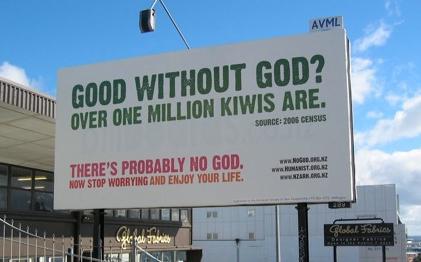
    Good Without God? Over One Million Kiwis Are.

    Here we are told one million kiwis are good without God because the census says so. This, however, is fallacious. What the census shows is not that one million kiwis are good without God, it shows that one million kiwis are good (although this is granting a lot for the sake of argument) without believing in the existence God. But to say one can be good without believing in God is not the same as saying one can be good without God. Many people throughout history have been able to live and breath without believing in the existence of hydrogen and oxygen atoms, it does not follow that they could live without water.

    Moreover, it is hard to tell what the point of this sociological fact is anyway. Why does the fact that people do not need to believe in something to do good deeds mean that the belief is false? For centuries people have done good deeds and lived good lives without believing in evolutionary theory or quantum mechanics, should we conclude that these theories are therefore ‘probably false’? Surely these atheists are not suggesting that our beliefs should be based on what is useful or helpful as opposed to what is true or false?

    Perhaps the atheists here mean to convey something else. Some Christian thinkers such as William Lane Craig, Robert Adams, Stephen Layman, Alvin Plantinga, John Hare, Philip Quinn have argued that moral properties such as right and wrong depend on God for their existence. Atheist writers such as Paul Kurtz and Christopher Hitchens retort that this claim is falsified by the existence of morally upright atheists. I suspect something like this is behind the slogan on the billboard, it repeats Hitchens and Kurtz’s retorts as though they said something insightful or clever.

    The problem is, as any one familiar with this discussion should know, this retort misses the point (as I pointed out in On a Common Equivocation). Craig, Adams, et al are not claiming that one needs to believe in God to be good (a point made several times in the literature and particularly made so many times to Kurtz that it beggars belief that he keeps repeating it) rather their claim is that moral properties, such as right and wrong, depend on God for their existence.

    This is a fairly basic and elementary distinction in the literature. How exactly expressing a common philosophical confusion counts as reason for thinking “there probably is no God” is hard to see.

    Let’s look at the next one.

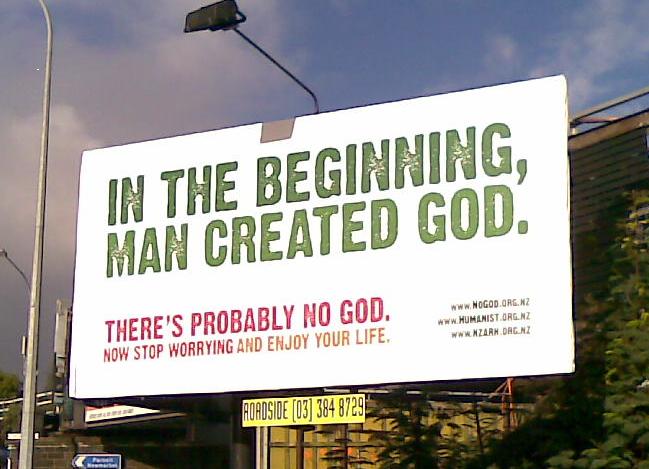
    In the Beginning, Man Created God.

    What is asserted here? That man created God. This, however, is clearly absurd. God is typically defined as an all-powerful, all-knowing, immaterial, necessarily-existent being who created the world. Now if one is going to claim that humans actually created an all-powerful, all-knowing, immaterial, necessarily-existent who created the world, then they are contradicting themselves.

    Humans are part of the world and therefore cannot have created the being that created the world – otherwise humans would have to exist prior to their own existence.

    Similarly, one cannot create a necessary being, this would entail it is possible for a necessary being to not exist, in which case it would not be a necessary being. Taken in a straight-forward, literal manner (the way freethinkers are so fond of taking every passage in the Bible) this billboard simply asserts contradictions.

    Of course, the authors of this billboard probably do not mean to say humans actually created God, they do not think he exists after all. Their claim is that humans created the idea or concept of God and developed it. This is undoubtedly true. Of course, humans also invented the idea or concept of atoms as well, ancient Greek philosophers came up the basics of this concept millennium ago. This trivial fact tells us nothing about whether or not the idea or concept humans developed actually corresponds to anything in reality. To assume that it tells us something about whether the idea or concept is true or false is a fairly obvious case of the genetic fallacy.

    So the second billboard either asserts a contradiction or it is a clear case of a logical fallacy.

    The last one is my favourite.

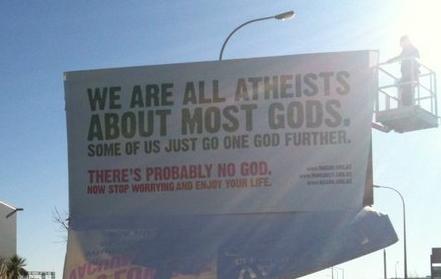
    We are all atheists about most gods. Some of us just go one god further.

    I am inclined to think the argument on this sign is invalid. To see why let’s take out the term “God” in the sign and replace it with some other term such as “non-Christian perspective.” When we do this we get: “We all reject most non-Christian perspectives, some of us just reject one more.” This argument has true premises, do we now have, a knock-down argument for Christianity?

    Similarly, an analogous argument form with true premises gives us an argument for nihilism, the total denial of the existence of morality. “We are all nihilists about some conceptions of morality, some of us are just nihilistic about one more.”

    The same argument for also furnishes a refutation of secularism, “we all reject some secular perspectives on reality, some of us just reject one more.” I could go on.

    Taking a stand on any issue of philosophical substance, whether by affirming, denying or simply being sceptical of it, is to put oneself in opposition to any number of other people and groups who take a contrary stance. That is life. Such pluralism hardly provides a reason for thinking “there probably is no God” any more than it gives us a reason to doubt any other perspective on the world.

    So what do the atheist billboards do? Well the first one tells us that some atheist groups conflate basic philosophical distinctions and don’t really understand the debate they are contributing to. The second shows us that these groups think contradictions and obvious fallacies are some how savvy and smart. The last shows us that they think that invalid argument forms, forms from which you could infer the denial of anything and everything by substituting one true premise with another, are avant-garde.

    All in all, pretty accurate advertising for these groups.

    Hat tip: MCAS

  • Clearing the Air: A Church Leaders Forum on Climate Change

    Matt has been asked to deliver the opening talk at the upcoming Clearing the Air Forum on 16-17 July 2010 at Unitec Institute of Technology, Auckland. The  forum has been organised by New Zealand Christian Network (visionnetwork) and its purpose is to look at the synthesis of science and faith on climate change try to develop a joint communiqué by national church leaders. In addition to Matt, the speakers include:

    • Professor Ralph Sims, Director, Centre for Energy Research, Massey University
    • Dr James Renwick, Principal climate scientist, NIWA
    • Ian Wishart, Editor, Investigate magazine, Author of Air Con: The Seriously Inconvenient Truth About Global Warming
    • Prof Jonathan Boston, Director of the Institute of Policy Studies, Victoria University
    • Barry Brills, President, NZ Climate Science Coalition
    • Dr Andy Reisinger, Senior Research Fellow, NZ Climate Change Research Institute, Victoria University
    • Ken Harrison, Chairman National Church Leaders group, National Superintendant Assemblies of God in New Zealand
    • Archbishop David Moxon, Anglican Church in Aotearoa, New Zealand, and Polynesia
    • Stephen Tollestrup, Executive Director, Tear Fund

    Clearing the AirHere is what it is all about:

    What does the Church have to say to government, society, and itself – if anything – on the topic of climate change? The failure to reach any agreement at the recent Copenhagen conference is regarded as a triumph by some and a tragedy by others.

    This forum – convened by Glyn Carpenter, National Director, NZ Christian Network, visionnetwork, and Associate Professor Jonathan Leaver, Unitec Institute of Technology – will bring together both groups, and look to produce a consensus-based position statement.

    Topics will include (a) epistemology, (b) creation mandate, (c) what position can be reasonably supported by the science, and (d) what can and should we do? The forum is designed primarily for church and public issues leaders, but places are available for students and others to hear a great line up of speakers.

    Matt’s talk is on epistemology and is entitled “Discovering truth in the synthesis of science and Faith.” The idea is that by having Matt talk first he will set the tone as to how we should be approaching and thinking about this synthesis of topics we can then sit back and hear all the speakers speak on their areas of expertise and know how to then grapple with the ideas.

    To see the full programme, click here.

  • Just Nuke BP’s Oil Leak

    Milo Nordyke, one of the masterminds behind US research into peaceful nuclear energy in the 1960s and ’70s and Viktor Mikhailov, a Physicist who served as a Russian Minister of Nuclear Energy, agree on a comparitively cheap solution for BP’s oil leak in the Gulf of Mexico – just nuke it. In what admittedly sounds like the plot to a blockbuster hollywood film, the Special Report: Should BP nuke its leaking well? opens with,

    His face wracked by age and his voice rasping after decades of chain-smoking coarse tobacco, the former long-time Russian Minister of nuclear energy and veteran Soviet physicist Viktor Mikhailov knows just how to fix BP’s oil leak in the Gulf of Mexico.

    “A nuclear explosion over the leak,” he says nonchalantly puffing a cigarette as he sits in a conference room at the Institute of Strategic Stability, where he is a director. “I don’t know what BP is waiting for, they are wasting their time. Only about 10 kilotons of nuclear explosion capacity and the problem is solved.”

    …

    Mikhailov has had a distinguished career in the nuclear field, helping to close a Soviet Union program that used nuclear explosions to seal gas leaks. Ordinarily he’s an opponent of nuclear blasts, but he says an underwater explosion in the Gulf of Mexico would not be harmful and could cost no more than $10 million. That compares with the $2.35 billion BP has paid out in cleanup and compensation costs so far. “This option is worth the money,” he says.

    As gung-ho and ‘Bruce Willis’ as it sounds the idea actually seems to have some merit. In addition to the cost being comparitively cheap (if BP sold the rights to Hollywood they might even cover the cost of the nuke) the article goes on talk about the environmental impact.

    Nordyke too believes the nuclear option should be on the table. After seeing nine U.S. nuclear explosions and standing behind the control board of one, he estimates that a nuclear bomb would have roughly an 80 to 90 percent chance of successfully blocking the oil. According to his estimates, it would have to be an explosion of around 30 kilotons, equivalent to roughly two Hiroshima bombs or three times as big as Mikhailov’s estimate. The explosion would also need to remain at least 3 to 4 miles away from other offshore wells in the area.

    The bomb, says Nordyke, would be dropped in a secondary well approximately 60-70 feet away from the leaking shaft. There it would create a large cavity filled with gas. The gas would melt the surrounding rock, crush it and press it into the leaking well to close it shut.

    Although the BP well is thousands of feet deeper than those closed in the Soviet Union, Nordyke says the extra depth shouldn’t make a difference. He also says that so far below the ground, not much difference exists in onshore or underwater explosions — even though the latter have never been tried.

    Nordyke says fears that radiation could escape after the explosion are unfounded. The hole would be about 8 inches in diameter and, despite the shockwave, the radiation should remain captured. Even in the case of radiation escape, he says, its dispersed effect would be less than that of floating oil patches.

    The article concludes that despite support for some sort of explosive solution even coming from quarters as unlikely as Bill Clinton (well, ok, maybe ‘just blowing it all up’ as a solution is not that unlikely for Clinton) the idea is highly unlikely to be implemented for the obvious reasons that managing the outcry towards the proposed solution would probably be worse than the outcry towards the oil spill. In short, it ‘aint going to happen but let’s cut to Mikhailov for the final scene:

    “Still,” he says, momentarily hard to see through a cloud of smoke from his cigarettes, “I see no other solution for sealing leaks like the one in the Gulf of Mexico.”

    The problem, he goes on, is that “Americans just don’t know enough about nuclear explosions to solve this problem … But they should ask us — we have institutes, we have professionals who can help them solve this. Otherwise BP are just torturing the people and themselves.”

    Hat Tip: Zwinglius Redivivus

  • Buckle your Belts as the ETS Arrives

    The Emissions Trading Scheme (ETS) comes into force today.  It is still not clear who we’ll be trading anything with (that implies that there are other parties in the scheme) but what is clear is that we are now all paying, dearly, for the controversial science and policies that many of us reject.

    Winter just got a lot colder in our house.