Category: Publications

  • Matt’s Latest Publication: Virtues in Action – New Essays in Applied Virtue Ethics

    Matt’s lastest publication in a book arrived by courier today. The book is Virtues in Action: New Essays in Applied Virtue Ethics; it is an an edited collection of new work in applied virtue ethics.
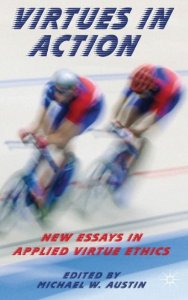
    Virtues in Action: New Essays in Applied Virtue EthicsVirtues in Action is edited by Michael W. Austin, who is Professor of Philosophy at Eastern Kentucky University, a specialist in ethics and philosophy of religion, author of Conceptions of Parenthood (2007), and editor or co-editor of several works, including The Philosophy of the Olympics (2012) and Being Good: Christian Virtues for Everyday Life (2012) – Being Good was the book Matt and each gave a paper on at the 2012 Evangelical Philosophy Society’s Annual Meeting in Milwaukee. Mike blogs at Ethics for Everyone.

    The chapter Matt wrote is called “Some Critical Reflections on Abortion and Virtue Theory.”

    From the Publisher:

    “In recent decades, many philosophers have considered the strengths and weaknesses of a virtue-centered approach to moral theory. Much less attention has been given to how such an approach bears on issues in applied ethics. The essays in this volume apply a virtue-centered perspective to a variety of contemporary moral issues, and in so doing offer a fresh and illuminating perspective. Some of the essays focus on a particular virtue and its application to one or more realms of applied ethics, such as temperance and sex or humility and environmental ethics. Other chapters focus on an issue in applied ethics and bring several virtues into a discussion of that issue or realm of life, such as sport, education, and business. Finally, several of the chapters engage relevant psychological research as well as current neuroscience, which enhances the strength of the philosophical arguments.”

    Table of contents:

    Introduction
    PART I: PROFESSIONAL VIRTUE
    1. Virtue-Centered Approaches to Education: Prospects and Pitfalls; Gregory Bassham
    2. The Virtues of Honorable Business Executives; Dan Demetriou
    3. Sport as a Moral Practice: An Aristotelian Approach; Michael W. Austin
    PART II: SOCIAL VIRTUE
    4. Sex, Temperance, and Virtue; Stan van Hooft
    5. Extend Your Benevolence: Kindness and Generosity in the Family and Beyond; Heidi Giebel
    6. A Virtue Ethical Case for Pacifism; Franco V. Trivigno
    7. Some Critical Reflections on Abortion and Virtue Theory; Matthew Flannagan
    PART III: ENVIRONMENTAL VIRTUE
    8. Environmental Degradation, Environmental Justice, and the Compassionate Agent; Chris Frakes
    9. Humility and Environmental Virtue Ethics; Matthew Pianalto
    PART IV: INTELLECTUAL VIRTUE
    10. Hope as an Intellectual Virtue; Nancy E. Snow
    11. Virtue Ethics and Moral Failure: Lessons from Neuroscientific Moral Psychology; Lisa Tessman
    12. Getting Our Minds Out of the Gutter: Fallacies that Foul Our Discourse (and Virtues that Clean it Up); Robert K. Garcia and Nathan L. King

    Get your copy from Amazon.

  • Published in Philo: Is Ethical Naturalism more Plausible than Supernaturalism? A Reply to Walter Sinnott-Armstrong

    Jeffery Jay Lowder  has informed me that my article “Is Ethical Naturalism more Plausible than Supernaturalism? A Reply to Walter Sinnott-Armstrong”  was  published in the Spring/Summer 2012 issue of Philo. The abstract is below:

    Is Ethical Naturalism more Plausible than Supernaturalism? A Reply to Walter Sinnott-Armstrong“In many of his addresses and debates, William Lane Craig has defended a Divine Command Theory of moral obligation (DCT). In a recent article and subsequent monograph, Walter Sinnott-Armstrong has criticized Craig’s position. Armstrong contended that a DCT is subject to several devastating objections and further contended that even if theism is true a particular form of ethical naturalism is a more plausible account of the nature of moral obligations than a DCT is. This paper critiques Armstrong’s argument. I will argue Armstrong’s objections do not refute a DCT and the ethical naturalism he defends is not more plausible than Craig’s ethical supernaturalism.”
    You can read “Is Ethical Naturalism more Plausible than Supernaturalism? A Reply to Walter Sinnott-Armstrong” here.

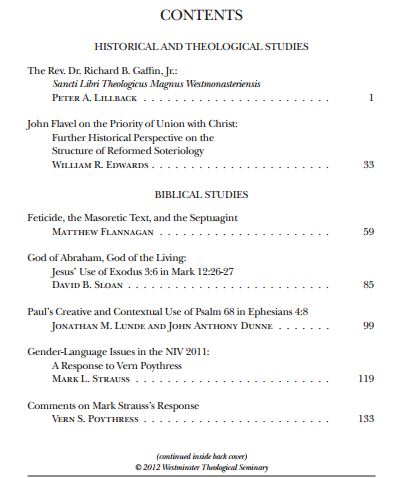
  • Published: “Feticide, the Masoretic Text, and the Septuagint” in The Westminster Theological Journal

    Matt’s article “Feticide, the Masoretic Text, and the Septuagint” is now available in Vol 74, No. 1 – Spring 2012 of The Westminster Theological Journal.

    The Westminster Theological Journal

    An abstract of “Feticide, the Masoretic Text, and the Septuagint” follows:

    A long Christian tradition of moral reflection on feticide interprets feticide, the killing of a formed conceptus, as a violation of  God’s law against homicide. In her book, Our Right to Choose, Beverly Harrison attempts to undercut this tradition of interpretation.

    Harrison alleges that the Alexandrian argument is based on a mistranslation of the Hebrew text. Harrison’s argument is based on apparent discrepancies between the Septuagint (LXX) and the Masoretic Text (MT) over the rendering of Exod 21:22-25. She makes three claims. Firstly, she suggests that Christian prohibition of feticide is based upon the LXX. Secondly, that the MT, which in her view accurately captures the original law, did not consider feticide a major crime. Thirdly, she argues that the LXX mistranslates this law and incorporates a prohibition of feticide into the text that is not there.

    In response I examine whether each of Harrison’s contentions is correct. From the outset I grant Harrison’s assumption that the MT accurately captures the original and that the LXX is the later translation. I also grant her point that the argument has origins in Alexandrian Judaism and the LXX. The discussion then asks whether each of Harrison’s other claims is correct. Does the MT consider feticide a minor crime? And does the LXX misinterpret the original?

    I defend a negative answer to both questions.

  • Singer on Matthew Flannagan in “Peter Singer Under Fire: The Moral Iconoclast Faces His Critics”

    Yesterday Matt went the library and did a little reading for his upcoming Evangelical Philosophical Society paper “Peter Singer, Human Dignity, and Infanticide“ and he discovered that email exchange he’d had with Peter Singer in 2006 had resulted in a few paragraphs in Singer’s book Peter Singer Under Fire: The Moral Iconoclast Faces His Critics.

    Here is a screen shot of what one sees when one uses the “search inside this book” function:

    Peter Singer Under Fire: The Moral Iconoclast Faces His Critics

    Matt does not feel that Singer accurately portrayed his counter example but the substance Singer presents of it is correct. Singer’s response to Matt seems to be that Matt is right in principle but in practice it would never be an issue.

  • Come Let Us Reason: New Essays in Christian Apologetics – Available on Kindle or Pre-Order the Book, Feat. William Lane Craig, Paul Copan, JP Moreland, Gary Habermas, Matthew Flannagan et al.

    The kindle edition of Come Let Us Reason: New Essays in Christian Apologetics, published by B&H Academic, edited by William Lane Craig and Paul Copan and featuring Craig, Copan, JP Moreland, Gary Habermas, Craig Keener, Mary Jo Sharp, this blog’s Matthew Flannagan, and others, with the foreword written by Rick Warren, is now available at the link above on Amazon.

    The book version of Come Let Us Reason: New Essays in Christian Apologetics can be pre-ordered at this link on Amazon.

    Matt’s chapter is “Did God Command Canaanite Genocide?” Here is the editorial review from Amazon:

    Come Let Us Reason: New Essays in Christian ApologeticsCome Let Us Reason is the third book in a series on modern Christian apologetics that began with the popular Passionate Conviction and Contending with Christianity’s Critics. The nineteen essays here raise classical philosophical questions in fresh ways, address contemporary challenges for the church, and will deepen the thinking of the next generation of apologists. Packed with dynamic topical discussions and informed by the latest scholarship, the book’s major sections are:

    • Apologetics, Culture, and the Kingdom of God
    • The God Question
    • The Gospels and the Historical Jesus
    • Ancient Israel and Other Religions
    • Christian Uniqueness and the World’s Religions

    Click to View the Table of Contents of Come Let us Reason

    Contributors include J. P. Moreland (“Four Degrees of Postmodernism”), William Lane Craig (“Objections So Bad That I Couldn’t Have Made Them Up”), Gary R. Habermas (“How to Respond When God Gives You the Silent Treatment”), Craig Keener (“Gospel Truth: The Historical Reliability of the Gospels”), and Paul Copan (“Does the Old Testament Endorse Slavery?”).

    Paul Copan is a professor and the Pledger Family Chair of Philosophy and Ethics at Palm Beach Atlantic University in West Palm Beach, Florida. He holds a Ph.D. in Philosophy from Marquette University.

    William Lane Craig is research professor of Philosophy at Talbot School of Theology in La Mirada, California. His Ph.D. in Philosophy is from the University of Birmingham in the United Kingdom.

    The Come let us Reason series is designed to bring scholarly work to the lay person so, depending on whether you prefer Kindle or book form, order or pre-order your copy now and let us know what you think.

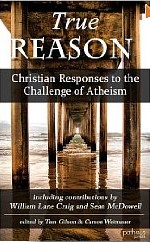
  • True Reason: Christian Responses to the Challenges of Atheism – on Kindle

    The kindle edition of new book featuring responses to the New Atheists, aimed to be readable at the popular level entitled True Reason: Christian Responses to the Challenges of Atheism is now available on Amazon. This blog’s Matthew Flannagan contributed to a chapter in it alongside William Lane Craig, Sean McDowell and others.

    Matt’s chapter is a reprint of his chapter “Did God Command Canaanite Genocide?” in the forthcoming in April B&H Academic book: Come Let Us Reason: New Essays in Christian Apologetics edited by Paul Copan and William Lane Craig.

    Here is the editorial review from Amazon:

    True Reason: Christian Responses to the Challenge of Atheism“While New Atheists like Richard Dawkins, Sam Harris, and others proclaim loudly their rationality, clear thinking, and incontrovertible scientific arguments, others are beginning to wonder how genuinely rational they are. Have they proved anything? Have they argued convincingly? Have they pinpointed any real challenges to the credibility of Christian faith?
    “True Reason,” edited by Tom Gilson and Carson Weitnauer, brings together a compendium of writers–philosophers, apologists, ethicists, theologians, historians–who look carefully at the best arguments atheism has and evaluate their validity, logic, assumptions, and naturalist conclusions.Authors include noted philosopher William Lane Craig and popular apologist Sean McDowell, along with Gilson, Weitnauer, John DePoe, Chuck Edwards, Matthew Flannagan, Peter Grice, Randy Hardman, David Marshall, Glenn Sunshine, David Wood, and Samuel Youngs. Each chapter tackles a different atheist argument and brings reason fully into the discussion.

    Which is more reasonable: atheism or Christianity? Read “True Reason” and think for yourself.”

    Get your copy now, read it, and let us know what you think both here and on Amazon 🙂

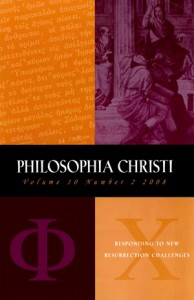
  • Philosophia Christi: Abstract Objects and Divine Command Ethics Down-Under

    In December we were told that Matt’s article “Tooley, Plantinga and the Deontological Problem of Evil”  had passed peer review and would be published in Philosophia Christi.  Issue, 13: 2  is  now out and if you look at the contents page you’ll see Matt’s article has now been published.

    The abstract to Matt’s article is as follows:

    Philosophia ChristiThis article criticises the deontological argument from evil proposed by Michael Tooley  in The Knowledge of God. I sketch Tooley’s distinction between deontological and axiological arguments from evil. Tooley rejects the axiological version because it rests  on “controversial ethical claims”, claims that are “likely to be rejected by many theists” and formulates a deontological version in its place. I argue that Alvin Plantinga’s criticism of the moral premises of this argument can be reformulated by appealing to a divine command theory of ethics. So reformulated, I argue that Tooley’s argument relies on controversial moral assumptions that many theists reject. I defend this response against potential criticisms found in the writings of Linda Zagzebski,  Tooley’s debate with William Lane Craig, and Peter Van Inwagen.

    Much of the focus of this issue is the topic of God and Abstract Objects. However, fortuitously, our good friend and fellow Kiwi, Glenn Peoples from Say Hello to My Little Friend,  has also been published in the same issue of Philosophia Christi immediately after Matt. His abstract is below:

    Of the objections to divine command ethics that still circulate in the literature, the epistemological objection is one of the two most common (the other being the objection from abhorrent commands). If morality is based on divine commands, the objection goes, then those who do not believe in God cannot know what is right or wrong. In this paper I explain the way in which this objection has been answered in the past (especially by Philip Quinn and Robert Adams) and I then look at a new attempt by Wes Morriston to resurrect and re-state the epistemological objection.  I explain the way in which this objection succumbs to responses that have already been made in the literature and is not new at all in spite of appearances, and I explain how it misconstrues the social nature of obligation in Robert Adams’ account of divine commands. In giving this explanation I flesh out the potentially difficult notion of a “sign” as an epistemic indicator of moral duty, and I argue that all the epistemological objections to divine command ethics this far fail because they have an underdeveloped concept of a “sign” as a central component of a command.

    Perhaps the theme for this issue should have been God, Abstract Objects and Divine Command ethics Down Under?