In my previous post I criticised the rationalist objection to belief in God. In this post I want to sketch an alternative view of faith and reason defended by Alvin Plantinga. In my next post I will address two common objections to this conception.Belief in God as Properly BasicIn several of his works Alvin Plantinga […]
Entries Tagged as 'Philosophers'
Belief without Proof: Is Belief in God Rational if there is no Evidence? Part II
April 6th, 2009 3 Comments
Tags: Alvin Plantinga · Faith and Reason · William Alston
Tooley, The Euthyphro Objection and Divine Commands: Part II
March 25th, 2009 8 Comments
In my last post, Tooley, The Euthyphro Objection and Divine Commands: Part I, I made some critical remarks on Michael Tooley’s critique of William Lane Craig’s version of the divine command theory. Tooley contends that this theory implies the conditional that if God had commanded mankind to torture one another as much as possible then […]
Tags: Divine Command Theory · Ethics · Euthyphro Dilemma · God and Morality · Philosophy of Religion · Walter Sinnott-Armstrong
Tooley, The Euthyphro Objection and Divine Commands: Part I
March 23rd, 2009 12 Comments
In a debate with William Lane Craig at the University of Colorado, Michael Tooley stated, There is a theory which has the consequence that there cannot be objective moral laws unless God exists—that’s the so-called ‘divine command theory of morality’. What it says is that an action is wrong because and only because God forbids […]
Tags: Divine Command Theory · Ethics · Euthyphro Dilemma · God and Morality · Philosophy of Religion · Selection · Walter Sinnott-Armstrong
Marquis, Pruss and the Twinning Argument
March 23rd, 2009 23 Comments
Augustine writes, And therefore the following question may be very carefully inquired into and discussed by learned men, though I do not know whether it is in man’s power to resolve it: At what time the infant begins to live in the womb: whether life exists in a latent form before it manifests itself in […]
Tags: Abortion · Embryocide · Ethics · Feticide · Science and Religion
Brink on Dialectical Equilibrium
February 5th, 2009 2 Comments
In my last two posts, I have criticised David Brink’s appeal to scripture in order to argue against the appeal to divine commands in ethics. Brink anticpates the kind of argument I have offered and states, A common theistic response to these interpretative puzzles is to endorse the interpretation of tradition and scripture that yields […]
Tags: David Brink · Ethics · Faith and Reason · God and Morality · Hermeneutics
Capital Punishment in the Old Testament: 2
January 27th, 2009 20 Comments
In Capital Punishment in the Old Testament: 1 I suggested that the capital sanctions found in The Torah in most cases were not intended to be carried out, that instead there operated an implicit assumption that a person who committed a serious crime had forfeited their life and hence was to pay a ransom as […]
Tags: Capital Punishment · David Brink · David Instone Brewer · Ethics · Gordon Wenham · Hermeneutics · Old Testament Ethics · Theology
Capital Punishment in the Old Testament: 1
January 25th, 2009 9 Comments
In “The Autonomy of Ethics,” David Brink writes that a literal reading of the Old Testament, [Y]ields problematic moral claims, such as Deuteronomy’s claims that parents can and should stone to death rebellious children (21:18-21) and that the community can and should stone to death any wife whose husband discovers that she was not a […]
Tags: Capital Punishment · David Brink · Ethics · Hermeneutics · Old Testament Ethics · Theology

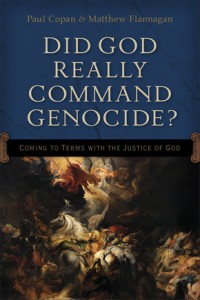 A common objection to belief in the God of the Bible is that a good, kind, and loving deity would never command the wholesale slaughter of nations. In the tradition of his popular Is God a Moral Monster?, Paul Copan teams up with Matthew Flannagan to tackle some of the most confusing and uncomfortable passages of Scripture. Together they help the Christian and nonbeliever alike understand the biblical, theological, philosophical, and ethical implications of Old Testament warfare passages.