Category: Blogging

  • The Theology of the Declaration of Independence

    As I write this it is just beginning to be the 4th of July in the United States now, though its been 4th July for some time here in New Zealand.

    The 4th of July is, of course, Independence Day. Typically in New Zealand, those members of the secular blogosphere, who consider themselves to be classical liberals, have an annual rant on the 4th of July about the Declaration of Independence, praising the philosophy expounded in this document.
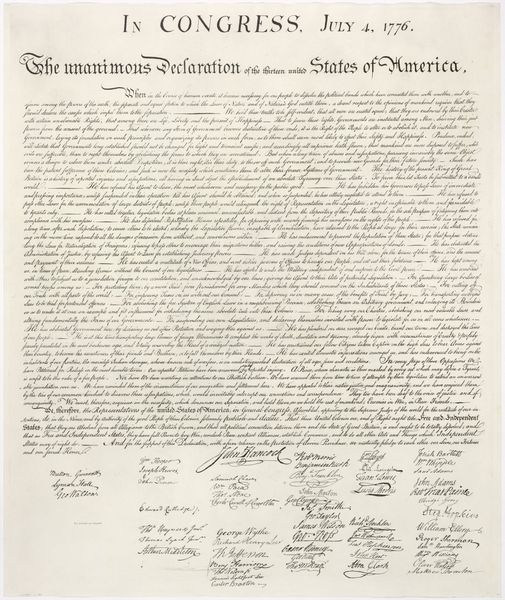
    Declaration of IndependenceNot PC’s Peter Cresswell, for example, states in Happy July 4th! that “with the exception of just a few words, the words could hardly be bettered today;” the declaration is, “A wonderful, wonderful anthem to freedom that rings down through the years.”  He bemoans, “if only the real meaning of those words could be heard and understood.”

    A few years ago Kiwiblog’s David Farrar made similar claims, he stated he would often “marvel at those marvelous words, written in the heat of oppression…Marvelous, absolutely marvelous.”

    I agree. I would simply point out to my secular, liberal, country-men what the words in this document actually say, and some of the philosophical ideas they expound.

    First, the declaration refers to God; it does so four times. Maverick Philosopher has an excellent analysis of the theological content;

    In the initial paragraph, we find the phrase “…Laws of Nature and of Nature’s God….” This phrase rules out pantheism: God is distinct from Nature. In the second paragraph, there is the phrase, “…endowed by their Creator with certain unalienable rights….” Putting these two references together, we may infer that the God being referred to is not merely a deistic initiator of the temporally first segment of the physical universe, but a being involved in the creation of the human race. For if God endowed human beings with rights, this endowment had to occur at the time of the creation of human beings, which of course occurred later than the beginning of the physical universe. In traditional jargon, God is a creator continuans rather than a mere creator originans. He is not a mere cosmic starter-upper, but a being who is continuously involved in maintaining the universe in existence.

    …

    The other two references are in the final paragraph. There we find the phrase, “…Supreme Judge of the World for the Rectitude of our Intentions….” near the beginning of the paragraph, and near the end, “…a firm Reliance on the Protection of divine Providence….” Now if God is the Supreme Judge, then he is more than a mere metaphysical cause responsible for the universe’s beginning to exist; he is also the supreme moral arbiter. And since he endows human beings with rights, as opposed to being merely a judge of rights antecedently possessed, then it seems we may infer that God is the source of moral distinctions (as opposed to a mere judge of them).

    The reference to divine providence is further evidence that the conception of God in the Declaration is non-deistic. For if God provides and protects, then God has an ongoing involvement with the world and its inhabitants such as would be ruled out by a deistic view. It should also be obvious that talk of providence (from the Latin, pro-videre) implies divine foreknowledge which implies intelligence and perhaps omniscience on the part of the deity. The God of the Declaration is not a blind metaphysical cause posited to explain why the universe began to exist, but a being with such attributes as moral goodness and intelligence…. So if by ‘deism’ is meant the doctrine that God is a mere metaphysical cause of the universe’s beginning to exist who is thereafter uninvolved in its continuing to exist, then the God of the Declaration is non-deistic.

    Second, the declaration claims that belief in a creator is self-evident; that is, it is a properly basic belief, which is rationally acceptable to hold in the absence of any proof.

    We hold these truths to be self-evident, that all men are created equal, that they are endowed by their Creator with certain unalienable Rights, that among these are Life, Liberty, and the pursuit of Happiness.

    Third, the declaration makes political pronouncements about public policy on the basis of these theological claims and expects these pronouncements to be taken seriously.

    Fourth, the declaration says that various rights, such as the right to life and liberty, are unalienable. That is, a person cannot alienate one’s life or freedom as they can legally alienate a piece of property. You can’t take my property if I do not consent to you having it but if I do consent, you can take it; property is alienable, life and liberty are not. The argument of the declaration reflects John Locke’s argument in the Second Treatise of Civil Government;

    To understand political power right, and derive it from its original, we must consider, what state all men are naturally in, and that is, a state of perfect freedom to order their actions, and dispose of their possessions and persons, as they think fit, within the bounds of the law of nature, without asking leave, or depending upon the will of any other man.[1]

    …

    But though this be a state of liberty, yet it is not a state of licence: though man in that state have an uncontroulable liberty to dispose of his person or possessions, yet he has not liberty to destroy himself, or so much as any creature in his possession, but where some nobler use than its bare preservation calls for it. The state of nature has a law of nature to govern it, which obliges every one: and reason, which is that law, teaches all mankind, who will but consult it, that being all equal and independent, no one ought to harm another in his life, health, liberty, or possessions: for men being all the workmanship of one omnipotent, and infinitely wise maker; all the servants of one sovereign master, sent into the world by his order, and about his business; they are his property, whose workmanship they are, made to last during his, not one another’s pleasure[2]

    …

    This freedom from absolute, arbitrary power, is so necessary to, and closely joined with a man’s preservation, that he cannot part with it, but by what forfeits his preservation and life together: for a man, not having the power of his own life, cannot, by compact, or his own consent, enslave himself to any one, nor put himself under the absolute, arbitrary power of another, to take away his life, when he pleases. No body can give more power than he has himself; and he that cannot take away his own life, cannot give another power over it.[3]

    The point here is that because your right to life and liberty are from God, no one can legitimately enslave or kill you, even if you consent to it. This was not a mere incidental addendum idea, it was central to Lockean political philosophy, which maintained (as the declaration does) that the government derives its powers from the consent of the governed. If a person can consent to be killed or enslaved then they can consent to the government enslaving them also to having the arbitrary power to kill them and hence tyranny can be legitimate. The reason tyranny is illegitimate is because, “No body can give more power than he has himself; and he that cannot take away his own life, cannot give another power over it.”

    The declaration then makes a metaphysical claim: God exists. It makes an epistemological claim about faith and reason: that belief in God is rational independent of proof. It makes an implicit claim of political philosophy: religion is not a private thing that should not influence public life but rather, theological claims should influence public life. Finally it makes a moral claim; that consenting adults do not have a right to do whatever they like with their own bodies, rather there are “Laws of Nature and of Nature’s God” that bind all human beings, that they are compelled to follow even if all parties consent otherwise. Governments are legitimate to the extent in which they respect these laws.

    I agree with PC, it is hard to improve on this philosophy; I have defended it in several places on this blog.

    Ironically, however, the militant secular liberals in NZ who parrot the declaration seem committed to attacking these ideas and rejecting them on every point. They argue that belief in God is irrational because it cannot be empirically proven, they claim that the public square should be secular, that religion should be private and not influence public policy and they argue that liberty means consenting adults can do whatever they like with their own bodies and lives. Far from being unalienable, a person’s life and freedom is his property to alienate as that person sees fit.

    It is also hard to disagree with PC’s sentiments that the declaration is “A wonderful, wonderful anthem to freedom that rings down through the years. If only the real meaning of those words could be heard and understood.” “Indeed, if only.”

    [1] John Locke Second Treatise of Civil Government Section II 4.
    [2] Ibid II6.
    [3] Ibid IV 23.

  • Wolterstorff, the Canaanites and Hyperbole: A Response to Ken Pulliam

    Critics of Christianity often ask how can a good and loving God command the extermination of the Canaanites as is taught the Old Testament? A clear assumption behind this question is that the Old Testament teaches that God did in fact command the extermination of the Canaanites, an assumption which is based on a straight-forward literal reading of some passages in Joshua and Deuteronomy. In an earlier blog series, Joshua and the Genocide of the Canaanites, I elaborated and defended the position of Nicholas Wolterstorff that such a literal reading of these passages is mistaken. The language of “leaving alive nothing that breaths” or “destroying” and other such language should be understood as hyperbole and hence is analogous to someone today saying after a ball game, “we totally slaughtered the opposition, we annihilated them just as coach told us to.”

    Ken Pulliam has taken issue with this defence so here I will respond to some of his criticisms. (I plan to address some of the other objections in future posts). Before doing so it is important to address some rhetorical tricks his article contains. To begin with Pulliam entitles his response “Grasping at Straws Part Eleven–Evangelicals Defend Genocide” and cites Wolterstorff and myself as examples. But neither Wolterstorff or I defended genocide, we argued that God did not command genocide. Moreover, referring to my argument, Pulliam states that I cited “external evidence of how other ANE nations reported their exploits of war [by citing] evangelical Kenneth Kitchen.” Now it is true that Kitchen is an evangelical and that I cite him, however, Kitchen is also a leading Egyptologist and I don’t just cite him I cite numerous examples of Ancient Near Eastern (ANE) reports of war where language similar to that used by Joshua and Deuteronomy are used hyperbolically. I also noted evidence that Joshua is written according to the literary conventions of such reports.

    Instead of addressing this evidence directly, Pulliam gives a series of arguments for the claim that the text is not hyperbolic but literal. One objection Pulliam raises is that this interpretation “fails to solve the other moral problems in the Hebrew Scriptures.” He asks, “are we to explain away all of the problems in the Old Testament by appealing to hyperbole?” The answer of course is no; it is hard to see why this is an objection. Why does an interpretation of one passage have to answer every question about every other passage in order for it to be plausible? Interpreting the first line of Pulliam’s post literally does not solve every problem I see in it should I, therefore, not take it literally?

    A second, objection Pulliam makes is that “it fails to take into account how these hyperbolic passages would be misused in the future by those who thought they were following divinely commanded principles.” Presumably Pulliam means that God, by allowing his word to be mediated through the literary conventions of ANE historiography, would forsee that future generations will misinterpret it. This, of course, is correct. Again, it is unclear why this means that the text should be taken literally. After all, it seems any language which God mediates his word through, whether literal or figurative, will have this implication. A message mediated through the more literalistic conventions of 21st century English, History and Moral Philosophy would be misunderstood by numerous people as well (his seems to be more a problem with verbal revelation per se rather than any particular interpretation of it).

    Pulliam’s other arguments are more on point. He argues that a hyperbolic interpretation “fails to appreciate that Judges 2:1-5 says that the Israelites did not obey the LORD in totally destroying the Canaanites, and that as a result, they will have problems for generations to come.” Pulliam poses a rhetorical question, “if the genocidal commands were never intended to be taken literally, why are the people scolded by Yahweh and told that their future problems will come as a result of their disobedience?” In fact, in articles which Pulliam refers to both Wolterstorff and I cite this passage and point out that, in fact, it says no such thing; it states,

    ‘I will never break my covenant with you,2 and you shall not make a covenant with the people of this land, but you shall break down their altars.’ Yet you have disobeyed me. Why have you done this?3 Now therefore I tell you that I will not drive them out before you; they will be thorns in your sides and their gods will be a snare to you.4

    Here Israel is criticised for disobeying an order to not make a covenant with the Canaanites and to destroy their altars. There is nothing at all present in these passages about extermination and genocide. Moreover, both Wolterstorff and myself pointed this out.

    Pulliam further objects that,

    One must ask if Wolterstorff’s opinion that Joshua uses “highly figurative” language is based on literary considerations or is it driven more by his need to solve the moral problems involved? He does not provide any direct parallels between Joshua and other literature which is clearly recognized as hagiographic and figurative.

    This again is simply a distortion of the situation. In my original post I gave a large number of direct parallels between Joshua and other literature which is both figurative and hagiographic (in Wolterstorff’s sense of the term). Given that I did this and that Pulliam has clearly read the post (he did link to it) one wonders why he claims no such parallels have been offered. Moreover, Wolterstorff, in the article he cites from, does provide several literary considerations for his thesis. It seems evident that several of Pulliam’s arguments involve simply ignoring what Wolterstorff and I have written and distorting the evidence.

    Equally puzzling is Pulliam’s argument, “If Joshua is hagiography, why shouldn’t one believe that the Gospels are as well? Why should one take their stories as literal history?” This is puzzling because my post addressed this. There is compelling textual evidence both from within the text itself and also via comparisons between Joshua and other ANE texts to suggest that it is hyperbolic. These parallels and textual considerations are not present with the gospels. Similarly, in his book Divine Discourse: Philosophical Reflections on the Claim that God Speaks Wolterstorff discusses the genre of the gospels and cites comparisons with ancient Greek biographies to defend the claim that the gospels are ancient Greek biography. Again Pulliam’s response appears to be to ignore what those he criticises actually wrote.

    It is worth noting that this kind of argument relies on a peculiar assumption, that if one grants that one part of a text is non-literal then one cannot, non-arbitrarily, take any other part of the text as literal. Pulliam’s own writing falsifies this claim. He concludes that “Wolterstorff is more sophisticated than some of the other harmonization attempts we have seen, it is in reality just another case of grasping at straws.” Surely, his phrase “grasping at straws” is a non-literal figure of speech (I am assuming he did not mean to refer to real straws) does it follow then that we should not take anything else he says in his post literally?

  • Showing Christianity is True at Apologetics 315

    Brian Auten of Apologetics 315 has run an essay series through the month of April on the topic “Why is Christianity True?” Brian has accepted 23 submissions from various apologetics bloggers from around the world and has each day posted 1 essay in the series along with a podcast of each. At the end of the series a PDF ebook version of all the essays will be made available.

    Matt’s essay “Showing Christianity is True” was selected to be the concluding essay and it too has been made into a podcast. To hear the podcast and join in the global discussion pop on over to Apologetics 315 (or you can read it below).

    Showing Christianity is True

    “Can you show that Christianity is true?” To help us focus our thinking as to how one should answer this question I will pose some other questions as follows. Can you show that other people exist or that there exists a world that endures independent of our senses, which continues to exist when we no longer perceive it? Can my belief that it is wrong to inflict pain on another person for no reason at all be shown as true? What about my belief that Russell’s sceptical hypothesis that the whole Universe came into existence six seconds ago, including all apparent memories and signs of age – is this false or true?

    I hope that the point of these examples is clear. Unless we want to fall into a global scepticism that defies all common sense we have to acknowledge that there are some beliefs which we hold rationally and know are true that, nevertheless, cannot be shown or proven to be true from premises that all intelligent people are required to accept. In fact, somewhat ironically, the claim that one is only rational in believing something unless it can be shown to be true from premises all sane people are required to accept, is self-refuting; after all, many sane people reject it and it has yet to be shown to be true from premises that all sane people accept.

    However, one is rational in accepting some beliefs independent of any argument showing the truth of those beliefs; philosophers term such beliefs ‘properly basic beliefs.’ These beliefs typically function as foundational beliefs, a person reasons from them as premises to the truth of other propositions one holds. Similarly, they function as the background data against which one assesses hypotheses proposed for one’s acceptance. They arise because ongoing appeals to premises to prove premises to prove premises have to end somewhere. Properly basic beliefs constitute those beliefs where it is rational for the appeal for proof to end.

    It needs to be noted that properly basic beliefs are not groundless. While one does not believe a basic belief based on an inference, basic beliefs are often based on some form of experience. Alvin Plantinga discerns two types of experience, “sensory evidence”, such things as appearing to see, hear or feel a given object and “doxastic evidence”, which he refers to as “the belief feels right, acceptable, natural.”1  Doxastic beliefs appear to be self-evident. An example of such a belief is the corresponding conditional of modus ponens. When one entertains the conditional of modus ponens it just seems to be correct. Modus ponens seems self-evident in a way that an overtly-fallacious inference does not. It is this kind of experience that grounds basic beliefs.

    Many philosophers and theologians such as Calvin, Pascal, Alston and Plantinga hold that certain theological beliefs are properly basic. Belief in the existence of God is, from the believer’s perspective, properly basic and grounded directly in some form of religious experience; hence it is justified and rational to believe these doctrines independently of any argument in favour of them. Although I cannot elaborate it in a small article, I am in fundamental agreement with this position. The request then that Christians show or demonstrate that Christianity is true often relies on an assumption that I think is mistaken; this assumption is that rational Christian belief requires that arguments or proofs be provided for Christianity and failure to provide them renders the believer irrational.

    There is another more moderate question which lurks in the neighbourhood. If one grants that the believer is rational in accepting Christian belief in a properly basic way then what reasons can the believer give to those who do not hold to the same properly basic beliefs for accepting Christian belief? Perhaps some people, on the basis of some kind of religious experience, have immediate properly basic beliefs but many people do not have this kind of experience – what reason can be given to them for accepting the Christian faith? This problem is exasperated by the fact that it is extremely difficult to demonstrate the truth of foundational beliefs precisely because they are foundational beliefs. To prove something one needs to appeal to premises and the whole question in this instance is over what ultimate premises to accept. How then would one show to these people that Christianity is true?

    I think several strategies are available but due to space I can only briefly sketch them here.

    First, in many instances, one can show Christianity is true by rebutting objections to Christian beliefs. Properly basic beliefs are beliefs that one is rational in believing independently of any argument for them in the absence of any good reasons for them. It does not follow, however, that these beliefs cannot be defeated by reasons offered against them.  If I see John screwing his face up and grasping his leg, I might form the belief that John is in pain. However, if later John tells me that he was not in pain but rather rehearsing his death scene in a play he is acting in I might change my belief to believing that he was not in pain. The initial belief that he was in pain was properly-basic; however, because of what I later discovered, its rational status was defeated.

    I think many people stand in an analogous position to various Christian beliefs; they reject them not because they do not see them to be true but because they accept various objections to these beliefs. Consider Richard Dawkins’ “All appearances to the contrary, the only watchmaker in nature is the blind forces of physics, albeit deployed in a very special way… it is the blind watchmaker.” What is interesting here is the phrase, “all appearances to the contrary,” Dawkins admits that, prima facie, the world appears and looks like it was designed and in the absence of any reasons for denying design then the natural observation is to say that it is. Dawkins suggests, however, that appearances are deceiving because science has allegedly provided defeaters for this belief. Showing Dawkins’ arguments are unsound in such a context enables people to accept appearances.

    The second line of argument is to show that various alternatives to Christianity are false. Often people fail to see the truth of Christianity because they accept mistaken views of the world and mistaken epistemic standards such as those associated with naturalism. They may experience God’s presence in nature but believe this is an illusion because they are convinced that nothing beyond nature exists. They might think that only things which can be empirically demonstrated can be rationally believed and these experiences are an illusion fostered by evolution to ensure social co-operation. Showing that these pictures of reality are false helps them to re-consider the veridical nature of these experiences. Refuting alternatives to Christianity provides another impetus for seeing the truth of Christianity.

    People have to live by some vision of the world. In terms of practice, one cannot remain agnostic on many existential questions. If all the viable alternatives to Christianity can be shown to be implausible then Christianity has to be taken seriously by people who cannot, in practice, live a life which suspends judgment on ultimate questions.

    Third, even if a person does not accept a given proposition they can still reason about such beliefs. One can reason “conditionally”,2  if one accepts certain premises or propositions as properly basic beliefs. Then certain other positions, hypotheses and theories are likely, and people from all sides of the dispute can assess and debate whether the reasoning is cogent. Plantinga notes,

    The conclusions of theistic science may not be accepted by non-theists, but the method – trying to see how best to explain the relevant phenomena from a theistic perspective – is indeed open to all.3

    One can show that when one does reason from a theistic perspective then certain existential and theoretical questions can be given coherent answers. One can explain such things as the origin of the universe, the existence of contingent beings, the existence and nature of moral obligation, the existence of laws of nature, existential questions about guilt and forgiveness and so on. Plantinga notes that the existence of God imports a “great deal of unity into the philosophic endeavor, and the idea of God helps with an astonishingly wide variety of cases: epistemological, ontological, ethical, having to do with meaning, and the like of that.”4 Showing that if one accepts theism, then plausible, defensible, comprehensive and unified answers are available to what would otherwise be intractable questions, provides one way of showing others why they should accept belief in God as a properly basic belief.

    The fourth and final way is to put a person in a position where that person is likely to have the requisite experience that grounds properly basic theological beliefs. Suppose I see a tree in the park and my wife asks me to show her that this tree exists. The obvious way to do so is not to construct a proof of the existence of a tree but to take her to a park and show her it. Similarly, many people fail to grasp self-evident axioms of logic because they fail to understand them, but when these are explained to them they become self-evident. The same is true with Christian belief. One way to show agnostics the truth of Christianity is to put them into circumstances where, if they are attentive, they are likely to start seeing the truth.

    One can explain the scriptures to them, encourage them to seek God in prayer – this is analogous to the way a person lost in the bush might call out to a rescuer even if he or she were unsure anyone was searching for him or her. One can encourage them to engage in the study of the scriptures whilst taking seriously the possibility that they are the word of God. The person could get involved in a community of believers where God dwells and works, where the person could be encouraged to live in accord with the moral law and honestly confess their failings and seek forgiveness for their moral errors. Pascal made this point in his famous wager; while an agnostic cannot simply choose to believe something he does not believe, he or she can choose to look, to seek and to understand. When the agnostic sincerely does so, it is likely that he or she will come to experience God. Just as a person who attempts to understand logic will see why its axioms are self-evident or a person who actually looks in the park will see that there is a tree there.

    In conclusion the basic doctrines of Christianity, if true, constitute properly basic foundational beliefs. One does not believe them on the basis of argument or proof as they are grounded directly in experience. Typically it is very difficult to prove with argument that a foundational belief is true; however their truth can be shown in other indirect ways. One can argue that the arguments against such beliefs are false, one can argue that the alternatives to accepting them are false or problematic, and one can show that if one accepts Christianity then these beliefs make coherent sense out of the world, they provide comprehensive answers to many theoretical and existential questions. Finally, in the context of all of the above, one can assist the sceptic to adopt the stance of a sincere seeker; to get him to put him or herself into the kind of position where he or she can come to have the requisite encounter with God so as to see that Christianity is true. This is ultimately how one shows that Christianity is true.

    1 Alvin Plantinga Warranted Christian Belief (New York: Oxford University Press, 2000) 110-111.
    2 See Alvin Plantinga “Creation and Evolution: A Modest Proposal” in Darwinism Design and Public Education ed John Angus Campbell & Stephen C Meyer (East Lansing: Michigan State University Press, 2004) 521-232; “Reason and Scripture Scholarship” in Behind the Text: History and Biblical Interpretation ed C Bartholomew, C Stephen. Evans, Mary Healy & Murray Rae (Grand Rapids, MI: Zondervan, 2003) 98-100.
    3 Alvin Plantinga “On Rejecting The Theory of Common Ancestry: A Reply to Hasker” Perspectives on Science and Christian Faith 44 (December 1992): 258-263.
    4 Alvin Plantinga “Two Dozen or so Theistic Arguments” accessed 7 March 2010.

  • Guest Post: Does Tax Exemption for Churches Directly Cost Taxpayers?

    Bethyada of True Paradigm offers us this guest post. I find it interesting because I wrote some thoughts about the New Zealand Association of Rationalist Humanist’s position on the issue of religious trusts having tax exemption in Equality or Hegemony: NZARH and Religious Trusts back in 2008. There I pointed out that humanist trusts that engage in the equivalent of evangelism for humanism are also tax exempt and promoted by the very same organisation. Anyway, Bethyada writes:

    Ken Perrott wrote about several objections he had to religious charities, specifically churches, being tax exempt. This was in response to my thoughts on proposed tax law changes. Initially he made the unlikely (or perhaps hyperbolic) proposal of how to significantly reduce the tax burden,

    Remove the classification of religion as a charity. That is allow charitable tax exemption only for genuine charity. Not for teaching of supernatural dogma.

    Given that most churches make little surplus money, and taxes are on the profits of a company, this revenue stream is going to be very small. Charities are not able to make large amounts of money and spend it as they wish, they must put the money back into the charity’s cause.

    Ken did also raise a related issue about the cost of charities being born by others. Philosophically I have sympathies with the potential issue he identifies; I object to both covering costs for other people that they should cover, and funding groups that promote ideology I disagree with. I can appreciate that an atheist would object to his money being used for Christian evangelism, much in the way that I object to my money being used to promote humanism. However I am not certain that churches are that costly.

    Now tax exemption is not a direct cost, it is a refusal to tax. When Ken was asked what was the cost to him, his initial reply was twofold: religious charities were using publicly financed resources and they have a responsibility to share society’s financial burden. Interestingly Ken was happy to subsidise genuine charities. Interesting in that I am not certain I support the use of government money in supporting any charities, religious or non-religious.

    Ken’s more detailed response can be read here. He covers several areas. His complaint is

    1. Religious organisations can get charity status and tax exemption but science, reason, or atheist organisations cannot register as charities;
    2. Churches do not pay rates, thus these services are covered by other people;
    3. Individuals can manipulate the system to their benefit;
    4. Charities offer fringe benefits;
    5. Charities have an unfair commercial advantage;
    6. Some religious people are morally corrupt; and
    7. Forced tithing has been important to the survival of the church.

    I think the main issue is around item 2, but I will briefly address the others.

    Item 1 is untrue. About 15% of the more than 25,000 charities in New Zealand are religious in nature. The criteria for charities are

    • the relief of poverty
    • the advancement of education
    • the advancement of religion
    • any other matters that are beneficial to the community.

    There are plenty of charities in New Zealand that are involved in scientific research. Schools can be charities. Neither is tax exemption restricted to charities: some sports groups have tax exemption and some of them can also request charity status.

    Item 3 is not unique to charities. Trusts can be misused, and some companies shift profit around the world to minimise tax. Simplifying tax law and minimising tax take are more likely to counter this problem.

    Item 4 is irrelevant. Companies do this too. Individuals can allow people to stay with them and not charge board, though other people may have to. This is an issue of envy, not justice.

    Item 5 could be a problem if true. It would need to be confirmed. Claims by business of unfair advantage may be an attempt to gain their own advantage, not necessarily because there is a legitimate unfair advantage. Offering my free services to any company, charity or not, is not an unfair commercial advantage, I am allowed to do what I want with my time.

    Item 6 is true, but completely irrelevant.

    Item 7 is irrelevant to New Zealand. It is more an issue in Europe. And I agree, forced tithing with money compulsory collected by the government and forwarded to the relevant church should not be compulsory based on your stated religion/ denomination. Preferably it should not be collected by the state at all. Some church organisations may struggle if this occurred, but that is not necessarily a bad thing.

    Returning to the main issue, item 2: churches getting services that are paid for by others. This includes services that local and national government supply, the first via rates, the latter via taxes. Ken argues,

    Churches, religious organisations, trusts, etc., are not paying their fare share of social costs – streets, rubbish, defense, health, emergency services, fire service, etc. Everything our taxes/rates are used for. The fair share my secular science and reasons organisation would have to pay.

    Now I think that many of these things should be funded by the people using them. Rubbish does not need to be run by council, nor does water supply, or sewage. However the system is that these things are provided by council currently. So I agree that it is reasonable for the charities to pay towards these things, but let’s review specifics.

    The costs should only be those that relate directly to the organisation and its property, not the people in it. This is because the individuals who are paid by the charity pay their own tax at the normal rates. So health costs for a person who works for a charity are contributed to from his personal tax. The organisation does not have any health costs. Conversely, if a church calls the police about vandalism to their property, then they are using this service as an organisation. So fire, police, water, sewage, rubbish are real costs incurred by the charity which if not paid by the charity are then covered by others. Health, defence, social welfare, retirement, education, are not costs that a church incurs and are covered by the individual tax of its workers. I have left off roading as it is mixed, though on balance is a minimal cost, and almost certainly covered by fuel taxes.

    Charities do pay rates. Yes it is reduced to a nominal amount and may not cover the full cost of amenities, but they contribute toward it.

    Charities can claim sales tax, but if they hold an event that they charge for they have to pay sales tax.

    So the legitimate costs of charities associated with their tax exempt status are small. These categories (such as water) are not significant costs to government.

    But how much do religious charities save government? The amount of food, counselling, shelter given to people in- and outside the church is enormous. It would easily dwarf any savings they make from not having to pay their contribution to say policing, and probably decreases policing costs indirectly.

    Not that I think churches shouldn’t pay for water and rubbish. Ideally these would not be managed by the council anyway, and then everyone including the church would have to pay private providers who could choose whether or not they wished to discount charities. And everyone would pay the true cost, and likely pay much less. But the situation is that the direct costs of religious charities to the state is minor, and completely offset by the savings they provide.

    RELATED POST:
    Equality or Hegemony: NZARH and Religious Trusts

  • Oxford Calling… Can you Help Glenn Peoples?

    The 18th Conference of the European Society of the Philosophy of Religion at the University of Oxford is on “Religion in the Public Square” and will feature my favourite philosopher (next to Matt of course) Professor Nicholas Wolterstorff and New Zealand’s own Glenn Peoples who blogs and produces brilliant podcasts at Say Hello to my Little Friend. Back in February Glenn blogged of his interest in giving a paper to this conference and of his intention, if accepted, to find a way there.

    The first hurdle was to get his paper accepted, which is no small feat but one that Glenn has pulled off – well done Glenn!

    The second hurdle is to raise the funds to get there, which is a work in progress…

    Glenn’s situation is much like Matt’s. Glenn holds a PhD in Philosophy and a Masters in Theology (the opposite way around to Matt). He is a very good Christian philosopher; I referenced him in my own philosophy of law paper on the subject, Matt has cited from him also  in several works (see our Glenn Peoples tag) and we both view Glenn’s blog to be MandM’s toughest competition in the NZ blog rankings for our niche .  Like Matt,  since graduating, Glenn has struggled to find work in his field. He currently works for the IRD and earns a very modest wage. Glenn is trying to find a position using his skills, if not in New Zealand, anywhere in the world so this conference is not only an opportunity for him to meet one of the world’s best living philosophers in Glenn’s field, it is not just an opportunity to have New Zealand Christian philosophy showcased at Oxford but it is a chance to help someone with a gift take another step towards using that gift to provide for his family and to support the broader church. Donations are currently being gathered and more information is available here if you would like to help and/or follow his progress.

  • Guest Post: No Official Religion in God’s Own?

    David Simpkin is a Hamilton based lawyer with an interest in church-state issues. He studied law at the University of Auckland and holds a BA majoring in history and political studies. David is married to Susan and has a infant son, Caleb. He attends Whitiora Bible Church in Hamilton. David writes:

    As a holiday weekend that coincides with the most significant festival on the Christian calendar, Easter, concludes we should reflect on the freedom of religion we have in this nation. The Human Rights Commission is calling for submissions on a draft statement on freedom of religion and belief that includes the statement:

    ‘New Zealand has no official or established religion.’

    Race relations conciliator Joris de Bres has publicly said that New Zealand’s absence of a state religion is a statement of fact[1]. Former Prime Minister Helen Clark was also quoted as saying there is no state religion, there will be no state religion[2]. These comments may be a surprise to those Kiwis who thought rugby has the role of a national religion!

    Given the above comments by influential New Zealanders and the tax payer supported Human Rights Commission it must be clearly correct legally to say that New Zealand has no official religion.

    Well, actually, no, it is not.

    Does New Zealand Have an Official Religion?
    An important distinction needs to be made at the outset. A state with an established religion is one in which a particular religion or church is effectively an arm of the state, and the state identifies with a particular religion. A state with an official religion gives special recognition or privileges to a religion. While an established religion and an official religion are usually found together, that is not always the case.

    One of the most (if not the most) important offices in New Zealand is that of our head of state. New Zealand is a constitutional monarchy and the head of state in New Zealand is our monarch, currently Queen Elizabeth II.

    The Accession Declaration Act 1910 provides New Zealand’s head of state’s oath of office’ This accession declaration states:

    “I … do solemnly and sincerely in the presence of God profess, testify, and declare that I am a faithful Protestant, and that I will, according to the true intent of the enactments which secure the Protestant succession to the Throne of my Realm, uphold and maintain the said enactments to the best of my powers according to law.”

    The accession declaration provides that the Queen must claim to be a Protestant. This is inconsistent with the notion that New Zealand has no official religion. It also refers to other laws which “secure the Protestant succession.” These other laws are the Bill of Rights 1688[3] and The Act of Settlement 1700[4]. All these acts of parliament were re-affirmed as part of the law of New Zealand by our parliament as recently as 1988 in the Imperial Laws Application Act (which, curiously given her comments above, Helen Clark voted in favour of passing[5]). The other laws that secure the Protestant succession are intended to ensure that the King or Queen of New Zealand is always a Protestant Christian. These laws are, incidentally, identical to the current law in the now multi-religious United Kingdom. Where New Zealand differs from the United Kingdom is that neither the Anglican nor Presbyterian churches are established.

    The legal requirement that New Zealand’s head of state must be a Protestant Christian means that in our constitutional form at least we are a Christian nation. Technically our official religion is Anglicanism[6]. Having an official religion of course in no way requires New Zealanders to profess a particular religion. But does an Official Religion pose a threat to Religious Minorities? To answer this question lets refer to some overseas examples.

    Having no official religion and a secular state has been no guarantee that freedom of religion and human rights generally will be respected in North Korea, Cuba and the People’s Republic of China, all of which have woeful human rights records.

    By contrast the Lutheran church is the established church in Norway (there is even a minister of church affairs). It would be fair to say that Norway is not known for its suppression of freedom of religion or for having a poor human rights record.

    Likewise, the established Anglican Church in England and the Presbyterian Church in Scotland has not led to a lack of freedom of religion. Indeed the tolerant Anglican Church is preferable for religious minorities to intolerant secularism.

    It may come as a surprise to learn that there are leading Muslim and Jewish scholars who are actually against disestablishing the Anglican Church in the United Kingdom. To paraphrase their argument, an established but tolerant Anglican Church is preferable to a nation where all reference to the religious or sacred is ruthlessly excluded from the public domain[7].

    The intolerant secularism rightly feared by religious minorities has been evident in France recently. France has already banned the Islamic headscarf and outward wearing of the crucifix, and other religious symbols, in state schools[8] and is considering banning the wearing of a burqa altogether, moves which are causing public discord in France[9].

    Having an official religion is not necessarily any threat to freedom of religion, and may actually be more beneficial to religious minorities than aggressive secularism. The advancement of the rights of religious minorities and multi-culturalism should not be mis-used as a Trojan horse to advance intolerant secularism.

    Conclusion
    As a nation we should celebrate our tolerant Christian tradition, not attempt to falsely deny the legal fact that Christianity is a part of our national constitution. Ironically denials that Christianity is our official religion are playing down the Christian religious tradition that bought about the very religious freedom and tolerance the Human Rights Commission is attempting to promote.

    We have nothing to fear and will gain by having a National Statement on Religious Diversity in New Zealand and a Draft Statement on Freedom of Religion and Belief that acknowledge the existence of New Zealand’s official religion rather than willfully ignore it.


    [1] “There’s No State Religion –De Bres” New Zealand Herald 19 February 2007.
    [2]
    As above.
    [3]
    The relevant section of Bill of Rights 1688 provides:

    And whereas it hath beene found by experience that it is inconsistent with the safety and welfaire of this Protestant Kingdome to be governed by a Popish Prince or by and King or Queene marrying a Papist the said Lords Spirituall and Temporall and Commons doe further pray that it may be enacted that all and every person and persons that is are or shall be reconciled to or shall hold communion with the See or Church of Rome or shall professe the Popish religion or shall marry a Papist shall be excluded and be for ever uncapeable to inherit possesse or enjoy the Crowne and Government of this Realme.

    [4] Section 3 of the Act of Settlement 1700 states (inter alia) “that whosoever shall hereafter come to the possession of this Crown shall joyn in Communion with the Church of England.”
    [5]
    Hansard, 1988 (4th Labour government 1984-1990).
    [6] The Head of State is required to be an Anglican – refer to footnote 4.
    [7]
    Tariq Modood “(Muslim) Establishment, Multiculturalism and British Citizenship,” Political Quarterly 65 (1994) pp.53-73; Rabbi Jonathan Sacks, Ibid at 63-64; also Jonathan Sacks, The Persistence of Faith: Morality and Society in a Secular Age, London, 1991, cited in R Ahdar and J Stenhous et al God and Government The New Zealand Experience, University of Otago Press 2000.
    [8] “Party Pushes Burqa Law Despite Public Discord” New Zealand Herald 10 January 2010.
    [9] Ibid.

    [Wikipedia have a chart showing which countries Queen Elizabeth II is currently head of state of.]

  • Auckland Bloggers Drinks – This Thursday

    On the first Thursday of every month (except for this month because the first Thursday fell on the eve of Good Friday and people tend to go away for Easter weekend) Auckland bloggers gather for the B3 (Bloggers Bar Bash).

    What: Auckland Bloggers Drinks
    When:
    Thursday 8 April from 6.30pm
    Where:
    Galbraiths, 2 Mt Eden Road, Mt Eden, Auckland

    The B3, as it is coined by regulars, is open to anyone who happens to be in Auckland who writes for, comments on or reads blogs.

    Past blogging celebrities in attendance include bloggers and bloupies (blog groupies) from Annie Fox, Barnsley Bill, Beretta, Cactus Kate, Garfield Herrington, Interest.co.nz, Kiwiblog, Lolly Scramble, MandM, Night City Trader, No Minister, Not PC, Roar Prawn, SOLO, State Highway One, Stephen Franks, The Fairfacts Media Show, Whale Oil and WHOAR.

    RSVP on Facebook or just turn up… we’ll be there.