Category: Atheists

  • Religion, Science, 9/11 and the Moon: Dawkins’ Response to Copan

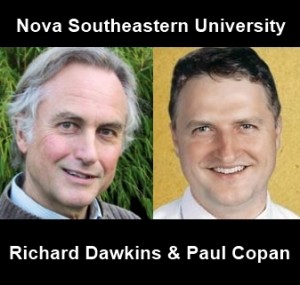
    Richard Dawkins and Paul CopanParchment and Pen, has an audio of a brief exchange between Paul Copan and Richard Dawkins who was speaking in Ft. Lauderdale at Nova Southeastern University on “The Fact of Evolution.” (The following week, Paul Copan spoke on “The Fact of God” at Nova Southeastern and gave a direct response to Dawkins.) This MP3 of Paul Copan and Richard Dawkins’ exchange is from the Q&A of Dawkins’ talk.

    In it Paul alludes to an argument advanced by C S Lewis, Alvin Plantinga, Michael Rea, Victor Reppert and also alluded to by Patrica Churchland, Thomas Nagel, William Whewell and Friedrich Nietzche. The argument is that if our cognitive faculties evolved by natural selection, unguided by God, then our cognitive faculties cannot be rationally relied on to give us truth. The literature on this argument is interesting but I won’t comment on that here.

    What interests me is the comment Dawkins made in the MP3 which got the applause of the audience. Dawkins appears to not grasp the point of the argument and takes it to be asking for a reason why he supports “scientific rationalism”. He said he believes in scientific rationalism because it “works”. He then provided an example of how it “works”, it is that “science flies us to the moon, while religion flies planes into buildings.”

    Much could be said here but I want to limit myself to a single point, the evidence Dawkins cites that science works and religion does not. Dawkins offers that science has done good things such as getting us to the moon; religion has done bad things like destroying the World Trade Centre on 9/11. In other words, the positive things science does commends it as a something we should trust whereas the negative things religious does commends it as some thing which we should not trust.

    So let’s look at the claim Dawkins made that “science” got us to the moon. Now how does a subject, get us to the moon? Presumably what he means is that it was through science that we developed the rocket propulsion technology which enabled us to get to the moon.

    But here is the problem. If the fact that science developed the propulsion technology that got us to the moon means that science is responsible for the flight to the moon, and can take credit for it, then science must be responsible for the flight into the World Trade Centre; science developed the propulsion technology of aeroplanes, hence, it should be science not religion that is blamed.

    Moreover, rockets are used for other things apart from space and air travel (more…)

  • The Sceptic and the Scientist: Ed Feser on Richard Dawkins and PZ Myers

    String TheoryHe is not one to pull punches and true to form, in To a Louse, Ed Feser holds a mirror up to the kind of reasoning that is all too common amongst Dawkins and Myers fans with this fictional dialogue between a scientist and a science sceptic;

    Skeptic: Science is BS. Physicists believe in these things called “quarks,” which are little flavored particles that spin around and work like magic charms. Their evidence is that they read about them in a James Joyce novel. Some of them think the universe is made up of tiny shoelaces tied together, though they admit that they have no evidence for this and have to take it on faith. Einstein said morality is all relative – which is why he stole his ideas from this guy who worked in a patent office, and why Richard Feynman stole atomic secrets during WWII. Meanwhile, the chemists contradict the physicists and believe instead in little colored balls held together by sticks. Biologists believe monkeys can give birth to human beings. What a bunch of crap! It’s child abuse to teach kids about this stuff in schools.

    Scientist: Are you joking? If not, I suggest that you actually read some science before criticizing it.

    Skeptic: I’ve already read a lot about it, in blog comboxes like this one. And why should I waste my time reading anything else? I already know it’s all BS! Didn’t you hear the examples I just gave?

    Scientist: No, you’re missing my point. You’ve completely distorted what scientists actually say. It’s not remotely as silly as you think it is. In fact it’s not silly at all. But you need to actually read the stuff to see that.

    Skeptic: So you deny that physicists believe in quarks? What flavor are your quarks, chocolate or vanilla? Do you deny that they think we came from monkeys? Which monkey was your mother?

    Scientist: No one says that monkeys gave birth to humans. That’s a ridiculous caricature. And of course I don’t deny that physicists believe in quarks, but you’re badly misunderstanding what they mean when they attribute “flavor” to them. They don’t mean that literally…

    Skeptic: Oh so it’s just empty verbiage, then. See, you’re just proving my point for me.

    Scientist: No, it’s not empty verbiage. It’s technical terminology.

    Skeptic: I see, like magic spells. That’s why (more…)

  • An Atheist and a Christian walk into a Bar… Original Sin & the Existential Paradox

    My previous post, William Lane Craig, Original Sin and Original Guilt, touched on the doctrine of original sin. According to the standard western articulation of this doctrine it has three components. First that human beings have a propensity towards doing wrong. Second, this propensity is inherited from our ancestors, it is not that we come into the world perfect and then later abandon perfection. In Edward Oakes’ words in “Original Sin: A Disputation”, “sin after Adam always takes the form of acquiescence and not of origination. We are born, that is, into a world where rebellion against God has already taken place, and the drift of it sweeps us along.” Finally, despite this we are responsible for this propensity in some way.

    As both theologians and philosophers have noted for centuries this doctrine appears paradoxical. How can we be responsible for something we inherit? I agree that there is something of a paradox in the notion of original sin and it is hard to find a coherent way of making sense of it. In this post I will take a different tack; I want to suggest that denying theological doctrines of original sin will not resolve this paradox. The reason: the paradox is in fact a paradox which is part of human existence and human moral experience. Hence, even without a doctrine of original sin, the paradox is still apparent to anyone who reflects on their experience.

    Original Sin

    This was made clear to me in a conversation I had in a bar with an atheist friend. My interlocutor, who had had a staunch Calvinist upbringing, was railing against the Calvinist doctrine of original sin and the apparent contradictions in it. His observations were fairly astute. He noted that on the one hand Calvinist parents instilled personal responsibility in their children and brought them up to accept responsibility and accountability for their actions. This he commended as morally good. At the same time he noted that these same parents believe in original sin. They believed human nature, as it exists today, is corrupt. Humans come into the world with a propensity to evil; their view is that from birth onwards it is inevitable that we will sin, that our hearts are inclined towards evil and so on. He proceeded to argue that if the latter view was correct then the former must be false. The doctrine of original sin undercuts the idea of personal responsibility.

    I listened carefully to my friend’s argument, when he had finished I asked him a question:

    Did he consider himself a moral agent who was responsible for his actions?

    Unsurprisingly, given his recent praise for personal responsibility, he immediately answered yes.

    Then came my second question:

    Have you ever lied? (more…)

  • William Lane Craig, Original Sin and Original Guilt

    A lot of people are up in arms at the moment about a paragraph in William Lane Craig’s answer to Question 193 “Overweening Ignorance.” Facebook, blogs, twitter and message boards are abuzz with Christians angrily attacking Craig with the charge that this paragraph shows he either does not hold to the doctrine of original sin or that he thinks it is not essential to Christianity. Here is what some are saying about the offending paragraph:

    “Craig denies that original sin is essential to the Christian faith.” Steve Hays

    In “Bible-optional Christianity” Hays sets out the offending sentences from the offending paragraph then puts them alongside Romans 5:12 and Corinthians 15:21-22, 45-49 (passages which speak of man’s sinful nature and the need for Christ’s salvation). The conclusion we are supposed to draw is that Craig is denying the truth of these passages and views these as “optional.”

    In “Hollywood Squares” Hays draws a ejusdem generis parallel between Craig’s paragraph and the writings of liberal scholars like Spong, Bultmann and The Archbishop of Canterbury.

    In the comments section of his third post on the paragraph “Rabbit Ears“, where he accuses Craig of making “a V-sign behind God’s head when God is speaking (the rabbit-ear gesture),” Hays writes:

    “Craig doesn’t seem to care what the Bible teaches about original sin. He simply absolves his correspondent of responsibility to believe what the Bible teaches on this subject, regardless.”

    On Facebook Dominic Bnonn Tennant wrote:

    “This is why, contrary to the objections of some, William Lane Craig not the world’s foremost apologist. The first duty of apologetics is to the truth. Not to unbelieving presuppositions. You can’t have good apologetics without good theology.”

    On Hays’ blog Bnonn Tennant wrote:

    “As I think someone has said already, the problem with Craig is that he starts with philosophy and only then worries about theology. That’s ass-backwards.”

    James R White of Alpha & Omega Ministries Apologetics Blog wrote:

    “this is not the first time WLC has made this statement. I have said repeatedly that WLC’s theology is way too hobbled to support biblical Christian theism, which is why he has to produce a much smaller theism to defend. And this is one of the manifestations of starting with philosophy and then crafting a theology to match your philosophical opinions.”

    Jonathan wrote:

    “Some apologists are eager to get people into the “Kingdom” anyway they can.”

    Saint and Sinner wrote:

    “I am so sick of minimalist Christianity”

    Peter Pike wrote:

    “Without Original Sin, there is no basis by which Christ’s blood can be applied to any sinner whatsoever. Craig should know this. He has a responsibility to teach this. I don’t care if ignorant, non-biblical “Christians” don’t hold to it–Craig is held to a higher standard, and his outright ignoring of this doctrine instead of teaching it in a way that someone can understand it simply neuters Christianity.

    You don’t defend Christianity by surrendering”

    William Lane Craig

    Apparently, Craig is not only affirming heresy but is a compromiser who is not committed to the truth, who denies that the existence of universal sinfulness and that the need for salvation is an essential Christian belief.

    This own goal demonstrates not just an alarming inability for many Christians to read in context but also some overweening ignorance about theology (not to mention an alarming lack of charity for the man who is internationally renowned and respected for publicly defending the faith by lay people and the academy alike.)

    Let us take a look at the offending paragraph (more…)

  • The New Zealand Association of Rationalist Humanists and the Privileging of Secularism

    The New Zealand Association of Rationalist Humanists (“NZARH”) has a statement of aspirational ideals for the New Zealand state on their website. Entitled “The Tolerant Secular State” it is anything but.

    The first two sentences of the document exhibit a confusion which is inherent throughout (and commonly found in discussions of church and state):

    Lord Voldemort

    “The NZARH strongly believes that government should be secular; that is dealing with the issues of this world rather than following a religious agenda. Our law should not give one set of beliefs privilege over another and the state should treat religious organisations the same as any other organisation.”

    An equivocation on the meaning of the word “secular” in the very first sentence is immediately apparent.

    Stephen Smith notes that the word secular has two distinct meanings. Etymologically, “secular” refers to things pertaining to this world and life as opposed to the next. In this sense of the word “secular” is not opposed to religion; many religious beliefs and values pertain to life in this world, beliefs about: marriage, sex, human life, killing,  justice for the poor, what one’s duties are in this life, what God’s purposes are in this life and so on are all secular beliefs in this sense. The second and more common meaning of “secular” is to say it excludes, is in opposition to beliefs and values that are religious in nature; this is usually the first definition one will find in a dictionary.

    The NZARH use both meanings in the first sentence of their “Tolerant Secular State” document (more…)

  • “Does the Universe Have a Purpose?” Dawkins, Ridley, Shermer v Craig, Geivett, Wolpe (in English)

    Richard Dawkins, Matt Ridley, Michael Shermer debated William Lane Craig, Douglas Geivett, David Wolpe on the topic “Does the Universe Have a Purpose?” on Mexican television on 13 November 2010. This is the english version:

  • God, Morality and Abhorrent Commands: Part II Robert Adams

    In this three-part series I will look at some different ways of adjudicating conflicts between apparent divine commands and moral beliefs. I started with Immanuel Kant, now I will look at Robert Adams’ position.

    In “God, Morality and Abhorrent Commands: Part I Kant” I mentioned Phillip Quinn’s observation that theists can face a particular dilemma,

    “[I]t seems possible that a theist should have both good reasons for believing that God has commanded him to perform a certain action and good reasons for believing that it would be morally wrong for him to perform that action. Thus a theist can be confronted with moral dilemmas of a peculiar sort.”

    Immanuel Kant argued that when faced with such a dilemma the theist should reject the belief that God has commanded the action and accept the moral belief. This was due to his belief that moral beliefs are more certain that theological beliefs. I contested this claim. More recently Robert Adams has defended Kant’s conclusion. Consider the structure of the kind of dilemma Quinn cites,

    [1] Whatever God commands is morally permissible;

    [2] God commands X;

    [3] It is wrong to do X.

    These three claims contradict each other; like Kant, Adams suggests that the rational person should reject [2]. However, his reasons are somewhat different. Adams persuasively reasons that [1] is true only if God is understood as perfectly good, in the sense of being loving, just and so on. If God were evil or morally indifferent then it would be possible for him to command wrongdoing and so [1] would be false.  This means that a person who accepts [1] must presuppose that God is good.

    Adams argues that God cannot be meaningfully said to be good if what he commands drastically departs  from what we consider to be right and wrong. Human beings have some grasp of what constitutes goodness and some grasp of what constitutes right and wrong and it is part of our concept of what is good that a good being does not command wrong doing. Moreover, to call a being good is to attribute to it a character trait that is incompatible with certain other actions, attitudes and so on. Raymond Bradley made the point succinctly in his debate with William Lane Craig “Can a Loving God Send People to Hell?“

    “If we were to describe someone such as Hitler as perfectly good despite all his evil doings, we’d be playing word games which are intellectually dishonest as they are morally pernicious. … it would be to deprive the word “holy” of its ordinary meaning and make it a synonym for “evil.”

    This supports Adams’ conclusion that one cannot rationally accept [1] as one implicitly assumes that God does not issue commands at variance with our conception of morality. In Finite and Infinite Goods: A Framework for Ethics he concludes,

    “Our existing moral beliefs are bound in practise, and I think, ought in principle, to be a constraint on our beliefs about what God commands. We simply will not and should not, accept a theological ethics that ascribes to God a set of commands that is too much at variance with the ethical outlook we bring to our ethical thinking.” [Emphasis original]

    As with Kant there is a lot of truth to this; however, Adams’ position has certain limits.  As critics of Adams have pointed out his conclusion is limited. In the paragraph above Adams concludes that “our existing moral beliefs” must be a constraint on our beliefs about what God commands. His justification for this is that we “should not, accept a theological ethics that ascribes to God a set of commands that is too much at variance with the ethical outlook we bring to our ethical thinking.” The phrase “too much” suggests that one can accept ascription of a set of commands that is somewhat at odds with the outlook we bring to our ethical thinking.

    Two points Adams makes elsewhere in Finite and Infinite Goods suggest that this limitation on his conclusion is necessary. First, while we do have some grasp of what is good and some grasp of what is right and wrong it is evident that our moral judgements are fallible. Adams calls this the “transcendence” of the good. He states,

    “All of God’s commands and judgments are right; God is the ethical standard. But our beliefs (even the most cherished) about them must be distinguished from God’s commands and judgments themselves. To fail to make that distinction is idolatry.”

    Adams is surely correct here. While God does not command wrongdoing. It is quite likely that a perfectly good omniscient being would command something contrary to what we think is wrong.  Our moral intuitions are fallible, hence it is possible that some of God’s commands would clash with our own moral judgements. In fact to suggest that God would never command something which we consider to be wrong expresses an incredible hubris. It is to dogmatically assume that we are such good judges of morality that God could never disagree with us. It is to put our own moral judgements beyond question. The existence of some commands that strike us as strange or immoral does not count for much.

    Second, our concept of goodness and our judgement about particular cases can be and sometimes is subject to revision. We change our opinions about the goodness and rightness of certain things without “playing word games which are intellectually dishonest” or depriving “the word ‘holy’ of its ordinary meaning and make it a synonym for ‘evil.’”  If this were not the case, one could never honestly or rationally change ones mind on an ethical issue. Nor could people coherently disagree with or persuade one another about moral issues. Adams’ notes this when he writes that he accepts “the possibility of a conversion in which one’s whole ethical outlook is revolutionized, and reorganized around a new center” but “we can hardly hold open the possibility of anything too closely approaching a revolution in which, so to speak, good and evil would trade places”.

    These points, however, quite evidently limit Adams’ conclusion. What his argument, in fact, shows is not that “our existing moral beliefs must serve as a constraint on our beliefs about what God commands” but rather that certain types of our existing beliefs do this, those so central to our concept of goodness that accepting them would be “approaching a revolution in which, so to speak, good and evil would trade places.” In “A Psychological Constraint on Obedience to God’s Commands: The Reasonableness of Obeying the Abhorrently Evil” James Rissler notes,

    “In such an instance, obedience requires that one give up everything one previously believed about morality… one has been commanded to relinquish everything one understands about the nature of goodness, one will have no concept of the good with which to identify Gods command, there will be complete breakdown of between everything one currently affirms about goodness and everything one is asked to believe about goodness.”

    Rissler gives two examples; the first is where God issues a command to reverse one’s conception of right and wrong or issues a set of commands, each one of which negates every moral imperative one currently accepts. Second, he suggests that a moral belief might be “sufficiently integral to one’s conception of morality” that abandoning it would force such a radical revision as to destroy one’s concept of goodness all together. Imagine a command to kill everyone around you purely for entertainment or a command that said harming, hurting and inflicting suffering on people for no reason at all is permissible. Consider a command to hate God and despise all other human beings. One cannot accept a system of divine commands where every duty we believe in is declared false nor can we accept a system which suggests that the vast majority of our moral beliefs are mistaken. This would come too close to the problematic revolution Adams talks of.

    To sum up, in Part I and II, I have looked at the Kantian approach to the kind of dilemma Quinn sketches. Neither Kant or Adams, I think, establish the claim that in “our existing moral beliefs must serve as a constraint on our beliefs about what God commands.” They did, however, lend support for a weaker thesis. Kant’s argument, for example, does suggest that those moral claims about which we are certain, should serve as such a constraint and I mentioned several beliefs which I consider to be fairly certain as examples.

    Adams’ argument on the other hand suggests that we cannot coherently “accept a theological ethics that ascribes to God a set of commands that is too much at variance with the ethical outlook we bring to our ethical thinking.” He argues that we cannot coherently or defensibly accept a theological ethics which, in effect, makes good and evil trade places and which so radically transforms our concept of goodness so that good becomes a synonym for what we call evil or calls our concept of goodness so radically into question that it breaks down. Certain beliefs such as it is prima facie wrong to inflict pain and suffering on others or it is prima facie wrong to treat others with contempt” or it is prima facie wrong to lie, steal and kill are so central to our account of goodness that we cannot coherently accept that a perfectly good being has issued commands that negate them.

    In my next post I will look at Philip Quinn’s alternative.

    RELATED POST:
    God, Morality and Abhorrent Commands: Part I Kant
    God, Morality and Abhorrent Commands: Part III Philip Quinn