Category: Theologians

  • A Godless Public Square: Do ‘Private’ Christian Beliefs Have a Place in Public Life? @ Auckland Uni

    Mon 1- Friday 5 August marks Jesus Week. A number of events will be held on the University of Auckland campus of which we are part of including this one brought to you by the Evangelical Union and Thinking Matters:

    Godless Public Square

    A Godless Public Square:

    Do ‘Private’ Christian Beliefs Have a Place in Public Life?

    A Jesus Week Panel Discussion
    7-9pm Wednesday 3 August
    Lib B28 (Library Basement) University of Auckland

    Christian theological convictions ought to impact the whole of life both in the private and public spheres; this is what the idea of an “undivided life” means, Jesus is Lord of all aspects of our lives.

    Yet this consequence of Christian faith conflicts with a pervasive contemporary attitude: the view that that religion is fundamentally a private matter. It is accepted that a Christian is free to utilise theological convictions when they make decisions about their own life but in a pluralistic society it is increasingly deemed inappropriate to bring such convictions into public discussions about morality, law, politics, economics, education, scholarship and so on. The desire to influence society with Christian ideals or to convert others to the faith is viewed by many as an intolerant desire to impose one’s private views onto others.

    It is widely accepted that theological convictions can govern churches and the private lives of believers yet we are told that the public square – government, public policy, the courts, the academy, education, business, arts, media, etc – should be secular only.

    This event looks at this issue. The conversation will span Theology, Philosophy and Law led by a panel made up of Christian representatives from each discipline along with you the audience.

    Up for discussion are issues like:

    – Is it wrong for Christians to impose their ‘private’ religious beliefs onto others?
    – Is secularism the neutral perspective it is claimed to be?
    – Are public expressions of religion regulated by law?

    Bring your own questions and ask them at the Q & A session.

    This is a free event open to the public, which will be lay friendly – a university degree is not necessary in order for you to attend!

    Panel:

    Moderator:

    RSVP on Facebook here (or just turn up with your friends)

  • Stark Wars

    Darth VaderThom Stark has written a lengthy response (304 pages!) to Paul Copan’s book Is God a Moral Monster? which he has published on his blog, Religion at the Margins; it is entitled Is God a Moral. Compromiser? A Critical Review of Paul Copan’s. “Is God a Moral Monster?” In it, alongside his criticisms of Copan, Stark makes several criticisms of the work of Richard Hess and Matt.

    Matt has not yet had time to read Stark’s book-length review, much less respond to it, but Copan and Hess have. Copan has published the following blog posts on his blog, Parchment and Pen:

    Is God a Moral Monster Revisited: Preliminary Replies to Thom Stark

    Richard Hess’s Response to Thom Stark

    Matthew Flannagan’s Interactions with Thom Stark

    Stark has responded to these posts with:

    Copan and Company, Part 1: A Brief Introduction

    Copan and Company, Part 2: Response to Matt Flannagan

    Copan and Company, Part 3: Response to Paul Copan

    Copan and Company, Part 4: Response to Richard Hess

    Other blogs have chimed in:

    Thom Stark’s Sweeping Claims by Christopher Copan Scott

    Reflections on the Thom Stark-Paul Copan debate by Randal Rauser

    Matt has on his ‘to do’ list an intention to wade through Stark’s review and write a response, at the very least, to the parts that critique his work. He also intends to answer Stark’s questions put to him on this blog post. However, Matt has several publication, conference and marking commitments to meet first and Matt simply cannot churn material out at the prolific rate Stark can.

    RELATED POSTS:
    Thom Stark on Wolterstorff and Hagiographic Hyperbole
    Is God a Moral Monster? A Review of Paul Copan’s Book
    God and the Genocide of the Canaanites Part I: Wolterstorff’s Argument for the Hagiographic Hyperbolic Interpretation
    God and the Genocide of the Canaanites Part II: Ancient Near Eastern Conquest Accounts
    God and the Genocide of the Canaanites Part III: Two Implications of the Hagiographic Hyperbolic Account

  • Hear Iain Provan on Why Should we Read the Old Testament, and How?

    Compass Foundation and Regent College are hosting Iain Provan at an event in Auckland next month entitled ‘Why Should we Read the Old Testament, and How?’ Here is the info from their blurb:

    Iain ProvanWhy read the Old Testament? What relevance could this old collection of books have for us today? And how should we read it? How do we approach this text from a very different time and culture?

    Iain will be exploring these questions, drawing on his many years of teaching, study and wrestling with these ancient texts. He will give special attention to the book of Jonah as an example of why we should read the Old Testament and how we should do it.

    When: Monday 4 July, 7pm to 9pm
    Where: Greenlane Christian Centre, 17 Marewa Road, Greenlane, Auckland

    Iain Provan is Marshall Sheppard Professor of Biblical Studies at Regent College, Vancouver, Canada. He is an accomplished Biblical scholar, writer of numerous books and articles, including commentaries on Lamentations, 1 and 2 Kings, Ecclesiastes and Song of Songs, as well as co-author of A Biblical History of Israel. Iain is an ordained minister of the Church of Scotland and was born and educated in the UK. He has taught at universities in England, Wales, Scotland, and most recently Canada.

    More info on how to rsvp for catering purposes @ Compass or on Facebook. To see Iain Provan’s other New Zealand events see his upcoming speaking engagements page.

  • Transcript: Sam Harris v William Lane Craig Debate “Is the Foundation of Morality Natural or Supernatural?” UPDATED

    William Lane Craig v Sam HarrisSam Harris and William Lane Craig debated the moot “Is the Foundation of Morality Natural or Supernatural?” at the University of Notre Dame on 7 April 2011. We’ve already linked to the debate MP3 and a playlist of the video and we have published a two part review but now, as an MandM exclusive, we bring you the transcript.

    This transcript is the result of some 32 playbacks of the debate and is accurate down to the “uhs” and “oks”.

    UPDATE:
    Since publishing this transcript, William Lane Craig has emailed us and asked us to adjust the paragraph breaks and punctuation in his sections of the transcript in accord with where he placed them — something he conceded was very hard to get right when one is transcribing from audio. He also provided us with the footnotes for his sources which we have also included below.

    If Sam Harris wishes us to adjust his sections of this transcript in the same manner we are very happy to do so.

    – Madeleine

    Transcript of the Harris v Craig debate

    MODERATOR:

    Welcome to the second installment of “The God Debate”. My name is Michael Rea. I’m a professor of philosophy here at the University of Notre Dame, and the director of the Center for Philosophy of Religion, one of the sponsors of tonight’s event. The Center for Philosophy of Religion was founded in the late 1970s with the aim of promoting cutting-edge research on topics in the philosophy of religion, and in distinctively Christian philosophy. One of our goals in sponsoring the “God Debate” series is to try to bring some of the very issues discussed among our research fellows to a wider, non-academic audience, and in a format that will hopefully be fun and engaging.

    Our show tonight, as you already know, is a debate between William Lane Craig and Sam Harris, coming together for the very first time to discuss the question, “Are the foundations of moral values natural or supernatural?”

    William Lane Craig is Research Professor of Philosophy at Talbot School of Theology in La Mirada, California. He is best-known among philosophers for his extensive and influential work in the philosophy of time and the philosophy of religion. He is known to the wider public as someone who is able to articulate and defend the doctrines of the Christian faith in a way that is highly accessible but also philosophically and theologically rigorous. He became a Christian at the age of 16, pursued undergraduate studies at Wheaton College, and holds two earned doctorates: one in philosophy from the University of Birmingham, and one in theology from the University of Munich. He has authored or edited over 30 books, as well as over a hundred articles in professional journals of philosophy and theology.

    Known as one of the “Four Horsemen” of the New Atheist movement, Sam Harris is the author of the New York Times best sellers: The Moral Landscape, The End of Faith, and Letter to a Christian Nation. The End of Faith won the 2005 Pen Award for non-fiction. Mr. Harris’s writing has been published in over 15 languages. He and his work have been discussed in Newsweek, Time, The New York Times, Scientific American, Nature, Rolling Stone, and many other journals. His writing has appeared in Newsweek, The New York Times, The Los Angeles Times, The Economist, The Times London, The Boston Globe, The Atlantic, the Annals of Neurology, and elsewhere. Mr. Harris is a co-founder and CEO of Project Reason, a non-profit foundation devoted to spreading scientific knowledge and secular values in society. He received a degree in philosophy from Stanford University, and a PhD in neuroscience from UCLA.

    The structure of tonight’s debate will be as follows: Each debater will take 20 minutes for his opening speech, followed by rebuttals of 12 minutes and 8 minutes respectively, and then closing speeches of 5 minutes each. At the conclusion of the debate, we will have about 30 minutes for questions from the audience. If you would like to ask a question, line up behind one of the two microphones in front, or in the balcony. We’re letting Notre Dame students ask the first four questions tonight, so if you are not a Notre Dame student, and somehow find yourself at the front of the Q&A line, please allow a student to go ahead of you.

    Time will be kept strictly. There is a timekeeper in the front who can be seen by both speakers, and once each speaker’s time has elapsed, he will be given at most 15 seconds to finish his final sentence before being rudely interrupted by me, the time enforcer. Because we are keeping the time strict, we ask you to hold all applause and other indications of agreement or disagreement, cheering, crowd-surfing, and the like, until the very end of the debate. Please remember that flash photography, video taping, and active cell phones are all prohibited.

    Finally, remember that Notre Dame is the world’s number one institution in the philosophy of religion, and also has one of the world’s best theology departments. Any questions you don’t get to ask during the 25 or 30 minute Q&A, you can ask of your local faculty in the days and weeks to come. And now, on with the show.

    CRAIG:

    Well, good evening. It’s wonderful to be here at the University of Notre Dame, and I want to begin by

    MODERATOR:

    Bill

    CRAIG:

    thank—

    MODERATOR:

    Sorry.

    CRAIG:

    Sorry.

    MODERATOR:

    I need to—We’re gonna begin each speech with me checking with the timekeeper to make sure that he’s ready, and then the timekeeper is gonna hit “Go”, and then you get to go—

    CRAIG:

    Alright.

    MODERATOR:

    So, so you go—

    CRAIG:

    Sorry—

    MODERATOR:

    —when I say “Begin”.

    CRAIG:

    Sorry for jumping the gun.

    MODERATOR:

    Professor Craig gets, uh, gets the first word in the debate, uh, Dr. Harris gets the last word. Timekeeper, are you ready? This is 20 minutes. Begin.

    CRAIG:

    I want to begin by (more…)

  • Contra Mundum: Stoning Adulterers

    Back in 2005 there was a minor furore when Labour MP Ashraf Choudhary stated he agreed with the Koran’s teaching that people who engaged in homosexual conduct or who committed adultery should be stoned to death. In the media spiral that followed, some commentators pointed out that it was not just Islam that held this view; Christians are committed to the same conclusion. Consider Deuteronomy 22:22 “If a man is found sleeping with another man’s wife, both the man who slept with her and the woman must die. You must purge the evil from Israel” or Leviticus 20:10 “If a man commits adultery with another man’s wife—with the wife of his neighbour—both the adulterer and the adulteress are to be put to death. Often passages like this motivate a rhetorical question “why don’t Christians today stone to death women who commit adultery? After all, this is what the Bible commands isn’t it?”

    Ten Commandments

    I’ll make two points in response to this. First, those who press this line of argument assume that these commands are addressed to contemporary Christians. This is a dubious assumption; the laws occur as part of a covenant or vassal treaty between the tribes of Israel and God. While some of the laws expounded in this treaty reflect rules of justice and equity applicable to all people, Gentiles were not parties to this treaty nor were gentile Christians required to be – something the New Testament spends a lot of time elaborating on.

    Second, and this will be my main focus, this line of argument assumes that these apparent laws function like modern statute law; the assumption is that they are literal and binding commands to kill people who had committed certain crimes. It is also assumed that the author of these laws expected them to be carried out. Interestingly, it is precisely this assumption which many scholars of these laws have questioned. Here I will spell out some reasons why they do so.

    Comparisons between Leviticus and Deuteronomy and other ancient Near Eastern (“ANE”) law codes suggest they are the same genre. One feature of such codes is seemingly harsh penalties. In old Babylonian law, the hand that assaults was severed; a man who kissed another’s wife was to have his lips cut off; a person who stole bees was to be stung by bees; a man who raped another’s wife would be sentenced to having his own wife or daughter raped; a negligent builder whose house collapsed and killed another’s son would be sentenced to having his own son killed, and so on.

    ANE expert Raymond Westbrook notes that these prescribed punishments are both inconsistent with the actual legal practice known to have occurred in these cultures and are often inconsistent with themselves. He notes, “some law codes impose physical punishments and others payments for the same offenses, while some codes have a mixture of the two.” The contradiction is only apparent because, “in highlighting one or the other alternative, the codes are making a statement as to their view of the gravity of the offence.” He argues that the laws “reflect the scribal compilers’ concern for perfect symmetry and delicious irony rather than the pragmatic experience of the law courts.” Westbrook concludes that the method used in ANE legal texts was “to set out principles by the use of often extreme examples.”

    A similar point is made by Old Testament scholar John Goldingay who suggests that many of these laws “were not intended to be enforced” but rather were “promulgated to indicate the moral and social priorities of the law giver.” They functioned to express certain ideals of behaviour, to denounce actions like adultery as really bad and intolerable rather than to define precise penalties for these actions.

    Westbrook points to the practice of (more…)

  • Thom Stark on Wolterstorff and Hagiographic Hyperbole

    Earlier this year I finished a forthcoming article in which I defended Nicholas Wolterstorff’s take on the Canaanite massacre recorded in the book of Joshua. Wolterstorff argues that the Book of Joshua is a highly figurative, hagiographic and hyperbolic account of Israel’s early skirmishes and it is not intended to be taken literally in its details.[1] The accounts of killing everything that breathes function something like the boast of a high school student who describes winning a football game in terms of totally slaughtering the opposition.[2]

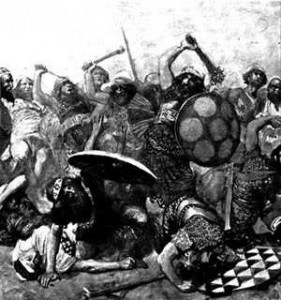
    Joshua Slaughters the CanaanitesMy article was a revised version of a paper I presented in Atlanta in November last year (my God and the Genocide of the Canaanites series gives a good overview of my position). Around the same time I presented this paper, Thom Stark, posted a critical review of Douglas S. Earl’s book The Joshua Delusion? Rethinking Genocide in the Bible. As a review, much of it was addressed to the specifics of Earl’s book. However, in the introduction Stark offered a critique of Wolterstorff’s position and made reference to my defence of it.

    He offered three lines of argument; two against the conclusion Wolterstorff and I offered and one against Wolterstorff’s argument itself. Since then several people have asked me my thoughts on his critique. In this post I will look at his critique of Wolterstorff’s argument, which I defended and adapted in my article.

    Before one can criticise an argument it is important to be clear as to what it is. As I note in my forthcoming article (and in the post I linked to above) Wolterstorff’s argument consists of three points and a basic assumption. The assumption is that “Joshua as we have it today was intended as a component in the larger sequence consisting of Deuteronomy, Joshua, Judges, I and II Samuel, and I and II Kings”.[3] On the basis of this assumption Wolterstorff contends “…  I propose that we interpret the Book of Joshua as a component within this larger sequence – in particular, that we interpret it as preceded by Deuteronomy and succeeded by Judges.”[4] In taking this approach, Wolterstorff engages in a more canonical approach to the text; he focuses on the meaning of the final form as part of a canonical sequence.

    The three premises are as follows. First, the so called genocide accounts in Joshua 1-11 are part of a broader context which includes both the rest of Joshua but also other canonical books, such as the book of Judges. When one reads the whole sequence one observes that while early passages in Joshua describe Israel exterminating the inhabitants, later passages in Joshua and Judges proceed on the assumption this never literally happened.[5] Taken literally these accounts of the conquest contradict each other (more…)

  • Is God a Moral Monster? A Review of Paul Copan’s Book

    On 11 September 2001 Islamic terrorists flew two planes into the World Trade Centre, killing thousands of innocent people. Ostensibly they did this because they believed God commanded them to do so. This event has reinvigorated a fear that has been latent in Western psyche since the 17th century when religious wars tore Europe apart. The fear of religious fanaticism, of people willing to murder hundreds in the name of God, has been whipped up by the new atheists–Richard Dawkins, Sam Harris, Christopher Hitchens, et al.

    The phenomenon is not just limited to the popular atheological literature. These fears went centre stage recently at a conference entitled “My Ways Are Not Your Ways” which was put on by the Centre for Philosophy of Religion at the University of Notre Dame. Sceptics presenting at the conference argued passionately that the God of the Bible issues commands which are at odds with modern understandings of morality; adultery is punished with death, God is portrayed as commanding the killing of non-combatants in “holy wars” against the Canaanites, God commanded Abraham to sacrifice his son, the Bible appears to approve of slavery and polygamy, and so forth.

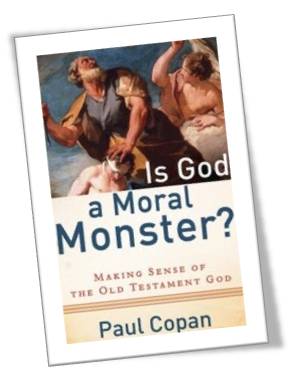
    Is God a Moral Monster?In Is God a Moral Monster? Paul Copan attempts to address some of these concerns. What’s novel about Copan’s approach is that, unlike many standard philosophical responses to the above problems, Copan draws on recent conservative Old Testament scholarship by people like Gordon Wenham, Tremper Longman, Christopher Wright, Walter Kaiser, Richard Hess and numerous others. This is novel as much of what has been going on in evangelical discussions of Old Testament ethics for decades has been done almost in isolation from contemporary philosophy of religion and vice versa. Copan, who has degrees both in Philosophy and in Biblical Studies, brings this material together in an accessible manner.

    There is no point in hiding the fact that I am a fan of Copan’s book. In a few places Copan cites my own writings as sources of ideas and in other places the overlap with my own thoughts on these issues is considerable. I have recommended it to my son who intends to read it as soon as he has finished William Lane Craig’s On Guard. However, this review will not simply be an exercise in cheer-leading; I will attempt to both summarise Copan’s work and add critical comments.

    The Review
    Is God a Moral Monster? opens with a discussion on the new atheism in general. In chapters 3 and 4 Copan addresses the charge that God in the Old-Testament is both jealous and egocentrically demands worship. Then in chapter 5 he turns to the binding of Isaac. I will touch briefly on this (more…)