Category: Theologians

  • Tom Wright on Hypocrisy: Catholic Church Sex Scandals, the Media and Jimmy Savile

    N T Wright, theologian and research professor at St Andrews University, tells the British media a few home truths about  hypocrisy and faux moral outrage.

    I listened in disbelief as John Humphrys interviewed Cardinal Cormac Murphy-O’Connor on Radio 4’s Today programme this week. Surely, he said, like a headmaster addressing an errant teenager, if highly placed people knew about the behaviour of Cardinal Keith O’Brien, somebody in authority should have done something rather than covering it up? I waited for the former archbishop of Westminster, who sounded weary of the whole thing, to come up with any of the phrases that might have stopped the interview in its tracks: “Jimmy Savile”; “BBC”; “people in glass houses”. Perhaps he was too polite. So Humphrys pressed on: the church claims it can tell people how to behave, so surely it has to live up to those standards itself?

    The joke here is that it is usually the media that tell people how to behave. Yes, the church sometimes “speaks out”. But if it’s moralising you want, turn on the radio. Or pick up a newspaper. And the institution the media especially love to attack is of course the church. There is a logic to this. The media want to be the guardians of public morality, but some people still see the church that way. Very well, it must be pulled down from its perch to make way for its secular successor.

    Don’t be fooled when “religious affairs correspondents” look prim and solemn and shake their heads at the latest clerical scandal. They are enjoying every minute of it. It keeps them in a job (did anyone imagine that the real “religious affairs” of this country, the prayerful and self-sacrificial work that goes on under the radar every day of every year, would ever make headlines?). More: it makes it easier to sustain the fiction that the journalists have taken over as the nation’s moral police.

    Until there’s another scandal – in the media themselves. Savile at the BBC. Phone hacking at the News of the World. Try suggesting that these were isolated, maverick one-off lapses, and listen to the hollow laughter echoing round the country. The church has rightly been attacked for hypocrisy. But is nobody else guilty? If the church is hypocritical about sex, the media are hypocritical about hypocrisy.

    The whole article in the Guardian is well worth reading. Wright goes on to  make some astute points about virtue, moral failure, morality and hypocrisy.

  • Contra Mundum: Dawkins and Secular Hypocrisy

    Richard DawkinsWhen I was a non-Christian I was forever hearing about how Christians are hypocrites. When I converted to Christianity at 17, one thing that struck me is how often these charges were often a case of the pot calling the kettle black. While there is undoubtedly some hypocrisy within the church, it is also pervasive outside it. Secular culture often contains absurd ironies and hypocrisy which are conveniently ignored.

    A great example was the media fiasco over William Lane Craig’s visit to the United Kingdom last year. Craig is distinguished philosopher known professionally for his work in philosophy of time and philosophy of religion. Alongside his scholarly work, he has also developed a reputation as a prolific public speaker and debater, debating many of the world’s leading sceptics. His combination of scholarly ability and effective debating skills has earned him a reputation as one of the world’s foremost Christian apologists.

    “Apparently, having two PhD’s, authoring over 100 papers, and writing 30 books on a topic makes you unqualified to speak on it, but being the star of the 80’s TV series “Growing Pains” does.”

    Craig’s visit to the UK attracted media attention when Richard Dawkins, author of the best selling “God Delusion”, publically and resolutely refused to debate him. Dawkins publically stated earlier of his critics that “he did not care” who they were, he would “dialogue” with them and “win the argument”. He also had publically debated numerous critics significantly less qualified than Craig, notably Ted Haggard. These facts, alongside Dawkins implausible and inconsistent reasons lead to accusations of cowardice and hypocrisy from other academics such as Daniel Came a philosophy professor at St Hugh’s College Oxford.

    In the UK newspaper the Guardian Dawkin’s gave two reasons for his refusal. According to Dawkins, Craig “parades himself as a philosopher, but none of the professors of philosophy whom I consulted had heard his name”. Dawkins omitted to mention that this was not the first time he had publicly denigrated Craig’s scholarly credentials. On a previous occasion  Daniel Came,  had e-mailed him stating:

    “Professor Craig has a PhD in philosophy and a PhD in theology. He is Research Professor in Philosophy at Talbot University. He has published more than thirty books and over a hundred papers in reputable peer-reviewed journal. Given your passionate and unconditional commitment to truth, I can only think that you were not aware of Professor Craig’s credentials when you made the above reference.”

    So Dawkins claim that no philosopher he had consulted had ever heard of Craig was less than honest. A less charitable person might describe this as simply slander.

    Dawkins concern about Craig’s alleged lack of scholarly credentials also seems odd seeing that he (Dawkins) had earlier accepted an invitation to debate actor Kirk Cameron.  Apparently, having two PhD’s, authoring over 100 papers, and writing 30 books on a topic makes you unqualified to speak on it but being the star of the 80’s TV series “Growing Pains” does qualify you. It’s also ironic that Dawkins would accuse Craig of lacking scholarly credentials on the matter given that he (Dawkins) is a biologist and not a philosopher of religion.

    Dawkins next excuse was that Craig is “morally unfit” to debate him.  To substantiate this he cites not from any of Craig’s scholarly writings. But two blog posts Craig had written on with the conquest of Canaan. At face value  the early chapters of the book of Joshua portrays God as commanding the killing of every man women and child in Canaan. I say “appears”, here because latter sections of the book of Joshua and its sequel in judges proceed on the assumption this never occurred, and studies into ancient conquest accounts of this genre have noted the widespread use of literary hyperbole whereby victories are described in sweeping rhetoric of killing absolutely everyone when in reality they were (more…)

  • Jesus, Hot Cross Buns, Easter Eggs, Ishtar and Constantine: Is Easter Pagan? Tim McGrew says No!

    Easter can be annoying.  My kids all want chocolate, this year the hot cross buns sold out and Matt brought crumpets home from the supermarket instead. People who don’t normally have any time for Christianity suddenly feel they must go to church, whilst some of my Christian friends refuse to let their children eat chocolate because Easter is a pagan festival. Navigating it does my head in sometimes.

    Easter

    In the past week we’ve had people phone, email, text and raise in conversation that Easter was invented by Constantine, that the bunnies and the buns are pagan and thus consuming them is an offence against God. We’ve heard that the dates are wrong and that Easter dates do not coincide with Passover, that it is a Roman festival, while others say that Easter is tied up with Ishtar. This wasn’t limited to people coming to us; Matt was on the Pat Brittenden Mornings Panel earlier in the week and because of that we heard that talkback radio was full of this too. So, it was very cool that Matt and I were able to have a word with the producers at Radio Rhema after the Panel, and put them in touch with Dr Tim McGrew whose interview as to Whether Easter is Pagan aired on Tuesday – click the link to listen.

    Tim is a good friend, a world renowned scholar whose expertise on miracles and particularly the historical accuracy of the resurrection qualifies him as an authority on some of these Easter-is-pagan claims. While he does not touch on all of the above in the interview he debunks a lot of it.

    Normally Matt and I try to do a Passover-ish meal – we do lamb, rosemary and red wine – and the kids all get to choose a king size block of chocolate each (they reason they get more chocolate for the money than buying Easter Eggs) and I try to ensure indulgement in a decent hot cross bun. Throughout the weekend we focus on Christ, his death and resurrection. We read relevant passages, we have conversations about the Passover and the fact that Christ is the fulfillment of it, in years gone by when the kids were younger we’ve made Easter story cookies. Basically we enjoy the food, the public holiday and we weave learning opportunities and ways to focus on Christ in as we go so that the thrust of Easter is on him.

    We are not worried about taking this approach because Christ conquered all and our focus and heart and intent is on him. Don’t get me wrong, it is important to pause and check that one is not engaging in Paganism but just because something at some point had something to do with Paganism does not mean it is Paganism presently. Tree worship is common among Pagans so must we eschew wood? What about Pythagorus’ theorem? If Easter was just Ishtar worship then we would not be celebrating it; how many of us wanting the spiritual side of Easter are heading to the local Ishtar temple this weekend? As for Constantine inventing Easter, direct evidence for Easter being celebrated by Christians can be identified in the 2nd century, some couple of hundred years prior to Constantine – Wikipedia can tell you that much.

  • More Mistakes: A Rejoinder to Randal Rauser

    For those who aren’t aware, there has been something of a “debate”, but what I’d prefer to refer to as an “in house discussion” between Randal Rauser (Professor of Historical Theology at Taylor Seminary) and myself.

    The discussion so far can be found here:

    My initial article was Randal Rauser’s Mistake: A Defense of Calvin’s Doctrine of Election

    Rauser’s response: Calvinism and the Arbitrary Camp Director Revisited: A Response to Andrew

    Andrew and CalvinBefore I begin, I should point out that I have been on the Kapiti coast for the last week at a TSCF (Tertiary Student Christian Fellowship, a cousin of Inter-Varsity) retreat where I was without internet. Hence it’s only in the last day that I’ve learned that Professor Rauser has kindly taken the time to respond to my initial article. So I apologize for my delayed response.

    I would also like to point out that while my intention was to provoke Rauser’s response, it was not to be rude, and I apologize if that’s the impression he has received. I have a great deal of respect for Rauser, particularly given (as I pointed out in my last article) that he is a Professor of Historical Theology with an obvious background in analytic philosophy, while I am a mere undergrad with far more ambition than actual ability. The last thing that I want is for this discussion to devolve into the kind of vitriol that plagues almost all other web based discussions of the philosophy of religion and/or theology. I say this, largely because I fear (from the tone of his response) that he has received the impression of ill intent on my part.

    Secondly, I appreciate that Rauser took the time to respond to my article, and I appreciate that he also took the time to counter my personal testimony with that of his own.

    Randal Rauser and ArminiusBut now to specifics: How does Rauser respond to my claim that the arbitrariness objection (at least if it is to be an objection) begs the question against Calvin’s doctrine of election? On the face of it, he doesn’t seem to challenge my point that God may not be acting unjustly if we are undeserving of salvation. To the contrary, Rauser seems to admit for the possibility that the tortures may be justly deserved. But if that’s the case, then, as I tried to point out in my first post, there’s no real injustice or immoral state of affairs that obtains if God so desires to instantiate those punishments. Paradoxically though, Rauser refers to my theology as “brutal” and “morally incoherent”. Both of these terms, emotionally provocative as they are, seem to suggest that there is something nasty, horrible, evil (whatever negative adjective your heart desires) about a God that selects some for salvation while selecting others for damnation. But if, as Rauser seems to allow, the tortures are justly deserved, then none of those adjectives can rightly be said to stick. After all, if the tortures are justly deserved, and God decides to carry out those tortures, then God can only be said to be doing what the demands of morality and/or justice require. So wherein does the moral incoherence obtain?

    But according to Rauser, I would still be missing the point. After all, he (Rauser) says, the Camp Director Analogy was not intended to show that God, given Calvinism, is “unjust”, but rather that He cannot be seen as “maximally loving”. I see no real reason to deny Rauser the liberty to make this distinction, but its relevance is, at best, unclear.

    Thankfully, Rauser does seem to hint at one possible way in which we could interpret this as an objection. He seems to engage in something of a pair-wise comparison between two possible scenarios that are supposed to be relevantly similar to the Arminian and Calvinist conceptions of election respectively.

    • Scenario 1: The director arbitrarily selects some children for beatings and others for loving rehabilitation.
    • Scenario 2: The director selects all children for loving rehabilitation.

    According to Rauser, were God to bring about scenario 2, we would state that He is more loving were he to bring about scenario 1. There are three things that I have to say to this (more…)

  • Randal Rauser’s Mistake: A Defense of Calvin’s Doctrine of Election

    John CalvinThanks go to Matthew Flannagan for pointing me in the direction of this response to the problem.

    A while back Professor Randal Rauser issued a blog entitled “Calvinism and the Arbitrary Camp Director” in which he criticised the Calvinist understanding of election.

    For those of you who are unaware of the Calvinistic understanding of election, very roughly, it’s the idea is that God elected some for salvation and did not elect others for salvation. Now obviously there’s FAR more to Calvin’s doctrine of election than merely the claim that some are elected and others are not. But that at least, is the centre point of Rauser’s criticism, and more particularly, it’s that element of Calvin’s doctrine that I seek to defend in this article.

    Before we begin, it’s interesting to note that barely three months ago I was a staunch Arminian when it came to soteriology. I reacted against Calvin’s doctrine with the greatest of revulsion. How could it possibly be, I thought, that God could be “good” and yet actively choose some for salvation while leaving others to die?! It made no sense to me! In-fact, I remember going to scripture one Sunday morning actively seeking to find that knock down scriptural blow against the Reformed understanding of election. Interestingly, the first scripture I read was the parable of the wheat and the tares Matthew 13:24-29/13:36-43. While I read it, it struck me that this challenged my Arminian understanding of Salvation. But I didn’t want to believe it, so I left it for a week hoping that there would be some other explanation. But none was forthcoming. Very quickly I found myself speaking in terms that a week earlier I would never have been revolted to hear myself say. I was not yet a practicing Calvinist. I was what you might call “soteriologically agnostic”.

    Now the reason I say this is not because I hope to establish myself as any authority on the matter. To the contrary, Rauser, being a Professor of Historical Theology at Taylor Seminary is far more of an authority on the matter than I can hope to be at this stage of my life. So it’s with much fear and trepidation that I dare post this article contradicting Rauser’s arguments. So why do I give my testimony of how I came to Calvinism? Well I myself am a little unsure. Nevertheless, I suspect that the main reason I give such testimony is that I find it and irony worth sharing that I am writing an article that barely three months ago I would never have even dreamed of writing. If I was going to write anything, it would have been about how Calvinism completely destroys any sensible understanding of God’s justice and love.

    But now let’s get down to business. Precisely what is Rauser’s objection? More than anything else, it appears to be a moral objection. The problem, Rauser urges, is that it makes God’s choice about who save entirely arbitrary. Why, he asks (referring to one of his dialectic opponents apparently named Tom) should God bring glory to him (Tom) and not another say Saddam Hussein? This picture, Rauser asserts, completely undermines the idea that God is loving. In order help us to see this point. Rauser entreats us to consider the following illustrative analogy:

    Randal Rauser“Imagine that there is a camp for troubled youth. The camp director has a rather unorthodox method of dealing with the campers. Some of them are beaten severely with whips in a wholly punitive or retributive (i.e. not restorative) manner while others are chosen by the director to receive care, love and nurture in a way that restores them.

    You are contemplating sending your child to the camp but you want your child to be lovingly restored, not viciously beaten, even if the beatings are just. So you enquire: what is it that makes the director decide to beat the children rather than nurture them? Is it the nature of their crimes? Their race? Gender? What?

    The answer comes back. There is (more…)

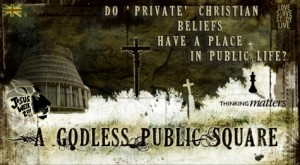
  • A Godless Public Square: Do ‘Private’ Christian Beliefs Have a Place in Public Life? Part I Matthew Flannagan – Theology

    A Godless Public Square: Do ‘Private’ Christian Beliefs Have a Place in Public Life? A few weeks ago, as part of Jesus Week at the University of Auckland, Thinking Matters and Evangelical Union hosted an event entitled A Godless Public Square: Do ‘Private’ Christian Beliefs Have a Place in Public Life? This event was a conversation between Theology, Philosophy and Law and featured Matthew Flannagan – Analytic Theologian, Glenn Peoples – Philosopher and Madeleine Flannagan – Legal Scholar. The video is still being edited and will be available soon but for now, this 3-part series comprises the written speeches of each speaker.

    Matthew Flannagan – Analytic Theology

    Recently, many Christian ethicists have defended the central place of God’s commands in Theological ethics. In this talk I want to discuss one important objection to appeals to God’s commands; this is the claim that, while it is perfectly appropriate for believers to appeal to purported divine commands when regulating their private conduct or the conduct of voluntary religious communities who believe in such commands, it is morally wrong to appeal to theological beliefs of this sort in any discussion of social ethics. When doing Ethics as a public enterprise i.e. engaging in debates over social policy or offering criticism of cultural and social practices, Christian Ethicists are morally bound to only appeal to secular considerations. I will argue that this position, though widely accepted inside and outside of the church, is mistaken.

    The Objection
    So what is the problem with appealing to divine commands in social ethics? Christian theological convictions ought to impact the whole of life both in the private and public spheres; this is what is meant by the idea of an “undivided life”, where Jesus is Lord of all aspects of our lives.

    Yet this consequence of Christian faith conflicts with a pervasive contemporary attitude: the view that that religion is fundamentally a private matter. It is accepted that a Christian is free to utilise theological convictions when they make decisions about their own life but in a pluralistic society it is increasingly deemed inappropriate to bring such convictions into public discussions about morality, law, politics, economics, education, scholarship and so on. The desire to influence society with Christian ideals or to convert others to the faith is viewed by many as an intolerant desire to impose one’s private views onto others.

    It is widely accepted that theological convictions can govern churches and the private lives of believers yet we are told that the public square – government, public policy, the courts, the academy, education, business, arts, media, etc – should be secular only.The problem is nicely summarised by Stephen Carter Christian theological convictions ought to impact the whole of life both in the private and public spheres; this is what is meant by the idea of an “undivided life”, where Jesus is Lord of all aspects of our lives.

    Yet this consequence of Christian faith conflicts with a pervasive contemporary attitude: the view that that religion is fundamentally a private matter. It is accepted that a Christian is free to utilise theological convictions when they make decisions about their own life but in a pluralistic society it is increasingly deemed inappropriate to bring such convictions into public discussions about morality, law, politics, economics, education, scholarship and so on. The desire to influence society with Christian ideals or to convert others to the faith is viewed by many as an intolerant desire to impose one’s private views onto others.

    It is widely accepted that theological convictions can govern churches and the private lives of believers yet we are told that the public square – government, public policy, the courts, the academy, education, business, arts, media, etc – should be secular only.

    This event looks at this issue. The conversation will span Theology, Philosophy and Law led by a panel made up of Christian representatives from each discipline along with you the audience:

    “One good way to end a conversation – or start an argument – is to tell a group of well educated professionals that you hold a political position (preferably a controversial one such as being against abortion or pornography) because it is required by your understanding of God’s will. In the unlikely event that anyone hangs around to talk with you about it, chances are that you will be challenged on the ground that you are intent on imposing your religious beliefs on other people. And in contemporary political and legal culture, nothing is worse.”[1]

    Carter cites the objection that appealing to God’s commands in public moral debate involves imposing one’s religious beliefs onto other people, and points out that such impositions are morally wrong. Note that the objection is not that such divine commands do not exist or that it is irrational to believe that they do. The objection is a specifically moral one. It is morally wrong to appeal to such beliefs; doing so violates a moral obligation people have to not impose their religious beliefs onto others. Something like this moral objection is widely held, both inside and outside the church. In response to this I will make four points. (more…)

  • Society of Biblical Literature: Blogger and Online Publication

    The Society of Biblical Literature’s program book for their 2011 meeting in San Francisco is now online. The blogger and online publication session for which Matt and I have had a joint paper accepted shows who we are sharing the session with and provides links to brief abstracts for each talk.

    Society of Biblical Literature Annual Meeting

    Blogger and Online Publication
    Robert R. Cargill, University of Iowa, Presiding
    11/19/2011

    4:00 PM to 6:30 PM
    Room: Room TBD – Hotel TBD

    Robert R. Cargill, University of Iowa
    Welcome and Introduction (5 min)

    Alice Bach, Case Western Reserve University
    Can Blogging at 3 AM Be Considered Scholarship? (25 min)

    Madeleine Flannagan, University of Auckland and Matthew Flannagan, Independent Scholar
    Blogging a Short-Cut to Peer Review: How to do it Effectively (25 min)

    Juhana Markus Saukkonen, University of Helsinki
    Sense and Practicality: Building a Historical GIS Online (25 min)

    Richard Price, CEO Academia.edu
    Academia.edu: The Past, Present, and Future of Scholarly Social Networking (25 min)

    The session will conclude with: Q&A discussion with Richard Price. (25 min)

    RELATED POSTS:
    We’re Going to San Francisco!