Category: Theologians

  • An Atheist and a Christian walk into a Bar… Original Sin & the Existential Paradox

    My previous post, William Lane Craig, Original Sin and Original Guilt, touched on the doctrine of original sin. According to the standard western articulation of this doctrine it has three components. First that human beings have a propensity towards doing wrong. Second, this propensity is inherited from our ancestors, it is not that we come into the world perfect and then later abandon perfection. In Edward Oakes’ words in “Original Sin: A Disputation”, “sin after Adam always takes the form of acquiescence and not of origination. We are born, that is, into a world where rebellion against God has already taken place, and the drift of it sweeps us along.” Finally, despite this we are responsible for this propensity in some way.

    As both theologians and philosophers have noted for centuries this doctrine appears paradoxical. How can we be responsible for something we inherit? I agree that there is something of a paradox in the notion of original sin and it is hard to find a coherent way of making sense of it. In this post I will take a different tack; I want to suggest that denying theological doctrines of original sin will not resolve this paradox. The reason: the paradox is in fact a paradox which is part of human existence and human moral experience. Hence, even without a doctrine of original sin, the paradox is still apparent to anyone who reflects on their experience.

    Original Sin

    This was made clear to me in a conversation I had in a bar with an atheist friend. My interlocutor, who had had a staunch Calvinist upbringing, was railing against the Calvinist doctrine of original sin and the apparent contradictions in it. His observations were fairly astute. He noted that on the one hand Calvinist parents instilled personal responsibility in their children and brought them up to accept responsibility and accountability for their actions. This he commended as morally good. At the same time he noted that these same parents believe in original sin. They believed human nature, as it exists today, is corrupt. Humans come into the world with a propensity to evil; their view is that from birth onwards it is inevitable that we will sin, that our hearts are inclined towards evil and so on. He proceeded to argue that if the latter view was correct then the former must be false. The doctrine of original sin undercuts the idea of personal responsibility.

    I listened carefully to my friend’s argument, when he had finished I asked him a question:

    Did he consider himself a moral agent who was responsible for his actions?

    Unsurprisingly, given his recent praise for personal responsibility, he immediately answered yes.

    Then came my second question:

    Have you ever lied? (more…)

  • Tim McGrew’s Library of Historical Apologetics: Rediscovering Forgotten Defenders of the Faith

    Last year Timothy McGrew, Professor of Philosophy at Western Michigan University (and reader of and occasional commenter on this blog) was kind enough to ship us a hard-drive from the US filled with thousands of old theological works on the historical argument for the truth of Christianity. It is truly a gold-mine of information, which Matt gets himself routinely lost in and for which visitors to our home have been known to arrive carrying their own portable hard drives so as take away a copy.

    Library of Historical Apologetics

    At the time Tim told us he was aiming to get this material online so that everyone could access it. Along with his advisory board of William Lane Craig, Gary Habermas, Craig Hazen, Robert Stewart, it seems he has made some progress as the Library of Historical Apologetics is now live and open for browsing and is really worth checking out.

    Paraphrasing and splicing bits together from the Collection page:

    The collection contains both one of the world’s largest catalogs of works in historical apologetics, the branch of apologetics dealing with the authenticity and credibility of the scriptures and particularly of the New Testament. The authors come from various denominational and educational backgrounds and would not agree with each other on all points of theology. Some are profound works of research and scholarship; others are brief works addressed to a non-specialist audience. But each makes a distinctive contribution to the literature of historical apologetics.

    In addition to the library, the site features:

    • Annotated Bibliography: Short descriptions of selected works.
    • Spotlight Articles: Published monthly, these two page articles describe an author, book or apologetic theme [Very cool!]
    • Quotation of the Week: Significant and pithy excerpts that make a poignant point and illustrate the subject matter of a particular author.

    All works available at the library are in English and are part of the public domain.

    HT Tim McGrew

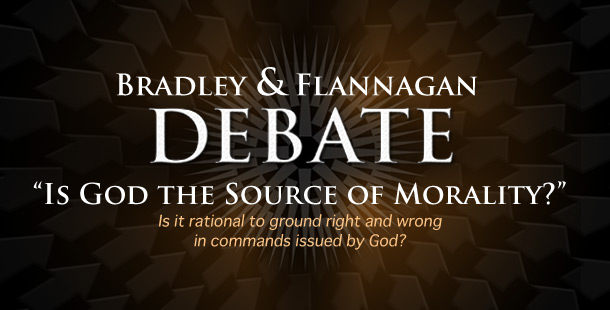
  • Bradley v Flannagan Debate @ Auckland Uni “Is God the Source of Morality?”

    Raymond Bradley and Matthew Flannagan will debate the topic “Is God the Source of Morality? Is it rational to ground right and wrong in commands issued by God?”

    The debate will be held at the University of Auckland on Monday 2 August from 7-9pm in “The Centennial” 260 – 098 OGGB (the bottom level of the Business School) on 12 Grafton Rd, Auckland City.

    Raymond Bradley v Matthew Flannagan "Is God the Source of Morality"

    If you enjoyed the 2008 debate at Auckland University between William Lane Craig and Bill Cooke, you should enjoy this debate.

    Raymond BradleyBradley is an Emeritus Professor of Philosophy with areas of specialty in Philosophical Logic, Metaphysics, Logical Atomism; he has previously debated William Lane Craig, Edward Blaiklock and many other Christian scholars and describes himself as an older generation “new atheist”.

    Matthew FlannaganFlannagan is an Auckland based Philosopher and Theologian with areas of specialty in Philosophy of Religion, Ethics and Theology; he has previously debated Bill Cooke, Zoe During and, of course, writes for this blog.

    The format of the debate will be as follows:

    Dr Bradley: Opening Comments [20 min]
    Dr Flannagan: Opening Comments [20 min]
    Dr Bradley: Reply to Dr Flannagan [10 min]
    Dr Flannagan: Reply to Dr Bradley[10 min]
    Dr Bradley: Closing Comments [7 min]
    Dr Flannagan: Closing Comments [7 min]
    Questions from the floor: [30 min]

    The moderator for the debate will be John Bishop.

    Bradley will be introduced by Robert Nola.

    Flannagan will be introduced by Chris Tucker.

    Both Bradley and Flannagan are experienced and engaging public speakers who are practiced at pitching their topics to suit their audiences. So, invite all your friends, and block out the evening of Monday 2 August from 7-9 pm now and make sure you get to the debate early to locate parking and grab a good seat.

    This debate is brought to you by the Evangelical Union and the Reason and Science Society as part of the University of Auckland’s Jesus week/Atheist week, with support from Thinking Matters.

    The event will be videoed and will be published on this blog. Entry is free and any and all are welcome.

    There is even a Facebook page you can rsvp on and use to invite your friends.

  • Inter-Continental Developments: Matt to Speak in the US

    When Matt wrote his blog series Joshua and the Genocide of the Canaanites Part I and Part II he had no idea just how far clicking the ‘publish’ button would end up taking him. It turns out that it will be taking him quite far;  half-way around the world from Auckland, New Zealand to Atlanta, Georgia in the United States to be precise.

    What’s in Georgia? Well it is this years location for the annual conferences and meetings of the  Evangelical Theological Society (ETS), the Evangelical Philosophical Society (EPS) and the Society of Biblical Literature (SBL). Each organisation’s events dove-tail the others so that they all run between 17-23 November 2010 in pretty much the same location.

    Anyway, in addition to the  Canaanite blog series being the catalyst to Matt’s receiving invitations to co-author chapters in edited books with Philosophers of Religion and Old Testament Ethicists  working at the top of the international field on the subject of Old Testament Ethics (see the upcoming publication list on Matt’s profile page) Matt will also be speaking on this topic in Atlanta.

    At the EPS Apologetics Conference, Matt will speak on “God and the Genocide of the Canaanites” (full details here). The following day he will join Palm Beach Atlantic University Professor of Philosophy  and Ethics and EPS President Paul Copan, Denver Seminary Professor of Old Testament and Semitic Languages Richard Hess and Taylor University Associate Professor of Historical Theology Randal Rauser at the SBL Annual Meeting for a panel discussion entitled “Navigating Old Testament Ethics” (full details here). He’ll also be attending bits of the ETS conference too.

    This is an incredible opportunity for Matt. Not only does he get to go somewhere where most of the Philosophers and Theologians at the top of his field will all be gathered in one place and meet them all but he gets to present his work to them and speak alongside them. The potential for Matt to obtain more research and speaking opportunities coupled with the fact that attending the EPS is seen in the evangelical academic world as one of the best ways to obtain employment makes this an opportunity that we are determined for Matt to take up.

    The problem is cost. Almost every other speaker in attendance has institutional backing. Financially this translates to their respective academic departments funding most of their attendance. Matt does not have institutional backing. EPS President Paul Copan, who personally invited Matt to take up these speaking opportunities, is aware of this and has generously offered to help Matt out with accommodation and to and fro conference travel. This brings the total cost down considerably but we are still chasing a total of $2,481.55 NZD ($1746.52USD) to get Matt there.

    From simply talking to friends about this opportunity we are aware that people who are able to would like to help Matt get to these conferences so we have decided to take a step of faith by accepting the speaking offers and purchasing the tickets. Given our employment woes and battle with ACC over my injury compensation being wrongfully discontinued, this has made things rather tight but we have faith we will get through.

    If you would like to help, our support page has various donation options. We would also greatly appreciate the word being spread, so if you are a blogger or you have website, please consider linking to this page.

  • Ronald Hendel on Pascal, Evangelicals and The Society of Biblical Literature

    Ronald Hendel, of the Biblical Archeology review, has written a critical piece entitled “Biblical Views: Farewell to SBL“. His beef appears to be that the Society of Biblical Literature (SBL) is allowing into its membership, heaven forbid, various “evangelical and fundamentalist groups.” This, he suggests, compromises the group’s scholarly integrity.

    Much could be said about his comments, here I will only parse some of them. First, Hendel begins by citing from Pascal’s Pensées, “The heart has its reasons, which reason does not know.” Hendel clearly approves of Pascal’s contention and goes so far as to appropriate the sentiment, he elaborates Pascal’s position as follows,

    This famous line from Pascal’s Pensées draws a wise distinction between religious faith and intellectual inquiry. The two have different motivations and pertain to different domains of experience. They are like oil and water, things that do not mix and should not be confused. Pascal was a brilliant mathematician, and he did not allow his Catholic beliefs to interfere with his scholarly investigations. He regarded the authority of the church to be meaningless in such matters.

    While I am not a Pascal scholar this appears to be a caricature of Pascal’s position. Hendel  suggests that Pascal’s distinction between “reason” and the “heart” is a distinction between faith and reason. He goes on to state that Pascal believed the two did not mix and had different domains, and that the latter (the heart) had no bearing on mathematics or other scholarly investigations.

    Now the former seems plausible, just after the citation Hendel refers to Pascal states “It is the heart which experiences God, and not the reason. This, then, is faith: God felt by the heart, not by the reason.” However with regards to the latter points Hendel made, Pascal goes on to state,

    We know truth, not only by the reason, but also by the heart, and it is in this last way that we know first principles; and reason, which has no part in it, tries in vain to impugn them. The sceptics, who have only this for their object, labour to no purpose. We know that we do not dream, and, however impossible it is for us to prove it by reason, this inability demonstrates only the weakness of our reason, but not, as they affirm, the uncertainty of all our knowledge. For the knowledge of first principles, as space, time, motion, number, is as sure as any of those which we get from reasoning. And reason must trust these intuitions of the heart, and must base them on every argument. (We have intuitive knowledge of the tri-dimensional nature of space and of the infinity of number, and reason then shows that there are no two square numbers one of which is double of the other. Principles are intuited, propositions are inferred, all with certainty, though in different ways.) And it is as useless and absurd for reason to demand from the heart proofs of her first principles, before admitting them, as it would be for the heart to demand from reason an intuition of all demonstrated propositions before accepting them.

    Pascal is quite clear, far from being “oil and water” and having nothing to do with maths or any other scholarly discipline Pascal believed that the very foundations of all knowledge, whether mathematical or another form, are based on faith; reason reasons from these premises but cannot prove them (not that it needs to). When Pascal goes on to state that “those to whom God has imparted religion by intuition are very fortunate and justly convinced” the implication is that certain religious beliefs, known by faith, function as properly-basic beliefs’ at the foundation of ones knowledge and, as such, are the premises one can legitimately reason from to other conclusions without first needing to prove them.

    Second, Hendel’s objection to allowing evangelical groups into the SBL is wanting. His basic objection is that,

    The SBL online book review journal (Review of Biblical Literature) has featured explicit condemnations of the ordinary methods of critical scholarly inquiry, extolling instead the religious authority of orthodox Christian faith.

    Hendel’s concern here seems to be that some evangelical groups are opposed to critical and scholarly inquiry. He substantiates this further,

    Listen to this, from Bruce Waltke, widely regarded as the dean of evangelical Biblical studies: By their faith in the God of Abraham, Isaac, and Jacob, [evangelical scholars] … hear the voice of higher biblical criticism, which replaces faith in God’s revelation with faith in the sufficiency of human reason, as the grating of an old scratched record.

    This, however, is a non-sequitur. Waltke in this citation criticises “higher criticism,” Hendel concludes from this that he opposes critical and scholarly inquiry. But this is not the same thing, why can’t a person, for example, engage in critical and scholarly inquiry, engage in careful research, follow the rules of logic, and so on, and yet reject some of the methodological principles of higher criticism. Alvin Plantinga has offered a carefully argued epistemology of religious belief that provides the basis for a critique of higher criticism. He might be mistaken but surely one needs to actually engage his argument instead of simply assuming it is wrong. Hendel’s assumption, that it is impossible to do this, surely needs more than mere assumption and assertion.

    Hendel’s objections to Waltke are similarly mistaken. In response to the above citation he says,

    This is a quaintly stated position, which directly attacks the applicability of human reason to the study of the Bible. Instead of reason, “faith in the God of Abraham, Isaac, and Jacob”—as interpreted by evangelical scholars—should be the rule in Biblical scholarship. Waltke dismisses critical inquiry as an annoying nuisance, like the scratchy sound of an old LP.

    Here Hendel contends Waltke denies “the applicability of human reason” to the study of the bible. This again does not follow. In the above statement Waltke denies that reason, by itself without faith, is insufficient but to say reason is by itself insufficient does not entail it has no application at all; it simply states that it has to be supplemented by faith to get a true or accurate answer.

    In summary Hendel confuses the claim that reason, unimplemented by faith, is insufficient with the rejection of reason altogether. Moreover, he seems to think that reason and higher criticism are the same thing. This, however, simply appears to, at best, misunderstand and, at worse, caricature the views of faith and reason many evangelicals hold. Had Hendel reflected on what Pascal actually said, he might have understood this a bit more.

  • Myth, Truth and Genesis 1-11

    In Naturalism Defeated, Evan Fales attacks the biblical teaching that man is made in the image of God. One reason he gives is, “How seriously, then, should one take the testimony of Genesis 1:26-27? … There is the generally mythical character of Genesis; many of the themes in the first 11 chapters are borrowed from, or influenced by, the myths of other ancient Near Eastern cultures.”[1]

    Fales’ reasoning here is not uncommon. He argues that what Genesis teaches is false because Genesis 1-11 is a myth. The latter claim he substantiates by comparing the early chapters of Genesis to various Ancient Near Eastern texts which we know to be myths. Fales contends that a comparison of the texts in question leads to the conclusion Genesis is a myth and hence what it teaches lacks authority.

    In this post I want to address one aspect of this argument. The key premise I want to contest is that if Genesis is a myth and of the same genre as Ancient Near-Eastern myths then what it teaches lacks authority. Note this is a conditional claim: I am arguing that if Genesis 1-11 is mythic in genre then this would not necessarily entail that the text lacks authority. I am not, in this post, committing myself to any claim that Genesis is mythic; I am simply asking what follows if it is.

    As a way of entering this question let me start by summarising a debate between two evangelical scholars, both of whom affirm biblical inerrancy. In Inspiration and Incarnation, Peter Enns compares the story of creation, fall, flood and Babel in Genesis 1-11 to various Ancient Near-Eastern texts such as Enuma Elish, The Gilgamesh Epic, Atrahasis Epic, the Sumerian Flood Story and the Sumerian King Lists. Enns argues that:

    (a) these writings appear to be earlier than Genesis; and,
    (b) the latter four in particular contain obvious parallels to Genesis that cannot be mere coincidence; and,
    (c) these texts are myths.

    In light of this, Enns argues that Genesis must be understood as a myth.

    When Enns says Genesis is a myth it is important to not misunderstand his meaning here. In contemporary English the word myth is often a colloquial term for a falsehood, so that calling something a myth means it is false. In Enns’ use of the term the word ‘myth’ refers to a particular kind of genre, “myth is an ancient, pre-modern, pre-scientific way of addressing ultimate meaning and origins in the form of stories: Who are we ? Where do we come from ?”[2] Hence, by saying Genesis is a myth Enns is not committing himself to the claim that the text is false.

    However, later in the same book Enns goes on to state that “the biblical account, along with its ancient Near Eastern counterparts assumes the factual nature of what it reports. They did not think, “We know this is all ‘myth’ but we will have to wait until science is invented to give us better answers.”[3] He suggests that while the text is myth, its original hearers would probably not have distinguished myth from what we would call an historical narrative.

    It is worth noting that Enns is not alone in this kind of assessment. Drawing on the same literary parallels, Gordon Wenham has argued that the author of Genesis 1-11 was retelling stories that were well known in Babylonian culture. However, the author was transforming them to make a radically different theological point. These  points, in fact, repudiate and at times ridicule, the very teachings the Babylonian myths  were trying to teach.

    Like Enns, Wenham notes several important parallels between Gen 1-11 and Ancient Near-Eastern myths and legends to substantiate this point. Wenham suggests that in retelling the Babylonian myths to make theological counter points the authors assumed or took for granted, the historicity of the folk stories in question. In The Erosion of Inerrancy in Evangelicalism, Greg Beale responds to Enns’ suggestion, “But Enns is saying more than this: the biblical writers thought they were recording history but were really recording myth … Thus one ends up with a completely inspired bible  in which the narrators recorded what they thought was history, but we know they are wrong. This is tantamount to saying the biblical writers made mistakes.”[4]

    Beale goes on to state that Enns sees Genesis as “a genre of divine accommodation,  whereby God knew better but the Israelite writers did not. They thought they were writing true history, but God knew they were not. In this respect has Enns formulated a new version of sensus plenor?”[5]

    I think Beale is correct; Enns’ position does commit him to the claim that the biblical authors made mistakes. However, I think the conclusion he tries to draw, that this claim compromises the authority of scripture is too quick. It is worth noting that Enns claimed that the biblical writers assumed the factual nature of what they reported. He explicitly states also that the genre of myth uses stories to teach answers to certain theological and existential questions.  For example, questions regarding ultimate meaning and origins, such things as, who are we? where do we come from? and so on. Hence while Enns position accords errors to what biblical writers assumed, it does not necessarily entail that what the text teaches is erroneous. This may sound like a minor technical point but I am inclined to think it is important.

    An example might help to illustrate this point. Let’s take as an example the well known story of  the boy who cried wolf. This story, on the face of it, is simply a description of a shepherd boy who was killed after giving false alarms about wolves. Taken in a straight-forward, literal fashion it appears to relay an historical event. Now most people recognise that this story is not designed to teach us an historical event, those who retell this story do so to make a moral point about the dangers and pitfalls of repeatedly lying. The story is a powerful and graphic way of teaching this point and gives the point a vividness and power that the mere claim “don’t lie” does not have.  It is also clear, I think, that no one would consider what this story teaches to be false if it was discovered the events the story described never happened (which they probably did not). This is because once the genre of the text is realised, it is evident that the text does not teach that the events happened and if it does not teach that they happened then the fact that they did not cannot render what it teaches as false.

    Now, let me provide a hypothetical situation. Suppose I was researching the origins of the story of the boy who cried wolf and I discovered that at some point in the past a person heard this story and believed it to be literally true, the person believed that the events actually happened. Suppose this person was also struck by the fact that these events provided a powerful illustration of the dangers of lying and issuing false reports so much so that this person began using this story to teach about the dangers of lying. Suppose that this person’s pedagogy caught on and the story entered into cultural consciousness and that those people who heard and retold the story also believed it actually happened. Would this discovery lead us to conclude that what the story teaches is false? Again it seems clear to me that it would not. This is because whatever the original teller believed about the story, what the story teaches remains true. The original teller may have all sorts of beliefs about what was authored but unless the story was actually used to teach each of these beliefs the story is not discredited by any finding to the effect that these beliefs are false. The story of the boy who cries wolf teaches us about lying it does not teach (nor does it purport to teach us) an historical event. As such, it is shown to be false only if someone can show us that what it says about lying is false.

    It is important to see the limitations of this illustration. I am not arguing that Genesis 1-11 should be construed as a fable in the vein of the story of the boy who cried wolf – I think Genesis  is clearly not a fable – the point I am making is that there is a distinction between what a person assumes about a story when they tell it and what the story actually teaches. Even if a person falsely assumes the factual accuracy of the events in a story or narrative as true then that does not entail that what the text teaches is untrue. The example of the boy who cries wolf shows that with some genres the truth of what is taught stands whether or not the story used to teach this truth is historically accurate. Even if we grant that Genesis is myth or folklore, it does not follow that what it teaches is false.


    [1] Evan Fales “Darwin’s Doubt, Calvin’s Calvary” in James Beilby Naturalism Defeated? Essays on Plantinga’s Evolutionary Argument Against Naturalism (Ithaca: Cornell University Press, 2000) 55.
    [2] Peter Enns  Inspiration and Incarnation: Evangelicals and the Problem of the Old Testament (Grand Rapids MI : Baker Books, 2005) 50.
    [3] Ibid 55.
    [4] Greg Beale The Erosion of Inerrancy in Evangelicalism: Responding to New Challenges to Biblical Authority (Wheaton Ill: Crossway Books, 2008) 69.
    [5] Ibid.

  • “Has Science Disproved God?” The Podcast (Fixed!)

    If you missed the “Has Science Disproved God?” panel discussion at Auckland University last week and you just cannot wait for the video to be edited, formatted and uploaded to You Tube then simply follow this link: “Has Science Disproved God?” to listen to the podcast of the event.

    In the first hour the speakers addressed four issues:

    1. Should a working scientist operate as a methodological atheist or, in other words, does the scientific project necessarily exclude God? – Dr Jeff Tallon
    2. Scientific beliefs are based on measurable, verifiable evidence, is belief in God any different? – Dr Matthew Flannagan
    3. Does evolution threaten belief in God? – Dr Neil Broom
    4. Science and free-will. – Dr Robert Mann

    The second hour consisted of questions from the audience.

    Hat Tip: Thinking Matters

    The second and final event in this series, Christianity on Trial, is on at Auckland University tonight at 7pm.