Category: Theologians

  • Christianity on Trial @ Auckland University

    Thinking Matters have organised some free to the public Q & A seminars at the University of Auckland.

    Christianity on Trial

    Today, many best-selling atheists argue that belief in God is delusional and a roadblock to political, moral, and scientific progress.

    In this public Q & A event, several of New Zealand’s top Christian thinkers come together to consider popular arguments against Christianity and whether belief in God is merely a consequence of superstition and credulity.

    The speakers are:

    Jeff Tallon (PhD) is Distinguished Scientist at Industrial Research Ltd and a former Professor of Physics at Victoria University. He is internationally known for his research in high-temperature superconductors, is a Fellow of the Royal Society of New Zealand and in 2002 was awarded the Rutherford Medal, New Zealand’s highest science award.

    Matthew Flannagan (PhD) adjunct lecturer in Philosophy at Laidlaw College and Bethlehem Tertiary Institute and  is currently teaching philosophy, ethics and religious studies at St Peters College. He specialises in applied ethics and the interface between philosophy and theology. He is a prominent New Zealand Christian commentator, debater and blogger.

    Michael Drake
    (DipTeach) is the principal of Carey College in Panmure and a pastor of the Tamaki Reformed Baptist Church. He has been involved in advocacy for Christian schools and in raising issues about race, education, and Christianity before Parliament. He is also a Tertiary Student Christian Fellowship Associate Chaplain at the Manukau Institute of Technology.

    Joe Fleener (MDiv) lectures in Old Testament, Church History, Christian Worldview, Apologetics, and Christian Ethics at The Shepherd’s Bible College.

    When: Tuesday 16 March at 7pm

    Where: “The Centennial” 260 – 098 Owen G Glenn Building, 12 Grafton Road, The University of Auckland

    Mark it in your diary, check out the Facebook page and tell your friends. This event is sponsored by the Tertiary Student Christian Fellowship.

  • The Theological Foundations of the Enlightenment Philosophers

    In my previous post, Freedom, Science and Christianity: A Response to James Valliant Part I, I criticised a recent post by James Valliant. I plan to put Part II of this critique online later this week (after Madeleine is clear of her exam on Tuesday to edit it). Here, I simply want to pick up on and further substantiate a point I made in Part I.

    On the SOLO discussion board, where Valliant’s article was originally posted and where I have posted some of my Part I response, Lindsay Perigo has dismissed my claims (notably without citing a single source) as “revisionist history.” I doubt very much anything I say will dissuade Perigo but for those like him, who react to this questioning of popular mythology with disbelief and scepticism, I ask them to compare the following enlightenment arguments for freedom of religion with some earlier patristic ones.

    Originally, Valliant argued,

    No, it was the horrible institution of Christian persecution, century after century, which inspired sensitive minds to first consider the idea of freedom of conscience, and, again, only with a good deal of philosophical help from those ancient, pagan sources, from Aristotle to Cicero — and from natural law to the experience of the Spartacus slave rebellion…. These are not to be found in the Bible, either. And, if they had been there, in any way, then why was this never noticed by the Councils, saints and theologians who piously taught what they thought was good Biblical policy, century after century after century?

    In response, I argued that, in fact, the defences of religious tolerance, proposed by enlightenment thinkers such as John Locke, Pierre Bayle and James Madison were often repetitions of the arguments offered by early Christian theologians such as Lactantius and Tertullian. Further, these pro-freedom of conscience arguments had been known to and given by Christian theologians for over a thousand years.

    These facts suggest it is mistaken to say that the idea of freedom of conscience was “first considered” after hundreds of years of Christian persecution and was developed from Pagan, as opposed to earlier Christian, sources.

    Turning to the enlightenment philosophers, let’s begin with James Madison,

    That religion or the duty we owe to our Creator, and the manner of discharging it, being under the direction of reason and conviction only, not violence or compulsion, all men are equally entitled to the full and free exercise of it accord[in]g to the dictates of conscience; and therefore that no man or class of men ought, on account of religion to be invested with peculiar emoluments or privileges, nor subjected to any penalties or disabilities.[1]

    Madison argues that true worship is based on conviction and therefore has to be voluntary; it is incompatible with coercion. His argument is not new, several Enlightenment defenders of freedom of religion made the same point. Below are two prominent examples. The first is John Locke,

    The care of souls cannot belong to the civil magistrate, because his power consists only in outward force: but true and saving religion consists in the inward persuasion of the mind, without which nothing can be acceptable to God. And such is the nature of the understanding, that it cannot be compelled to the belief of anything by outward force. Confiscation of estate, imprisonment, torments, nothing of that nature can have any such efficacy as to make men change the inward judgment that they have framed of things.[2]

    The second is Pierre Bayle,

    It is evident then that the only legitimate way of inspiring religion is by producing in the soul certain judgments and certain movements of the will in relation to God. Now since threats, prisons, fines, exile, beatings, torture, and generally whatever is comprehended under the literal signification of compelling, are incapable of forming in the soul those judgments of the will in respect to God which constitute the essence of religion, it is evident that this is a mistaken way of establishing a religion and, consequently, that Jesus Christ has not commanded it.[3]

    Now compare these arguments with the following three examples from prominent, pre-Enlightenment, Christian Theologians.

    First, Aquinas, a 13th century theologian, discussed whether one should tolerate non-believers. In his discussion he summarised the following argument for an affirmative answer, which he attributed Augustine of Hippo, another theologian, who lived in the 5th century,

    Augustine says (Tract. xxvi in Joan.) that “it is possible for a man to do other things against his will, but he cannot believe unless he is willing.” Therefore it seems that unbelievers ought not to be compelled to the faith.[4]

    Second, Lactantius, a 4th century theologian,

    I should wish to know, when they compel men to sacrifice against their will, what reasoning they have with themselves, or to whom they make that offering. If it is made to the gods, that is not worship, nor an acceptable sacrifice, which is made by those who are displeasing to them, which is extorted by injury, which is enforced by pain….These things may indeed be said with justice. But who will hear, when men of furious and unbridled spirit think that their authority is diminished if there is any freedom in the affairs of men? But it is religion alone in which freedom has placed its dwelling. For it is a matter which is voluntary above all others, nor can necessity be imposed upon any, so as to worship that which he does not wish to worship. Some one may perhaps pretend, he cannot wish it. In short, some, through fear of torments, or overcome by tortures, have assented to detestable sacrifices: they never do that voluntarily which they did from necessity;[5]

    And finally Tertullian a 2nd century theologian

    It is a fundamental human right, a privilege of nature, that every man should worship according to his own convictions: one man’s religion neither harms nor helps another man. It is assuredly no part of religion to compel religion— to which free-will and not force should lead us— the sacrificial victims even being required of a willing mind. You will render no real service to your gods by compelling us to sacrifice. For they can have no desire of offerings from the unwilling.[6]

    Comparing these texts, it is, I think, fairly evident that Madison, Locke and Bayle repeated the same line of argument one finds in Aquinas (Augustine), Lactantius and Tertullian. Their arguments had been formulated and known and accepted for over a thousand years before the Enlightenment.

    So Randians remain free to make claims that no Christian thinkers supported freedom of religion until after the Enlightenment and that the Enlightenment thinkers did not get their ideas from Christian thinkers if they wish but supported examples, like the above, show that this is mistaken. This is not revisionist history (at least, not on my part). I would simply call it checking sources and comparing them.


    [1] James Madison Memorial and Remonstrance against Religious Assessments.
    [2] John Locke A Letter Concerning Toleration.
    [3] Pierre Bayle Pierre Bayle’s Philosophical Commentary trans AG Tannenbaum (New York: Peter Lang, 1686) 31.
    [4] Thomas Aquinas Summa Theologicae II II q. 8, obj 3.
    [5] Lactantius Epitome of the Divine Institutes 53, 54.
    [6] Tertullian To Scapula Ch 2.

    RELATED POSTS:
    Freedom, Science and Christianity: A Response to James Valliant Part I
    Freedom, Science and Christianity: A Response to James Valliant Part II
    The Theology of the Declaration of Independence

  • John Loftus on Calvin, Matthew Flannagan and Psalm 14

    John Loftus from Debunking Christianity is at it again. In his recent post, When Psalm 14:1 Says Atheists Are “Fools” This Can Be Easily Refuted, he suggests he can easily refute the idea of biblical inerrancy and cites me to assist him in doing so! Unfortunately he makes several straight-forward mistakes. Given that he has decided to devote a blog post to elaborating these claims, I will devote one in response.

    Loftus states his thesis clearly, “I claim Psalm 14:1 is about morality, that it claims an atheist is an immoral person, not an insane one. And I reject that was well. I also claim this correct interpretation is easily proven false.”

    To demonstrate this thesis he cites my discussion with him on the meaning of the word “fool” and my Sunday Study Sunday Study: Christ on The Prohibition on Homicide Part II. In that post I cited Psalm 14 and stated “A fool here is not someone who is imprudent but someone who is positively wicked. The text speaks of those who commit “abominable deeds;” the idea is that such a person is morally corrupt, someone who rejects doing good, someone who is committed to evil.”

    Loftus’ response is as follows:

    Thanks so much Matt.

    You wrote:

    “A fool here is not someone who is imprudent but someone who is positively wicked. The text speaks of those who commit “abominable deeds;” the idea is that such a person is morally corrupt, someone who rejects doing good, someone who is committed to evil.”

    It’s about deeds is it not? It’s about immoral behavior.

    …Then we’re agreed, Matt. Jim West is ignorant, and so was Calvin!

    As to the immoral charge, do you think that’s true of atheists? You see, this is not about having a basis for morality. It’s a charge against the behavior of people who do not believe in God. It claims that we are in fact immoral people; that we do not live according to moral “wisdom.” This is about our behavior not beliefs.

    I would think this discussion alone should end any pretensions about an inerrant Bible. One lone ethical atheist destroys such a notion, even if he does not believe, or even if he is inconsistent in his behavior, as you might want to claim….

    …All it takes is one lone ethical atheist to upset the cart, correct?  I’ll put my behavior up to most Christian theists, okay?

    Agreed?

    Unfortunately John has made straight-forward errors here. I’ll make a few brief points in response.

    1. Loftus thinks my discussion of the meaning of the word fool somehow provides a refutation of biblical inerrancy: he writes,

    As to the immoral charge, do you think that’s true of atheists? You see, this is not about having a basis for morality. It’s a charge against the behavior of people who do not believe in God. It claims that we are in fact immoral people; that we do not live according to moral “wisdom.” This is about our behavior not beliefs.

    I would think this discussion alone should end any pretensions about an inerrant Bible. One lone ethical atheist destroys such a notion, even if he does not believe, or even if he is inconsistent in his behavior, as you might want to claim.”

    Three things here. First, as I said in to Loftus, I am not sure that the passage talks about atheists in the modern sense of the term. The NIV translates Psalm 14:1 as follows, “The fool says in his heart, “There is no God.” They are corrupt, their deeds are vile; there is no one who does good.” In English this appears to be talking about people who profess atheism, the philosophical position that God does not exist. However, as I noted in correspondence with Loftus, the words “there is” are not in the original Hebrew. They are rather an interpretation of the Hebrew added by many modern English bibles. The original Hebrew simply states “the fool says in his heart no God”. Many commentators interpret the phrase “no God” to mean “there is no God”, however, as I pointed out to Loftus, there is an alternative way of interpreting the phrase as someone who says no to God; someone who is aware of God’s existence and his commands and yet chooses to reject them.

    It is worth noting that even commentators who interpret the phrase as “there is no God” do not think it refers to atheism as we understand the term today. There are several reasons for this. The first is that the phrase “no God” is used in Psalm 10:4. Here it refers to a person who “curses and renounces God”, acts as though God will not hold him or her accountable for his or her actions. The point is not that the person does not believe in God but that the person rejects God’s requirements to do what is right and does not consider him or herself to be accountable or responsible for what they do.

    The second is that Psalm 14, in context, applies its criticism not to atheists per se but to all human beings, the majority of whom historically and today do believe in a deity of some sort. Note the second half of the verse,

    The fool says in his heart, “There is no God.” They are corrupt, their deeds are vile; there is no one who does good.

    The next verse states,

    The LORD looks down from heaven on the sons of men to see if there are any who understand, any who seek God. All have turned aside, they have together become corrupt; there is no one who does good, not even one.

    This brings me to the third reason for doubting that the psalm refers to atheists as Loftus and I mean the term – someone who affirms that God does not exist – as the New Testament applies the judgment in this psalm to theists. In the opening chapters of Romans (verses 1-3) Paul identifies two groups specifically who fail under the criticism of this psalm; the first are Greeks who for the most past believe a deity exists, know what his requirements are and yet still reject them. The second are Jews who know that God exists, know what his requirements are in the Torah and yet refuse to follow them.

    In Romans 3:12 Paul cites this Psalm to summarise the point he has made that both groups, who are theists, have rejected God. Clearly these groups are not atheists in the sense that Loftus and I use the term. The person who says “no God” is not the person who does not believe in God, rather, it is the person who rejects the demands that God places on their lives.

    2. Suppose the passage does refer to the intellectual position of atheism and says “the fool says in his heart there is no God” Loftus seems to think that this means that all atheists are immoral. But this does not follow. The claim that fools are atheists does not entail that all atheists are fools, any more than the claim that all Buicks are cars entails that all cars are Buicks. This would commit the fallacy of affirming the consequent.

    3. Suppose the text did affirm that all atheists are immoral. Loftus seems to think that this means that the text affirms that all theists are more moral than atheists. His response, “I’ll put my behavior up to most Christian theists, okay?”, implies that if one atheist is more moral than most theists then the Psalmists claim is refuted.

    Now I could express my scepticism that Loftus knows enough about the character of most theists in the world to make this claim, not to mention the hubristic self-righteousness this comment displays, but these issues can be put aside because even if Loftus is a shining paragon of virtue, the claim that all atheists are immoral does not entail that all atheists are more immoral than all theists. It is possible that both atheists and theists could be immoral to a degree and that the degrees of each differ on an individual by individual basis.

    4. John seems to believe that his citation of me, writing on the meaning of the word “fool” in Psalm 14, is in disagreement with Calvin’s exposition of the psalm. Further, that this commits me to saying that Calvin was ignorant. This is mistaken.

    First, if one examines Calvin’s commentary on Psalm 14 it is not clear that he does disagree with what I have said. On the meaning of the word fool he states,

    As the Hebrew word נבל, nabal, signifies not only a fool, but also a perverse, vile, and contemptible person, it would not have been unsuitable to have translated it so in this place; yet I am content to follow the more generally received interpretation, which is, that all profane persons, who have cast off all fear of God and abandoned themselves to iniquity, are convicted of madness. David does not bring against his enemies the charge of common foolishness, but rather inveighs against the folly and insane hardihood of those whom the world accounts eminent for their wisdom. We commonly see that those who, in the estimation both of themselves and of others, highly excel in sagacity and wisdom, employ their cunning in laying snares, and exercise the ingenuity of their minds in despising and mocking God. It is therefore important for us, in the first place, to know, that however much the world applaud these crafty and scoffing characters, who allow themselves to indulge to any extent in wickedness, yet the Holy Spirit condemns them as being fools; for there is no stupidity more brutish than forgetfulness of God. We ought, however, at the same time, carefully to mark the evidence on which the Psalmist comes to the conclusion that they have cast off all sense of religion, and it is this: that they have overthrown all order, so that they no longer make any distinction between right and wrong, and have no regard for honesty, nor love of humanity.[1]

    It is clear that Calvin agrees with my point here; the word fool refers to a person of low moral character and not an intellectually sub-par person. Moreover, it also seems clear that Calvin’s reading of the use of the phrase “there is no God” in psalm 14, it is not a reference to people who profess the philosophical position of atheism. On the meaning of the phrase “there is not God” Calvin states,

    Not that they maintain, by drawn out arguments or formal syllogisms, as they term them, that there is no God, (for to render them so much the more inexcusable, God from time to time causes even the most wicked of men to feel secret pangs of conscience, that they may be compelled to acknowledge his majesty and sovereign power;) but whatever right knowledge God instils into them they partly stifle it by their malice against him, and partly corrupt it, until religion in them becomes torpid, and at last dead. They may not plainly deny the existence of a God, but they imagine him to be shut up in heaven, and divested of his righteousness and power; and this is just to fashion an idol in the room of God. As if the time would never come when they will have to appear before him in judgment, they endeavor, in all the transactions and concerns of their life, to remove him to the greatest distance, and to efface from their minds all apprehension of his majesty. And when God is dragged from his throne, and divested of his character as judge, impiety has come to its utmost height; and, therefore, we must conclude that David has most certainly spoken according to truth, in declaring that those who give themselves liberty to commit all manner of wickedness, in the flattering hope of escaping with impunity, deny in their heart that there is a God.[2] [Emphasis added]

    Here Calvin states that the issue is not so much the intellectual disbelief in God but rather the living of one’s life in a manner that rejects God’s laws and one’s own responsibility for following them.

    5. Putting aside Loftus’ apparent misunderstanding of Calvin’s position (he did, afterall, confess to not having read Calvin after he wrote the post in question) let’s assume for the sake of argument that I did come to a conclusion different from Calvin, does it follow, as Loftus suggests, that Calvin was ignorant? I think this is a non-sequitur, if Loftus has Calvin correct (which he does not) and Calvin contends that a fool is someone who is intellectually or mentally sub-par, not a person with a bad character, then I would disagree with him – but it does not follow from this that Calvin is ignorant. I think it is quite possible (and common) for educated, informed people to disagree on a particular issue. The suggestion that unless someone agrees with me on everything then they are an ignoramus seems to me to make to big a leap.

    Given points 1-5, I do not accept John Loftus’ claim that my comments on Psalm 14 force me, or anyone else, to conclude that Biblical inerrancy is false or that one of history’s greatest Biblical expositors and theologians was an ignoramus. Loftus’ claims to the contrary seem to be based on reading a comment I made, failing to grasp the issues in interpreting a Psalm, misunderstanding the position of Calvin and then making a series of unwarranted jumps in logic (all, I deduce, in an attempt to make me side with him in his attack on Jim West, whom I had not heard of until a few days and whose writings on the subject are no longer online).


    [1] John Calvin Commentary on Psalms Psalm 14:1.
    [2] Ibid.

    RELATED POSTS:
    Sunday Study: Christ on The Prohibition on Homicide Part II
    Sunday Study: Christ on The Prohibition on Homicide Part I
    John Loftus Tag

  • Sunday Study: Joshua and the Genocide of the Canaanites Part I

    Critics of Christianity often claim that the book of Joshua teaches that God commanded genocide. Raymond Bradley for example states,

    In chapters 7 through 12, [the book of Joshua] treats us to a chilling chronicle of the 31 kingdoms, and all the cities therein, that fell victim to Joshua’s, and God’s, genocidal policies. Time and again we read the phrases “he utterly destroyed every person who was in it,” “he left no survivor,” and “there was no one left who breathed.”[1]

    Similarly, Walter Sinnott-Armstrong cites passages in Joshua with the same point in mind.[2]

    The objection that Bradley and Armstrong raise in highlighting these passages is that Christians are committed to an inconsistent set of propositions.

    [1] Any act that God commands is morally permissible.
    [2] The scriptures are an authoritative revelation of God’s commands.
    [3] It is morally impermissible for anyone to commit genocide.
    [4] According to the book of Joshua, God commanded Israel to commit genocide.

    If we are to rationally affirm both [1] and [2] then we must give up either [3] or [4]. So which one should we reject?

    Philip Quinn has developed a way of addressing clashes such as this. He suggests that we can draw on a principle whereby “whenever two conflicting claims differ in epistemic status, the claim with the lower epistemic status is to be rejected.”

    [3]Given this approach, if a particular interpretation of any passage conflicts with one of our moral intuitions then we should ask whether or not the case for that interpretation is as convincing as the principle that it clashes with. Now, the principle that genocide is wrong is, I think, a highly plausible one. Therefore, if one is to prefer [3] to [4] then the case for a literal reading must at least be this plausible, and preferably even more plausible. In this series of posts I will argue, perhaps surprisingly to some, that [4] is doubtful. While it is true that taken in isolation and interpreted in a strict literal fashion the book of Joshua does appear to state that God commanded Genocide, I contend that when the text is read in its literary and textual context this conclusion is far from evident and is, in fact, rather questionable.

    In the tenth chapter of the book of Joshua we read,

    They [Joshua and his troops] took the city, its king and its villages, and put them to the sword. Everyone in it they totally destroyed. They left no survivors. They did to Debir and its king as they had done to Libnah and its king and to Hebron. So Joshua subdued the whole region, including the hill country, the Negev, the western foothills and the mountain slopes, together with all their kings. He left no survivors. He totally destroyed all who breathed, just as the LORD, the God of Israel, had commanded. Joshua subdued them from Kadesh Barnea to Gaza and from the whole region of Goshen to Gibeon. (Joshua 10:39-41)

    This text summarises Joshua’s campaign in southern Canaan. The northern campaign is summarised in a similar fashion in the following chapter,

    So Joshua took this entire land: the hill country, all the Negev, the whole region of Goshen, the western foothills, the Arabah and the mountains of Israel with their foothills, from Mount Halak, which rises toward Seir, to Baal Gad in the Valley of Lebanon below Mount Hermon. He captured all their kings and struck them down, putting them to death. Joshua waged war against all these kings for a long time. Except for the Hivites living in Gibeon, not one city made a treaty of peace with the Israelites, who took them all in battle. For it was the LORD himself who hardened their hearts to wage war against Israel, so that he might destroy them totally, exterminating them without mercy, as the LORD had commanded Moses. At that time Joshua came and wiped out the Anakim from the hill country, from Hebron, from Debir, from Anab, and from all the hill country of Judah, and from all the hill country of Israel; Joshua utterly destroyed them with their towns. No Anakites were left in Israelite territory; only in Gaza, Gath and Ashdod did any survive. So Joshua took the entire land, just as the LORD had directed Moses, and he gave it as an inheritance to Israel according to their tribal divisions. Then the land had rest from war. (Joshua 11:16-23)

    If these passages are taken in a strict literal fashion and read in isolation from the proceeding narrative they record the divinely authorised commission of genocide. Taken literally these passages state three things.

    Firstly, that Joshua conquered and subdued the entire regions of southern and northern Canaan. Verse 11:23 states that “Joshua took the entire land” and then “gave it as an inheritance to Israel according to their tribal divisions.” This suggests that the region in question is the same land that is later divided between the Israelite tribes, which was the entire land of Canaan.

    Secondly, the passage repeatedly emphasises that Joshua exterminated all the Canaanites in this region. Verse 11:21 states “Joshua came and wiped out the Anakim from the hill country, from Hebron, from Debir, from Anab, and from all the hill country of Judah.” Verse 11:22 states that no Anakites were left living in Israeli territory after this campaign.  Repeatedly it states that Joshua left “no survivors” and “destroyed everything that breathed” in “the entire land.” Alongside these general claims the text goes to identifies several specific places and cities where Joshua exterminated everyone and left no survivors and killed all who breathed. These include Hebron, Debir, the hill country and the Negev.

    Thirdly, the text states that God commanded these actions. Verse 23 identifies the commands with those laid down in the Law of Moses, which refers back to passages like Deut 20:16-19 and Deut 7.1-5.

    The first thing I want to note is that the text should not be read in isolation from the narrative in which this occurs. This hermeneutical point may seem rather obvious but when it is taken seriously immediate and obvious problems occur with a strictly literal reading of the ‘genocide passages’ I mention above. The most glaringly obvious issue relates to the opening of the book of Judges. In the first chapter of Judges we read of events that occurred after the death of Joshua (and, hence, after the campaigns mentioned in Josh 10 and 11). Here it is explicitly stated that Canaanites are living in the land which had been allotted to various Israeli tribes, the land that Joshua is said to have conquered and “left no survivors” in. Note that this was not a small remnant. They existed in such numbers that each of the tribes of Israel needed to fight in order to dislodge them from the land. Several of the tribes were unable to do so and so Israel failed to dislodge them.

    Of particular interest, however, are the several cities and regions mentioned. In the first chapter we are told that the Canaanites lived Gaza (Judg 1:18), the Negev (1:9), in the hill country  (Judg 1:9) in Debir (Judg 1:11), in Hebron (Judg 1:10) and in the the western foothills (Judg 1:9). Moreover, they did so in such numbers and strength that they had to be driven out by force. These are the same cities that Joshua 10 tells us Joshua had annihilated and left no survivors in.  Moreover, the text explicitly states that Anakites are in Hebron, yet Joshua 11:22 tells us that “No Anakites were left in Israelite territory.” This seems rather odd if Joshua had exterminated everyone there and left no survivors. It is also odd given that Joshua is said, in the genocide passages, to have conquered and subdued the entire region.

    Moreover, the account of what God commanded also differs in Judges 2:1. Here no mention of genocide or annihilation is made, instead we hear of how God had promised to drive them out and has commanded the Israelites to not to make treaties with them and to destroy their shrines. Taken in a straight-forward literal manner then, Joshua’s actions are at odds with the first two chapters of Judges.

    It is not just Judges that this problem occurs in. There are numerous places within the book of Joshua itself where the same picture is presented. As noted, Joshua 11 ends by stating that “the entire land, just as the LORD had directed Moses” was given “as an inheritance to Israel according to their tribal divisions.” When the text turns to giving an account of these tribal divisions it is evident that the Israelites do not actually occupy it, but living, breathing, Canaanites do.

    The allotments begin with God telling Joshua, “You are very old, and there are still very large areas of land to be taken over” (Josh 13:1). Moreover, when one examines the allotment given to Judah we see Caleb asking permission to drive the  Anakites (Josh14: 11) from the hill countries and we also hear how Caleb has to defeat Anakites living in Hebron and, after this, marches against the people “living in Debir” (Josh 15:13-19). Similarly it is evident with several of the other allotments that the people have yet to drive Canaanites entrenched in the area and that Israelites were not always successful in doing so.

    We read, for example, that Ephraimites and Manassites “did not dislodge the Canaanites living in Gezer; to this day the Canaanites live among the people of Ephraim” (Josh 16:10). Similarly, in Chapter 17 it states “Yet the Manassites were not able to occupy these towns, for the Canaanites were determined to live in that region. However, when the Israelites grew stronger, they subjected the Canaanites to forced labor but did not drive them out completely” (Joshua 17:12-13). We hear that “Danites had difficulty taking possession of their territory, so they went up and attacked Leshem, took it, put it to the sword and occupied it. They settled in Leshem and named it Dan after their forefather” (Joshua 19:47). Here, we see the same land said to be subdued and conquered by Joshua in battles where he exterminated and left alive nothing that breathed. This land is yet to be occupied by the tribes of Israel and is occupied by Canaanites, often heavily armed and deeply entrenched (17:17-18).

    Brevard Childs notes the apparent contradiction,

    Critical scholars have long since pointed out the tension – usually it is called a contradiction – in the portrayal of the conquest of the land. On the one hand, the conquest is pictured in the main source of Josh. 1-12 as a unified assault against the inhabitants of the land under the leadership of Joshua which succeeded in conquering the entire land. On the other hand, there is a conflicting view of the conquest represented by Judges 1 and its parallels in Joshua which appears to picture the conquest as undertaken by individual tribes, extending over a long period beyond the age of Joshua, and unsuccessful in driving out the Canaanites from much of the land.[4]

    More recently Kenneth Kitchen has taken issue with Childs’ picture of Joshua 1-12. He notes that, apart from the passages cited at the beginning of this post, a careful reading of Joshua 1-12 makes it clear that Israel did not actually occupy or conquer the areas mentioned at all. Kitchen notes that after crossing the Jordan the Israelites set up camp in Gilgal “on the east border of Jericho” (Joshua 4:19). He notes that after every battle in the next six chapters the text explicitly states that they returned to Gilgal,

    The conflict with Canaanite city-state rulers in the southern part of Canaan is worth close examination. After the battle for Gibeon, we see the Hebrews advancing upon six towns in order, attacking and capturing them, killing their local kings and such inhabitants that had not gotten clear, and moving on, not holding on to those places. Twice over (10:15, 43), it is clearly stated that their strike force returned to base camp at Gilgal.  So there was no sweeping take over and occupation of this region at this point. And no total destruction of the towns attacked.[5]

    Kitchen goes on to note,

    What happened in the south was repeated up north. Hazor was both leader and famed center for the north Canaanite kinglets. Thus as in the south the Hebrew strike force defeated the opposition; captured their towns, killed rulers and less mobile inhabitants, symbolically burned Hazor and Hazor only[6] to emphasis its end to its local supremacy. Again Israel did not attempt to immediately hold on to Galilee: they remained based at Gilgal (14:6).[7]

    Kitchen notes that the first “real indication of a move in occupation beyond Gilgal comes in 18:4.” This is after the first allotment of “lands to be occupied are made” and as we saw above the Israelites did not find occupying these allotments easy. He concludes, “these campaigns were essentially disabling raids: they were not territorial conquests with instant Hebrew occupation. The text is very clear about this.”[8]

    So a straight-forward, literal, reading of the passages cited at the beginning of this post does not cohere with the rest of the narrative. The best account I have come across for explaining this apparent contradiction between a literal reading of the “genocide passages” and the rest of Joshua and Judges is one recently defended by Nicholas Wolterstorff.[9] Wolterstorff suggests that the phrases such as, “Everyone in it they totally destroyed,” “They left no survivors,” etc are not intended to be read literally but function as hyperboles. The analogy he gives is of a high school student who, after a baseball game states, “we totally slaughtered the opposition, we annihilated them just as coach told us to.”[10]

    Plantinga suggests a similar line as a possibility. That phrases such as, “put to death men women infants and cattle” are to be understood more like a person who in the context of a boxing match states, “knock his block off, hand him his head” or  in a football or baseball game where it is stated that the team should “kill the opposition” or that “we totally slaughtered them.”[11] Understood in a non-literal sense the phrases probably meant “something like, attack them, defeat them, drive them out; not literally kill every man, woman, child donkey and the like.”[12] Wolterstorff elaborates,

    When a high-school basket ball player says his team slaughtered the other team last night he’s not asserting, literally now, that they slaughter the other team. What is he asserting? Not easy to tell. That they scored a decisive victory? Maybe, but suppose they barely eked out a win? Was he lying? Maybe not. Maybe he was speaking with a wink of the eye hyperbole. High school kids do.[13]

    In the same way,

    To say Joshua struck down all the inhabitants with the edge of the sword is a way of saying something like Israel scored a decisive victory and once you recognise the presence of hyperbole it is not even clear how decisive the victories were. Joshua did not conquer all the cities in the land nor did he slaughter all the inhabitants in the cities he did conquer. The book of Joshua does not say that he did.[14]

    In my next Sunday Study, Sunday Study: Joshua and the Genocide of the Canaanites Part II,  I will attempt to defend Wolterstorff’s position.


    [1] Raymond Bradley “A moral Argument for Atheism” Presented at the University of Western Washington, May 27, 1999, and–in a revised form–at the University of Auckland, September 29, 1999.
    [2] Walter Sinnott-Armstrong “Why Traditional Theism Cannot Provide an Adequate Foundation for Morality” in Is Goodness without God Good Enough: A Debate on Faith, Secularism and Ethics eds Robert K Garcia and Nathan L King (Lanham: Rowman & Littlefield Publishers, 2008) 110.
    [3]
    Philip Quinn “Religion and Politics” in ed William Mann The Blackwell Guide to Philosophy of Religion (Malden MA: Blackwell Publishing, 2005) 316.
    [4]
    Brevard Childs An Introduction to the Old Testament as Scripture (Fortress Press Philadelphia: 1979) 247.
    [5]
    Kenneth Kitchen On the Reliability of the Old Testament (Grand Rapids and Cambridge: William B. Eerdmans Publishing Company, 2003) 162.
    [6]
    See Joshua 11:13 “But Israel burned none of the towns that stood on mounds except Hazor, which Joshua did burn.”
    [7] Kitchen, above n 5.
    [8]
    Ibid.
    [9] Nicholas Wolterstorff “Reading Joshua” a paper presented to “My Ways Are Not Your Ways: The Character of the God of the Hebrew Bible” Conference at the centre for Philosophy of Religion, University of Notre Dame, Saturday 12 September 2009
    [10] Ibid.
    [11]
    Alvin Plantinga “Comments on Evan Fales’ Satanic Versus: Moral Chaos in Holy Writ” a paper presented to “My Ways Are Not Your Ways: The Character of the God of the Hebrew Bible” Conference at the centre for Philosophy of Religion, University of Notre Dame, Friday 11 September 2009.
    [12]
    Ibid – stated by Plantinga in the Q&A session.
    [13] Nicholas Wolterstorff “Response to Louise Anthony” a paper presented to “My Ways Are Not Your Ways: The Character of the God of the Hebrew Bible” Conference at the centre for Philosophy of Religion, University of Notre Dame. Saturday 12 September 2009.
    [14]
    Wolterstorff, above n 9.


    More recently Kenneth Kitchen has taken issue with Childs’ picture of Joshua 1-12. He notes that, apart from the passages cited at the beginning of this post, a careful reading of  Joshua 1-12 makes it clear that Israel did not actually occupy or conquer the areas mentioned at all. Kitchen notes that after crossing the Jordan the Israelites set up camp in Gilgal “on the east border of Jericho” (Joshua 4:19). He notes that after every battle in the next six chapters the text explicitly states that they returned to Gilgal,

    RELATED POSTS:
    Sunday Study: Joshua and the Genocide of the Canaanites Part II
  • St Matthews in the City: Progressive Irrationality

    It was a typical chilly Dunedin morning. I was standing in line at the Otago University Post Shop, about to send an important document overseas, when the student in front of me, oblivious to his audience, announced to the girl beside him “I’ve got a doll of Jesus in my car, I have tied a noose around its neck and hanged it. It’s hilarious. It really pisses those Christians off.” Laughter ensued. Now I was outwardly restrained but in my mind I contemplated a come back; it went like this, as soon as the guy had spoken I would call him an “asshole” in front of everyone in the line. When he looked bewildered and offended that a complete stranger had insulted him for no reason at all, I would respond, “What’s your problem, you just said that it was funny to insult people for no reason at all other than the fact that you find it funny to piss them off.”

    Now I did not do this, and for good reason. It is generally not a good look for a doctoral student to go around insulting other students simply because they said things about my religion that I disagreed with – people would justifiably be outraged at me and denounce me as bigoted. But, isn’t this the point?

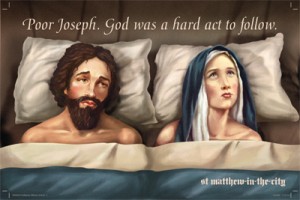
    I recalled this event this morning as I heard that the controversial Christmas billboard, put up by St Matthews in the City, has been taken down. For those outside of Auckland, St Matthews in the City is an Anglican congregation that propounds, what they like to call, “progressive Christianity.” They recently put up a billboard showing Mary and Joseph in bed, not looking too happy, with the line “poor Joseph, God was a tough act to follow.” The billboard implies quite clearly that God not only literally had sex with Mary, was a fantastic orgasmic lover but it also, by implication, entails that God committed adultery, and so did Mary.

    Mary and JosephI am glad the billboard is down (though I will not endorse the  reported method) for the obvious reason that it is insulting to other people and, prima facie, it is wrong to insult other people. Of course, there can be situations, such as where a person does something wrong, that the appropriate response is to insult them but absent such situations, charity dictates that we refrain from doing so. Millions of people world-wide worship God and millions of Roman Catholic venerate Mary, this billboard affirmed that persons they love and adore are adulterers.

    Of course some are saying that this is just a joke and we Christians should get a sense of humour. I always find this response disingenuous. Suppose I, for a joke, put a picture of the vicar of St Matthews, Glyn Cardy and his wife, outside my Church, made both of them look not so happy, and added the phrase “Glyn Cardy is as soft and floppy as his theology,” right there, in public – outside my church let’s not forget – for all to see. Would the response, ‘oh come on it’s only a joke, get a sense of humour,’ wash with anyone? I doubt it. If I were a gambler I would bet we would hear another of Cardy’s little sermons about how this is proof of the narrow-minded intolerance that non-progressive Christians like me expound. But then wouldn’t it be evident that neither Cardy nor anyone else believes that humor justifies making insulting personal comments of this nature?

    Of course in many ways this whole event shows up the intellectual shallowness that so called “progressive Christians” show towards others. Take Cardy’s justification for the billboard according to Stuff, Cardy states,

    St Matthew’s church says the aim is to provoke conversation about spiritual matters by lampooning the literal Christian conception story and inviting people to think again about what a miracle is … He said the idea behind the billboard was to move a debate that was inside the church to outside it ”and certainly people in all sorts of places are talking about it”. He didn’t doubt that some people had been offended by the billboard, but ”the literalness of a male God impregnating Mary needs to be laughed at”.

    Note two things here, first Cardy clearly caricatures the “literal conception story” yet mainstream Christendom, who believes this story, do not hold that God is literally a man and that he had sex with Mary. God in traditional theology is immaterial, he has no sex organs and the story of a virginal conception is just that, a virginal conception. Cardy, of course, being theologically trained, knows this. Second, Cardy on calling for “debate” means that people who hold orthodox Christian views “needs to be laughed at.” So Cardy’s understanding of theological debate apparently involves deliberately distorting and caricaturing the views of other people and then responding, not with reasoned argument, but ridicule.

    I might be a bit too conservative and old fashioned but in my book theological argument involves trying to understand another’s position by trying to grasp the best representative examples of it so one can articulate it accurately and then offer sound arguments or reasons for rejecting it or for showing where and why it is flawed. It also involves treating ones interlocutors with respect. Of course I do not always live up to this ideal but it is one that I think Theologians should aspire to.

    The fact that Cardy and St Matthews thinks otherwise tells us a bit about them and their “progressive Christianity.” People who think it is ok to ridicule and insult people simply because they hold a different religious perspective to them, who will dishonestly distort other’s views and responds to being challenged on this, not by reason, but by self-confident ridicule is not “progressive” and no amount of relabeling it will change this fact.

  • Sunday Study: Interpreting the Sixth Commandment Part II

    In a previous post, Sunday Study: Interpreting the Sixth Commandment Part I, I discussed some translations of the sixth commandment of the Decalogue. I began with the King James Version (KJV), “thou shall not kill.”[1] I looked at problems with this translation most famously raised by Augustine. The New International Version (NIV) and New Revised Standard Version (NRSV) translate the word rasah as “murder” in an attempt to avoid these problems. However, as I noted in my previous post, this translation fails to capture accurately the use of rasah in Hebrew and turns the command into an empty tautology.

    Augustine’s Interpretation
    I want to suggest that an adequate understanding or account of the sixth commandment was suggested by Augustine or at least can be constructed from his writings. In Book One of The City of God, Augustine addressed the question of whether suicide is lawful and concluded that it is not. What is interesting is how Augustine interpreted and applied the sixth commandment in doing this.

    Augustine’s argument against suicide consists of three observations. Firstly, Augustine takes the commandment fairly literally as forbidding homicide. He states, “The commandment is ‘Thou shall not kill man.’”[2] We saw in the last post that there is a sensible basis for this. The term literally means to slay and is predicated only of human beings; further, while in most instances it is used of unjustified killing, it can be used of a lawful execution. The slaying of humans is a common meaning to the different nuances that its use takes in the text.

    The obvious problem for such a reading is that elsewhere the scriptures seem to allow, even command, killing in certain instances. This does not perplex Augustine,

    However, there are some exceptions made by the divine authority to its own law, that men may not be put to death. These exceptions are of two kinds, being justified either by a general law, or by a special commission granted for a time to some individual. And in this latter case, he to whom authority is delegated, and who is but the sword in the hand of him who uses it, is not himself responsible for the death he deals. And, accordingly, they who have waged war in obedience to the divine command, or in conformity with His laws, have represented in their persons the public justice or the wisdom of government, and in this capacity have put to death wicked men; such persons have by no means violated the commandment, “Thou shalt not kill.”[3]

    Augustine’s answer is straightforward. The universal prohibition is the general rule while the specific commands are the exceptions to this rule. The law prohibits homicide; however, the law must be read in its context and not in isolation and, when this is done, one realises that other commands and prohibitions offer qualifications or exceptions to this general rule.

    There are several reasons for accepting this way of interpreting the sixth commandment. Firstly, it is in other areas a matter of common-sense; as Bahnsen notes,

    Human communication by means of language would come to a grinding halt if it were illegitimate ever to express yourself by way of generalizations which do not explicitly acknowledge qualifications and exceptions. Lawyers may specialize in the fine print of complicated legal contracts, but even they do not speak that way in ordinary discourse. A father who asserts that his son is a fine basketball player is not guilty of falsehood or deception simply because he does not add that, of course, his son has some bad games.

    Generalizations which state an accurate summary or the prevailing principle are not, as generalizations, faulty or inaccurate.[4]

    In fact, not only is this a matter of common-sense, it is a method followed elsewhere in scripture. For example in Exodus 21:12,

    Anyone who strikes a man and kills him shall surely be put to death. However, if he does not do it intentionally, but God lets it happen, he is to flee to a place I will designate. But if a man schemes and kills another man deliberately…

    Here we see a universal principle “Any one who strikes a man and kills him shall be put to death” and then immediately this principle is qualified in the proceeding verses. Moreover, contrary to Bahnsen, this type of writing is common even in legal circles. Even contemporary, legal codes often have a general, universal principle laid down regarding homicide or assault and then add specific exceptions which one can appeal to as a defence to committing actions which fall within the broad definition of the general rule.[5]

    As Madeleine has pointed out to me, the legal maxim ‘lex specialis derogat legi generali’ (specific rules override general rules) is still used in legal interpretation today. She said,

    If my lecturer said to the class, I want you to go straight to the library and get started on your assignments but then he said, Madeleine and Matt I want to see you two before you leave he would not be saying that he did not want everyone to go straight to the library and start their assignments just because he gave a specific, contradictory instruction to Matt and I and he wouldn’t be saying that we did not have to go to the library to start our assignments after he had finished speaking to us (once the exception no longer applies) because his specific instructions to us do not override the general instruction to all.[6]

    Secondly, the hermeneutical principle of the analogy of scripture supports this kind of interpretation. We have a general command prohibiting homicide; then we have more specific rules commanding or permitting homicide in certain situations. To interpret the command as absolute and unqualified would be to render the text internally incoherent.

    This leaves two other options; either one understands the general prohibition as the exception to the more specific ones or the specific ones as exceptions to the general rule. The former option is problematic. If a command permitting killing in a certain context is subject to an exception that you can never kill at all then the specific command is redundant and pointless. On the other hand, a general rule that states “do not kill,” except in certain specified circumstances is not redundant. This then seems the more sensible approach.

    A third reason for Augustine’s interpretation follows from a voluntarist understanding of the moral law. In several previous posts I have defended a voluntarist (divine command theory) account of the moral law; one that states that actions are right or wrong in virtue of their being commanded by God. On this account, what is fundamentally wrong about homicide is that it violates the law of God. Now, just as homicide is wrong because it violates the law of God, when God commands or permits homicide in a certain context the very property that makes killing wrong ceases to be present and hence the law is not being broken in that instance. It follows then that the killing in question is not wrong in this instance. This voluntarist understanding of Augustine’s position has a long history and is suggested by Bernard of Clairvaux[7] and Aquinas,[8] as well as those 14th century voluntarists such as Andreas de Novo.[9] Contemporary defenders of this position are Philip Quinn[10] and William Lane Craig.[11]

    Augustine’s position then is to interpret the command as a prohibition on homicide, understanding that in its context it is subject to qualification and exceptions provided elsewhere in the other commands of the law. His basic insight is that the law lays down the general principle “thou shall not kill man;” given that this is the general norm, one is to assume that any given act of homicide is prohibited unless the law elsewhere qualifies this rule or lays down an exception.

    This means that in practice the commandment forbids killing a human being without justification, where justification is construed as an excuse or permission granted by God’s law. In the absence of any other command or permission to the contrary, one should refrain from homicide. In this respect homicide differs from an action that is permissible. One does not need a reason or justification for engaging in a permissible action as one can do it for any reason at all or even no reason. However, because God condemns homicide one needs a reason drawn from the law of God itself before one can engage in it licitly.

    This interpretation clarifies Augustine’s argument that suicide is unlawful. Augustine justifies his conclusion by defending two points. Firstly, “he who kills himself still kills nothing else than man.”[12] Secondly, “It is not without significance, that in no passage of the holy canonical books can there be found either divine precept or permission to take away our own life.”[13] He adds, “in the commandment, ‘Thou shalt not kill,’ there is no limitation added nor any exception made in favor of any one, and least of all in favor of him on whom the command is laid!”[14]

    In other words suicide is homicide and the law does not qualify or grant exclusions to suicide, so suicide is unlawful. It is clear that this inference presupposes the interpretation of the commandment I have defended above. Homicide is unlawful unless the law of God provides grounds or exceptions to the general rule.

    In summation, the sixth commandment offers a general prohibition on homicide. This prohibition is binding unless a specific exception or qualification is found elsewhere in the law of God showing that a particular instance of homicide is licit. The procedure in applying the law is then as follows; first, ascertain whether the action in question is homicide and then ask whether it falls under any lawful exception. If an act is homicide then prima facie it is unlawful and a positive argument from some other command is needed to justify the action if it is to be defensible.


    [1] Exodus 20:13 KJV.
    [2]
    Ibid, 1:20.
    [3]
    Ibid, 1:21.
    [4]
    Greg L Bahnsen “Cross Examination: In Defense of Theonomy” The Counsel of Chalcedon XIV:5-6 (1992).
    [5]
    I am thankful to David Simpkin for bringing this point to my attention.
    [6]
    I am grateful to my wife, Madeleine Flannagan, for sharing this example she developed from Paul Rishworth.
    [7]
    Bernard of Clairvaux On Precept and Dispensation III.6.
    [8]
    Aquinas Summa Theologicae I-II q 800, a. 8, ad 3.
    [9]
    Andrea de Novo Castro Primium Scripturum Sententiarium d 48, q 2, a 2 Concl. 2. I.
    [10]
    Phillip Quinn “The Recent Revival of Divine Command Ethics” Research Philosophy-and Phenomenological Research (Fall 1990) 345-365.
    [11]
    William Lane Craig & Edwin Curley “Does the Christian God Exist?” A debate held at the University of Michigan (5 February 1998).
    [12]
    Augustine City of God 1:21.
    [13]
    Ibid.
    [14]
    Ibid.

    RELATED POSTS:
    Sunday Study: Interpreting the Sixth Commandment Part I

  • Rest In Peace Richard Neuhaus

    It is with sadness that I have just read that Richard John Neuhaus died on Thursday the 8th of January at age 72. There are various obituaries here

    For those New Zealand readers who won’t know. Neuhaus was a Lutheran turned Catholic priest who wrote and commented extensively on issues of religion and public life. His book The Naked Public Square was an important work challenging the modern liberal notion that religion should be privatised and not be utilised in public debate. Neuhaus was was a long time civil rights activist who marched in the civil rights movement, against Vietnam, and became a leading intellectual in the Neo Conservative movement. The journal he edited First Things brought together Jewish, Catholic and Protestant scholars with a conservative bent and produced some of the some of the most thoughtful and insightful commentary on issues related to religion and public life that I have read.

    Neuhaus and his excellent and often sarcastically witty columns will be missed.