Dostoevsky’s Ivan Karamazov’s famously contended that if God does not exist then anything is permissible. Ken over at Open Parachute disagrees and goes one step further and argues that the shoe is on the other foot. Ken maintains that theistic accounts of obligation lead to an “extreme form of moral relativism” and in fact, Dostoevsky’s […]
Entries Tagged as 'Divine Command Theory'
With God Anything can be Permitted: Another Bad Argument against Theistic Morality
April 28th, 2009 30 Comments
Tags: Atheism · Bad Reasoning · Divine Command Theory · Ethics · God and Morality
Walter Sinnott-Armstrong, William Lane Craig and the Argument from Harm Part II
April 20th, 2009 7 Comments
In my last post, I discussed Walter Sinnott-Armstrong’s argument from harm. I concluded by suggesting that his conclusion missed the point and failed to address the conditional, defended by William Lane Craig that, if theism is true then there exists a sound foundation for moral duties. In this post I will argue that the same […]
Tags: Divine Command Theory · Ethics · God and Morality · Walter Sinnott-Armstrong · William Lane Craig
Walter Sinnott-Armstrong, William Lane Craig and the Argument from Harm Part I
April 18th, 2009 1 Comment
This is the first of a two-part series where I examine a recent argument criticising religious ethics by Walter Sinnott-Armstrong. In many of his publications and debates William Lane Craig has defended the contention that if theism is true then there exists a sound foundation for moral duties. In a recent article, Walter Sinnott-Armstrong has […]
Tags: Divine Command Theory · Ethics · God and Morality · Walter Sinnott-Armstrong · William Alston · William Lane Craig
Tooley, The Euthyphro Objection and Divine Commands: Part II
March 25th, 2009 8 Comments
In my last post, Tooley, The Euthyphro Objection and Divine Commands: Part I, I made some critical remarks on Michael Tooley’s critique of William Lane Craig’s version of the divine command theory. Tooley contends that this theory implies the conditional that if God had commanded mankind to torture one another as much as possible then […]
Tags: Divine Command Theory · Ethics · Euthyphro Dilemma · God and Morality · Philosophy of Religion · Walter Sinnott-Armstrong
Tooley, The Euthyphro Objection and Divine Commands: Part I
March 23rd, 2009 12 Comments
In a debate with William Lane Craig at the University of Colorado, Michael Tooley stated, There is a theory which has the consequence that there cannot be objective moral laws unless God exists—that’s the so-called ‘divine command theory of morality’. What it says is that an action is wrong because and only because God forbids […]
Tags: Divine Command Theory · Ethics · Euthyphro Dilemma · God and Morality · Philosophy of Religion · Selection · Walter Sinnott-Armstrong
On a Common Equivocation
January 12th, 2009 6 Comments
Recently I did a post on relativism and in earlier posts I have defended a divine command theory of ethics against various objections. In the comments section Mark V raised an interesting and thoughtful response. I hope Mark does not mind if I pick up on his points because the themes he raises are well […]
Tags: Divine Command Theory · Ethics · God and Morality · James Cornman · Keith Lehrer · Louise Anthony · Mark V · Patrick Nowell Smith · Philosophy of Religion · Walter Sinnott-Armstrong · William Lane Craig
On the Meta-Euthyphro Objection
October 18th, 2008 8 Comments
According to proponents of the Euthyphro Objection, defenders of a Divine Command Theory of Ethics face a dilemma, actions are morally-required either because: (i) God commands them; or, (ii) God commands them because they are morally-required. The latter (ii) entails that actions are right and wrong independently of God’s commands and as such, a Divine […]
Tags: Divine Command Theory · Ethics · Euthyphro Dilemma · God and Morality · Philosophy of Religion

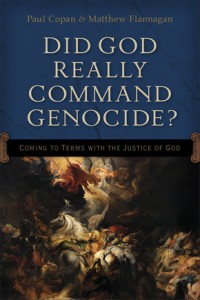 A common objection to belief in the God of the Bible is that a good, kind, and loving deity would never command the wholesale slaughter of nations. In the tradition of his popular Is God a Moral Monster?, Paul Copan teams up with Matthew Flannagan to tackle some of the most confusing and uncomfortable passages of Scripture. Together they help the Christian and nonbeliever alike understand the biblical, theological, philosophical, and ethical implications of Old Testament warfare passages.