Category: Philosophers

  • Back from Atlanta

    On Wednesday I arrived back in New Zealand after a full-on week in Atlanta. During this time I attended bits of four conferences: The Annual Meeting of the Evangelical Theological Society (ETS), The Annual Meeting of the Evangelical Philosophical Society (EPS), The Evangelical Philosophical Society Apologetics Conference “Set Forth Your Case” and the The Annual Meeting of the Society for Biblical Literature (SBL).
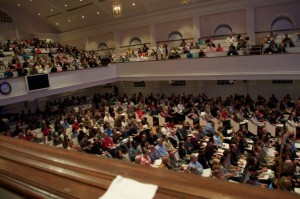
    The EPS Apologetics Crowd at Johnson Ferry Baptist Church

    These four conferences ran over a period of two weeks, in roughly the same place, and overlapped each other – thousands of people attended them.

    There is no way I can do justice to everything that occurred so here are some highlights.

    I did not attend many sessions of the ETS as it ran parallel to the EPS. However, the highlight for me of what I did see was a rigorous address by Tom Wright on justification and the new perspective on Paul. This was followed by a lively panel discussion on this issue with Tom Wright, Thomas Schreiner, Frank Thiemann.
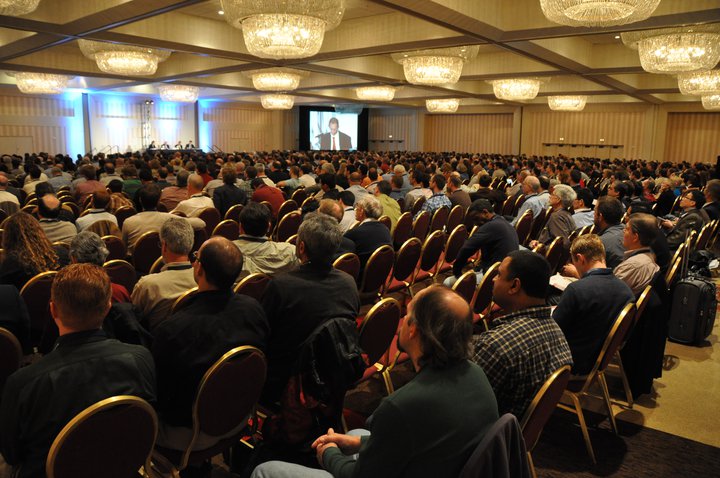
    The ETS crowd.I thoroughly enjoyed my time at the EPS, this was an excellent three days. I attended numerous sessions. My hosts laughed at how I was constantly seen going back and forward to various Hilton conference rooms between sessions, I could always be found engaging in rigorous discussion during the Q&A sessions or simply involved in an intense conversation dissecting the issues just raised with other attendees. It was a fairly intense time intellectually but I really enjoyed it.

    Space prevents me doing justice to all the excellent papers I heard. There was an interesting paper on the role of ridicule and irony in convincing people of basic beliefs, which combined ideas from Kerkigaard and Reid. Another I enjoyed was an interesting discussion on inclusivism, the view that people who have not heard or accepted the gospel can be saved through Christ’s atonement if they are invincibly ignorant and respond in faith to the minimal revelation about God they do have. I heard some fascinating discussions on whether it is possible for God to issue insincere commands and how the issue of Abraham relates to this; questions of whether the fact that one’s epistemic peers disagree with you provides grounds for reducing confidence in your beliefs.

    Mike Austin delivered a thoughtful paper on the Canaanite issue, noting that on an influential moral theory, Rossian deontology, that duties to not kill are prima facie duties which can be overridden in certain circumstances and so God could, in principle, command killing the innocent. There was also a really interesting paper by Gary Habermas on the latest theories regarding the Turin Shroud. Frank Beckwith criticised evangelical appropriations of Aquinas. Mike Licona offered a synopsis of his new book. Paul Copan spoke on how naturalists declare the glory of God. All these sessions were associated with vigorous and thoughtful discussion.
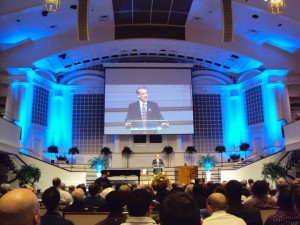
    William Lane Craig presenting at the EPS

    The two most technical papers were William Lane Craig’s response to Peter Van Inwagen and Alvin Plantinga’s paper “A New Argument against Materialism.” Van Inwagen has argued for Platonism, the view that abstract objects have real existence independently of God. Craig, a fictionalist, argued Van Inwagen had not really responded to the nominalist and fictionalist alternatives. Plantinga, in a packed out plenary session – by packed out, I mean a good thousand in attendance – argued that the counter-factual test for causation shows that if materialism is true then beliefs cannot cause behaviour. This involved Plantinga making some really interesting moves such as rejecting the standard view of impossible counter-factuals. Plantinga was particularly good in the Q&A.
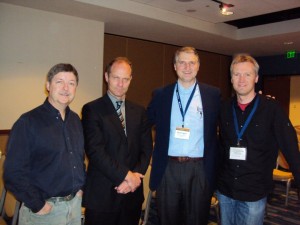
    Doug Geivet, me, Paul Copan, Rodney Lake

    What was striking for me was not just the calibre of the papers and the philosophical seriousness of those in attendance but also the obvious evangelical Christian commitment of the attendees. There was a strong sense that even when offering critique we were working together to better each other’s papers in the service of God. It was quite weird for me to be in a context where both of these things were conjoined. It was also surreal to find myself in the same room as numerous people whose work I had read and respected for years and yet I was able to discuss and critique their work face to face. This mixture of intellectual rigor, fellowship and spirituality was perhaps most evident at the reception. There, while we mingled with Philosophy greats, like Alvin Plantinga, everyone paused for a talk on the importance of prayer and religious devotion in spiritual formation. My entire experience to that moment as a Christian had been that when people spoke of the latter they did so at the expense of the former. It was refreshing to see the kind of spiritual wholism those present aspired to.

    Another thing that totally blew me away was how many people read MandM and recognised me on sight. On the first day I sat next to a woman who told me she knew my wife from the net. Later I heard someone walking past say “I read that guys work, he has a good website.” A few Philosophy professors approached me and said things like “it’s good to meet you Dr Flannagan” and they’d relay how they regularly read my work online.
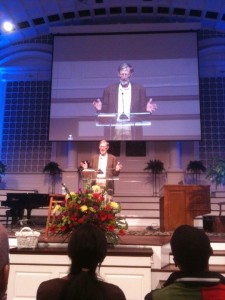
    Alvin Plantinga at the EPS

    On Thursday, we drove to Johnson Ferry Baptist Church for the EPS Apologetics conference. This church was huge. I have never seen a church of this size in my life. It was three stories high and had literally hundreds of rooms. It had numerous lecture theatres, a gymnasium, a two-storied church auditorium, a dining room, bookstore and so on. Over 1,500 people turned up to hear Alvin Plantinga give his plenary talk. Plantinga presented his paper “Science and Religion where the Conflict Really Lies.” He rebutted arguments that evolution shows that God does not exist and then offered a summary of his evolutionary argument against naturalism. What was a little disappointing was the aggressive response of some questioners who were horrified that  evolution and atheism may not *be* the same thing. In the Q&A, however, Plantinga, quite typically, provided gracious but effective responses exposing with humour the fallacies in the objections raised.

    After the talk I went to the book signing session only to discover a huge number of Americans who read MandM, knew who I was on sight and wanted my thoughts, ideas or even to be photographed with me (go figure!?). One biblioblogger made a point of snapping at least one papparazzi-style shot of me every day which he then published on his blog. Madeleine kept emailing me links to blogs and Facebook status updates of people present at the conferences excitedly rattling off a list of their favourite scholars that they’d met that day that had me in them. It was surreal.

    The business end of the conferences occurred on Saturday where I had two presentations to give. The first was on Saturday morning where I presented my paper “God and the Genocide of the Canaanites,” an updated and modified version  (thanks to the many people who interacted with it on this blog and others) of the infamous blog post I published back in January, which will soon be published in Come Let us Reason edited by William Lane Craig and Paul Copan to be published through B&H Academic.
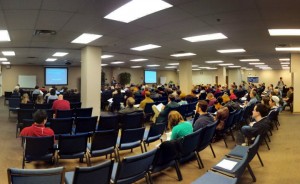
    My talk at EPS Apologetics ConferenceThe basic thesis of this paper was that the accounts of Genocide in Josh 6-11, if taken literally, contradict the accounts of the conquest in Judges and Joshua 13-17. Given that the final editor of the Canon juxtaposed these accounts, and was not stupid, he must have not intended both to be taken literally. I suggested that Wolterstorff’s position, that the former were hagiographic history and highly hyperbolic, made best sense of the evidence.

    To my considerable surprise it was well received. Given some of the tone of the questions directed at Plantinga, I was worried I might have upset the more literalist attendees but instead there was real interest in my idea that the Joshua narratives were not literal accounts of what happened. I later heard that William Lane Craig had said I’d had the biggest attendance of the break-out sessions that day, and I was inundated with people asking me questions afterwards so that I had to go into over time.

    Particularly amusing was the response to an illustration in my talk I gave as an example of hyperbolic and hagiographic writing, the claim that the All Blacks annihilated their opponents whilst touring the northern hemisphere. This is obviously hyperbole and, as any kiwi knows, it is also a form of hagiography (the All Blacks are revered after all). After the talk, a US rugby player told me he really appreciated this illustration; he also told me that if his team ever played the All Blacks he expected that his team would be annihilated and that the annihilation would not be hyperbolic!
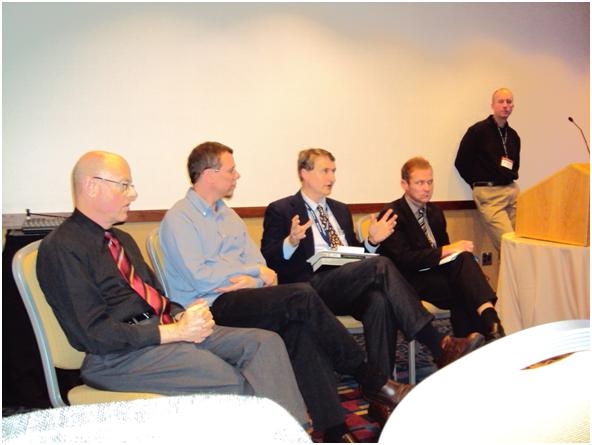
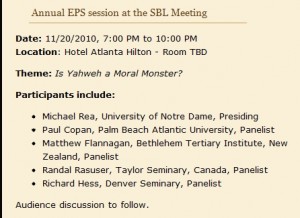
    The EPS Session at the SBL: Richard Hess, Randal Rauser, Paul Copan, me, Michael ReaThe second presentation was positively terrifying. I was on a panel at the SBL Conference. The SBL Conference was not only the biggest of the fourconferences but is the biggest annual gathering of biblical scholars in the world. Naturally it is a gathering of the world’s best biblical scholars in one place too. The panel topic was “Is Yahweh a Moral Monster?” and I was talking on how the holy war passages related to divine command morality. This was really scary. First I was on the panel with some pretty good scholars. Richard Hess, from Denver seminary, is a world class old testament scholar. Paul Copan of Palm Beach Atlantic University, the President of the Evangelical Philosophical Society has just published a monograph on Old Testament Ethics. Randall Rauser is a theologian from Canada who has also published in this area. The chair was the distinguished Notre Dame Philosopher, Michael Rea. Moreover, the audience contained numerous high-level scholars including Christopher Wright, William Lane Craig, Doug Geviett and many others. Each panellist was slated to speak for 20 minutes and then there would be a long Q&A afterwards. I was terrified.
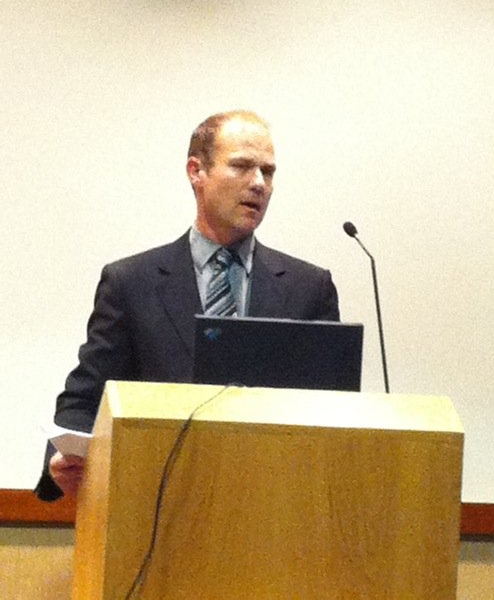
    Me speaking at the EPS panel discussion at the SBLDespite being gripped with panic, the talk went well. Everyone in the audience I spoke to said they found it interesting and I eventually settled into the Q&A with increasing confidence. The panellist’s presentations were all very interesting. Richard Hess argued that the cities the Isrealites were commanded to attack in Deut 20:16 were forts not population centres.  Paul Copan argued that the Bible does not support slavery, as that term is understood in English, but rather tolerated a form of indentured servitude. Particular suprising was the presentation from Randal Rauser. Prior to thetalk I had expected to be radically at odds with his views but I was surprised on how many basic issues and methods we agreed. Both of us, for example, advocated a more canonical approach, one that stressed the divine author of the final form as opposed to focusing on individual authors of pericopes in addressing the issue. We did disagree over some exegetical questions, how to interpret herem, for example, and we did sharply disagree over whether a particular analogy he used was valid.
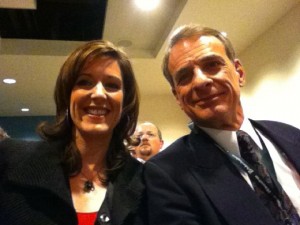
    Mary Jo Sharp and William Lane Craig in the audience at my SBL talk

    What I was even more pleased with, however, was the positive feedback from the audience regarding the Q&A. William Lane Craig said he found our discussion “hugely interesting and helpful!” This was a sentiment repeated by numerous others including Doug Geviett and Mike Licona. Mary Jo Sharp said “this discussion was outstanding” and Claude Mariottini said that he considered it the best of the sessions he attended. It turned out to have had the biggest turn-out of any EPS presentation at the SBL to date.

    So now I am back in NZ, having presented papers that began as blog posts on a international stage and have done so successfully. The opportunity was truly amazing and I thank all MandM supporters and readers who have supported me in doing this. I also need to thank Paul Copan and William Lane Craig for the opportunity to do so. I truly enjoyed the challenge and relish the opportunity to do it again next year in San Fancisco.

    RELATED POSTS:
    Georgia on my Mind
    Joshua and the Genocide of the Canaanites Part I
    Joshua and the the Genocide of the Canaanites Part II
    Did God Command Genocide in the Old Testament?
    A Selection of Matt’s posts on Divine Commands

  • “Does the Universe Have a Purpose?” Dawkins, Ridley, Shermer v Craig, Geivett, Wolpe (in English)

    Richard Dawkins, Matt Ridley, Michael Shermer debated William Lane Craig, Douglas Geivett, David Wolpe on the topic “Does the Universe Have a Purpose?” on Mexican television on 13 November 2010. This is the english version:

  • In Atlanta

    I have a few snaps of Matt in Atlanta, this first one had our kids excited when they saw it [which should tell you everything you need to know about just how much Matt is a fan of Dr Alvin Plantinga – LOL!]

    Alvin Plantinga, Matt and Rodney Lake
    Alvin Plantinga, Matt and Rodney Lake

    Fellow kiwi Rodney Lake of Thinking Matters Tauranga, also in Atlanta attending the conferences, took the above photo and wrote on Facebook of it:

    Tonight I met and chatted with simply the greatest collection of Christian thinkers the world has to offer – hands down – without a doubt – the best! You couldn’t put together a better bunch in the same room than this. There were others, but the ones I got to talk to included: Alvin Plantinga, William Lane Craig, Mike Licona, JP Moreland, Paul Copan, Craig Hazen, Frank Beckwith, Mary-Jo Sharp and of course Matthew Flannagan. Also earlier in the day shook hands with Gary Habermas and Greg Koukl. A day to remember…

    Rodney has been doing a tour around the US over the last few weeks of the various Apologetics ministries and has been meeting up with various biblical scholars and Christian philosophers. You can read about what he has been up to and who he’s been trying to talk into coming out to New Zealand on his blog.

    Jim West snapped this one, Matt the kid in the candy shop – surrounded by the worlds best in his field and their books!

    Jim West snaps Matt at the EPS

    Jim has been quite the tourist, he’s been snapping everyone and everything by the looks of his homepage.

    I just talked to Matt on Skype – we are so grateful to the kind and generous people who donated us Skype equipment – he said it is quite surreal to be wandering around, sitting in seminars and recognising all these philosophers and theologians whose works he has read and admired all around him. He said the conversations following each session are very stimulating; everyone understands the topics, it is a lot like being at a Philosophy department seminar, only everyone is coming from a Christian perspective – which is something Matt is just not used to but is really appreciating. He said that MandM is clearly more widely read than either of us realised as plenty of people recognised him and complete strangers asked after me, commented on our blog and so on. The internet clearly makes the world a small place! Anyway he is having a blast and is doing great.

  • Georgia on my Mind

    On Tuesday 10 November 2009 I was in Tauranga. I had been commuting from Auckland to Tauranga every Monday to attend lectures for the teaching diploma I was studying towards and then on Tuesdays I would deliver lectures for the adjunct position I had at the same institution in Tauranga. I remember that particular Tuesday well as, during the several hours that elapsed between the lectures I was giving, I listened to a talk by Nicholas Wolterstorff, which had been delivered during a Conference at the University of Notre Dame. The paper was entitled “Reading Joshua.” Wolterstorff noted that the book of Judges proceeded on the assumption that the events of Joshua 6-11 never literally happened. He then argued that taking Joshua in its context as the first of a sequence of Canonical books, which included Judges as the sequel, the account of the “conquest”  should not be taken literally.

    Atlanta, Georgia - my home for the next 10 daysLooking at internal textual evidence, Wolterstorff  argued that the accounts of genocidal slaughter recorded in Joshua were hyperbolic and should not be taken literally. Joshua was a hagiographic account of various skirmishes Isreal had and it was a mistake to read it as saying God actually commanded Genocide.

    Wolterstorff’s paper fascinated me because it resonated with another book I had read in 2006. In, On the Reliability of the Old Testament,  Kenneth Kitchen wrote a comprehensive critique of biblical minimalism, addressing the charge that archaeology showed that the total conquest and genocide the book of Joshua records never happened. Kitchen contended that Joshua did not teach a total conquest. Kitchen pointed out that it was common in Ancient Near Eastern historiography to write highly hyperbolic accounts of battles involving the gods sending meteors onto the enemy, campaign’s  being completed in a day and victories involving the  killing of every single member of the enemy. Both Mernphath and Mesha had written in the 1200’s and 600’s, respectively had used similar language to claim they had destroyed Israel. Such accounts were hyperbolic.

    I heard this talk just over a year ago. Since then my adjunct contract has finished, I graduated with a teaching diploma in May and have been earning a living on the short term contracts to teach here and there, all of which dried up with the close of the school year, donations from speaking engagements and those received via this blog. It has been a tough year. Yet what  began on that November Tuesday back in 2009 has proved extremely fruitful. I began turning thoughts around in my mind, asking questions and piecing ideas together.  A month later, in December, I began discussing some ideas with Paul Copan. A philosopher in Poland wrote to me out of the blue asking me what I thought of the Canaanite Genocide he then passed my thoughts onto others. I had an interesting exchange on the issues with Lydia McGrew. I began chasing down Kitchen’s sources and in January I tentatively wrote up some of my ideas in Joshua and The Genocide of the Canaanites Part I and Part II.

    These posts have been extremely well read. The huge number of backlinks received make those posts some of the most linked to pages on this blog and the critical comments have been overwhelming, almost impossible to keep up with especially as they began to spread out on the net turning up on other blogs, message boards, facebook pages and so on. I suddenly found, people from all over the world contacting me on facebook and by e-mail to ask me questions and talk to me on my ideas. The secular blogosphere increasingly began to take notice of what I had written.

    In just a few months, offers to publish on this issue in upcoming anthologies began to come in. I discovered I was appearing in footnotes of major publications. I found myself debating Raymond Bradley, an Emeritus Philosopher of Philosophy and a world class logician. I received offers to speak at the annual meetings of the Evangelical Philosophical Society (EPS) and the Society of Biblical Literature (SBL); the latter will be in the form of a panel discussion where I am taking the place of Christopher Wright (!)

    SBL Panel Discussion

    This all seemed to me to be quite ridiculous. Here I am, an unemployed theologian, a relatively recent graduate who wrote some ideas in a blog, suddenly I was being asked to speak alongside William Lane Craig, Alvin Plantinga and over 20 of the world’s top evangelical scholars?

    In addition to having published a more popular version of the work in a mainstream magazine, I have now updated the original post into an article which has been given a solid offer of publication as a chapter in an edited book. In addition, I have four other publications on the issue forthcoming next year and in less than 24 hours I will fly to Atlanta, Georgia, USA to deliver my EPS and SBL talks. I am terrified, humbled and overwhelmed by how providence has moved in the last 12 months. The practical support I have received from people all over the world, as well as the untold comments from people all over the world who have stated appreciation for what I had written has been truly overwhelming.

    It is so hard to fathom that I am at this point. In 1997 I completed a masters thesis on Alvin Plantinga’s reformed epistemology. At that time I dreamed of going to the US at some point to hear Plantinga speak. It never eventuated, I got married, had kids and heard Plantinga was retiring. I figured it would never happen. I saw an advertisement for the Atlanta EPS conference last year and saw that Plantinga was the key note speaker. I did not even submit a paper because I was convinced it was too much of a long shot, they’d never want me and how would I raise the funds to get there? In 2008 I was involved in organising some speaking engagements for Bill Craig in Auckland. After the last event I walked Bill and Jan back to their hotel and said goodbye. Half jokingly I said to Bill, I’ll see you at a conference in a few years. At the time I was employed to stack shelves in local supermarkets and I thought to myself that what I said was probably wishful thinking. If you had told me 12 months ago that my ideas on hearing Wolterstorff’s lecture would see me speaking at a conference alongside these people and that I would be publishing with them – just one year later – I would have told you you were nuts.

    Fundraising for my US trip

    I have no idea what the future holds, or where this all is going. Tomorrow, I leave New Zealand to head to Atlanta to spend 10 days with some of the best Christian Philosophers in the world. People whose works I’ve been reading and admiring for years are now treating me, at least for a time, as a collegue. I really do not know what this means, what God is doing or what his plans are. I really hope and pray that some employment working in my field will eventuate from this but all I can say at this stage is thank you to all readers of MandM who have believed in my work. Without your daily visits and comments and links MandM would not have risen to its current prominence in the blogosphere or its position in Google, which it needed to to get my work noticed. (I am also very aware of the no-small efforts and skill of my wife on this front). I must thank Paul Copan for making this happen and opening doors for me – his support and encouragement has been tremendous. Thank you again to those who have supported us financially, kept us in your prayers, believed in me, encouraged me and who have recommended this blog to others. I feel overwhelmed and humbled by your support. The prospect of sharing some of my ideas to audiences that contain scholars of this magnitude is probably one of the scariest undertakings I have done to date, and I have addressed some scary audiences! Thank you everyone for this opportunity.

    I’ll try to pop into the blog from Atlanta and I will definitely write an update when I get back. Please continue to pray for me and for Madeleine back in New Zealand holding down the fort with the kids, the blog and sitting her final Certificate of Professional Legal Studies examinations (the NZ equivalent of the US Bar Exams) while I am away. Please also pray that the conferences happening in Atlanta touch people’s hearts and minds and draws them into a closer and more thorough knowledge of God.

  • God, Morality and Abhorrent Commands: Part II Robert Adams

    In this three-part series I will look at some different ways of adjudicating conflicts between apparent divine commands and moral beliefs. I started with Immanuel Kant, now I will look at Robert Adams’ position.

    In “God, Morality and Abhorrent Commands: Part I Kant” I mentioned Phillip Quinn’s observation that theists can face a particular dilemma,

    “[I]t seems possible that a theist should have both good reasons for believing that God has commanded him to perform a certain action and good reasons for believing that it would be morally wrong for him to perform that action. Thus a theist can be confronted with moral dilemmas of a peculiar sort.”

    Immanuel Kant argued that when faced with such a dilemma the theist should reject the belief that God has commanded the action and accept the moral belief. This was due to his belief that moral beliefs are more certain that theological beliefs. I contested this claim. More recently Robert Adams has defended Kant’s conclusion. Consider the structure of the kind of dilemma Quinn cites,

    [1] Whatever God commands is morally permissible;

    [2] God commands X;

    [3] It is wrong to do X.

    These three claims contradict each other; like Kant, Adams suggests that the rational person should reject [2]. However, his reasons are somewhat different. Adams persuasively reasons that [1] is true only if God is understood as perfectly good, in the sense of being loving, just and so on. If God were evil or morally indifferent then it would be possible for him to command wrongdoing and so [1] would be false.  This means that a person who accepts [1] must presuppose that God is good.

    Adams argues that God cannot be meaningfully said to be good if what he commands drastically departs  from what we consider to be right and wrong. Human beings have some grasp of what constitutes goodness and some grasp of what constitutes right and wrong and it is part of our concept of what is good that a good being does not command wrong doing. Moreover, to call a being good is to attribute to it a character trait that is incompatible with certain other actions, attitudes and so on. Raymond Bradley made the point succinctly in his debate with William Lane Craig “Can a Loving God Send People to Hell?“

    “If we were to describe someone such as Hitler as perfectly good despite all his evil doings, we’d be playing word games which are intellectually dishonest as they are morally pernicious. … it would be to deprive the word “holy” of its ordinary meaning and make it a synonym for “evil.”

    This supports Adams’ conclusion that one cannot rationally accept [1] as one implicitly assumes that God does not issue commands at variance with our conception of morality. In Finite and Infinite Goods: A Framework for Ethics he concludes,

    “Our existing moral beliefs are bound in practise, and I think, ought in principle, to be a constraint on our beliefs about what God commands. We simply will not and should not, accept a theological ethics that ascribes to God a set of commands that is too much at variance with the ethical outlook we bring to our ethical thinking.” [Emphasis original]

    As with Kant there is a lot of truth to this; however, Adams’ position has certain limits.  As critics of Adams have pointed out his conclusion is limited. In the paragraph above Adams concludes that “our existing moral beliefs” must be a constraint on our beliefs about what God commands. His justification for this is that we “should not, accept a theological ethics that ascribes to God a set of commands that is too much at variance with the ethical outlook we bring to our ethical thinking.” The phrase “too much” suggests that one can accept ascription of a set of commands that is somewhat at odds with the outlook we bring to our ethical thinking.

    Two points Adams makes elsewhere in Finite and Infinite Goods suggest that this limitation on his conclusion is necessary. First, while we do have some grasp of what is good and some grasp of what is right and wrong it is evident that our moral judgements are fallible. Adams calls this the “transcendence” of the good. He states,

    “All of God’s commands and judgments are right; God is the ethical standard. But our beliefs (even the most cherished) about them must be distinguished from God’s commands and judgments themselves. To fail to make that distinction is idolatry.”

    Adams is surely correct here. While God does not command wrongdoing. It is quite likely that a perfectly good omniscient being would command something contrary to what we think is wrong.  Our moral intuitions are fallible, hence it is possible that some of God’s commands would clash with our own moral judgements. In fact to suggest that God would never command something which we consider to be wrong expresses an incredible hubris. It is to dogmatically assume that we are such good judges of morality that God could never disagree with us. It is to put our own moral judgements beyond question. The existence of some commands that strike us as strange or immoral does not count for much.

    Second, our concept of goodness and our judgement about particular cases can be and sometimes is subject to revision. We change our opinions about the goodness and rightness of certain things without “playing word games which are intellectually dishonest” or depriving “the word ‘holy’ of its ordinary meaning and make it a synonym for ‘evil.’”  If this were not the case, one could never honestly or rationally change ones mind on an ethical issue. Nor could people coherently disagree with or persuade one another about moral issues. Adams’ notes this when he writes that he accepts “the possibility of a conversion in which one’s whole ethical outlook is revolutionized, and reorganized around a new center” but “we can hardly hold open the possibility of anything too closely approaching a revolution in which, so to speak, good and evil would trade places”.

    These points, however, quite evidently limit Adams’ conclusion. What his argument, in fact, shows is not that “our existing moral beliefs must serve as a constraint on our beliefs about what God commands” but rather that certain types of our existing beliefs do this, those so central to our concept of goodness that accepting them would be “approaching a revolution in which, so to speak, good and evil would trade places.” In “A Psychological Constraint on Obedience to God’s Commands: The Reasonableness of Obeying the Abhorrently Evil” James Rissler notes,

    “In such an instance, obedience requires that one give up everything one previously believed about morality… one has been commanded to relinquish everything one understands about the nature of goodness, one will have no concept of the good with which to identify Gods command, there will be complete breakdown of between everything one currently affirms about goodness and everything one is asked to believe about goodness.”

    Rissler gives two examples; the first is where God issues a command to reverse one’s conception of right and wrong or issues a set of commands, each one of which negates every moral imperative one currently accepts. Second, he suggests that a moral belief might be “sufficiently integral to one’s conception of morality” that abandoning it would force such a radical revision as to destroy one’s concept of goodness all together. Imagine a command to kill everyone around you purely for entertainment or a command that said harming, hurting and inflicting suffering on people for no reason at all is permissible. Consider a command to hate God and despise all other human beings. One cannot accept a system of divine commands where every duty we believe in is declared false nor can we accept a system which suggests that the vast majority of our moral beliefs are mistaken. This would come too close to the problematic revolution Adams talks of.

    To sum up, in Part I and II, I have looked at the Kantian approach to the kind of dilemma Quinn sketches. Neither Kant or Adams, I think, establish the claim that in “our existing moral beliefs must serve as a constraint on our beliefs about what God commands.” They did, however, lend support for a weaker thesis. Kant’s argument, for example, does suggest that those moral claims about which we are certain, should serve as such a constraint and I mentioned several beliefs which I consider to be fairly certain as examples.

    Adams’ argument on the other hand suggests that we cannot coherently “accept a theological ethics that ascribes to God a set of commands that is too much at variance with the ethical outlook we bring to our ethical thinking.” He argues that we cannot coherently or defensibly accept a theological ethics which, in effect, makes good and evil trade places and which so radically transforms our concept of goodness so that good becomes a synonym for what we call evil or calls our concept of goodness so radically into question that it breaks down. Certain beliefs such as it is prima facie wrong to inflict pain and suffering on others or it is prima facie wrong to treat others with contempt” or it is prima facie wrong to lie, steal and kill are so central to our account of goodness that we cannot coherently accept that a perfectly good being has issued commands that negate them.

    In my next post I will look at Philip Quinn’s alternative.

    RELATED POST:
    God, Morality and Abhorrent Commands: Part I Kant
    God, Morality and Abhorrent Commands: Part III Philip Quinn

  • God, Morality and Abhorrent Commands: Part I Kant

    In this three-part series I will look at some different ways of adjudicating conflicts between apparent divine commands and moral beliefs starting with Immanuel Kant.

    In “Commonsense Atheism and the Canaanite Massacre” I addressed a question put to me by Luke from Commonsense Atheism,

    “If Matt did think these events happened literally as described in the Bible, would he then conclude that God was an evil monster to command them? Or would he, in the end, agree with Bill Craig that genocide is okay as long as God feels like it?”

    In my response I pointed out Craig claims that killing non-combatants in war is permissible if a loving and just God commands it (which is an implication of a divine command theory). This conditional is arguably true. Either it is possible for a just and loving omniscient person to command genocide or it is not. If it is then genocide would only be commanded in situations where a just and loving person, aware of all the relevant facts, could endorse it; under these circumstances it is hard to see how genocide could be evil. On the other hand, if it is impossible for a just and loving omniscient person to ever command genocide then the situation Luke mentions is one with an impossible antecedent. On the standard accounts of counter-factual logic, conditionals with impossible antecedents are true. So far from being absurd there are reasons for thinking this conditional is true.

    The question Luke asks is really a species of a larger and important question in theological ethics. In Finite and Infinite Goods Robert Adams notes “A convincing defense of a divine command theory of the nature of obligation must address our darkest fear about God’s commands–the fear that God may command something evil.” Philip Quinn makes a similar point,

    “[I]t seems possible that a theist should have both good reasons for believing that God has commanded him to perform a certain action and good reasons for believing that it would be morally wrong for him to perform that action. Thus a theist can be confronted with moral dilemmas of a peculiar sort.”

    I suspect Luke is really asking how a theist can rationally respond to a dilemma of this sort. While I do not know what Luke’s opinion on this issue is, a common view is that if a theist has good reasons for believing an action is wrong then any claim that God has commanded should be rejected. The locus classicus for this position is Immanuel Kant; in Reason within the Bounds of Religion, Kant stated:

    “Abraham should have replied to this supposedly divine voice: “That I ought not kill my good son is quite certain. But that you, this apparition, are God — of that I am not certain, and never can be, not even is [read: if] this voice rings down to me from (visible) heaven.”

    Similarly, in the Conflict on the Faculties he states he states,

    “That to take a human being’s life because of his religious faith is wrong is certain, unless (to allow the most extreme possibility) a divine will, made known to the inquisitor in some extraordinary way, has decreed otherwise. But that God has ever manifested this awful will is a matter of historical documentation and never apodictically certain. After all, the revelation reached the inquisitor only through the intermediary of human beings and their interpretation, and even if it were to appear to him to have come from God himself (like the command issued to Abraham to slaughter his own son like a sheep), yet it is at least possible that on this point error has prevailed.”

    Kant, here, is discussing the kind of dilemma Quinn refers to. The dilemma can be spelled out as follows, in certain situations a theist might find him or herself with reason to affirm the following three propositions,

    [1] Whatever God commands is morally permissible;

    [2] God commands X;

    [3] It is wrong to do X.

    These three claims cannot all be true, so a rational person must reject one of them; the question is which one? Kant’s answer is that when faced with a dilemma of this sort the theist should reject [2].  It is worth elaborating on his position a bit.

    First, note that Kant accepts [1] he grants that if we knew that God commanded the killing of a particular human being, it would be permissible to kill that human being. Kant’s objection is that one cannot be rational in believing that God has, in fact, issued such a command. Philip Quinn notes that Kant’s argument involves an appeal to an epistemic principle: whenever two conflicting claims differ in epistemic status, the claim with the lower status is to be rejected.  Kant contends that moral claims such as “it is wrong to kill innocent people” are certain. However, claims that God commands or forbids a certain action are not certain and never can be. From these points it follows that a rational person will accept [3] and reject [2].

    Despite its appeal Kant’s argument is flawed for several reasons. Philip Quinn notes two problems. First, “Kant has an extremely optimistic view of our ability to attain epistemic certainty about principles of moral wrongness,” he thinks we can be certain of moral claims. This, however, is dubious. There are some moral claims of which I am fairly certain. I am certain, for example, that it is wrong to inflict as much pain on another as I can merely for my own entertainment. I am fairly certain that killing, assault, theft and lying are prima facie wrong and can only be justified if some overriding moral reason applies. However, many moral claims are highly controversial and are far from certain at all. Consider, for example, the debate over whether the bombing of Hiroshima was justified because it saved a huge number of lives by ending a war early. While I myself do not share this opinion, I would not say I am certain about it. Similarly, consider moral debates about capital punishment or euthanasia or affirmative action. While I believe there are defensible and justified answers to these questions, I doubt we can claim certainty about answers to these questions.

    Second, Kant claims that we can never be certain that God has prohibited a certain action. Quinn notes, “It would thus seem to be well within God’s power to communicate to us a sign that confers on the claim that God commands some intolerant behavior, for example, issuing threats to heretics, a fairly high epistemic status.” If God were to do this then we would have certainty that he had commanded the action. So it is not clear that beliefs about what God wills are always less certain than moral beliefs.

    I am inclined to push this criticism further. It seems to me that many sceptical worries that are raised about God and his commands apply with equal force to moral beliefs. Consider three common concerns sceptics raise about religion. One is the claim that the existence of God is not necessary to explain any empirical phenomena. The second is the concern that the claim God exists and has commanded a particular action cannot be empirically demonstrated or proven to exist. The third is the widespread pluralism with regard to both the existence of God and his nature. All three of these worries apply to moral beliefs. The existence of moral properties appears unnecessary to explain any empirical phenomena, almost any empirical phenomena can be explained equally well by accepting that moral beliefs are all false but that people think they are true. Attempts to prove that moral beliefs are true from non-moral premises alone are probably more controversial than any argument for the existence of God. And there is widespread pluralism over whether moral properties exist; nihilists and non-cognitivists deny such properties exist and amongst believers in the truth of moral beliefs, there is widespread disagreement over the nature of morality. Intuitionists contend it is a non-natural property, naturalists contend it is a natural property but disagree over what the natural property in question is, supernaturalists contend it is a divine command or a theological property and so on.

    In fact, Kant’s own argument provides an example of this point. Kant argues in The Conflict in the Faculties that we can never be certain that God has commanded an action because,

    “the revelation reached the inquisitor only through the intermediary of human beings and their interpretation, and even if it were to appear to him to have come from God himself (like the command issued to Abraham to slaughter his own son like a sheep), yet it is at least possible that on this point error has prevailed.”

    But this is equally true of many moral beliefs, a good amount of what people believe with regards to morality comes to them through the intermediary of human beings and their interpretation. Most westerners belief’s in liberal ideals, such as, the equality of women, opposition to slavery and so are mediated through human beings. Moreover, even if we directly intuit moral properties, it is possible that we are mistaken. Human moral intuitions and judgements are fallible and can err. So in many instances I am inclined to think that the sceptical worries people raise to conclude that theological beliefs are uncertain apply also to moral beliefs. To appeal to these concerns, so as to claim that belief about God’s will is less certain than moral beliefs, is to engage in special pleading.

    In my next post I will look at Robert Adams’ defence of Kant’s position and then I will look at Philip Quinn’s alternative.

    RELATED POSTS:
    God, Morality and Abhorrent Commands: Part II Robert Adams
    God, Morality and Abhorrent Commands: Part III Philip Quinn

  • Podcasts on Christian Physicalism and The Probability of Christianity

    Matt and I have been listening to podcasts in the evening lately. These two, featuring two of our friends, who are both philosophers and bloggers, are really worth a listen.

    Glenn on Physicalism
    Glenn Peoples, of Say Hello to my Little Friend: The Beretta Blog and Podcast, recently spoke at the University of Oxford at the annual conference of the European Society for the Philosophy of Religion on the topic “Raising the Justificatory Hurdle: How to Make Sure Religion Stays Out of Politics No Matter What” and while he was there he appeared on the UK’s Unbelievable? radio show to debate the issue of physicalism with John Haldane.

    Listen to: Christian Physicalism: Do we have a soul? – Unbelievable? 04 Sep 2010

    Christians have traditionally held that humans comprise two things – a body and a soul. Christian Philosophers have written in defence of the soul against a reductive atheism that claims we are material beings alone.

    But a new movement in Christian philosophy claims that the atheists are correct, at least when it comes to humans.

    Dr Glenn Peoples is a Christian philosopher who subscribes to physicalism – that humans are only physical and they have no immaterial soul. He explains how he arrived at that view from Scripture and how he defends it philosophically, without giving up an evangelical Christian view.

    Prof John Haldane is a Christian philosopher at St Andrews University in Scotland. He believes that Christian faith and Philosophy bear witness to an immaterial soul – though his “Thomistic” view defends it differently to the prevailing trend.


    Lydia on The Probability of Christianity
    Dr Lydia McGrew, of What’s Wrong With the World and Extra Thoughts, has recently co-authored a Bayesian defence of the historicity of the resurrection in The Blackwell Companion to Natural Theology, and so Luke Muehlhauser, of Common Sense Atheism, interviewed her for his podcast, Conversations from the Pale Blue Dot.

    Listen to: Lydia McGrew – The Probability of Christianity – CPBD episode 071

    Lydia describes herself as ‘a homemaker and home schooling mum who does analytic philosophy in some of her spare time.’ She is very good at it, as you will quickly pick up in her discussion with Luke. They talk about, among other things:

    • The probability of the Resurrection v the probability of witchcraft at Salem and the Hindu milk miracle
    • The practice of Christian philosophy
    • The fine-tuning argument
    • God as an explanation

    Listen carefully to work out which blogger from this blog gets cited in an example 😉