The unofficial video of Glenn Peoples’ talk at Auckland Uni “The New Atheism, Science & Morality” is online.
Hat Tip: E†B
The unofficial video of Glenn Peoples’ talk at Auckland Uni “The New Atheism, Science & Morality” is online.
Hat Tip: E†B
New Zealand motorists will have noticed a new genre of advertising billboards, those attempting to sell the concept that there is probably no God. These billboards are the collective efforts of the New Zealand Atheist Campaign, The Humanist Society and the New Zealand Association of Rationalist Humanists. Like all advertising campaigns, these billboards offer clever-sounding slogans, which are indicative of the philosophy of the seller – in this case three variants of popular ‘new-atheist’ arguments. Like any consumer, I want to read the product labelling a little deeper before I consider buying. So here I intend to unpack the slogans and take a look at the implicit reasoning behind each.
Each billboard has the tagline “There’s probably no God. Now stop worrying and enjoy your life.” My first thought on seeing this was that authors must find atheism psychologically liberating. We do not have to worry that there is a God and that means that we can enjoy ourselves but why would the existence of God be something to worry about? Is it the moral accountability that goes with it? If God exists then we might have to worry that He has seen what we have done in secret, and being free from this worry enables us to enjoy our lives. If this is so then prima facie this suggests that guilt is a major motivation behind, at least some peoples, atheism.
The tagline aside, let’s look at the three slogans currently affronting us as we navigate our cities. The billboard on Auckland’s Newton Rd states, “Good without God? Over One Million Kiwis Are. Source:2006 Census.”
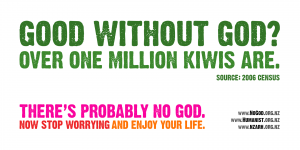
Here we are told that one million kiwis are good without God because the census says so. Now a lot could be said about the appeal to the census here, I don’t recall a question on it asking me if I was good and even if it did I am not sure that we should take too much from self-reported assessments of people’s own integrity. Let’s assume, however, that the billboard makes a fair claim. The inference is still is fallacious. What the census shows is not that one million kiwis are good without God, rather, it shows that one million kiwis are good without believing in the existence of God. But to say that one can be good without believing in God is not the same as saying that one can be good without God. Many people throughout history have been able to live and breath without believing in the existence of hydrogen and oxygen atoms yet it does not follow that they could live without hydrogen and oxygen.
I am still left wondering how the fact that people do not need to believe in something to do good deeds renders the belief false? For centuries people have done good deeds and lived good lives without believing in heliocentricism or quantum mechanics, should we conclude that these theories are therefore ‘probably false’? Surely we are not being asked to buy that the basis of our beliefs should be what is useful or helpful as opposed to what is true?
Perhaps the sellers mean to convey something else. Some Christian thinkers such as William Lane Craig, Robert Adams, Stephen Layman, Alvin Plantinga, John Hare and Philip Quinn have argued that moral properties such as right and wrong depend on God for their existence. Atheist writers such as Paul Kurtz and Christopher Hitchens retort that this claim is falsified by the existence of morally upright atheists. I suspect something like this is meant by the slogan on the billboard, it repeats Hitchens’ and Kurtz’s retorts as though they said something insightful or clever.
This retort misses the point. Craig, Adams, et al are not claiming that one needs to believe in God to be good – a point made several times in the literature (and particularly made so many times to Kurtz that it beggars belief that he keeps repeating it) rather, their claim is that moral properties, such as right and wrong, depend on God for their existence. This is not the same thing, we know that water depends for its existence on the existence of hydrogen and oxygen, this does not mean, however, that we need to believe in the existence of hydrogen and oxygen in order to effectively recognise and use water. Ancient and medieval people were drinking, washing in, swimming in and sailing on water centuries before the discovery of contemporary atomic theory.
This is a fairly basic and elementary distinction in the literature. How exactly expressing a common philosophical confusion counts as reason for thinking “there probably is no God” is hard to see.
Parnell Rise’s billboard informs us “In the Beginning Man Created God.”
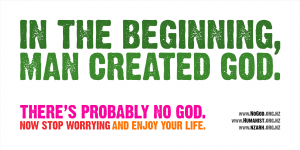
This one asserts that man created God. Now if one takes this statement in an absurdly literal manner (the way many sceptical organisations approach parables, hyperbole and poetry in the Bible) we find that atheists are telling us that God actually exists. I have no issue with the slogan at this juncture, however, the idea that God was created by human beings is clearly absurd. God is typically defined as an all-powerful, all-knowing, immaterial, necessarily-existent being who created the world and who sustains everything in it. Now if one is going to claim that humans actually created an all-powerful, all-knowing, immaterial, necessarily-existent who created and sustains the world, then they are contradicting themselves. Humans are part of the world and therefore cannot have created the being that created the world – otherwise humans would have to exist prior to their own existence.
Of course to interpret this billboard in this way would be uncharitable. The authors of this billboard probably do not mean to say that humans actually created God, they do not think He exists after all. Their claim is that humans created the idea or concept of God and developed it. This is undoubtedly true. Of course, humans also invented the idea or concept of atoms as well – ancient Greek philosophers came up with the basics of this concept millennia ago – but this fact tells us nothing about whether or not the idea or concept humans developed actually corresponds to anything in reality. To assume that it tells us something about whether the idea or concept is true is a fairly obvious case of what logicians call the genetic fallacy.
The last one is my favourite, “We Are All Atheists About Most Gods. Some of Us Just Go One God Further.”
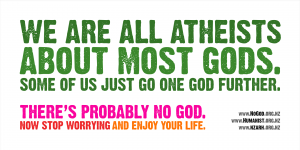 To see the problems with this slogan take out the term “God” in the sign and replace it with some other term such as “non-Christian perspective.” When we do this we get: “We all reject most non-Christian perspectives, some of us just reject one more.” This argument has true premises, do we now have, a knock-down argument for Christianity?
Similarly, an analogous argument form with true premises gives us an argument for nihilism, the denial that humans have moral duties, the total denial of the existence of morality. “We are all nihilists about some conceptions of morality, some of us are just nihilistic about one more.”
The same argument for also furnishes a refutation of secularism, “we all reject some secular perspectives on reality, some of us just reject one more.” I could go on.
Taking a stand on any issue of philosophical substance, whether by affirming, denying or simply being sceptical of it, is to put oneself in opposition to any number of other people and groups who take a contrary stance. That’s life. Such pluralism hardly provides a reason for thinking “there probably is no God” any more than it gives us a reason to doubt any other perspective on the world.
So what do the atheist billboards do? Well the first one tells us that some atheist groups conflate basic philosophical distinctions and do not really understand the debate they are contributing to. The second shows us that these groups think contradictions and obvious fallacies are some how savvy and smart. The last shows us that they think that invalid argument forms, forms from which you could infer the denial of anything and everything by substituting one true premise with another, are avant-garde. All in all, pretty accurate advertising for these groups.
I write a monthly column for Investigate Magazine entitled Contra Mundum. This blog post was published in the Sept 10 issue and is reproduced here with permission. Contra Mundum is Latin for ‘against the world;’ the phrase is usually attributed to Athanasius who was exiled for defending Christian orthodoxy.
Letters to the editor should be sent to:
editorial@investigatemagazine.DELETE.com
RELATED POSTS:
Contra Mundum: Did God Command Genocide in the Old Testament?
Contra Mundum: Fairies, Leprechauns, Golden Tea Cups & Spaghetti Monsters
Contra Mundum: Secularism and Public Life
Contra Mundum: Richard Dawkins and Open Mindedness
Contra Mundum: Slavery and the Old Testament
Contra Mundum: Secular Smoke Screens and Plato’s Euthyphro
Contra Mundum: What’s Wrong with Imposing your Beliefs onto Others?
Contra Mundum: God, Proof and Faith
Contra Mundum: “Bigoted Fundamentalist” as Orwellian Double-Speak
Contra Mundum: The Flat-Earth Myth
Contra Mundum: Confessions of an Anti-Choice Fanatic
Contra Mundum: The Judgmental Jesus
The bold statement “Richard Dawkins opens minds” leaped out at me from the newsletter sitting on the University of Auckland’s Law Library counter. The article went on to sing the praises of Richard Dawkins and mentioned his book The God Delusion. On reading the piece one could be forgiven for concluding that Dawkins’ works are a paragon of the open minded assessment of ideas.
Now Dawkins is a Zoologist and I, not being a Zoologist, would not presume to assess his work on Zoology. What is interesting, however, is that much of Dawkins’ most famous work is not on Zoology; it is on Theology and specifically Philosophy of Religion. That field of Philosophy which critically analyses religious questions, such as, the veracity of arguments for and against God’s existence. Having some background in these fields I find it a little surprising that an Auckland University publication would contend that his work is open minded because it is evidently not.
In The God Delusion Dawkins’ main argument against the existence of God alludes to Fred Hoyle’s famous claim that the probability of something as complex as life evolving by blind chance was less likely than a fully-functional Boeing 747 being created by a hurricane blowing parts around in a junk yard. Dawkins writes, “However statistically improbable the entity you seek to explain by invoking a designer, the designer himself has got to be at least as improbable. God is the Ultimate Boeing 747.” Dawkins has made the same line of argument elsewhere “God, or any intelligent, decision-making calculating agent, is complex, which is another way of saying improbable.” In The Blind Watchmaker he argues,
Once we are allowed simply to postulate organized complexity, if only the organized complexity of the DNA/protein replicating machine, it is relatively easy to invoke it as a generator of yet more organized complexity”. But of course any God capable of intelligently designing something as complex as the DNA/protein machine must have been at least as complex and organized as that machine itself.
This argument contains three premises. First, that theism (belief in God) is justified by “postulating” God to explain the existence of organised complexity. Second that the God appealed to by theists is complex. Third, that the existence of complex beings are highly improbable. These lead to the conclusion that “God is the Ultimate Boeing 747” and hence “almost certainly does not exist”. The problem with this argument is that all three premises rest on caricatures and misunderstandings of contemporary theology and ignorance of contemporary philosophy of religion. I will explain.
Dawkins contends that God is postulated to explain organised complexity. There are two problems with this contention. First, Dawkins assumes that God is rationally believed only if his existence is inferred by some kind of argument for the best explanation of a given phenomenon. However, not all beliefs are justified on the basis of some kind of argument of this sort. Our belief in the existence of the past, our belief that it is wrong to rape, our belief that other people exist or that basic axioms of logic are true are not based on inferences to the best explanation. It is not that they are rationally believed because they explain some phenomena better than all alternatives, it is rather that these beliefs are part of the background data that we use to assess proposed explanations against. These things are true because we immediately experience them as true. I have the experience of remembering the existence of a past event. I intuitively perceive that rape is wrong. I experience the basic axioms of logic as self-evident and so on. Such beliefs are called properly-basic beliefs.
Since the late 1970’s an extremely important movement within Philosophy of Religion, known as the reformed epistemology movement, has offered detailed and rigorous defences of the contention that, for theists, belief in God can be properly-basic. This position has been defended by leading philosophers of religion such Alvin Plantinga, William Alston, Nicholas Wolterstorff, Peter Van Inwagen and others. Now, of course, it is possible that this movement is mistaken but Dawkins surely owes us an argument to this end as opposed to his simply assuming it and ignoring the counter evidence.
Second, among those theists who do defend God’s existence on the basis of some argument for the best explanation, very few do so on the basis that God explains “organized complexity”. Richard Swinburne, the leading proponent of such arguments, argues that God explains the existence of laws of nature, religious experience, the origin of the universe and the continued existence of the universe. Swinburne does not postulate God to explain “organised complexity”. Similarly, William Lane Craig, a leading defender of theism, suggests that God explains the origin of the universe, the existence of morality and the fine tuning of the laws of nature. Again, Craig makes no appeal to “organized complexity”. In 2009 The Blackwell Companion to Natural Theology was published which contains the most up to date versions of the 11 most definitive arguments used to defend the existence of God in the literature today. Not one of them involves an appeal to “organised complexity”. While the cogency of arguments for the existence of God that do not involve “organized complexity” remains open to substantive debate, it is undisputed that these arguments exist. Dawkins’ picture of God as a postulate to explain organised complexity is a crude caricature of theistic scholarship.
To be fair Dawkins attempts to address some of these other arguments elsewhere in the book. However, here again much of his writing consists of caricature. He attacks five arguments proposed 800 years ago by Thomas Aquinas as being representative of the current case for theism and completely ignores the vastly more sophisticated and vigorous versions being defended in the literature today. Ironically, Dawkins quite severely misunderstands Aquinas’ arguments and attributes to him a position no Aquinas scholar would accept as accurate. However, even if his account were accurate, critiquing theism by attacking the arguments of one 12th century theologian is a bit like me attacking evolution on the basis of the evidence for it gathered in the 12th century and ignoring any of the scientific developments of the last 800 years. Such ineptitude would not be tolerated in the scientific world and should not be seen as de rigueur just because the topic is religion.
Dawkins’ second contention fares little better. Dawkins states that “A God capable of continuously monitoring and controlling the individual status of every particle in the universe cannot be simple” this seems to be because,
The corners of God’s giant consciousness are simultaneously preoccupied with the doings and emotions and prayers of every single human being—and whatever intelligent aliens there might be on other planets in this and 100 billion other galaxies.
There are several problems here. First, as Craig has noted, this confuses whether what God thinks about is complex with whether God himself is complex. Second, as Plantinga has noted, in The Blind Watchmaker Dawkins states that something is complex if it has parts that are “arranged in a way that is unlikely to have arisen by chance alone.” However, the concept of God employed by most theists is of an immaterial being that does not have material parts so by Dawkins’ own definition God is not complex (unless one assumes that God is a material being but theists almost unanimously maintain that God is an immaterial being).
This misrepresentation is made all the more pertinent by the fact that for centuries theists have been offering rigorous and sophisticated arguments that God is not in fact complex but is simple. While these arguments may not be successful, Dawkins still needs to actually provide reasons for rejecting them. To simply assert that God is to be conceived in a way that no one conceives Him and to ignore the numerous arguments to the contrary seem more like a child who asserts his position and then puts his hands over his ears and repeats “I am not listening” than it does a serious critical evaluation of another’s position.
Dawkins’ final contention, that the existence of complex beings is improbable, is similarly confused. Suppose one grants that God is “the Ultimate Boeing 747” and that God’s existence is as statically improbable as the complexity it is invoked to explain. Little in fact follows from this. This is because what is improbable in the Boeing 747 analogy is that the plane came into existence by chance. If God is “the Ultimate Boeing 747” then the conclusion to be drawn is only that it is improbable that God came into existence by chance. This, however, provides us with no reason for thinking that God does not exist. No theist holds that God came into existence by chance, theists hold that God is eternal. Here, again, Dawkins attacks a concept of God nobody holds to and hence is caught jousting with a straw-man.
On examining Dawkins’ central argument what one discovers is not an open-minded, informed, careful examination of the contemporary debate over the existence of God. Nor does one find a carefully researched assessment of theism. Instead one finds Dawkins simply ignoring what theists mean by God. He ignores how they conceptualise God and ignores the arguments and discussions they have actually made. The theism Dawkins dismisses apparently assumes that God is a material being with parts, that He came into existence by chance and is postulated merely to explain organized complexity. The actual arguments proposed in defence of theism that have been put forward in the literature are not addressed at all.
Some Auckland University academics might consider such tactics to count as open-minded but I do not. In my view an open-minded honest assessment of religion requires accurately representing what theologians say and teach. It means endeavouring to read and understand their position and offer informed and critical responses to these positions. Ignorance and caricature is not open-minded scholarship.
I write a monthly column for Investigate Magazine entitled Contra Mundum. This blog post was published in the May 10 issue and is reproduced here with permission. Contra Mundum is Latin for ‘against the world;’ the phrase is usually attributed to Athanasius who was exiled for defending Christian orthodoxy.
Letters to the editor should be sent to: editorial@investigatemagazine.DELETE.com
RELATED POSTS:
Contra Mundum: Slavery and the Old Testament
Contra Mundum: Secular Smoke Screens and Plato’s Euthyphro
Contra Mundum: What’s Wrong with Imposing your Beliefs onto Others?
Contra Mundum: God, Proof and Faith
Contra Mundum: “Bigoted Fundamentalist” as Orwellian Double-Speak
Contra Mundum: The Flat-Earth Myth
Contra Mundum: Confessions of an Anti-Choice Fanatic
Contra Mundum: The Judgmental Jesus
We’ve all heard the slogan that atheism is superior to theism because of all the atrocities committed in the name of religion. If you flick through the pages of the new-atheist publications by the likes of Dawkins, Hitchens, Loftus, Harris, et al you’ll probably find some version of this assertion in each.
Setting aside the dubious factual claims and the fact that I could list a stack of atheist atrocities that could outnumber the theist ones just from the last century alone, there is another way of addressing the slogan. If a person joined Weight Watchers, got the points book, the pamphlets explaining how the program works and began attending weekly meetings to fellowship with others on the same journey but instead of following the instructions began to bend the rules, invent new ones and ignore others and as a result began to gain weight, could that person justifiably claim that Weight Watchers made them fat? That Weight Watchers should be rejected as a weight-loss program, in fact, attempting to lose weight in and of itself is a bad thing, because this person gained weight whilst ostensibly being a follower of the program?
If you can see how ridiculous it would be to blame Weight Watchers and to abandon the pursuit of weight loss because someone who cheated on the program had a bad outcome then why can’t you see it when the same reasoning is applied to atrocities committed in the ‘name of’ Christianity
H/T Rodney Lake at Thinking Matters Tauranga
Now by juxtaposing this question next to the description of the beating, Loftus insinuates, that the scriptures explicitly or implicitly condone these sorts of practices. In his book, Loftus reinforces this by noting that,
the Bible was still used by Christians to justify the brutal slavery in the American South. Distinguished Princeton professor Charles Hodge defended American slavery in a 40 page essay written in 1860, just prior to the Civil War.
Now in my post I pointed out that Loftus’ claim that the Bible does not explicitly condemn the kind of practices he describes is mistaken. In the comments thread I also noted his suggestion that Hodge did is also mistaken. Hodge did defend the existence of slavery an as institution, but on page 831 of Cotton is King, the book Loftus himself referred me to, Hodge states that if the bible is used to argue that “slavery as it occurs among us [in the US south]” is sinful, then “he has no objection.” Hodge only objects to the idea that all forms of slavery, including the ebed in scripture, are unjust. On the same page, he states that laws allowing people to beat, harm, kill and starve their slaves are condemned by scripture. A point, Loftus conveniently missed. On the next page, page 832, Hodge again states that it is very plain that the institution which existed in the US was condemned by scripture.
The same is true if one looks at Slavery Sabbath and War. Many of the pro-slavery theologians Loftus referred to, in fact, criticised the abuses that were occurring in their day and suggested these should be condemned.
It is also worth noting, at this juncture, that Loftus’ claim about the Catholic Church has been shown to be false by Rodney Stark. Stark notes that “[the Catholic Church repeatedly condemned slavery] … beginning in 1435 and culminating in three major pronouncements against slavery by Pope Paul III in 1537.” He notes that Pope Eugene IV (1431-1447), Pope Pius II (1458-1464), Pope Sixtus IV (1471-1484), Pope Paul III (1534-1549), Pope Urban VIII (1623-1644) issued bulls against slavery; in addition, the Roman Inquisition condemned slavery on 20 March 1686. These condemnations were largely motivated by concerns about new world slavery.
In addition to weighing into the comments, Loftus responded with a post on his own site, Nitpickers Have Started to Attack; this response led with aspersions about my education and intelligence concluding that my comments were “nitpicking” and did not address the real issue. This lead to a response by Glenn Peoples, Skeptics and the annoyance of the little things…. like facts. Glenn noted.
Apparently it’s just in poor taste and really just skirts around the edges to point out that contrary to the claims that some skeptics love to make, the Old Testament does not endorse what we call slavery. But I daresay that annoyance has clouded John’s vision, for what has been shown is that in fact God did condemn kidnapping and/or mistreating people, the very things that Loftus is concerned about and which he is calling “slavery.” it may be irritating to have the rug ripped out from under your argument, but getting annoyed and demanding that people deal with the “main” argument by pretending that the rug is still there (for the sake of your argument and nothing else) is a bit of an ask, don’t you think? Why not just graciously thank the other person for their helpful explanation and remove the argument from your repertoire?
Here’s exhibit “A” of the backward thinking of some Christians. This is incredibly ignorant:
“So yes, I…am happy to be treated the same way women were in the Bible.” Link
How much more ignorant can someone be? Although, her husband probably likes it! 😉
I write this post to demonstrate how some people who pass themselves off as free-thinkers or rationalists are often dogmatic proponents of a secular party-line who will happily ridicule and attack other people personally who question the orthodoxy that they expound even if the facts get in the way.
Madeleine asks that even though Loftus hefted a stone at our marriage that commenters refrain from doing the same in turn.
In my last post, Tooley, Plantinga and the Deontological Argument from Evil Part I, I sketched Tooley’s distinction between a deontological and an axiological argument from evil and argued that Tooley rejects the axiological version because it rests on controversial ethical claims that are likely to be rejected by many theists. I outlined Tooley’s deontological version and explored the moral assumptions it is based on and Plantinga’s criticism of these.
“God can do wrong only if he commands himself to do something and then disobeys his own command.”In this post, I will argue that Plantinga’s criticisms can be reformulated by appealing to a divine command theory of ethics and when they are, it can be shown that Tooley’s argument relies on controversial moral assumptions that many theists do, in fact, reject. Finally I will look at two objections to this line of argument; the claim that, even on a divine command theory, God has obligations and Tooley’s critique of the divine command theory. I will argue both objections fail.
To save you having to click back repeatedly to the previous post, I will first re-cite step one of Tooley’s argument,
(12) The property of choosing not to prevent an event that will cause the death of more than 50,000 ordinary people is a wrongmaking property of actions, and very serious one.
(13) The Lisbon earthquake killed approximately 60,000 ordinary people.
Therefore, from (12) and (13):
(14) Any action of choosing not to prevent the Lisbon earthquake has a very serious wrongmaking property.
Tooley then adds as an additional premise,
(15) No rightmaking properties that we know of are such that we are justified in believing both that an action of choosing not to prevent the Lisbon earthquake would have had those rightmaking properties, and that those properties are sufficiently serious to counterbalance the relevant wrongmaking property.[1]
Modifying Plantinga’s Response : The Divine Command Theory
In a more recent paper, Naturalism, Theism, Obligation and Supervenience, Plantinga makes a comment that suggests he could formulate his objection so that “permitted by God” was taken in the second sense mentioned above. Plantinga writes,
Theists typically think ethical properties are intimately related to what God approves or values or commands. Thus they will often think of moral obligation as a matter of what God commands. What is obligatory are those actions God commands or wills; what is wrong are those actions God prohibits; what is permissible are those actions God does not prohibit.[2]
Plantinga here refers to what has been called the divine command theory of ethics[3]; the position that, “an action or kind of action is right or wrong if and only if and because it is commanded or forbidden by God.”[4] According to a divine command theory of ethics, being permitted by God is a right-making property; actions are right, if and only if, and because, they are permitted by God. I am inclined to think that any theist who accepts a divine command theory of ethics will deny (15) whether or not they “offer a theodicy.” They will also have reasons for denying (12).
This is because, if the divine command theory of ethics is true then (12) is false. Tooley affirms that, “the property of choosing not to prevent an event that will cause the death of more than 50,000 ordinary people is a wrongmaking property of actions, and very serious one.” According to a divine command theory of ethics this is false; there is only one ultimate wrong-making property, that of being contrary to God’s commands. Given that the property of “choosing not to prevent an event that will cause the death of more than 50,000” is not the same property as “being permitted by God,” it follows that the former property is not a right-making property of actions and, as such, (12) is false.
Even if one puts this point to one side, if a divine command theory of ethics is true, there is a further problem with (12); it is ambiguous compare:
[12 a] The property of choosing not to prevent an event that will cause the deaths of more than 50,000 ordinary people is a serious wrongmaking property of actions performed by human beings (or rational creatures relevantly like human beings).
and
[12b] The property of choosing not to prevent an event that will cause the deaths of more than 50,000 ordinary people is a serious wrongmaking property of actions performed by (including God).
For Tooley’s argument to be successful he must mean for (12) to be taken as [12b]. Tooley is arguing for the conclusion that if God exists then he has performed actions that it would be wrong for God to perform; which, given that God is good, is an impossible state of affairs.
However, what is an “uncontroversial moral claim” that “does not seem very problematic” is [12a]. If a divine command theory of ethics is true then [12b] is false. This is because one implication of a divine command theory of ethics is that God does not have obligations and hence, strictly speaking, nothing he does can be right or wrong.[5] Craig notes “nor, plausibly, is God bound by moral duties since he does not issue commands to himself.”[6] Similarly Alston, in an article defending the claim that God has no obligations, states “we can hardly suppose that God is obliged to love his creatures because he commands himself to do so.”[7]
Craig and Alston’s arguments seem sound. If the divine command theory of ethics is true then a person p is required to do an action a, if and only if, God commands p to do a. It follows then, that God is required to do a, if and only if, God issues commands to himself. Moreover, if divine command theory of ethics is true then a person engages in wrongdoing, if and only if, they disobey a command that God issues to them. Hence, if divine command theory of ethics is true then God can do wrong only if he commands himself to do something and then disobeys his own command.
Neither of these conditions seems very likely. It seems unlikely that God issues commands to himself. Why would he need to? If he wanted to do something wouldn’t he just do it? Moreover, it seems absurd to suggest that even if God issues commands to himself that he would then disobey them. That would suggest that God displays some form of weakness of the will and it is not clear that weakness of the will is compatible with a supremely excellent being such as God.[8]
The divine command theorist will take a similar stance towards (15). If a divine command theory of ethics is true then the property of “being permitted by God” is a right-making property. If God permits an action, in the sense of refraining from prohibiting it, then that makes the action morally permissible. Consider then, “[God’s] action of choosing not to prevent the Lisbon earthquake.” For the reasons spelt out above, God did not forbid himself from doing this; hence, this action has a right-making property that a theist, who embraces divine command theory of ethics, knows about.
Similarly, this right-making property outweighs any wrong-making property that the action has. As I mentioned previously, according to a divine command theory of ethics, there is only one ultimate wrong-making property, the property of being contrary to God’s commands. Given that God did not command himself to stop the Lisbon earth quake, the action of allowing the Lisbon earthquake to occur does not have any wrong-making properties and so there can be none that outweigh it.
Consequently, if a divine command theory of ethics is true then both (12) and (15) are false. It is not just theists who offer a theodicy then who would reject (15).
The Significance of this Conclusion
I think this conclusion is significant for two reasons. First, a significant number of contemporary theists embrace and defend the divine command theory of ethics. Those who have defended it include, Robert Adams,[9] John Hare,[10] William Alston,[11] William Lane Craig,[12] Stephen C Evans,[13] Philip Quinn,[14] Edward Wierenga,[15] Janine Marie Idziak,[16] William Wanwright,[17] William Mann,[18] Thomas Carson[19] and more recently Alvin Plantinga.[20] These people are not obscure, marginal representatives of theism; these names include some of the leading defenders of theism in the literature today. Tooley’s argument then contains a premise that would be, and in fact is, rejected by many leading theists.
Second, this fact introduces a significant incoherence into Tooley’s discussion of the argument from evil. In “Does God Exist?” Tooley rejects an axiological argument from evil on the grounds that it rests on a moral claim that was “within ethical theory deeply controversial, and likely to be rejected by many theists and others.” Tooley’s own argument, however, presupposes the denial of a divine command theory of ethics. This is a controversial moral claim and one that is rejected by many theists. His own deontological argument then seems to be no better than the axiological version he rejects.
Finally, it seems in light of these conclusions that Tooley’s deontological argument from evil is incomplete. It is not enough for Tooley to simply ask “what rightmaking properties can one point to that one has good reason to believe would be present in the case of an action allowing the Lisbon earthquake and that would be sufficiently serious to counterbalance the property of allowing more than 50,000 to be killed?”[21] The theist can point to such a property. Tooley needs to supplement his argument with a refutation of the divine command theory; specifically, he needs to argue that even if theism is true then this theory is implausible and problematic. Until the divine command theory can be shown to be a rationally untenable option for theists, theists can avoid Tooley’s deontological argument from evil.
Objections
In this last section I want to anticipate and criticise two lines of argument that Tooley or a defender of Tooley, might make against the above line of critique.
Tooley’s Critique of Divine Command Theory
I suggested that Tooley’s argument was incomplete until he provides the theist with some reason why a divine command theory of ethics cannot be accepted then the theist can reject two crucial premises of his argument. (A defender of Tooley could object here that he has argued for this conclusion. In a debate with William Lane Craig at the University of Colorado Tooley addressed the divine command theory and offered a Euthyphro style argument against it. I agree that a complete defence of my position requires a response to this argument, regular readers, however, will note that I have addressed this argument previously in Tooley, The Euthyphro Objection and Divine Commands.)
Divine Commands and Divine Obligations
My argument depended on the claim, made by Craig and Alston, that if a divine command theory is true then God does not have duties. Linda Zagzebski has called this claim into question. In “More Suggestions for Divine Command Theorists,” Zagzebski proposes an account of divine obligations which is compatible with a divine command theory. Zagzebski starts by offering an account of the meaning of obligation, “What we mean by ‘obligation,’ is essentially this: there is no other option compatible with moral goodness.”[22] From this definition she argues that “the metaphysical source of divine obligation” and “the metaphysical source of human obligation are distinct.”[23]
The metaphysical source of the property of an act of a human being which makes it the case that there is no alternative act compatible with goodness is that it is commanded by God. The metaphysical source of the property of an act of God that makes it the case that there is no alternative act compatible with goodness is that that any alternative is incompatible with Gods nature.[24]
Hence, she concludes that it is “metaphysically necessary that an act X is an obligation for a human if and only if X is commanded by God” and “it is metaphysically necessary that an act X is an obligation for God if and only if X is compatible with Gods nature.”[25]
While I am not convinced by Zagzebski’s account of divine obligations, even if one grants them for the sake of argument it is clear that it cannot be used to defend Tooley’s deontological argument from evil. Consider,
(15) No rightmaking properties that we know of are such that we are justified in believing both that an action of choosing not to prevent the Lisbon earthquake would have had those rightmaking properties, and that those properties are sufficiently serious to counterbalance the relevant wrongmaking property.[26]
If Zagzebski’s account of divine obligation is correct then (15) is false. Plantinga’s original unreformulated response is rehabilitated. As Plantinga pointed out “God exists and is a perfectly good being. If this is true, then any action that God has in fact performed has the property of being performed by a perfectly good being.”[27] Moreover, “theists believe that God performed the action of permitting the Lisbon earthquake. They therefore believe that the action of performing the Lisbon earthquake has the property of being performed by God, who is a perfectly good person.”[28] But if the Lisbon earthquake was performed by a perfectly good person, performing it must be compatible with the divine nature and hence it has the very right-making property that Zagzebski identifies in her account of divine obligation.
The same is true for (12). Tooley contends,
(12) The property of choosing not to prevent an event that will cause the death of more than 50,000 ordinary people is a wrongmaking property of actions, and very serious one.
On Zagzebski’s account (12) is false. There are only two right-making properties that exist. The property of being compatible with God’s nature, which is what makes God’s actions right, and the property of being permitted by God, which is what makes human actions right. Now the property of “choosing not to prevent an event that will cause the deaths of more than 50,000 people” is neither of these properties and hence, is not a right-making property.
[1] Michael Tooley “Does God Exist?” in The Knowledge of God eds Michael Tooley and Alvin Plantinga (Malden, M A: Blackwell Publishers, 2008) 119; I am following Tooley’s enumeration.
[2] Alvin Plantinga “Naturalism, Theism, Obligation and Supervenience” accessed 4 April 2009.
[3] The position is perhaps more correctly known as ethical voluntarism as some proponents of it emphasise the divine will as opposed to divine commands. However, because of the widespread use of the term ‘divine command theory’ in the literature I will stick with the term.
[4] W K Frankena Ethics 2nd ed (Englewood Cliffs, NJ: Prentice-Hall, 1973) 28.
[5] It should also be noted that the claim that God does not have obligations has been defended on grounds other than a divine command theory. See, for example, William Alston, “Some Suggestions for Divine Command Theorists” in Christian Theism and the Problems of Philosophy ed. Michael Beaty (Notre Dame, IN: University of Notre Dame Press, 1990). Hence, even if one dismisses a divine command theory of ethics it still follows that [12a] is not the obviously uncontroversial statement Tooley thinks it is.
[6] William Lane Craig Philosphical Foundations of a Christian World View (Downers Grover Il: Intervarsity Press, 2003) 529.
[7] William Alston “Response to Zagzebski” Perspectives on the Philosophy of William P. Alston eds Heather D Battaly, Michael P Lynch, William P Alston, (Lanham, MD: Rowman & Littlefield Publishers, 2005) 204.
[8] It is worth noting the definition of God that Tooley works with in formulating his argument. For the purposes of his argument, Tooley is defining God as “an appropriate object of worship” as well as an appropriate object of other human concerns such as the desire that good will triumph over evil, and that justice will be done” etc.
[9] Robert Adams “Divine Command Meta-Ethics Modified Again” Journal of Religious Ethics 7:1 (1979); Finite and Infinite Goods (New York: Oxford University Press, 1999).
[10] John Hare God’s Call: Moral Realism, God’s Commands and Human Autonomy (Grand Rapids, MI: Eerdmans Publishing Company, 2001); God and Morality: A Philosophical History (Oxford: Blackwell Publishing, 2007).
[11] William Alston “Some Suggestions for Divine Command Theorists” in Christian Theism and the Problems of Philosophy ed Michael Beaty (Notre Dame, IN: University of Notre Dame Press, 1990).
[12] William Lane Craig “This most Gruesome of Guests” in Is Goodness Without God Good Enough? A Debate on Faith, Secularism and Ethics eds Robert K Garcia and Nathan L King (Lanthan: Rowan and Littlefield Publishers Inc, 2009) 172; also Philosphical Foundations of a Christian World View (Downers Grover Il: Intervarsity Press, 2003) 529-532.
[13] C Stephen Evans Kierkegaard’s Ethic of Love: Divine Commands and Moral Obligations (New York: Oxford University Press, 2004).
[14] Philip L Quinn Divine Commands and Moral Requirements (Oxford: Oxford University Press, 1978); “An Argument for Divine Command Theory” in Christian Theism and the Problems of Philosophy ed Michael Beaty (Notre Dame, IN: University of Notre Dame Press, 1990) 289-302; “The Recent Revival of Divine Command Ethics” Philosophy and Phenomenological Research (Fall 1990) 345-365; “The Primacy of God’s Will in Christian Ethics” Philosophical Perspectives 6 (1992) 493-513; “Divine Command Theory” in Blackwell Guide to Ethical Theory ed Hugh Lafollette (Cambridge: Blackwell Publishers, 2000) 53-73; “Theological Voluntarism” The Oxford Handbook of Ethical Theory (New York: Oxford University Press, 2006) 63-90.
[15] Edward Weirenga The Nature of God: An Inquiry into the Divine Attributes (Ithaca, NY: Cornell University Press, 1989) 215-27. See also, “Utilitarianism and the Divine Command Theory” American Philosophical Quarterly 21 (1984) 311-318; and “A Defensible Divine Command Theory” Nous 17 (1983) 387-408.
[16] Janine Marie Idziak “Divine Commands Are the Foundation of Morality” Contemporary Debates in Philosophy of Religion (Malden, MA:Blackwell Publishing Ltd 2004) 290-298.
[17] William Wrainwright Religion and Morality (Aldershot: Ashgate Publishing, Ltd, 2005).
[18] William Mann “Theism and the Foundations of Ethics” in The Blackwell Guide to Philosophy of Religion ed William Mann (Oxford: Blackwell Publishing, 2005).
[19] Thomas Carson Value and the Good Life (Notre Dame IN: Notre Dame University Press, 2000).
[20] Alvin Plantinga “Naturalism, Theism, Obligation and Supervenience”available at http://www.ammonius.org/grant_topics.php#0708 accessed 4 April 2009.
[21] Michael Tooley “Does God Exist?” in The Knowledge of God eds Michael Tooley and Alvin Plantinga (Malden, M A: Blackwell Publishers, 2008), 122
[22] Linda Zagzebski “More Suggestions for Divine Command Theories” in Perspectives on the Philosophy of William P. Alston eds Heather D Battaly, Michael P Lynch, William P Alston, (Lanham, MD: Rowman & Littlefield Publishers, 2005) 189.
[23] Ibid.
[24] Ibid.
[25] Ibid.
[26] Tooley “Does God Exist?” 119.
[27] Alvin Plantinga “Reply to Tooley’s Opening Statement” in The Knowledge of God eds Michael Tooley and Alvin Plantinga (Malden, M A: Blackwell Publishers, 2008), 170
[28] Ibid.
RELATED POSTS:
Tooley, Plantinga and the Deontological Argument from Evil Part I
This two-part series criticises the deontological argument from evil proposed by Micheal Tooley in The Knowledge of God, the print debate between him and Alvin Plantinga.1 My critique proceeds in four parts. Initially I will sketch Tooley’s distinction between a deontological and an axiological argument from evil and will argue that Tooley rejects the axiological version because it rests on “controversial ethical claims;”2 claims that are “likely to be rejected by many theists.”3 Then I will outline Tooley’s deontological version and focus on the moral assumptions upon which it is based and Plantinga’s criticism of these. This will conclude Part I of the series.
In my next post, Tooley, Plantinga and the Deontological Argument from Evil Part II, I will argue that Plantinga’s criticisms can be reformulated by appealing to a divine command theory of ethics and when they are it can be shown that Tooley’s argument relies on controversial moral assumptions that many theists do, in fact, reject. Finally I will look at two objections to this line of argument; the claim that, even on a divine command theory, God has obligations and Tooley’s critique of the divine command theory. I will argue both objections fail.
Deontological and Axiological Arguments from Evil
Tooley distinguishes axiological versions of the argument from evil from deontological versions. The former, “are formulated in terms of axiological concepts—specifically, in terms of the goodness or badness, the desirability or undesirability of states of affairs.”4 [Emphasis original] The latter, “uses concepts that focus upon the rightness and wrongness of actions, and upon the–rightmaking or wrongmaking–properties that determine whether an action is one that ought to be performed.”5
Tooley suggests that axiological versions are problematic. He takes as a paradigm the version proposed by William Rowe. Central to Rowe’s argument is the following conceptual claim about a perfectly good being.
(2) Any omnipotent, omniscient and morally perfect person would prevent the existence of any state of affairs that is both (a) intrinsically bad, or undesirable, and (b) such that he could prevent its existence without either allowing an equal or greater evil, or preventing an equal or greater good.6
Rowe applies (2) to concrete evils in the world. He identifies various concrete evil states of affairs and contends that these concrete cases meet the criteria (a) and (b) specified in (2).
There are well rehearsed problems with Rowe’s attempt to do this.7 While Rowe can maintain that there are cases where we do not know of any greater good lost or greater evil prevented by the allowance of these evils, this is insufficient to show that the cases meet the specified criteria. His argument requires that we know that there are no greater goods lost or evils prevented known to an omniscient being. Tooley notes that the step from “we don’t know” to the claim that an “omniscient being does not know” is difficult to bridge and Rowe’s attempts to do so have been unsucessful.8
Tooley’s most important objection is to contest (2) itself. Tooley notes that (2) appears to rely on a,
common consquentialist claim … namely, the claim that an action is morally wrong if it fails to maximise the balance of good states of affairs over bad states of affairs. But the difficulty then is that “such a claim is, within ethical theory, deeply controversial, and likely to be rejected by many theists, and others.9
In response, Tooley develops and defends an argument from evil which does not rely on “controversial ethical claims,”10 one that focuses “upon the rightness and wrongness of actions.”
Tooley’s Deontological Argument
Tooley summarises his argument succinctly,
The basic idea involved in a deontological formulation of the argument from evil is then as follows. First, it is claimed that the world contains certain states of affairs such that any action of allowing any of those states of affairs to obtain would involve one or more known wrongmaking characteristics that would outweigh the sum total of known rightmaking characteristics that the action would have. If this is right, then any such action is prima facie wrong, relative to the total information that one presently has concerning the action’s rightmaking and wrongmaking characteristics. Secondly, the crucial question is then whether there is any sound inductive argument that will take one from the conclusion that such an action is prima facie wrong to the further conclusion that the action is probably wrong all things considered. If there is, one will then have an ‘inductively sound’ version of the evidential argument from evil.11 [Emphasis original
As Tooley notes the argument has two crucial steps. The first is the claim that an argument that allows a certain states of affairs to occur is prima facie wrong. The second is an inductive argument from the conclusion that such an action is prima facie wrong to the claim that it is ultra facie wrong; that is, wrong all things considered.
It is clear that Tooley considers the second step to be the ‘crucial question’ and he spends most of his article defending the inductive inference he draws. Tooley appears to think that the first step is fairly straight-forward and uncontroversial. His defence of it consists of a few paragraphs.
Tooley’s Argument for Step One
Tooley’s argument for the first step consists of three premises,
(12) The property of choosing not to prevent an event that will cause the death of more than 50,000 .ordinary people is a wrongmaking property of actions, and very serious one.
(13) The Lisbon earthquake killed approximately 60,000 ordinary people.
Therefore, from (12) and (13):
(14) Any action of choosing not to prevent the Lisbon earthquake has a very serious wrongmaking property.
Tooley then adds as an additional premise,
(15) No rightmaking properties that we know of are such that we are justified in believing both that an action of choosing not to prevent the Lisbon earthquake would have had those rightmaking properties, and that those properties are sufficiently serious to counterbalance the relevant wrongmaking property.12
Tooley believes that (12)-(15) are uncontroversial “(12) makes a moral claim, but one that does not seem at all problematic while statement (13) makes a historical claim for which there is, I believe, very good evidence.”13 Tooley appears to think that the only potentially controversial premise is (15) but that this would be denied only by philosophers who offer a theodicy.14 Tooley maintains that (15) is,
[V]ery reasonable, given the relevant facts about the world, together with the moral knowledge that we possess. For what rightmaking properties can one point to that one has good reason to believe would be present in the case of an action of allowing the Lisbon earthquake, and that would be sufficiently serious to counterbalance the wrongmaking property of allowing more than 50,000 to be killed.15
Tooley concludes that, in the absence of a defensible theodicy, there are compelling arguments for concluding that allowing the Lisbon earthquake to occur is prima facie wrong. This is not an insignificant conclusion. Many contemporary theists discuss the argument from evil by conceding that there are no defensible theodicies and then arguing that even in the absence of such a theodicy, belief in God is not rendered improbable by the existence of evil. If Tooley is correct, this line of argument is mistaken. The burden of proof is clearly on the theist to provide a theodicy; if he or she cannot then God’s action of permitting the Lisbon earthquake to occur is prima facie wrong. Moreover, if Tooley’s inductive arguments hold, the God’s actions will be ultra facie wrong.
Plantinga’s Response
Plantinga responds to Tooley’s argument by calling into question (15).
Christians and other theists believe that God exists and is a perfectly good being. If this is true, then any action that God has in fact performed has the property of having been performed by a perfectly good being. Furthermore, Christians and other theists believe that God performed the action of permitting the Lisbon earthquake. They therefore believe that the action of permitting the Lisbon earthquake has the property of having been performed by God, who is a perfectly good person. This is a rightmaking property that clearly outweighs and counterbalances any wrongmaking properties that action has.16
In this citation, Plantinga denies that only theists who offer a theodicy would contest [15]. Plantinga suggests that theists will typically believe that there is a right making property of which they know of; the property of being permitted by God. This property overrides all others and the action of allowing the Lisbon earthquake has this property. Hence, the Theist has good reasons for rejecting [15] even if he or she cannot offer an adequate theodicy.
Tooley’s response is to deny that being permitted by God is a right making property,
Suppose that God exists, and, thus permitted the Lisbon earthquake. One can ask “What property did the action of permitting the Lisbon earthquake have that made it morally permissible for God to permit it?” The response that it had the property of having been permitted by God, who is perfectly good, is not a satisfactory answer to that question: there must be some other property that made it permissible for God to permit the Lisbon earthquake. The property of having been permitted by God, while it entails that there must have been a rightmaking property, is not itself a rightmaking property.17 [Emphasis original]
The phrase “having been permitted by God” is ambiguous. In one sense it could refer to God allowing an event to occur; if he does not stop it occurring then God permits the Lisbon earthquake. In another sense, however, it can refer to God refraining from forbidding an action. God permits drinking alcohol, for example. If God refrains from issuing a command to abstain from drinking alcohol then it is clear, I think, that Plantinga means the former and Tooley seems18 correct in suggesting that in this sense it is clear that being permitted by God is not a right making property but this leaves an important question hanging; couldn’t Plantinga’s critique be reformulated in terms of the “second sense” of the phrase “having been permitted by God.”
In my next post, Tooley, Plantinga and the Deontological Argument from Evil Part II, I will propose a Plantingan reformulation and address some objections.
1 Michael Tooley “Does God Exist?” in The Knowledge of God eds Michael Tooley and Alvin Plantinga (Malden, M A: Blackwell Publishers, 2008) 70-147.
2 Tooley “Does God Exist?”105.
3 Ibid.
4 Ibid.
5 Ibid, 106.
6 William Rowe “Evil and Theodicy” Philosophical Topics 16: 119-32. I am following Rowe’s enumeration.
7 Stephen John Wykstra “Rowe’s Noseeum Arguments from Evil;” Peter van Inwagen “The Problem of Evil, the Problem of Air, and the Problem of Silence” and “Reflections on the Chapters by Draper, Russell, and Gale;” William P Alston “The Inductive Argument from Evil and the Human Cognitive Condition” and “Some (Temporarily) Final Thoughts on Evidential Arguments from Evil;” Daniel Howard-Snyder “The Argument from Inscrutable Evil” in The Evidential Argument from Evil ed Daniel Howard-Snyder (Bloomington, Indiana University Press: 1996). See also, Alvin Plantinga Warranted Christian Belief (New York: Oxford University Press, 2000).
8 Tooley “Does God Exist” 104.
9 Ibid, 105.
10 Ibid.
11 Ibid, 116.
12 Ibid, 119; I am following Tooley’s enumeration.
13 Ibid, 122.
14 Ibid.
15 Ibid.
16 Alvin Plantinga “Reply to Tooley’s Opening Statement” in The Knowledge of God eds Michael Tooley and Alvin Plantinga (Malden, MA: Blackwell Publishers, 2008) 170-71.
17 Michael Tooley “Closing Statement and Reply to Plantinga’s Comments” in The Knowledge of God eds Michael Tooley and Alvin Plantinga (Malden, MA: Blackwell Publishers, 2008) 238.
18 I say seems because Linda Zagzebski’s account of divine obligations would challenge this contention as I will argue in part IV.
RELATED POSTS:
Tooley, Plantinga and the Deontological Argument from Evil Part II